


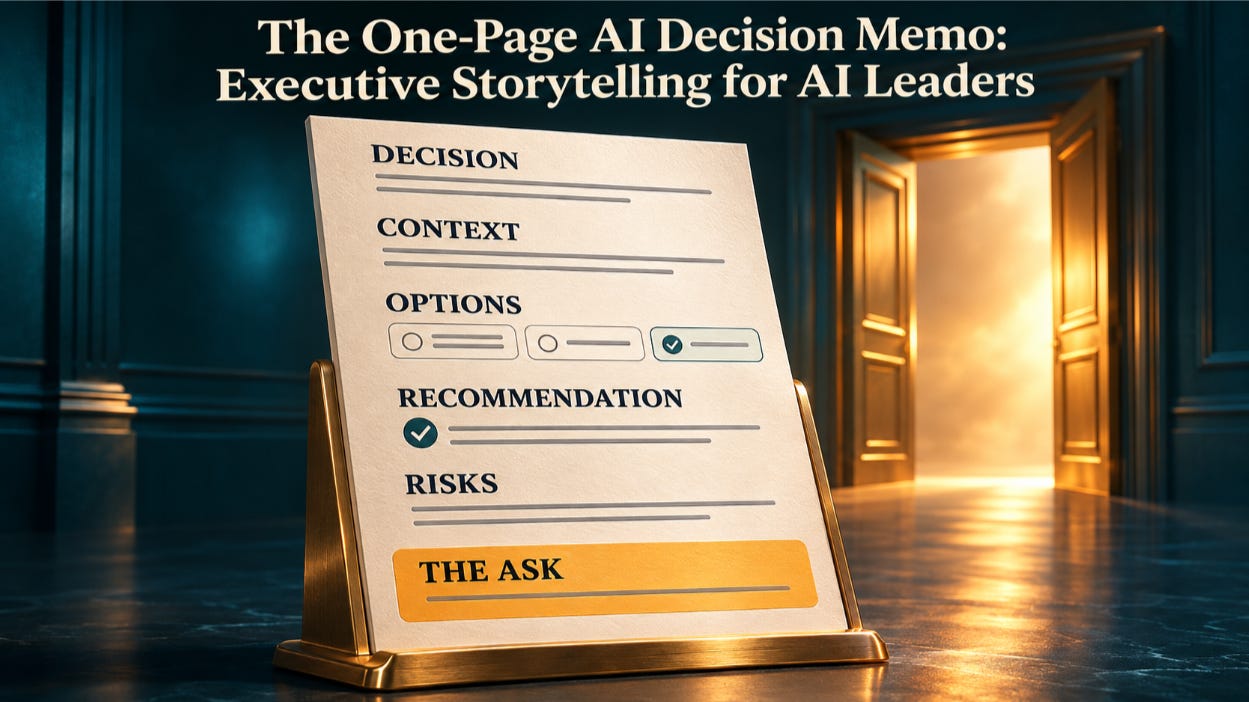
A simple structure that turns Artificial Intelligence (AI) program complexity into fast, well-documented executive decisions.
AI programs generate enormous amounts of information: delivery updates, adoption figures, risk logs, vendor news and new capabilities every month. Senior executives do not need more of it. They need a clear choice, a clear recommendation and a clear ask, ideally on one page.
This is Part 9 of a series on my series on running AI transformation. The approach works for leaders in banking, insurance, healthcare, technology, manufacturing, education and government.
In this article, you will learn:
Why status decks fail senior executives
The six-part structure of a one-page decision memo
How to tell a credible value story
How to escalate bad news early and well
How to use generative AI to draft, but never to decide
Why Status Decks Fail Senior Executives
Executives do not need more information; they need a clearer choice.
Most program reporting is built for the people who write it, not the people who read it.
Activity over outcome: Pages of completed tasks hide whether anything changed for the business.
Buried ask: The decision the program needs appears on slide 27, if at all.
Too long: Executives skim, so the key message is often missed.
Green until red: Status stays green until it suddenly turns red, which destroys trust.
When reporting is built for the reader, decisions get made; when it is built for the writer, they get delayed.
The One-Page Structure
If the decision cannot fit on one page, the thinking is not finished yet.
A decision memo has six parts, always in the same order:
Decision needed: One sentence stating the decision and the deadline.
Context: Three or four sentences on why this decision is needed now.
Options: Two or three real options, each with its cost, benefit and risk.
Recommendation: The option you recommend and why, in plain language.
Risks and mitigations: What could go wrong with the recommendation and how you will manage it.
The ask: Exactly what you need from the reader, such as approval, funding or a policy decision.
A short illustrative example
The figures below are illustrative only.
Decision needed: Approve expanding the employee policy assistant from two pilot regions to all regions by the end of next quarter.
Context: The pilot cut average answer time from two days to minutes for 70% of questions, with accuracy above target and strong user ratings.
Options: Expand now, expand in two phases or pause until the platform upgrade.
Recommendation: Expand in two phases, which captures most of the value while the support team scales.
Risks and mitigations: Policy differences between regions, managed through regional content owners and testing before each launch.
The ask: Approval of the phased plan and the budget for regional content owners.
One page forces clarity: the decision, the options, the recommendation and the ask, with nothing hidden on slide 27.
Telling the Value Story
Value stories are believed when they start with an honest baseline.
Executives have heard many AI promises. A credible value story is built on evidence.
Baseline: Where the process stood before, measured the same way you measure it now.
Change: What improved and by how much.
Evidence: The data source and the period measured, so anyone can check it.
Human story: One short, real example of what changed for an employee or customer.
What is next: How the value will grow if the program continues.
Numbers earn belief and stories earn attention; the best value story uses both, anchored to an honest baseline.
Escalating Bad News Early, Always with Options
Bad news delivered early with options builds more trust than good news delivered late.
Every program meets setbacks. How you escalate them defines your credibility.
No surprises: Raise issues as soon as they become likely, not once they are certain.
Bring options: Never arrive with only a problem. Bring at least two ways forward.
Own it: Explain what happened plainly, without blame.
State the need: Say exactly what decision or support you need.
As the main point of contact with a regulator for a major regulatory reporting program, I learned that early transparency, with a clear plan, is respected far more than late perfection.
Early, honest escalation with options turns setbacks into decisions and protects the trust every program depends on.
Using Generative AI to Draft, Never to Decide
Let AI sharpen the words, but keep the judgment and the signature human.
Generative AI is an excellent writing partner for executive communication when it is used in the right role.
Drafting: Turn notes and data into a first draft in the six-part structure.
Tightening: Shorten long sentences and remove jargon.
Challenge: Ask the AI to argue against your recommendation and find weaknesses.
Checking: Verify every number and claim against the source before sending.
Two rules never bend. Use only approved tools for confidential information, and never let the AI choose the recommendation for you.
Use AI to write faster and think harder, but the recommendation and the accountability always stay with you.
Key Takeaways
Clear writing is clear thinking made visible to the people who decide.
Write for the reader: Executives need a decision, not a diary.
Use the six-part memo: Decision, context, options, recommendation, risks and the ask
Prove value honestly: Baselines, evidence and one human story.
Escalate early: Bring bad news fast and always bring options.
Use AI as a writing partner: Let it draft and challenge, never decide.
The leaders who move AI forward are the ones who make decisions easy to make.
This concludes the series. Across nine parts, we covered program structure, champions, change, governance, responsible AI, AI in the program office, pilots, HR use cases and executive communication. Which part would you most like me to expand into a deeper guide?
Previous Articles in the AI Transformation Strategy Series:
Strategy to Execution: Standing Up an AI Transformation Program
The Governance Cadence: OKRs, KPIs and RAID for AI Programs
Responsible AI by Design: Controls at Every Stage of Delivery
AI in the Program Office: Agentic Tools for Transformation Delivery
Pilots That Earn the Right to Scale: Delivery Discipline for AI
AI for the Workforce: HR Use Cases and Their Guardrails
Explore more: Start Here · Topics · Archive · About