


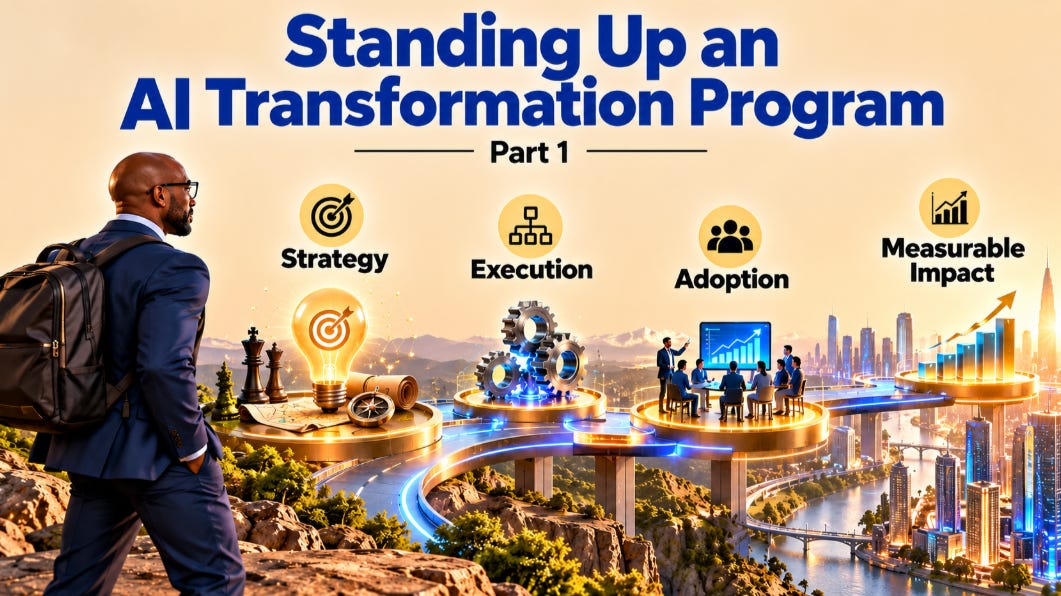
How to turn an executive Artificial Intelligence (AI) vision into a funded, governed and adopted program.
Most organizations no longer need convincing that AI matters. What they need is someone who can turn the strategy deck into delivered, adopted and measured change, quarter after quarter. In August 2025, the Massachusetts Institute of Technology (MIT) Networked Agents and Decentralized AI (NANDA) initiative reported that roughly 95% of enterprise generative AI pilots were not producing measurable business impact, and the gap it described was about execution and integration, not model quality.
This is Part 1 of a series on running AI transformation, drawn from my years leading finance digital and AI transformation at a global bank. The lessons apply to banks, insurers, hospitals, manufacturers, retailers, universities and public agencies alike.
In this article, you will learn:
Why AI transformation must be run as a program, not a collection of projects
The four layers every AI transformation program needs
How to build one integrated plan across business, technology and vendors
How to design a multi-year roadmap that keeps earning sponsorship
A practical first 90 days for a new transformation lead
Why AI Transformation Is a Program, Not a Project
Strategy inspires people, but only execution changes how the work actually gets done.
A project has a defined scope, a fixed end date and one accountable team. AI transformation has none of those properties. It touches many teams at once, depends on several vendors, rides on a technology that changes every few months and, most importantly, asks thousands of people to change how they work.
What makes AI different
Moving technology: Models, tools and vendor roadmaps change faster than annual planning cycles, so plans must be built to absorb change.
Shared foundations: Data, identity, security and platform decisions affect every use case, so they cannot be made team by team.
Human adoption: A tool nobody uses delivers no value, no matter how well it was built.
New risk types: Hallucinations, data leakage and autonomous agent actions require controls that traditional projects never needed.
Treating each use case as an isolated project produces a familiar result:
Dozens of pilots, inconsistent controls, duplicated spending and no story the executive committee can follow.
When the technology moves monthly and the people must change daily, only a program can hold the whole transformation together.
The Four Layers of an AI Transformation Program
A transformation without structure is just a collection of good intentions.
Programs that succeed are built on four connected layers. Each layer answers a different question, and each needs a named owner.
Sponsorship and intent: Why are we doing this, and what does success look like in three years? The executive sponsor owns the ambition, the funding envelope and the hard trade-offs.
Portfolio and roadmap: Which use cases, in what order, and why? This layer prioritizes by value, feasibility and risk, and it says no to good ideas that are not yet the right ideas.
Integrated delivery plan: Who delivers what, by when, and what depends on what? This is where business, technology, data, risk and vendor plans become one plan.
Adoption and value tracking: Are people using what we delivered, and is it creating the value we promised? This layer closes the loop back to the sponsor.
Many programs invest heavily in the second and third layers and neglect the fourth. That is how organizations end up with impressive delivery reports and disappointing business results.
Sponsorship sets direction, the portfolio sets priority, the plan sets pace and adoption proves value. Skip one layer and the others weaken.
One Integrated Plan Across Business, Technology and Vendors
One plan, one truth and one rhythm will outperform ten brilliant plans that never meet.
An AI transformation usually spans organizations that each have their own planning habits. Business teams plan around operating calendars, technology teams around releases, vendors around contracts and risk teams around review cycles. The program's job is to stitch them together.
What the integrated plan must show
Shared milestones: A small set of program-level milestones that every team recognizes and reports against.
Visible dependencies: Every cross-team dependency named, owned and dated, with the receiving team's agreement.
Vendor commitments: Vendor deliverables tracked in the same plan as internal work, not in a separate spreadsheet.
Control gates: Risk, security and legal reviews scheduled as planned steps rather than late surprises.
Adoption activities: Training, communication and support milestones planned alongside go-live dates.
When I founded and scaled a finance transformation organization, the most valuable artifact we had was not the strategy document. It was the integrated plan that let every team see how its work connected to everyone else's.
Integration is the quiet discipline that turns many moving teams into one moving program.
A Multi-Year Roadmap That Keeps Earning Sponsorship
Every quarter should deliver enough value to earn the right to the next one.
Executive sponsors fund multi-year transformations, but they renew their confidence every quarter. A roadmap that promises value only in year three will lose its sponsor in year one.
Designing the roadmap
Quarterly value checkpoints: Each quarter delivers at least one visible, measurable outcome that the sponsor can explain to peers.
Foundations paired with wins: Platform, data and governance work runs alongside use cases that show early value, so foundations never look like overhead.
Explicit decision points: The roadmap names where the program will decide to scale, pivot or stop, based on evidence.
Room for change: Some capacity is reserved for new opportunities created by fast-moving AI capabilities.
Long-term transformation is funded in years but trusted in quarters, so design every quarter to prove the program is worth it.
The First 90 Days of a New Transformation Lead
Listen before you lead, baseline before you promise and deliver before you ask for more.
Whether you inherit a program or start one, the first 90 days set your credibility. A simple sequence works across industries.
Listen (days 1 to 30): Meet sponsors, delivery leads, risk partners, vendors and frontline users. Map the current portfolio, the pain points and the unwritten expectations.
Baseline (days 15 to 45): Establish where the program stands on delivery health, adoption, value and risk, so future progress can be measured honestly.
Stabilize the cadence (days 30 to 60): Put a governance rhythm in place, clean up the risk log and agree on the integrated plan.
Deliver an early win (days 61 to 90): Choose one visible outcome that matters to the sponsor and deliver it, ideally one that also proves the program's way of working.
Credibility is earned in the first 90 days through listening, honest baselines and one visible win.
Key Takeaways
The best AI strategy is the one still being delivered three years from now.
Run it as a program: AI transformation spans teams, vendors and a fast-moving technology, so it needs program-level ownership.
Build all four layers: Sponsorship, portfolio, integrated plan and adoption tracking each need an owner.
Integrate relentlessly: One plan with shared milestones and visible dependencies beats many disconnected plans.
Earn sponsorship quarterly: Pair foundational work with visible wins every quarter.
Start by listening: A structured first 90 days builds the credibility everything else depends on.
AI transformation succeeds when someone owns the whole journey from executive intent to everyday adoption.
What is the hardest gap you have seen between AI strategy and execution in your organization?
Next in this series, Part 2: Building an AI Champions Network That Actually Scales.
Explore more: Start Here · Topics · Archive · About