


Why go-live is only the starting line, and how to move every audience from awareness to daily use.
Many Artificial Intelligence (AI) programs celebrate deployment and measure success by licenses issued. Yet value appears only when people actually change how they work. Prosci, the change management research firm, makes the point that even enterprise-wide change ultimately happens one person at a time.
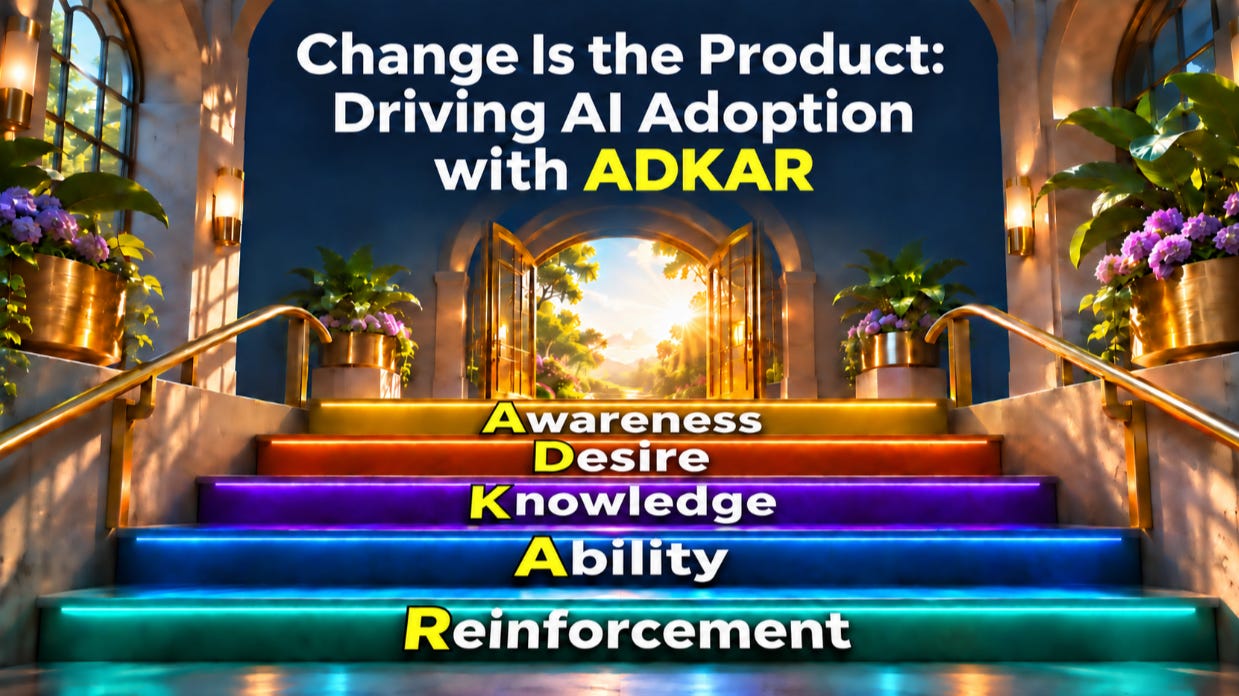
In this article, I will apply Prosci's ADKAR model (Awareness, Desire, Knowledge, Ability, Reinforcement) to the specific challenges of AI adoption, in any industry, from financial services to healthcare, retail and the public sector.
In this article, you will learn:
Why AI change is different from other technology change
How to apply each ADKAR element to an AI rollout
How to map impact by persona instead of by department
Which adoption metrics go beyond logins
How to reinforce new habits so they last
Why AI Change Is Different
People rarely resist new tools; they resist uncertainty about what those tools mean for them.
Most technology rollouts change a process. AI changes how people think about their own value at work, and that raises questions a normal training plan does not answer.
Job anxiety: Employees wonder whether the tool is a helper or a replacement, and silence from leadership is read as the worst answer.
Trust in output: People worry about confident but wrong answers, and they are right to.
Accountability: It is often unclear who is responsible when an AI-assisted decision goes wrong.
Constant change: The tool keeps improving, so training must be refreshed rather than delivered once.
Uneven benefit: Some roles gain a great deal and others very little, which creates perceptions of unfairness.
Address the fear, the trust question and the accountability question directly, or adoption will stall no matter how good the tool is.
ADKAR Applied to an AI Rollout
Find the first missing step in each person's journey and fix that before anything else.
Prosci describes the ADKAR elements as sequential but not strictly linear, and advises focusing support on the earliest element that is missing. Here is one concrete action for each element in an AI rollout.
Awareness: Leaders explain the business reason for AI in their own words, including what AI will not be used for.
Desire: Show real examples from peers, and target tedious tasks first, so the first experience is relief rather than threat.
Knowledge: Provide role-based training on approved tools, data handling rules and how to verify outputs.
Ability: Give people time, office hours, champions and safe practice environments to apply AI to their real work.
Reinforcement: Recognize good use, have managers ask about it in regular check-ins and update procedures to include it.
The most common mistake is jumping straight to Knowledge. Organizations schedule training when the real gap is Desire, and then wonder why trained employees do not use the tool.
Training cannot fix a desire problem, and enthusiasm cannot fix an ability problem; diagnose the gap before you prescribe the fix.
Mapping Impact by Persona, Not Department
Change lands on people, so plan for the people it lands on.
Departments are too broad for an AI change plan. An analyst who reconciles data, a manager who reviews outputs and a service agent who talks to customers in the same department will experience AI very differently.
For each persona, capture
What changes: The specific tasks that will be done differently.
What they gain: Time saved, fewer errors or more interesting work.
What they fear: Loss of status, loss of control or more scrutiny.
What they need: Skills, permissions, support and time.
Who they trust: The managers, peers or experts whose opinion will shape their attitude.
When I led a program that replaced hundreds of spreadsheets and desktop database tools, known as End-User Computing (EUC) tools, with governed analytics platforms, the technology was the easier part. Long-held habits were the real challenge, and persona-level plans made the difference.
A persona-level change plan replaces vague resistance with specific, solvable needs.
Adoption Metrics That Go Beyond Logins
A login proves curiosity; a changed workflow proves adoption.
Login counts and license totals tell you that people opened the tool. They do not tell you that work changed. A stronger set of measures looks like this.
Breadth: The share of target users who are active every week.
Depth: The number of distinct tasks each user performs with AI.
Frequency: How many days per week people use it.
Workflow coverage: The share of a process that is now AI-assisted.
Quality outcomes: Changes in error rates, rework, cycle time and satisfaction.
Sentiment: Confidence and trust measured through short, regular surveys.
Set targets by persona and review them monthly with business owners, not only with the technology team.
Measure breadth, depth and outcomes together, because high usage without better results is just activity.
Reinforcement: Making the New Way the Normal Way
Change becomes permanent when the old way quietly disappears.
Reinforcement is the most neglected element, because by the time it matters the project team has often moved on.
Recognition: Celebrate specific people and specific results, not generic participation.
Manager role modeling: Managers use AI visibly and ask about it in one-on-ones and team meetings.
Updated procedures: Write the AI-assisted steps into Standard Operating Procedures (SOPs) so the new way is the documented way.
Retired old paths: Decommission the old spreadsheets and manual steps once the new workflow is proven.
Feedback loops: Give users an easy way to report problems and see them fixed.
Reinforcement is where adoption becomes culture: recognize it, model it, write it down and retire the old path.
Key Takeaways
Deployment delivers a tool, but adoption delivers the value.
AI change is personal: Address job anxiety, trust and accountability openly and early.
Diagnose before you prescribe: Use ADKAR to find the first missing element for each group.
Plan by persona: Departments are too broad to capture how AI changes real work.
Measure real adoption: Track breadth, depth, workflow coverage and outcomes, not logins.
Reinforce relentlessly: Recognition, manager behavior and updated procedures make change stick.
Treat change as the product you are delivering, and the technology will finally deliver its value.
Which ADKAR element is most often missing in the AI rollouts you have seen?
Previous Articles in my AI Transformation Strategies Series:
Next in this series, Part 4: The Governance Cadence: OKRs, KPIs and RAID for AI Programs.
Explore more: Start Here · Topics · Archive · About