


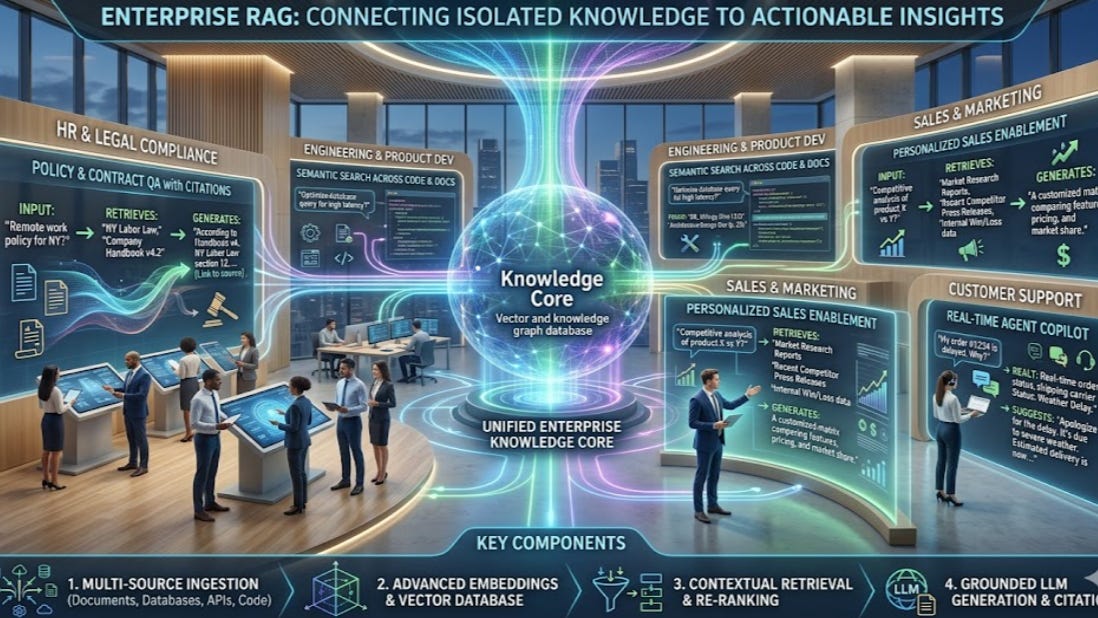
In Part 1 of this series, we explored the foundations of Retrieval-Augmented Generation: what it is, why it matters, and how it fits into the broader enterprise AI landscape. This article focuses on practical applications, addressing the real challenge for AI strategists and enterprise leaders: moving from conceptual understanding to deploying RAG at scale within a governed, production-grade environment. This article tackles the three pillars that separate successful enterprise RAG programs from costly experiments: implementation architecture, governance and risk controls, and evaluation frameworks.
1.1 Data Preparation and Ingestion
Data preparation is the most critical and time-consuming phase of RAG implementation. Moreover, costs related to data cleaning, labeling, grounding, and storage represent a significant portion of the total cost of AI ownership.
Document Processing Considerations:
Format Handling: Enterprise data spans PDFs, Word documents, spreadsheets, emails, wikis, databases, presentations, and scanned images. Each format requires specialized parsing.
OCR for Scanned Documents:Many legacy documents exist only as scanned images and require Optical Character Recognition before they can be chunked and embedded.
Table and Chart Extraction: Tabular data in documents often carries high information density and requires specialized extraction techniques.
Metadata Enrichment: Tagging chunks with metadata (source, date, author, classification, department) enables more precise retrieval and filtering.
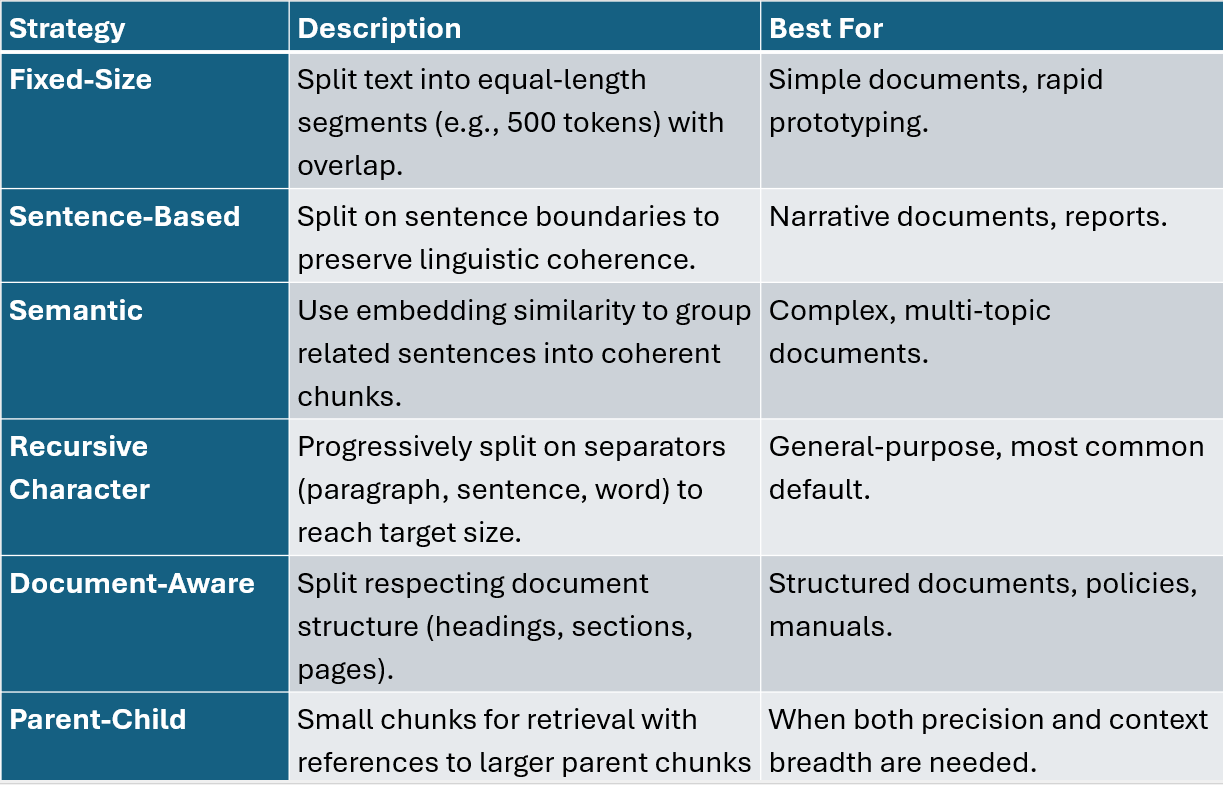
Data Chunking Strategies
1.2 Embedding Model Selection
The embedding model is one of the most impactful decisions in a RAG system. Key factors include:
Dimensionality: Higher dimensions capture more nuance but increase storage and compute costs.
Domain Fit: General-purpose embedding models may underperform on domain-specific language (legal, medical, financial).
Multilingual Support: If the enterprise operates across languages, the embedding model must support multilingual retrieval.
Hosting Options: Proprietary API-based models (OpenAI, Cohere) vs. self-hosted open-source models (BGE, GTE, E5).
Benchmark Performance: Consult the MTEB (Massive Text Embedding Benchmark) leaderboard for comparative performance data.
1.3 Vector Database Selection
The vector database is the backbone of the retrieval layer. Selection criteria include scalability, query latency, filtering capabilities, cloud vs. on-premises deployment options, cost model (per-vector pricing vs. infrastructure-based), metadata filtering support, and integration with existing enterprise architecture.
1.4 Integration Architecture
RAG systems can be deployed using one of three primary access models:
Chat-Based Tools: RAG-enhanced chatbots and knowledge assistants for employee self-service.
API-Based Integration: RAG pipelines embedded into existing business applications, workflows, and automation platforms.
Self-Hosted Enterprise Models: On-premises RAG systems using open-source models for maximum data privacy and regulatory control.
1.5 Deployment Options
Enterprises can choose among three primary deployment models for RAG infrastructure based on the organization’s risk appetite, data sensitivity, and regulatory requirements:
Public Cloud: Offers rapid deployment and scalability using managed cloud services, but requires careful attention to data residency, multi-tenancy risks, and compliance with data sovereignty requirements.
Virtual Private Cloud (VPC): Provides a dedicated, isolated cloud environment that balances the scalability of cloud infrastructure with stronger data isolation and network controls.
On-Premises: Maximizes data control, privacy, and regulatory compliance by keeping all RAG components within the organization’s own infrastructure but requires significant capital investment and internal engineering capacity.
1.6 Build vs. Buy Strategy
A critical strategic decision for enterprise RAG is whether to build a custom solution or procure a managed platform:
Build:Building a custom solution provides maximum control and customization over the RAG pipeline, including data handling, retrieval logic, and governance integration. However, it requires significant engineering resourcesfor orchestration, maintenance, and ongoing optimization (typically using frameworks such as LangChain, LlamaIndex, or Haystack).
Buy:Buying a managed platform reduces development time and operational burden, but may introduce vendor lock-in, limited customization, andreduced transparency in retrieval and generation behavior.
In practice, many enterprises adopt a hybrid approach: building custom retrieval and governance layers while leveraging managed services for embedding generation, vector storage, or LLM inference. The strategist should evaluate this decision against the organization’s engineering capacity, time-to-value requirements, data sensitivity, and long-term scalability needs.
1.7 Scaling RAG to Enterprise Production
Moving a RAG system from a successful pilot to enterprise-wide production involves addressing scalability, operational efficiency, and organizational structure. Three key dimensions define this transition:
Vector Database Sharding:As document volumes grow into the millions, a single vector database instance may become a performance bottleneck. Sharding distributes the database across multiple servers, enabling parallel query processing and horizontal scalability. Enterprise RAG architectures should plan for sharding strategies early to avoid costly architectural redesign as data volumes grow.
Asynchronous Ingestion Processing:In production environments, data ingestion (document parsing, chunking, embedding, and indexing) should be handled asynchronously in the background so that it does not degrade the real-time query experience for end users. Batch processing pipelines and event-driven architectures are common patterns for decoupling ingestion from retrieval.
Center of Excellence (CoE) Operating Model:To avoid fragmented RAG implementations across business units, many enterprises establish a Center of Excellence that provides standardized RAG infrastructure, shared best practices, governance frameworks, and reusable components. The CoE model accelerates adoption by enabling business units to build on a common platform rather than reinventing the pipeline from scratch.
2.1 RAG-Specific Risks
While RAG reduces hallucination risk compared to standalone LLMs, it introduces its own risk landscape:
Retrieval Failure:The system retrieves irrelevant, outdated, or incorrect documents, leading to confidently wrong answers.
Context Poisoning: Malicious or low-quality data in the knowledge base contaminates RAG outputs.
Data Leakage:RAG systems with broad access may surface confidential information to unauthorized users.
Stale Data:Knowledge bases that are not regularly refreshed may provide outdated policy or regulatory information.
Prompt Injection via Retrieved Content: Adversarial content in indexed documents could manipulate LLM behavior.
Over-Reliance on Retrieval:The model may ignore its own reasoning capabilities when retrieval results are noisy or contradictory.
2.2 Governance Controls for RAG Systems
Access Control: Implement document-level and chunk-level access controls to ensure users only retrieve content they are authorized to view.
Source Provenance: Every RAG output should include citations linking back to the source document, page, and section.
Data Freshness Monitoring: Establish refresh schedules and staleness alerts for knowledge base content.
Quality Assurance on Ingested Data: Validate document quality before indexing. Remove duplicates, outdated versions, and low-quality content.
Output Guardrails: Apply post-generation checks for accuracy, compliance, toxicity, and relevance before delivering outputs to users.
Audit Logging:Log all queries, retrieved documents, and generated responses for regulatory review and model improvement.
Data Redaction and Personally Identifiable Information Protection:Implement data redaction layers that strip Personally Identifiable Information (PII) before data enters the RAG pipeline.
Explainability and Transparency:Users and regulators must clearly understand why an AI system produced a given output. RAG inherently supports explainability by providing the exact documents, passages, and paragraphs used to generate each response.
3.1 The RAG Evaluation Challenge
Evaluating RAG systems requires measuring quality across both the retrieval and generation stages independently. A perfectly functioning LLM cannot compensate for poor retrieval, and excellent retrieval is wasted on a poorly prompted generator.
RAG production readiness is assessed across four core dimensions:
Faithfulness: Does the generated answer accurately reflect the content of the retrieved documents (no hallucination)?
Answer Relevance: Does the generated answer address the user's original question?
Context Precision and Recall: Did the retriever find all the necessary information, and was it ranked correctly?
Groundedness: Can every claim in the response be traced back to a retrieved source?
3.2 Evaluation Frameworks
Several open-source frameworks support automated RAG evaluation:
RAGAS: A widely used framework measuring faithfulness, answer relevance, and context metrics.
TruLens: Provides feedback functions for evaluating LLM-based applications, including RAG-specific metrics.
DeepEval: Offers unit testing for LLM outputs with built-in RAG evaluation metrics.
Custom Evaluation: Enterprise-specific evaluation using human reviewers, domain experts, and automated quality scoring systems.
3.3 Automated vs. Human Evaluation
In practice, RAG evaluation benefits from combining automated and human approaches to balance scalability and nuanced judgment:
LLM-as-a-Judge: Using a powerful model to automatically score RAG responses based on the metrics discussed above. This approach enables rapid and scalable evaluation across large volumes of test queries without requiring manual review for every output.
Human-in-the-Loop (HITL) Evaluation: Expert human review remains essential for nuanced judgment, edge case detection, and maintaining high data quality standards across the dimensions of accuracy, completeness, and consistency.
The most robust enterprise evaluation strategies combine both approaches. They use LLM-as-a-Judge for continuous monitoring, and HITL for deep-dive validation.
3.4 Operational Performance Metrics
RAG systems must also be evaluated on operational performance dimensions that determine production readiness and user experience:
Latency:The total time taken to embed the user’s query, retrieve relevant chunks from the vector database, and generate the final response. End-to-end latency directly affects user experience and must meet acceptable thresholds for the target use case. Interactive applications (such as customer-facing chatbots) typically require sub-second retrieval with total response times under a few seconds, while batch processing workflows may tolerate longer cycles.
Throughput:The number of concurrent queries the RAG system can handle simultaneously without degradation in latency or quality. Throughput planning is essential for enterprise deployments where hundreds or thousands of users may query the system concurrently during peak hours. Load testing and capacity planning should be conducted before production launch.
These operational metrics should be tracked continuously in production alongside quality evaluations.
Enterprise RAG is not merely a technical architecture. It is a strategic capability that demands the same rigor applied to any production-grade financial system. From data preparation and embedding selection to vector database scaling, governance controls, and evaluation frameworks, every layer of the RAG pipeline must be designed with auditability, resilience, and regulatory alignment in mind. Organizations that invest in robust governance, combine automated and human evaluation, and build scalable infrastructure from the outset will be positioned to unlock the full potential of RAG by delivering grounded, explainable, and trustworthy AI that creates real business value.
In Part 3 of this series, we will explore advanced RAG patterns, including agentic RAG, multi-hop retrieval, and how RAG architectures are evolving to support autonomous AI workflows in the enterprise.

Explore more: Start Here · Topics · Archive · About