


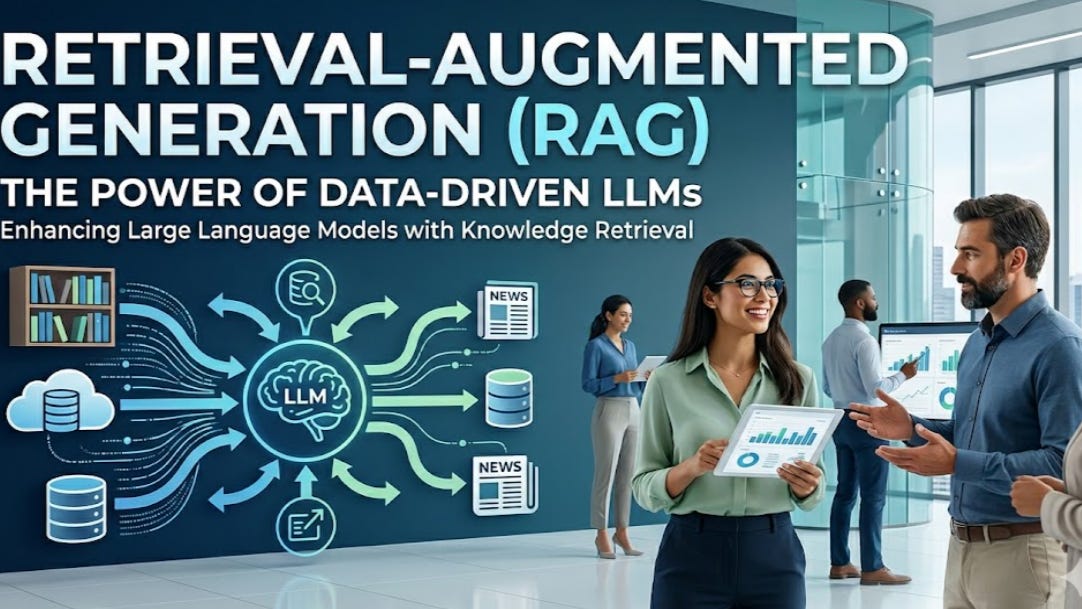
In Parts 1 and 2 of this series, we built the foundation: what RAG is, why it matters for the enterprise, and how its core components work together to ground AI-generated responses in verified organizational knowledge. It is now time to move beyond the basics. In this installment, we explore the advanced RAG techniques that separate experimental pilots from production-grade, enterprise-ready systems. From Hypothetical Document Embeddings (HyDE) and Self-Reflective RAG to multi-modal retrieval, recursive query decomposition, and the evolution of RAG into fully agentic ecosystems, these are the capabilities that define the next frontier of intelligent knowledge infrastructure. We will also map high-value RAG use cases specific to financial services, examine the best practices and common pitfalls that determine success or failure at scale, and walk through a structured cost analysis framework so that AI strategists can build the business case with clarity and confidence. If Parts 1 and 2 addressed the ‘what’ and ‘why,’ Part 3 focuses on the ‘how’ and ‘what comes next.’
Beyond basic retrieval lies a set of advanced techniques that significantly improve how AI systems find, validate, and deliver enterprise knowledge. We will discuss these techniques in this section.
1.1 Hypothetical Document Embeddings (HyDE)
Instead of embedding the user's raw query, HyDE asks the LLM to generate a hypothetical answer first, then uses the embedding of that answer to search the vector store. This improves retrieval because the hypothetical answer is closer in embedding space to stored documents than a short query.
1.2 Self-Reflective RAG (Self-RAG / CRAG)
Self-RAG introduces a critique step where the model evaluates whether retrieval is needed, whether the retrieved documents are relevant, and whether the generated response is supported by the evidence. Corrective RAG (CRAG) adds a correction loop that triggers web search or alternative retrieval when initial results are deemed insufficient.
1.3 Multi-Modal RAG
Multi-modal RAG extends retrieval beyond text to include images, charts, tables, and diagrams. This is critical for enterprises where knowledge is stored in presentations, engineering drawings, or visual dashboards. Multi-modal embedding models (such as CLIP variants) or vision-language models can encode and retrieve across modalities.
1.4 Recursive Retrieval and Query Decomposition
For complex questions that require information from multiple sources or multiple reasoning steps, recursive retrieval breaks the question into sub-questions, retrieves relevant context for each, and then synthesizes the results. This is particularly valuable in compliance, legal research, and multi-factor risk assessment.
1.5 Contextual Retrieval
Contextual retrieval enriches each chunk with surrounding context at indexing time, so that individual chunks carry enough information to be useful even when retrieved in isolation. This technique prepends a brief context summary (often LLM-generated) to each chunk before embedding.
1.6 Late Chunking
Late chunking applies the embedding model to the full document first and then segments the resulting embeddings, preserving cross-chunk context that is lost in traditional chunk-then-embed approaches.
RAG is evolving beyond simple document question-answering into the foundation of intelligent, agentic ecosystems where multiple AI agents collaborate autonomously. This evolution represents a shift from “interacting with documents” to building systems capable of autonomous investigation, self-correction, and institutional knowledge codification.
Key patterns in this evolution include:
Autonomous Investigation Agents:Agents that leverage RAG to research complex, multifaceted problems across multiple systems autonomously. For example, a fraud investigation agent might use RAG to pull transaction histories, regulatory guidance, and prior case outcomes from separate knowledge bases, synthesizing findings into a comprehensive analysis without human intervention at each step.
Self-Correcting Workflows: Advanced agentic RAG architectures include reflector agents that evaluate retrieval quality in real time. If a retrieval result is assessed as low-quality or irrelevant, the reflector agent instructs the retrieval agent to reformulate its query or search an alternative data source. This self-correcting loop improves output reliability and reduces the need for human oversight in routine operations.
Codified Institutional Knowledge: RAG becomes the mechanism through which an organization’s collective wisdom, institutional memory, and operational history are made continuously accessible to every employee and AI agent. In this vision, RAG transforms “dark data” (unused or inaccessible organizational knowledge) into an active, searchable, and continuously updated knowledge layer that supports decision-making across the enterprise.
Below are high-value RAG use cases for the financial services industry:
3.1 Regulatory Policy Q&A
Enterprise Priority:Regulatory and Compliance Adherence
Functional Goal: Enable staff to quickly find and interpret regulatory guidance
RAG Value:Index regulatory documents (Basel, SR 11-7, EU AI Act, OCC guidance) and enable natural language queries with cited, grounded responses
Alignment Rating: Perfect alignment
3.2 Internal Policy and Procedure Search
Enterprise Priority:Efficiency and Workforce Enablement
Functional Goal: Reduce time employees spend searching for internal policies
RAG Value: Index internal wikis, policy documents, and procedure manuals for instant, grounded retrieval
Alignment Rating: Strong alignment
3.3 Client Inquiry Response Assistance
Enterprise Priority:Customer and Client Experience
Functional Goal:Provide faster, more accurate responses to client queries
RAG Value: RAG system retrieves from product documentation, FAQs, and client history to draft accurate responses
Alignment Rating:High strategic fit
3.4 Risk and Compliance Report Generation
Enterprise Priority:Risk Reduction and Control Enhancement
Functional Goal: Accelerate report creation with grounded data
RAG Value:Retrieve from risk databases, audit findings, and regulatory submissions to generate grounded narrative summaries
Alignment Rating: Strong alignment
3.5 Contract and Legal Document Analysis
Enterprise Priority:Risk Reduction and Growth
Functional Goal: Accelerate contract review and clause extraction
RAG Value: Index contract templates, legal precedents, and regulatory requirements to support clause comparison and risk flagging
Alignment Rating: Strong alignment
Start with data quality. The single most impactful investment in a RAG system is high quality, well-structured, and current source data.
Experiment with chunking strategies.There is no universal best approach. Test different chunk sizes (256, 512, 1024 tokens) and overlap percentages for your specific data.
Always implement a reranking step. Reranking consistently improves retrieval precision and is a low-cost, high-impact optimization.
Use hybrid search. Combining dense vector search with sparse keyword search (BM25) covers both semantic and exact-match retrieval needs.
Build evaluation into your pipeline from Day 1. Avoid waiting until production to begin measuring retrieval and generation quality.
Implement access controls at the document level. RAG systems must respect information security boundaries.
Include source citations in every response.This enables trust, auditability, and user verification.
Plan for knowledge base maintenance.Establish refresh schedules, version control, and staleness detection.
Design prompts that instruct the LLM to say "I don't know" when retrieved context is insufficient, rather than generating unsupported answers.
Monitor and iterate.RAG systems improve over time through user feedback, retrieval analytics, and continuous tuning.
Avoid prolonged pilot phases. Move deliberately from simple demos and proofs of concept to production-ready systems that handle concurrent user loads, real-world data volumes, and enterprise-grade reliability requirements.
Set explicit criteria for graduating a RAG pilot to production, including performance benchmarks, governance sign-off, and operational readiness reviews.
Establish clear KPIs from the outset. Define measurable success criteria tied to efficiency gains, risk reduction, and financial outcomes before deployment, not after. Without predefined KPIs, it becomes impossible to objectively assess whether a RAG implementation is delivering its intended value or requires course correction.
Organizations typically progress through four stages of RAG and AI maturity as their capabilities evolve:
Experimental:Scattered RAG pilots with unclear ROI, limited governance, and ad hoc implementation approaches. Most organizations begin here.
Repeatable: Standardized processes emerge with defined governance frameworks, consistent evaluation practices, and documented best practices that can be replicated across teams.
Scalable: A unified AI platform supports strong adoption across business units, with centralized infrastructure (often through a Center of Excellence), enterprise-grade governance, and measurable business outcomes.
Autonomous Enterprise: Multi-agent systems with self-optimizing RAG pipelines operate at scale, enabling the organization to function as an intelligent network where every workflow is supported by the full breadth of institutional knowledge.
Understanding this maturity progression helps strategists set realistic expectations, plan phased investments, and avoid the common trap of expecting enterprise-scale outcomes from experimental-stage implementations.
Ignoring Chunk Quality: Poorly chunked documents lead to irrelevant retrieval regardless of how good the embedding model is.
One-Size-Fits-All Chunking: Using the same chunking strategy for different document types (policies vs. emails vs. reports) degrades performance.
Neglecting Metadata:Failing to enrich chunks with metadata (date, source, classification) limits filtering and governance capabilities.
Embedding Model Mismatch:Using a general-purpose embedding model for highly specialized domain content without evaluation.
Skipping Reranking: Relying solely on vector similarity often returns "close but wrong" results that could be filtered by a reranker.
No Evaluation Framework: Deploying without measuring faithfulness, relevance, or retrieval precision makes quality invisible.
Stale Knowledge Base: Failing to refresh the index as source documents are updated leads to outdated or contradictory responses.
Ignoring Access Controls: Allowing all users to retrieve from all documents without authorization checks creates data leakage risk.
Over-Retrieving: Passing too many chunks to the LLM overwhelms context windows and introduces noise that degrades answer quality.
Under-Investing in Prompts: Even with perfect retrieval, a poorly designed generation prompt will produce low-quality outputs.
7.1 Data Preparation
Components:Document parsing, OCR, cleaning, chunking, metadata tagging.
Optimization Strategies: Automate ingestion pipelines and batch processing.
7.2 Embedding Costs
Components: Per-token fees for API-based embeddings; compute for self-hosted.
Optimization Strategies: Use smaller embedding models for large corpora and cache embeddings.
7.3 Vector Storage
Components: Per-vector storage and query fees or infrastructure for self-hosted.
Optimization Strategies:Optimize dimensionality and implement data lifecycle policies.
7.4 Retrieval Compute
Components:Query embedding, similarity search, and reranking.
Optimization Strategies: Approximate nearest neighbors and caching frequent queries.
7.5 LLM Generation
Components: Per-token costs for the generation model (often the largest cost).
Optimization Strategies:Use context compression and smaller models for simpler queries.
7.6 Infrastructure
Components: Cloud hosting, networking, monitoring, and logging.
Optimization Strategies:Right-size infrastructure and use serverless where possible.
7.7 Maintenance
Components: Knowledge base updates, model upgrades, and pipeline monitoring.
Optimization Strategies: Automate refresh pipelines and implement change detection.
As organizations move from experimentation to enterprise-scale adoption, Retrieval-Augmented Generation is no longer just a technical pattern but a strategic capability that shapes how knowledge is accessed, trusted, and operationalized. The true value of RAG lies not only in improving accuracy. It also lies in transforming fragmented data into a governed, scalable, and continuously evolving intelligence layer that powers decision-making across the enterprise. By combining advanced retrieval techniques, strong data foundations, rigorous evaluation, and disciplined governance, organizations can unlock the full potential of RAG and position themselves for the next evolution toward agentic, self-optimizing systems. The journey is not about deploying a tool but about building a resilient knowledge infrastructure that turns information into sustained competitive advantage.

Explore more: Start Here · Topics · Archive · About