


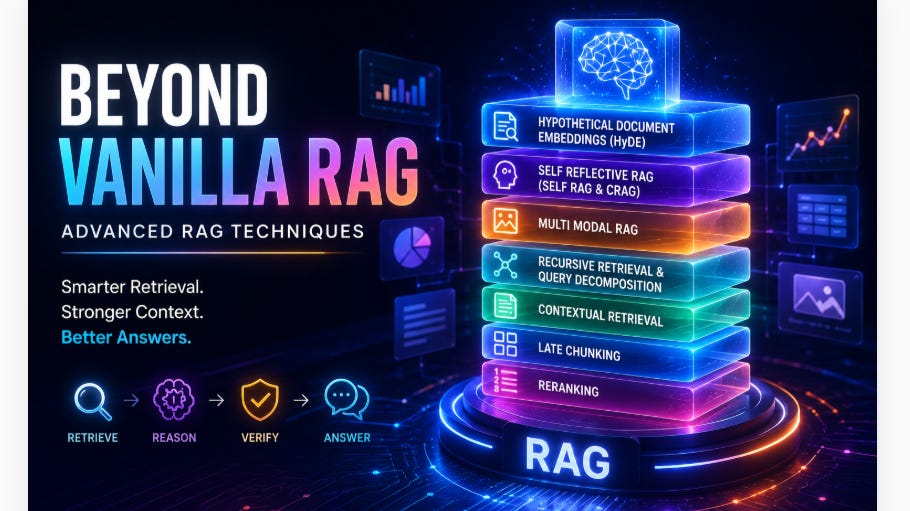
Once you have a solid baseline RAG system, with thoughtful chunking, a serious indexing strategy, and an honest evaluation pipeline, you reach the point where vanilla retrieval is no longer enough. The hard questions start to dominate. Multi part questions. Questions that depend on relationships across documents. Questions that need a chart, not just paragraphs. Questions that the retriever stubbornly misunderstands.
This article is a tour of the advanced techniques that lift RAG from working to excellent. None of these are exotic anymore. They are showing up in production stacks across financial services and other regulated industries.
Hypothetical Document Embeddings (HyDE)
Short user queries embed poorly because they carry too little semantic content for the vector to be precise. HyDE addresses this by asking the LLM to generate a hypothetical answer to the query first, then using the embedding of that hypothetical answer to search the vector store.
The hypothetical answer might be partly wrong. That is fine. What matters is that it sits closer in embedding space to the actual stored documents than a short question would. The retriever then surfaces the right chunks, and the generation step produces a grounded final answer using the real evidence.
HyDE is most useful for short, ambiguous queries and exploratory research questions. It is less useful for very specific lookups where the query already contains the right keywords.
RAG Types and Flavors
1. Self-Reflective RAG
Introduces a critique step in which the model evaluates whether retrieval is needed at all, whether the retrieved documents are relevant, and whether the generated response is supported by the evidence. The model learns special tokens during fine tuning that indicate retrieve, support, no support, and similar states. The output of the system includes both an answer and a self assessment of its own reliability.
2. Corrective RAG (CRAG)
Adds a correction loop that triggers when initial retrieval is judged insufficient. The system can fall back to web search, re-query with a reformulated question, or escalate to a richer source. CRAG is particularly attractive in enterprise contexts where some questions can be answered from internal data and others require live external lookups.
3. Multi Modal RAG
In practice, enterprise knowledge does not live only in text. It lives in charts, dashboards, engineering drawings, tables, scanned documents, slide decks, and screenshots. Multi modal RAG extends retrieval beyond text to these other modalities.
Two architectural patterns dominate.
Multi modal embeddings:use a model that embeds images and text into the same vector space, such as CLIP and its successors. A textual query can then retrieve images, and an image query can retrieve text.
Captioning and unified text search:use a vision language model to caption every image at index time, embed the captions, and search the captions. Less elegant but more controllable, easier to debug, and easier to evaluate.
Financial services examples include indexing earnings call slides, regulatory exam findings with embedded charts, and operations dashboards that capture institutional knowledge through visual context.
4. GraphRag
GraphRAG (Graph Retrieval-Augmented Generation) is an advanced evolution of traditional RAG that enhances retrieval by organizing knowledge as a graph of entities, relationships, and concepts rather than relying solely on isolated text chunks stored in a vector database. During indexing, GraphRAG extracts entities (such as people, products, regulations, or organizations) and their relationships, creating a knowledge graph that allows the system to understand how information is connected across documents. When a user asks a question, GraphRAG can traverse these relationships to retrieve relevant context from multiple connected sources, making it particularly effective for complex, multi-hop questions that require reasoning across documents. This approach often delivers more accurate, explainable, and comprehensive answers than traditional RAG, especially in domains such as financial services, healthcare, legal research, and enterprise knowledge management where understanding relationships between entities is critical.
5. Agentic Retrieval
Next part of this RAG Mastery Series (part 8) will be dedicated to discussing Agentic RAG
Recursive Reterieval and Query Decomposition
Some questions cannot be answered from a single chunk or even from a single retrieval pass. Consider a compliance question that combines a regulatory definition, an internal policy, and a recent supervisory letter. No single chunk contains the full answer.
Recursive retrieval and query decomposition handle these multi step questions by:
Breaking the question into sub questions.
Retrieving relevant context for each sub question independently.
Synthesizing the results into a single grounded answer.
This is the foundational pattern that leads into Agentic RAG, which we cover in detail in Part 8. The difference is that classical recursive retrieval is a fixed pipeline, while agentic RAG lets the agent decide dynamically how to decompose, route, and synthesize.
Contextual Retrieval
A technique that has rapidly become a standard upgrade to vanilla chunking. Each chunk is enriched at indexing time with a brief, often LLM generated, context summary that describes where the chunk sits within the larger document. The summary is prepended to the chunk text before embedding.
The effect is that each chunk carries enough information to be useful even when retrieved in isolation. A paragraph from section 4 of a policy no longer floats free. It is anchored by a short context that says, for example, this paragraph defines an exception within the broader policy on third party data sharing. Retrieval quality improves measurably for documents with strong hierarchical structure.
Late Chunking
A newer technique that flips the traditional order of operations. Instead of chunking first and embedding each chunk independently, late chunking applies the embedding model to the full document and then segments the resulting embeddings.
This preserves cross chunk context that traditional chunk then embed approaches lose. A reference in chunk three that depends on a definition introduced in chunk one no longer suffers from the broken context problem. The technique is computationally heavier and requires a model that supports long context embedding, but the quality gains can be substantial on long, narrative heavy documents.
Reranking, the Quietly Essential Step
Reranking deserves its own callout because almost every team that adopts it sees meaningful gains. After initial retrieval returns a candidate set, often 20 to 50 chunks, a smaller but more accurate model rescore the candidates and reorders them. The top few after reranking go into the generation prompt.
Why this works:retrieval uses a fast approximate vector search. Reranking uses a more expensive cross encoder that considers the query and each candidate chunk together. The cross encoder is too slow to apply to the whole knowledge base but fast enough to apply to a few dozen candidates. The result is better precision at low cost.
Mature options include Cohere Rerank, BGE reranker, and Voyage rerank. If your stack does not have a reranker, adding one is usually the highest leverage change you can make.
Hybrid Search Done Right
We touched on hybrid search in Part 5. The technique deserves a deeper note here because it interacts with the advanced patterns above.
Hybrid search combines dense vector search with sparse keyword search, often BM25. Vector search captures paraphrases and semantic neighbors. Keyword search captures exact terms, proper nouns, regulatory citations, and product codes that embeddings can blur. Most modern retrievers blend the two with a weighted score and then send the merged candidates through a re-ranker.
Hybrid is now the default in serious production RAG. Pure vector search underperforms on queries that depend on exact strings, and pure keyword search underperforms on queries that depend on meaning. Combining them costs little and gains a lot.
Prompt Engineering for Generation
Advanced retrieval techniques deliver better evidence. The prompt then decides what the generation model does with that evidence. A few patterns matter.
1. Instruct the Model to Cite
Require the model to include citations to specific retrieved chunks for every claim. This is a powerful anti hallucination control and a precondition for auditability.
2. Instruct the Model to Refuse When Evidence Is Insufficient
Design prompts that explicitly permit and encourage the model to say I do not know when the retrieved context does not support a confident answer. This is more difficult than it sounds and is one of the most important behaviors to evaluate.
3. Separate Instructions, Context, and Question
A clean prompt structure with separate sections for the system instructions, the retrieved context, and the user question helps the model treat each appropriately. Mixing them invites confusion.
Putting It All Together, an Advanced Stack
A modern advanced RAG stack typically looks like this:
Source documents loaded with format aware parsers.
Structure aware chunking with metadata enrichment.
Contextual retrieval applied at indexing time.
Optional late chunking for long form documents.
HNSW index in a managed vector database with metadata filtering.
Hybrid retrieval combining vector and BM25.
Cross encoder reranking of the merged candidates.
HyDE for short or ambiguous queries.
Query decomposition for multi part questions.
Self critique step before the generation model finalizes the answer.
Citation enforcement and explicit permission to refuse when evidence is insufficient.
Multi modal support for visual content where the domain requires it.
Continuous evaluation across retrieval, generation, and operational metrics.
This is not science fiction. It is what serious teams are shipping in 2026.
Closing Thought
Advanced techniques are not about chasing novelty. They are about closing the specific quality gaps that emerge once your basic system is sound. Add them deliberately, measure their impact, and keep what works.
Part 8 takes us into the next architectural leap, where the system stops being a fixed pipeline and starts behaving like a reasoning loop:Agentic RAG.

Explore more: Start Here · Topics · Archive · About