


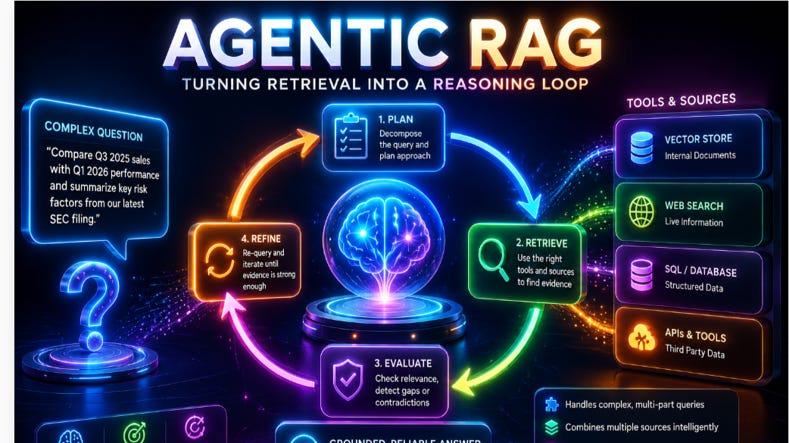
Traditional RAG retrieves once, generates once, and stops. That works beautifully for single hop factual questions, and it falls apart the moment the question gets complex. Compare third quarter 2025 sales with first quarter 2026 performance and summarize key risk factors from our latest SEC filing. A single retrieval pass produces a mishmash that does not cleanly address either part of the question.
Agentic RAG is the architectural response. Instead of treating retrieval as a single, well-defined step, it treats retrieval as an ongoing reasoning process. The agent decomposes the query, routes each part to the right source, checks what it gets back, and iterates until it has enough grounded context to generate a reliable answer.
This article walks through what changes when retrieval becomes a loop, the building blocks of agentic RAG, when it is the right choice, and when it is overkill.
The Limitations of Static RAG That Force the Move
To understand why agentic RAG matters, start by understanding what classical RAG cannot do.
1. One Shot Solution
The retriever runs once, produces a set of chunks, and those chunks go to the LLM. There is no second look. If retrieval misses the mark, the pipeline cannot try again with a different approach.
2. No Reasoning About Usefulness
Classical RAG has no mechanism to verify whether the retrieved context actually answers the question. The model receives whatever was retrieved and generates an answer, even if the chunks are weak.
3. Single Source
Classical RAG pulls from one vector store. It cannot blend internal documents with web search, structured database queries, or APIs that hold the precise answer.
4. Fails on Multi Part Queries
Questions that require comparison, synthesis across sources, or stepwise reasoning do not fit the classical pipeline.
These are not exotic limitations. They are the everyday reality of compliance research, risk analysis, and client advisory work
What Agents Add
An agent introduces three capabilities that turn a fixed pipeline into a reasoning system.
1. Planning
The agent decides how to approach a complex query before retrieving anything. It can break the query into sub questions, choose an order of operations, and commit to a plan that the rest of the loop executes.
2. Tool Use
The agent can call multiple retrievers, web search, SQL queries, or APIs, choosing the right tool for each sub question. Internal documents go to the vector store. Live news goes to a web search tool. Position data goes to a SQL connector. Each tool is a callable resource the agent can select among.
3. Iterative Reasoning
The agent loops through retrieval, evaluation, and refinement until the evidence is strong enough to answer. Basic RAG retrieves and generates. Agentic RAG retrieves, evaluates, iterates, and then generates
The Agentic Retrieval Loop in Practice
1. Query Decomposition and Source Routing
The agent breaks down a complex query into focused sub questions, then routes each one to the most appropriate source. A typical routing pattern looks like this:
Contextual knowledgegoes to internal documents in a vector store.
Current informationgoes to a web search tool.
Factual lookupsgo to structured data through SQL or APIs.
That routing is the agent's first non-trivial reasoning act. Done well, it dramatically improves the quality of every downstream step.
2. Multi Hop Retrieval
Retrieval happens in stages. Each step uses what was found previously to refine the next query. The answer is not in any single chunk. It emerges by connecting evidence across several. The agent reasons across documents in a way that classical RAG cannot.
3. Self-Correction and Retrieval Validation
In a static pipeline, retrieved context is passed straight to the LLM, which cannot verify its relevance and may generate plausible but incorrect answers from loosely related chunks.
Agentic systems add validation steps. The agent checks relevance, detects contradictions, and re queries when needed. Irrelevant or weak evidence is not passed forward. Retrieved data is treated as evidence to evaluate, not as truth to assume. This self-correction loop is the most important difference from static RAG and substantially reduces hallucinations.
Graph RAG and Structured Knowledge
Vector search treats documents as independent chunks ranked by embedding similarity. That works when relevant information is self-contained, but it breaks down on queries that depend on relationships between entities across documents. Who reports to whom. Which counterparty is exposed to which sector. Which clause amends which precedent.
Graph RAG addresses this by building a knowledge graph from the documents and retrieving via graph traversal instead of embedding similarity. Entities become nodes, relationships become edges, and queries become walks through the graph.
Best fit domains are relationship heavy: legal research where citations form a web, healthcare diagnostics where symptoms link to conditions and treatments, financial exposure analysis where counterparties connect through transactions.
Tradeoff: knowledge graphs are expensive to build and maintain. Best suited for stable, high value data. Not well suited for simple or fast changing datasets where the construction cost cannot be amortized.
Reflection and Memory
Reflection:the agent reviews its draft answer for gaps, errors, or weak support, and triggers further retrieval if needed. This is the single largest contributor to perceived answer quality in modern agentic systems.
Memory operates at two levels:
Short term memorytracks what has already been retrieved in the current session. It prevents redundant work and allows multiturn conversations to feel coherent.
Long term memorylearns from past queries to improve future retrieval efficiency. It surfaces patterns, anchors definitions, and personalizes behavior over time.
Together, reflection and memory push agentic RAG from a stateless retrieval loop toward a reasoning system with genuine operational history.
When Agentic RAG Is Overkill
Agentic RAG is more powerful, slower, and costlier than static RAG. Multiple LLM calls per query mean latency, token use, and failure risk all increase with complexity.
A useful rule of thumb:
Use static RAG for single hop factual queries where one retrieval pass and one generation pass produce a complete answer.
Use agentic RAG for multi step reasoning, cross source synthesis, comparative analysis, or anything that requires the system to verify its own work before answering.
Resist the urge to wrap every use case in agents.The most reliable production systems use static RAG by default and reserve agentic flows for queries where the added cost is justified by the added capability.
Patterns You Will Recognize from the Frameworks
Several open-source frameworks make agentic RAG easier to build and observe:
LangGraph,a graph-based orchestration layer built on top of LangChain, used to define agent state machines explicitly.
CrewAI and AutoGen,multi agent orchestration frameworks that let several specialized agents collaborate, each with its own tools and prompts.
OpenAI Agents SDK,a managed framework for building agentic flows with explicit tool calling and handoffs.
LlamaIndex Agents,tight integration with LlamaIndex retrievers and indexes for agentic retrieval flows.
All of them implement variations on the same loop: plan, choose a tool, execute, observe, reflect, repeat. The vocabulary differs. The structure does not.
Observability Becomes Mandatory
Static RAG is hard enough to evaluate. Agentic RAG is harder. Multiple steps, branching paths, tool calls, and self-correction loops mean that something can go wrong in many more places.
Mature teams instrument every step of the agent loop with tracing, capture every prompt and tool call, and route the telemetry to observability platforms that can replay individual runs.
Tools that show up frequently in production:Langfuse, LangSmith, Arize Phoenix, and home grown OpenTelemetry stacks. Without this, debugging an agent is guesswork.
Governance Considerations for Agentic RAG
Agentic systems introduce new failure modes that risk managers and model risk teams need to think through carefully.
Autonomy boundaries:which actions the agent can take without human approval, and which require a human in the loop.
Tool risk:every tool the agent can call is a new attack surface and a new compliance question. Web search introduces external content. SQL connectors introduce data lineage questions.
Loop bounding:iteration limits to prevent runaway behavior or excessive cost.
Explainability:the ability to reconstruct exactly which tools were called, which evidence was retrieved, and which reasoning steps led to the final answer.
Alignment with SR 11-7 and SR 26-2:in the United States, the new principles based supervisory guidance on model risk management for generative AI directly addresses agentic behavior, autonomy, and ongoing monitoring.
These topics deserve their own series. I have written extensively on agentic AI guardrails and governance, and I will be drawing on that material in future articles.
Closing Thought
Agentic RAG is the natural endpoint of RAG progression. You start with a pipeline that retrieves and generates. You add evaluation, reranking, and self-critique. Eventually you accept that for the hardest questions, the system needs to think rather than just answer.
The transition from pipeline to reasoning loop is also a transition from product to platform. Once the agent can choose its tools and verify its own work, it stops being a chatbot over a knowledge base and starts being a research analyst that happens to be implemented in software.
Part 9 closes the series by stepping back to the strategic decision every CIO and Chief AI Officer eventually faces: when to use RAG, when to fine tune, and when to combine them through RAFT, especially in the context of financial services.

Explore more: Start Here · Topics · Archive · About