


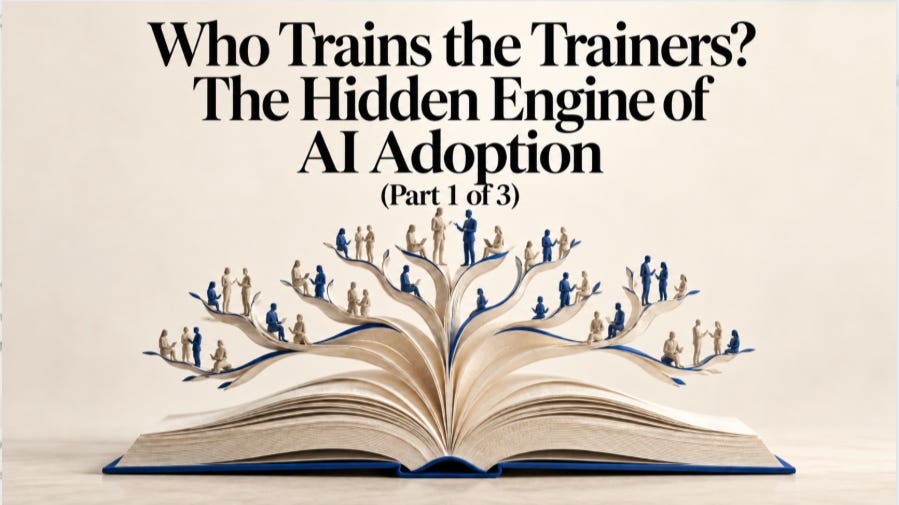
Training the AI Trainers Series, Part 1 of 3
Almost every organization I talk to tells me the same story. The licenses are bought, the artificial intelligence (AI) assistant is rolled out, the announcement email goes out, and then adoption stalls. Some people try the tool a few times, get a mediocre answer, and quietly go back to the old way of working. Others go in the opposite direction and paste sensitive information into whatever tool is closest.
The missing piece is rarely the technology. It is the people who teach everyone else how to use it well, safely and every day. Those people are your AI trainers, and who trains them may be the most underrated decision in your entire AI strategy.
In this article, you will learn:
Why the AI training gap is getting wider even as AI usage grows
Why a train-the-trainer model is the fastest way to close that gap
Who makes a great AI trainer, and who does not
The five roles every AI trainer must play
The five most common mistakes organizations make when they build their trainer bench
This is Part 1 of a three-part series.
Part 2 covers what your trainers must know and how they must teach.
Part 3 covers how to deploy, support and measure them.
The ideas apply to any organization in any sector:technology, healthcare, manufacturing, retail, education, government, professional services, and banking and financial services.
The AI Training Gap Is Getting Wider, Not Smaller
Here is what recent research is telling us:
Usage is up, training is down: PwC's 2026 Global Workforce Hopes and Fears Survey of more than 49,000 workers in 48 countries and territories found that 64% of workers used AI at work over the past year, while only 51% said they had adequate access to training, down from 59% in the previous survey.
Fewer workers feel equipped: A poll by the nonprofit Jobs for the Future (JFF) found that 36% of more than 3,000 respondents said they have the training and resources they need to use AI in their jobs, compared with 45% in 2024.
Many have had no training at all: The State of AI Jobs and Skills Report 2026 found that 35% of employees have received no AI training of any kind.
Most training does not produce independence: In that same report, only 18% of the employees who did receive training said it prepared them to work with AI independently.
Fluency is rare: An Indeed and YouGov survey found that only 32% of workers said they had received proper AI training from their employer, and just 19% of job seekers felt fluent in AI.
Read the fourth point again. Even when organizations do train, most of that training does not produce people who can work on their own. That is rarely a content problem.
It is a delivery problem:generic sessions, too many slides, too little practice, and no follow-up. Delivery is the trainer's job.
There is also a regulatory angle: In the European Union (EU), Article 4 of the EU Artificial Intelligence Act (EU AI Act) has applied since February 2, 2025. It asks organizations that provide or deploy AI systems to take measures to support a sufficient level of AI literacy among their staff, tailored to their knowledge, experience and the context in which the AI is used. Regulators and auditors in banking, insurance, healthcare and the public sector are asking similar questions: who taught your people to use this, and how do you know they learned it?
Tools do not create adoption. Teachers do.
Why Train-the-Trainer Is the Multiplier
A small central team of AI experts cannot personally teach tens of thousands of employees. Even if it could, it would end up teaching generic material that does not match anyone's actual job.
The train-the-trainer (TTT) model solves this. A small expert core prepares a cohort of internal trainers, and those trainers then teach their colleagues in their own business units, in their own language, using their own workflows.
Here is why it works:
Scale: The math is simple. Consulting firm Talan describes a program in which more than 60 AI champions were trained through a train-the-trainer model, which then resulted in 850 employees trained. In another example, KPMG in the Netherlands worked with lighting company Signify to train and support 158 AI Champions who applied AI to real challenges from their daily work.
Relevance: A trainer who works in accounts payable, nursing administration, claims, logistics, marketing or trade operations already knows the real tasks, the real data and the real pain points. Their examples land because they are real.
Trust: People learn best from peers they trust. When a respected colleague shows how AI saves them an hour a day, fear goes down and curiosity goes up.
Feedback: Trainers are your sensors. They hear first where the tools fail, where the policy is confusing and where the next valuable use case is hiding.
Sustainability: The knowledge stays inside the organization after the vendor demo is over and the consultants have gone home.
One expert reaches a room. One hundred trained trainers reach a company.
Who Makes a Great AI Trainer
The best AI trainer is not always the most technical person in the room. Look for these qualities:
Credibility: A respected practitioner in their business area whom colleagues already go to for help.
Hands-on curiosity: Someone who already uses AI tools regularly and enjoys experimenting.
Clear communication: Can explain a concept without jargon and is patient with beginners.
Sound judgment: Knows when not to use AI, respects data rules, and verifies outputs before trusting them.
Learning mindset: Comfortable saying "I don't know yet, let's find out together," because AI tools change every few months.
Real capacity: Has a manager who will protect time in their week for training and coaching.
Watch out for these red flags:
The enthusiast who believes AI is always right
The skeptic who was assigned the role against their will
The deep expert who cannot simplify
The willing volunteer who has no time at all
A simple selection process looks like this:
Nominate: Ask managers to nominate candidates and allow people to self-nominate.
Screen: Give candidates a short practical exercise. For example, use an approved AI tool to complete a real task from their job, then explain what they did to a non-expert in five minutes.
Balance: Make sure your cohort covers different functions, locations, seniority levels, languages and perspectives.
Commit: Agree in writing with each trainer and their manager on time, expectations and recognition.
Choose trainers for credibility and judgment first. Technical skills can be taught. Trust cannot.
The Five Roles Every AI Trainer Plays
An AI trainer does much more than deliver a class. Prepare them for five roles:
Teacher: Delivers structured sessions and hands-on labs.
Coach: Supports individuals after the session through office hours, desk-side help and quick answers.
Translator: Turns enterprise AI strategy and policy into everyday language that makes sense for their team.
Guardian: Models responsible use, reminds colleagues about data handling, verification and human review, and knows when to escalate.
Scout: Spots new use cases and captures friction, then feeds both back to the central AI team.
An AI trainer is not a presenter. They are a teacher, coach, translator, guardian and scout rolled into one.
Five Mistakes to Avoid
Treating it as a one-time event: A single webinar does not create a trainer. AI tools change constantly, so trainers need ongoing refreshers.
Training on features instead of work: Trainers who only know where the buttons are cannot help someone redesign a real task. Train on workflows, not menus.
Skipping responsible AI: If trainers cannot explain data classification, verification and acceptable use, they will spread risky habits at scale.
Deploying trainers without certifying them: Every trainer should prove they can teach before they stand in front of a room. A short teach-back assessment is enough to start.
Making it an invisible side job: If trainers get no time, recognition or career credit, your best people will quietly drop out.
The quickest way to kill an AI trainer program is to make it a side job nobody notices.
Key Takeaways
AI usage is growing faster than AI training, and most training today does not produce independent users.
The train-the-trainer model gives you scale, relevance, trust, feedback and sustainability.
Select trainers for credibility, judgment and capacity before technical skill.
Prepare trainers for five roles: teacher, coach, translator, guardian and scout.
Avoid one-time events, feature-only training, missing guardrails, uncertified trainers and invisible roles.
In Part 2, we will step inside the AI Trainer Academy:what your trainers must know, how they must teach, and how to certify them before they go live.
Your AI strategy will travel only as far as your trainers can carry it.
What about your organization? Do you have a formal AI trainer or champion program, or are people mostly teaching themselves? I would love to hear what is working for you in the comments.
Explore more: Start Here · Topics · Archive · About