


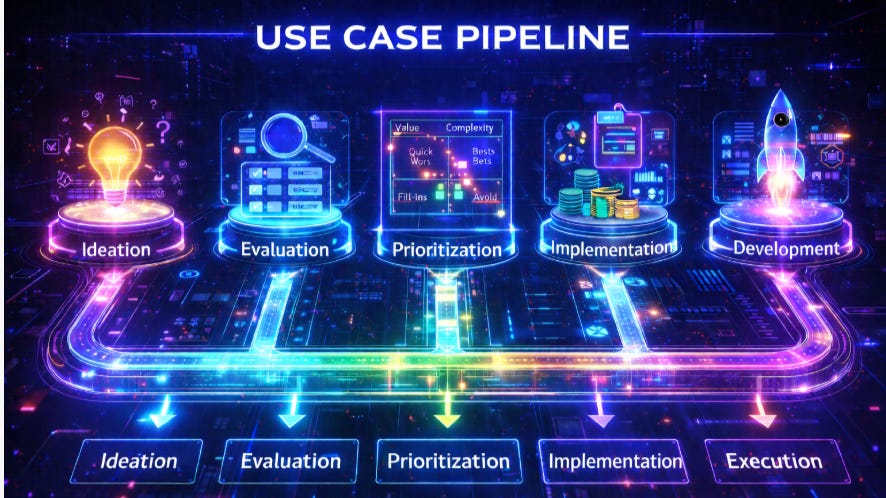
Once a set of AI candidate use cases has been identified, the critical challenge is prioritization. Every organization has more AI opportunities than it has capacity to pursue. Structured prioritization frameworks and methodologies provide the discipline to make defensible, transparent choices that leadership can understand and support.
AI is an amplifier. It scales good decisions into breakthroughs and bad decisions into disasters.
Below are four robust methodologies for prioritizing AI use cases.
Method 1: The ICE Score
The ICE Score is one of the most elegant prioritization tools available. It is simple, fast to apply, and transparent enough to share with executive stakeholders without requiring extensive explanation.
Formula: ICE = (Impact × Confidence) ÷ Effort
Impactestimates the business value the use case will create, including cost reduction, risk improvement, time saved, quality gains, or enhanced customer experience.
Confidencereflects the certainty of that impact, based on data readiness, subject matter expert validation, alignment with proven approaches, and early proof-of-concept signals.
Effort captures the total cost of delivery, including time, budget, integration complexity, governance work, and cross-team coordination requirements.
Interpreting ICE Scores
A Practical Example
An AI assistant for financial exposure commentary might score 8 on Impact, 7 on Confidence, and 5 on Effort. The resulting ICE Score of 11.2 marksit as a strong candidate worth advancing to full business case development. The ICE Score is not perfect, but it serves as an effective first-pass filter for a large pipeline of opportunities.
ICE Score Calculation for This Example:
Impact = 8
Confidence = 7
Effort = 5
ICE Score = (8 × 7) ÷ 5 = 11.2
Method 2: The RICE Score
The RICE Score extends the ICE model by adding a Reach dimension, making it well-suited for enterprise-scale decisions where the number of people, processes, or cases affected significantly changes the strategic calculus.
The formula is: RICE Score = (Reach × Impact × Confidence) ÷ Effort.
A high-impact use case that affects only three analysts scores very differently from an equally impactful use case that touches every client-facing operation across an enterprise.RICE helps teams avoid the trap of over-investing in locally impressive but strategically narrow initiatives.
Interpreting RICE Scores
Example
Reach= 1,000 users
Impact= 8
Confidence= 7
Effort= 5
RICE Score = (1000 × 8 × 7) ÷ 5 = 11,200
High scores typically come from large-scale enterprise impact.
Method 3: The Value vs. Complexity Grid
The Value vs. Complexity Grid maps every candidate use case onto two dimensions: the value it delivers, and the complexity required to execute it. This framework does not produce a numeric score.
Instead, it produces four strategic categories that guide sequencing decisions:
High Value, Low Complexity (Quick Wins):These are the natural starting point. Fast return on investment, low organizational resistance, and strong momentum-building for a broader transformation program. These use cases earn credibility that funds the next phase.
High Value, High Complexity (Strategic Bets):The are worth pursuing but require deliberate planning, governance design, and careful sequencing. They often flagship initiatives of a mature AI program and benefit from being preceded by quick wins that build organizational confidence.
Low Value, Low Complexity (Fill-Ins):These are only worth considering when all higher-priority work is covered and resources are genuinely available. Do not let these crowd out strategic priorities.
Low Value, High Complexity (Avoid or Deprioritize): These are high effort, low return use cases. Avoid unless tied to a regulatory mandate or a critical risk control the organization cannot defer.
Method 4: The Risk vs. Reward Lens
The Risk vs. Reward Lens is particularly important in regulated industries.It evaluates each use case not only for its upside potential but also for its downside exposure.
Reward dimensions include value created, efficiency gains, cost savings, competitive advantage, and customer or employee impact.
Risk dimensions include operational and model risk, compliance and regulatory exposure, technology uncertainty, change management complexity, and reputational or security concerns.
This lens connects AI prioritization directly to enterprise risk appetite. A use case with extraordinary return on investment potential that exceeds the organization's regulatory risk tolerance is not a strategic opportunity. It is a liability. The strategist who applies this lens consistently builds an AI program that survives regulatory examination and earns sustained executive trust.
Building a Credible Business Case
Every AI initiative that competes for enterprise funding needs a business case. But a credible AI business case is not a cost-savings spreadsheet.It is a comprehensive argument that addresses value, feasibility, risk, governance, architecture, resources, and outcomes in a single integrated narrative that can withstand scrutiny from finance, risk, and executive leadership simultaneously.
The nine components of a complete AI business case are:
Problem Statement. A clear, unambiguous description of the business pain being addressed. Vague problem statements produce vague solutions and generate skepticism from approvers.
Opportunity Description. A specific account of how AI improves the identified process or workflow, including the mechanism of value creation.
Expected Value. Both quantified metrics and qualitative benefits. Quantified value earns financial approval. Qualitative value earns organizational commitment. You need both.
Feasibility Analysis. An honest assessment of data readiness, workflow fit, and the technical implementation path. Overly optimistic feasibility assumptions are a common cause of delayed or failed AI projects.
Risk and Governance Assessment. Identification of model risk, compliance requirements, control design, and documentation obligations. In financial services, this section must explicitly address regulatory and compliance obligations.
Architecture Pathway. How the AI solution integrates with existing systems, data infrastructure, and enterprise platforms. Standalone AI tools that cannot connect to enterprise systems rarely scale.
Resource and Cost Estimate. Realistic investment requirements including people, technology, governance overhead, and ongoing model maintenance. Underestimating the total cost of ownership is a common issue in AI business cases.
Success Metrics. The specific KPIs that will be tracked to measure AI performance over time. Without predefined success criteria, there is no basis for continued funding or disciplined program management.
Timeline and Roadmap. A sequenced implementation plan with defined milestones, decision gates, and dependency mapping.
If you can answer all nine components with precision and evidence, you have a business case that can withstand executive scrutiny, financial review, and risk governance oversight. Organizations that skip elements of this structure are not moving faster. They are building technical and governance debt into the foundations of their AI programs.
The KPIs That Define AI Success
Strategists define success before deployment begins, not after deployment ends.
The most important AI KPIs fall into four categories, each corresponding to a different dimension of enterprise value:
Efficiency Outcomes. Cycle time reduction, manual effort reduction, cases handled per analyst, and throughput improvement. These are the most readily quantifiable and often the most persuasive for initial business case approval.
Financial Outcomes. Cost savings, productivity uplift, cost avoidance, and operational leverage. These translate AI performance into the financial language that CFOs and budget committees require.
Risk and Quality Outcomes. Error reduction, reduction in false positives and false negatives, decision consistency, and compliance adherence. In regulated industries, these outcomes often carry more weight than financial metrics.
Customer and Strategic Outcomes. Faster response times, higher customer satisfaction, better personalization, improved workforce enablement, and enhanced competitive differentiation. These measure the longer-term strategic value that sustains AI investment over multiple cycles.
The discipline of defining these metrics upfront is whatseparates well-managed AI programs from those that merely operate.Measurement creates accountability, and accountability creates the organizational discipline that enables scale.
Escaping Pilot Purgatory
Pilot purgatory is one of the most common and least discussed failure modes in enterprise AI.
Signs of Pilot Purgatory:
The organization maintains an impressive portfolio of AI experiments, none of which have ever reached production
Leadership grows increasingly skeptical
Budgets shrink
Talented practitioners leave
Stakeholders lose interest
No enterprise governance or platform infrastructure exists
Strategists prevent this outcome by designing for scale from the very beginning:
They apply one of the structured prioritization techniques introduced earlier (ICE, RICE, Value-Complexity, The Risk vs. Reward Lens) to determine which initiatives should move forward.
They secure senior leadership sponsorship and stakeholder alignment before initiatives begin.
They select use cases that are data-ready and workflow-tested before committing to implementation. They do not begin a pilot on the assumption that data quality issues will be resolved during the project.
They engage risk and compliance early, not as a checkpoint at the end of the project but as active partners throughout the design and development process. Early risk engagement prevents late-stage failures.
They use 90-day implementation cycles with defined deliverables and measurable milestones. Short cycles create accountability and maintain organizational momentum.
They align to enterprise platforms and architecture from the start rather than building bespoke environments that cannot connect to production systems.
They establish cross-functional ownership so that no single team can abandon a use case without organizational consequence. Shared accountability is what separates projects from programs.
They define success criteria before the pilot begins, not after it ends. Success criteria defined retroactively are not success criteria. They are rationalizations.
Strategic Red Flags: Knowing When Not to Use AI
Strategic clarity means knowing when to say no to an AI use case as clearly as when to say yes. Not every process is an appropriate AI candidate, and pursuing the wrong ones creates costs, governance failures, and organizational skepticism that damages the entire AI program for years.
The following conditions indicate that a workflow is not ready for AI deployment and should be deferred until the underlying conditions change:
Highly volatile or frequently changing workflows where model performance will rapidly decay and require constant retraining
Processes with inconsistent, incomplete, or low-qualityinput data that cannot be remediated before deployment begins
Tasks that genuinely require niche human judgmentand contextual wisdom that cannot be codified or approximated by current AI capabilities
Low-volume workflows where the investment in AI infrastructure, governance, and ongoing maintenance exceeds any realistic return
Areas with unresolved regulatory uncertainty where AI deployment could create compliance exposure before guidance is clear
Processes with upstream issues that have not been resolved and that AI will amplify rather than solve
Workflow redesign projects that are still in fluxand not yet stable enough to establish reliable training baselines
AI amplifies what it finds. If it finds stable, well-defined, high-volume workflows with quality data and clear governance, it creates extraordinary value. If it finds instability, inconsistency, and poor data, it creates risk at scale. The strategist who can make this distinction clearly and confidently before committing organizational resources is operating at the level the enterprise genuinely needs.
Practical Exercise: Building Your AI Use Case Pipeline
Strategic AI development is ultimately a practice, not a theory.The most effective way to develop strategic alignment skills is through structured application: taking a real business function and systematically building a prioritized AI use case pipeline.
The exercise follows five steps that can be completed in a structured working session or as a facilitated workshop with key business and technology stakeholders:
Step 1: Select a business function such as Finance, Risk, Treasury, Operations, Compliance, Fraud, HR, or PMO. Choose a function where you have genuine access to process knowledge and stakeholder relationships.
Step 2: List five to seven core workflows within that function, mapped to their business purpose and current performance levels. Document who performs them, how often, and what the current cycle time and error rate look like.
Step 3: Flag pain points by identifying where friction, error, delay, or inconsistency is most acute. These signal the areas with the greatest leverage potential.
Step 4: Identify AI leverage points by locating the specific workflow steps where AI intervention would produce the greatest improvement relative to the function's strategic KPIs.
Step 5: Score each use case using the ICE Score, RICE Score, or the Value vs. Complexity Grid, and select the top one or two use cases for full business case development.
Strategists who repeat this exercise systematically across every business function build something powerful and difficult to replicate: a prioritized enterprise AI portfoliowith a clear strategic narrative, early success opportunities mapped across functions, and a sequenced roadmap for scale. This portfolio is the core deliverable of an AI Strategist, and it is what transforms organizational AI ambition into disciplined, defensible, and sustained execution.
Conclusion: The Discipline That Separates Pilots from Programs
The gap between AI experimentation and AI transformation is not a technology gap. It is a strategy gap.Organizations that bridge it do so by developing the discipline to align AI initiatives to enterprise priorities, apply rigorous use case evaluation, build credible business cases, govern their deployments from the outset, and measure what matters with precision.
The frameworks explored in this article are operational tools for the AI strategist who must make high-stakes choices about where to invest, what to build, and how to defend those decisions to executives, regulators, and boards. They are the product of hard-won experience in environments where failure is not merely a learning opportunity but a regulatory and reputational event.
AI success does not begin with the model. It begins with the question: Is this the right problem, at the right time, for the right reason, with the right governance?
That question, answered with rigor and strategic clarity, is how durable AI programs are built and how AI leaders earn the sustained confidence of the organizations they serve.
Strategic alignment is not a phase in AI implementation. It is the continuous discipline that keeps AI programs relevant, funded, and defensible across every organizational cycle.
Explore more: Start Here · Topics · Archive · About