


From Intuition to Discipline: How Strategic Alignment Turns AI Ambition into Enterprise Value
We are living through one of the most profound technological shifts in modern history.
But history will not remember which companies experimented with AI first. It will remember which leaders understood where intelligence truly belonged inside their organizations.
Every major organization now faces the same fundamental question about artificial intelligence: not whether to deploy it, but where, when, and how to deploy it. The executives and boards who ask the right version of that question are the ones building durable AI programs. Those who ask the wrong version are building pilots that will never see production.
The right question is not simply whether AI can help. It almost always can. The right question is: where does AI create the most value, with acceptable risk, in direct alignment with our most important organizational priorities? That question belongs not to technologists alone but to AI strategists operating at the intersection of business, risk, and transformation.
This article draws on a comprehensive framework for AI alignment and strategic use-case identification. It is written for AI strategists, enterprise transformation leaders, digital program managers, and anyone responsible for turning AI potential into measurable organizational outcomes. It is grounded in the regulatory realities of financial services, where alignment to enterprise strategy is not a best practice but a governance requirement.
Why Strategic Alignment Is the Deciding Factor
Decades of technology implementation research point to a consistent finding: misalignment between technology initiatives and organizational strategy is the primary cause of failure. For AI, this dynamic is amplified. The speed of AI development, the breadth of potential applications, and the increasing scrutiny from regulators mean that the organizations that succeed with AI are the ones that anchor every initiative to a clear and defensible strategic rationale.
Misalignment takes many forms. Some organizations pursue AI because a competitor announced a pilot. Others chase use cases driven by vendor demonstrations rather than genuine business pain. Still others launch technology-first experiments in isolation from risk, compliance, or enterprise architecture. These patterns share a common outcome: wasted investment, abandoned projects, and growing skepticism from leadership.
Alignment is the single most importantfactor determining whether an AI program scales. A well-aligned use case is easier to fund, easier to govern, easier to defend to regulators, and far more likely to survive organizational change. The strategic AI practitioner understands this not as an abstract principle but as a daily operating discipline.
The Six Pillars of Enterprise Strategic Alignment
Every major enterprise operates through a set of core strategic pillars. These pillars represent what executive leadership, boards, and regulators care about most. AI initiatives that connect to these pillars attract funding, executive sponsorship, and organizational commitment. Those that do not are perpetually at risk of being cut.
The six pillars most relevant to AI strategy in large enterprises are:
1. Efficiency and Productivity
AI is uniquely positioned to eliminate friction, automate cognitive tasks, and free people for higher-value work. Reducing manual effort, minimizing repetitive tasks, accelerating processing times, and improving resource utilization all fall within this pillar.
2. Risk Reduction and Control Enhancement
Agentic and generative systems amplify both strengths and vulnerabilities, which means alignment with risk appetite is non-negotiable. Lower error rates, improved consistency, stronger auditability, and enhanced compliance adherence are the outcomes this pillar demands.
3. Customer and Client Experience
Banks, insurers, and service organizations benefit significantly when AI reduces cycle time and increases clarity. Faster response times, personalized support, and greater consistency across channels are the measures that matter here.
4. Growth and Innovation
AI is no longer a nice-to-have innovation. It is a competitive differentiator. Launching AI-enabled products, modernizing legacy services, and creating new revenue streams all connect to this pillar.
5. Workforce Enablement
AI amplifies human capability when introduced thoughtfully. Upskilling staff, providing better tools, improving decision quality, and reducing burnout are the outcomes this pillar pursues.
6. Regulatory and Compliance Adherence
This is especially critical in finance, healthcare, legal, and government sectors. Faster documentation, better monitoring, enhanced reporting, and clearer audit trails are the specific outcomes AI must deliver to satisfy this pillar.
Each of these pillars has its own measurement framework. Efficiency initiatives are measured in cycle time, throughput, and cost avoidance. Risk initiatives are measured in error rates, consistency scores, and audit outcomes. Regulatory initiatives are measured against compliance gap metrics and documentation quality. A strategist who cannot speak the measurement language of each pillar is not yet operating at the strategic level.
Thinking in Value Chains
One of the most powerful conceptual tools available to an AI strategist is the value chain. Rather than examining isolated tasks or individual workflows, thinking in value chains means asking: what business goal does this process ultimately serve, and how does AI intervention at this specific point create value upstream or downstream?
Before identifying an AI use case, strategists must understand three core elements:
The purpose of the business function and its contribution to enterprise goals
The KPIs that measure the function's performance and the drivers behind them
The points in the process flow where AI can improve or transform outcomes with maximum leverage
This value-chain lens prevents the most common strategic error in AI: solving a local problem while missing the systemic opportunity. An AI that speeds up one workflow step may have limited strategic value if that step is not the actual constraint in the larger process. The strategist who maps the full value chain identifies points of maximum leverage, not just points of obvious friction.
The Alignment Pyramid: Three Levels of Strategic Connection
Level 1: Enterprise Strategy
At the top level, the strategist asks what the organization is trying to achieve. This means understanding the priorities of the CEO, CFO, COO, and Chief Data and Analytics Officer. It means knowing where the biggest cost centers are, where regulatory pressure is highest, and where competitive differentiation is most urgent. AI deployed at this level earns executive support because it directly enables the organization's most visible and publicly accountable commitments.
Key questions at this level include:What are our enterprise objectives for the year? Where are we losing ground to competitors? What has the board identified as a top-tier risk? AI should enable these goals directly, not sit adjacent to them.
Level 2: Functional Strategy
Each department operates with its own version of enterprise strategy. Finance prioritizes accuracy, speed, and compliance. Risk prioritizes transparency, explainability, and consistency. The Operations department wants workload reduction and SLA improvement. The Treasury department wants forecasting accuracy and liquidity insight. The HR department wants efficiency in hiring, onboarding, and learning.
AI use cases must map to functional KPIs at this level. A use case with no measurable impact on a function's scorecard will not sustain sponsorship, regardless of how technically impressive it may be. Connecting AI to the language of functional performance is how strategists earn and maintain organizational commitment.
Level 3: Process and Workflow Strategy
At the ground level, alignment requires understanding the mechanics of work itself. Which workflows matter most? Who performs them? How often? Which steps are painful, error-prone, or slow? Where does work get stuck, escalated, or rerouted unnecessarily?
This level of analysis reveals where AI can meaningfully improve flow, quality, or cost. It also reveals where AI will encounter resistance, data gaps, or integration complexity that will slow or block implementation.
The Seven Questions Every AI Strategist Must Ask
One of the most important functions a strategist performs is filtering.When someone proposes that the organization should use AI for a particular application, the strategist's job is to evaluate that proposal systematically and quickly. The following seven questions form the core of that evaluation:
1. Which enterprise objective does this support?
If the answer is vague or aspirational, the use case lacks strategic grounding. Weak answers signal that the idea is solution-first rather than problem-first.
2. What KPI will this improve?
If no metric changes, no value is created. A use case that cannot be connected to a measurable outcome is cosmetic, not strategic.
3. What problem is this solving?
AI should not be a solution in search of a problem. Clarity here is non-negotiable and separates genuine opportunities from hype-driven experiments.
4. Who owns this problem?
Alignment requires clear business ownership. AI projects with no sponsors die in governance reviews, and they should. Without an accountable business owner, there is no one to defend the initiative when scrutiny arrives.
5. What is the before and after story?
Executives need clarity on what changes, who benefits, and how large the improvement is. The strategist who cannot articulate this story concisely is not yet ready to seek funding.
6. What are the risks if we automate this poorly?
Alignment includes risk appetite. Every strategic use case must account for downside scenarios, especially in regulated industries where AI failures carry regulatory consequences.
7. What would happen if we did nothing?
If the honest answer is that nothing meaningful would change, the use case is not strategic. It may be interesting. It is not a priority.
These questions are not bureaucratic gatekeeping; they are essential evaluation criteria. They are the foundation of a credible business case and the language of executive sponsorship. A strategist who can answer all seven with precision and evidence has a use case worth investing in.
Five Misalignment Patterns That Kill AI Programs
Strategic misalignment does not always announce itself dramatically. It accumulates through recognizable patterns that, once understood, are far easier to prevent. The five most common are:
1. Cool-Tech Explorations
Excitement about AI tools with no strategic anchor. The technology becomes its own justification rather than a means to a business end. These initiatives consume resources and produce demonstrations, not outcomes.
2. Shadow AI Projects
Teams launch AI pilots without leadership, technology, or risk alignment. These create technical debt, governance gaps, and reputational risk. In financial services, they also create compliance exposure that cannot be easily remediated after the fact.
3. Siloed Innovation
Different business units build disconnected AI workflows independently. The result is redundancy, inconsistency, and enterprise-scale governance chaos. When every department has its own AI stack and its own standards, there are effectively no standards.
4. Proof-of-Concept Addiction
Projects never scale because they were never designed for production. A perpetual pilot state is not an AI program. It is expensive theater that erodes executive confidence and wastes the organization's best AI talent.
5. Hype-Driven Prioritization
Choosing use cases based on what is trending in the market rather than what delivers value for the specific organization. This is how AI budgets get wasted and how AI leaders lose credibility with finance and risk leadership.
In financial services, these patterns carry regulatory consequences well beyond wasted investment. SR 11-7 in the USA and its global equivalent frameworks require that model risk be managed systematically. AI systems deployed through shadow projects or siloed innovation are not governed, not documented, and not defensible under supervisory examination. Preventing misalignment is simultaneously a strategic and compliance imperative.
Eight Characteristics of a High-Value AI Use Case
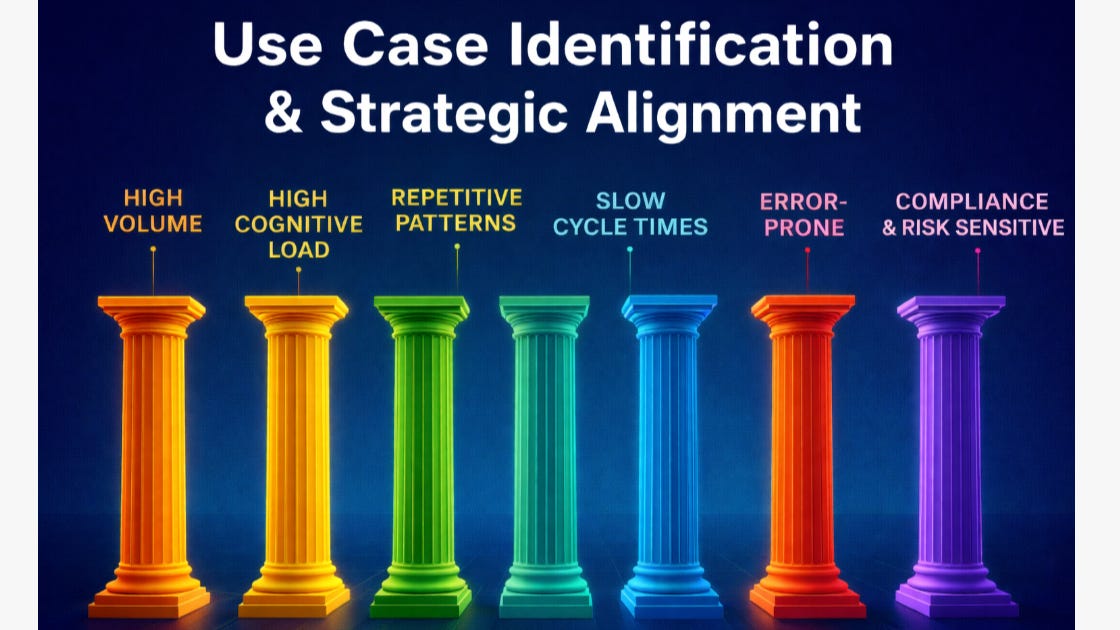
Not every business process is a strong AI candidate. The most promising use cases share a recognizable profile. If a workflow exhibits four or more of the following characteristics, it warrants serious strategic evaluation:
1. High Volume
The more transactions, cases, or interactions a process handles, the greater the potential return on AI investment. Volume is the multiplier that turns incremental AI improvements into significant business outcomes.
2. High Cognitive Load
Tasks requiring intelligence, reasoning, or judgment are precisely where AI creates the most leverage. If the work demands sustained mental effort from skilled people, AI can absorb a meaningful portion of that load.
3. Repetitive Patterns
If skilled professionals repeat the same logic, analysis, or decision structure every day, AI can learn and accelerate that pattern, freeing those professionals for work that genuinely requires human judgment.
4. Document or Knowledge Intensity
AI excels at understanding, summarizing, extracting, and synthesizing information from large document sets. Any workflow that depends heavily on PDFs, reports, contracts, or email threads is a strong candidate for AI augmentation.
5. Slow Cycle Times
Delays and bottlenecks indicate structural opportunities for AI-driven acceleration. Long cycle times often signal processes that are constrained by human review bandwidth, not by complexity.
6. Error-Prone Processes
When human inconsistency is a known risk, AI can improve standardization, provided it is trained and governed responsibly. Consistency at scale is one of AI's most distinctive and reliable capabilities.
7. Cross-Functional Dependence
Workflows that require coordination across multiple teams benefit from AI that standardizes handoffs, reduces rework, and maintains consistency across organizational boundaries.
8. Compliance and Risk Sensitivity
When designed correctly, AI increases auditability, consistency, and traceability in regulated workflows. Processes that generate audit trails and compliance documentation are often well-suited to AI-assisted execution.
This profile is a starting filter rather than a final verdict.Use it to quickly separate high-potential workflows from marginal ones before investing time in deeper analysis or business case development.
A Strategic Taxonomy of AI Use Cases
AI strategists classify opportunities across a spectrum of ambition, complexity, and governance requirement. Understanding this taxonomy helps teams sequence their portfolios intelligently, building institutional capability and organizational confidence before advancing to more demanding deployments.
1. Augmentation Use Cases
AI helps humans work better, faster, or smarter without replacing their judgment. Examples include response drafting, document summarization, research assistance, and knowledge search. These typically offer high impact with minimal risk and are often ideal starting points for organizations new to production AI.
2. Automation Use Cases
AI handles repetitive or rule-based tasks independently. Examples include data extraction, basic reconciliation, document classification & tagging, and form processing. These are productivity multipliers with strong and demonstrable return on investment.
3. Decision Support Use Cases
AI provides analysis and structured insights while humans retain final authority. Examples include risk scoring, pattern detection, recommendation engines, and scenario evaluation. These carry high value in Finance, Risk, Compliance, and Operations, and they are where many organizations spend the majority of their AI investment at maturity.
4. Autonomous Agentic Use Cases
Agents independently complete multi-step tasks end to end, often without human intervention at each step. Examples include end-to-end investigations, complex triage, automated quality assurance loops, and self-improving analytical pipelines. These represent the future of enterprise AI and carry extraordinary potential, but they require rigorous governance design from the outset.
Most mature AI programs begin with augmentation and automation, build institutional confidence and governance infrastructure, then gradually advance toward decision support and agentic workflows as trust and capability develop. Organizations that attempt to begin with autonomous agentic AI in regulated industries almost always encounter governance failures that set back broader adoption significantly.
Article Recap
In this article, we explored a central reality of enterprise AI adoption: technology alone does not create value. Alignment does.
We examined why many AI initiatives fail.The most common reason is not weak models, poor tools, or insufficient data. It is misalignment between AI initiatives and enterprise priorities.
To address this challenge, we introduced a structured strategic framework for identifying and evaluating AI use cases.
First, we explored the Six Pillars of Enterprise Strategic Alignment: Efficiency & Productivity, Risk Reduction & Control Enhancement, Customer & Client Experience, Growth & Innovation, Workforce Enablement, and Regulatory & Compliance Adherence.
We then examined the importance of thinking in value chains, encouraging strategists to look beyond isolated tasks and instead identify the points in business processes where AI intervention creates the greatest enterprise impact.
To operationalize alignment, we introduced the Alignment Pyramid, which connects AI initiatives across three strategic layers: Enterprise strategy, Functional strategy, and Process & workflow execution.
We also reviewed the Seven Questions every AI strategist must ask when evaluating a potential use case. These questions help separate genuine opportunities from hype-driven experiments by focusing on measurable value, clear ownership, and risk awareness.
Next, we examined the five patterns of misalignment that commonly derail AI programs, including: Cool-tech exploration without strategic anchors, Shadow AI projects, Siloed innovation, Proof-of-concept addiction, and Hype-driven prioritization.
Conclusion
Artificial intelligence does not create strategic value simply by being powerful.
It creates value when it is applied deliberately to the right problems, at the right level of the organization, with the right governance discipline.
The role of the AI strategist is therefore not to chase the most advanced model or the most impressive demo. It is to ensure that every AI initiative is anchored to enterprise priorities, measurable outcomes, and responsible risk management.
Organizations that master this discipline will not only build better AI systems; they will build AI programs that scale, survive leadership changes, withstand regulatory scrutiny, and deliver sustained enterprise impact.
And that ultimately is the difference between AI experimentation and AI strategy.
This article is part of an ongoing thought leadership series exploring the strategy, governance, and risk frameworks that enterprise organizations need to deploy AI at scale, responsibly, and sustainably.

Explore more: Start Here · Topics · Archive · About