


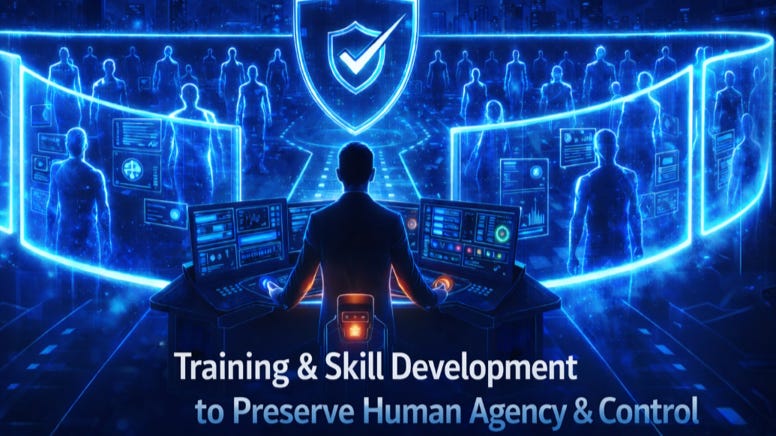
Every serious conversation about Agentic AI eventually arrives at the same question: who is truly in control?
When AI agents can plan, decide, and act across complex workflows with minimal human intervention, the boundaries of control begin to blur. In regulated industries like financial services, blurred boundaries are exactly where risk emerges.
This article focuses on the most overlooked dimension of Agentic AI deployment: the human capability layer.
Specifically, it examines how organizations must invest in training and skill development to ensure that human teams can effectively manage, oversee, and collaborate with autonomous AI systems without surrendering the judgment and accountability that only humans can provide.
Why Human Skill Development Is a Governance Imperative
There is a common assumption that Agentic AI deployment is primarily a technology problem. Deploy the right model, build the right guardrails, and the system will run itself. That assumption is incomplete and potentially misleading.
Agentic AI does not just automate tasks; it redistributes responsibility. As agents take on more complex, multi-step workflows, the humans who remain in the loop must become more capable, not less. The cognitive demands on oversight teams actually increase as AI autonomy expands.
Think of it this way: a pilot flying manually needs skill. A pilot supervising an autopilot needs a different but equally demanding set of skills, knowing when to trust the system, when to intervene, and how to take back control in a crisis. The training requirements are different, but they are just as real.
The same principle applies to human operators of Agentic AI. Training is not a nice-to-have. It is a governance requirement.
The Four Pillars of Human Capability for Agentic AI
Effective human oversight of Agentic AI systems requires building capability across four interconnected dimensions:Technical Literacy, Oversight Skills, Collaboration Skills, and Ethical Reasoning.
1. Technical Literacy
Human operators do not need to be AI engineers. But they do need to understand what an agent can and cannot do, how it makes decisions, and where its architecture creates blind spots.
Technical literacy in the context of Agentic AI means:
Understanding an agent's function and scope boundaries
Recognizing the difference between deterministic rule-based logic and probabilistic model behavior
Knowing how context windows, memory systems, and tool integrations affect agent outputs
Understanding why a model confident in its answer can still be wrong
A useful framing is this: Technical Literacy is not about knowing how the engine works. It is about knowing when the engine sounds wrong.
2. Oversight Skills
Oversight is where governance becomes operational. Human teams need a structured set of skills to monitor agent behavior, assess performance, and intervene decisively when needed.
Core oversight competencies include:
Anomaly Detection: Identifying when an agent's behavior deviates from expected patterns, including subtle drift that may not trigger automated alerts
Performance Assessment: Evaluating whether the agent is actually achieving its intended goals, not just completing tasks
Intervention Protocols: Knowing when and how to pause, redirect, or override an agent mid-workflow
Risk Evaluation: Assessing downstream impact before an agent's action becomes irreversible
A critical and often undertrained competency is distinguishing between an agent that is wrong and an agent that is right for the wrong reasons.Both require intervention. Only the second case is difficult to detect.
The Hidden Risk: Automation Bias
Automation bias is the tendency of human operators to rely excessively on automated systems, accepting their outputs with insufficient scrutiny. Research across aviation, healthcare, and financial services consistently shows that highly capable automated systems can paradoxically reduce the quality of human oversight by lulling operators into passive monitoring.
Training programs for Agentic AI must explicitly address automation bias. This means:
Designing oversight protocols that require active engagement, not passive observation
Rotating human operators through manual task execution to maintain critical instincts
Creating deliberate friction points that require human judgment before high-stakes actions proceed
3. Collaboration Skills
Human-AI collaboration in Agentic AI systems is a genuinely new discipline. It requires skills that most organizations have never formally trained for.
Effective collaboration with AI agents demands:
Prompt Engineering Fluency: The ability to provide clear, contextually rich instructions that guide agent behavior toward intended outcomes
Feedback Interpretation: Reading agent outputs critically, understanding what the AI is signaling, and identifying when its reasoning is flawed
Calibrated Trust: Knowing which tasks to delegate confidently and which to verify closely, based on a realistic assessment of the agent's strengths and failure modes
Adaptive Communication:Adjusting how instructions are framed based on observed agent behavior and operational context
Human-in-the-Loop vs. Human-on-the-Loop
A key design and training distinction is whether humans are in the loop (approving each action before it executes) or on the loop (monitoring with the ability to intervene). Neither model is universally correct. The right design depends on task criticality, reversibility, and regulatory context.
The training implication is significant: human-on-the-loop requires higher vigilance, stronger anomaly detection, and faster decision-making than the human-in-the-loop.
4. Ethical Reasoning
As Agentic AI takes on increasingly complex, consequential tasks, the humans who govern it must be prepared to navigate genuinely difficult ethical terrain. This is not abstract philosophy. It is operational necessity.
Ethical reasoning capabilities include:
Bias Recognition: Identifying when an agent's outputs reflect systemic biases embedded in its training data or design
Societal Impact Assessment: Evaluating the broader consequences of AI-driven decisions, especially at scale
Principled Override:Making the call to override a statistically sound AI recommendation on ethical grounds, while retaining the organizational authority to do so
Accountability Clarity: Understanding who is responsible for an agent's actions and ensuring that accountability is never diffused away by AI involvement
In financial services, the ethical dimension is particularly acute. An AI that optimizes for a quantitative metric can still produce outcomes that violate fair lending standards, treat customers inequitably, or create systemic risk. Training teams to catch these gaps is not optional; it is a regulatory and reputational imperative.
Maintaining Human Agency: Four Structural Mechanisms
Training builds capability. But capability alone is not enough. Organizations must also implement structural mechanisms that preserve human agency as a practical reality, not just a stated principle.
1. Human Veto Authority
The most fundamental mechanism is the practical ability of a human operator to override an AI decision or halt an AI action at any point. In high-stakes domains, this veto power must be:
Technically accessible, with clear and functional override controls in the operational interface
Organizationally legitimate, with explicit authorization for operators to exercise veto authority without bureaucratic escalation
Psychologically safe, so that operators do not hesitate to override AI out of fear of appearing to obstruct progress or distrust a senior-endorsed system
That third point is critically underappreciated. In many organizations, the implicit culture signals that overriding AI reflects low confidence in AI systems or resistance to transformation. That culture must be actively countered. A well-exercised veto is not a failure of AI governance. It is governance working as designed.
2. Skill Preservation Programs
One of the most insidious risks of advanced AI systems is skill atrophy:the gradual erosion of human expertise that occurs when AI systems routinely handle tasks that humans once performed manually.
Skill atrophy is not merely theoretical:
It has been documented in aviation, where pilots in highly automated cockpits showed reduced manual flying proficiency.
It has been observed in radiology, where AI-assisted screening reduced the diagnostic attentiveness of human reviewers.
It is actively unfolding in financial services, where algorithmic decision-making is eroding the analytical instincts of the professionals who now oversee it.
Skill preservation programs must be intentional and structured:
Periodic manual task exercises in which humans perform core functions without AI assistance
Complex case routing that directs the most ambiguous and high-stakes situations to human judgment first
Simulation-based training that creates realistic scenarios requiring unaided human decision-making
Structured reflection practices in which operators review AI outputs critically and record disagreements, even when they ultimately accept the AI recommendation
3. Agency Boundaries
Not every domain should be available to autonomous AI decision-making. Organizations must explicitly define the boundaries of AI agency, identifying the categories of decision or action where human judgment is nondelegable.
These boundaries should be based on:
Risk and reversibility: High-impact, hard-to-reverse decisions require human approval
Ethical sensitivity: Decisions with significant fairness, privacy, or reputational implications warrant human review
Regulatory requirement:In financial services, many categories of decision have explicit human accountability requirements under SR 11-7, GDPR, and related frameworks
Contextual complexity: Situations that require integrating soft information, institutional knowledge, or stakeholder relationships that AI cannot fully represent
Agency boundaries should not be considered static.They should be reviewed as AI systems mature, as regulatory guidance evolves, and as organizations develop greater empirical understanding of where AI judgment is reliable and where it is not.
4. Empowerment Mechanisms
Human control is ultimately only as strong as the information, tools, and authority available to the humans exercising it. Empowerment mechanisms ensure that oversight is not nominal but operational.
Three dimensions of empowerment are critical:
Information Access:Transparent dashboards, real-time audit logs, and explainability tools that allow operators to understand how the AI arrived at its outputs and where uncertainty is highest
Control Tools: Intuitive interfaces for pausing, redirecting, or overriding agent actions, designed for use under pressure and without requiring deep technical knowledge
Organizational Authority: Governance structures that formally empower oversight personnel to exercise control, with clear escalation paths and protection from retaliation for legitimate interventions
Beyond Training Programs: Building a Culture of Continuous Human Development
Training events matter. But sustaining human agency in Agentic AI environments requires something more durable: a continuous learning culture in which human capability is actively developed, measured, and protected as a strategic organizational asset.
This means:
Embedding AI oversight competency into performance frameworks, not just onboarding curricula
Creating communities of practice in which oversight professionals share observations, surface edge cases, and develop collective intelligence about agent behavior
Investing inred teamexercises in which human teams actively try to identify how agents could fail, be manipulated, or produce harmful outputs
Measuring oversight quality, not just AI performance, so that the organization has visibility into the health of its human governance layer
Celebrating effective interventions as organizational wins, reinforcing the value of human judgment alongside AI capability
Red Teaming for Human Oversight
One of the most powerful and underutilized training approaches for Agentic AI governance is red team simulation: structured exercises in which human teams deliberately probe agent systems for failure modes, manipulation vulnerabilities, and edge case behavior.
Red teaming builds several critical capabilities simultaneously:
Deepens understanding of how agents behave under pressure and adversarial conditions
Develops the anomaly detection instincts that are essential for effective oversight
Creates shared organizational knowledge about where agent systems are most likely to fail
Builds the psychological confidence required for humans to challenge and override AI outputs
In financial services, red team exercises aligned with model risk management frameworks represent a natural integration point between Agentic AI governance and existing SR 11-7 validation practices.
The Governance-Velocity Paradox: Why Human Investment Cannot Be Deferred
There is a common tension in enterprise AI adoption between the speed of AI deployment and the pace of governance maturity.Leadership teams want to capture the competitive advantage of Agentic AI quickly. Governance and oversight infrastructure inevitably takes longer to build.
The temptation is to deploy first and govern later. That temptation should be resisted.
In Agentic AI systems, the gap between AI capability and human governance capacity is not a temporary inconvenience. It is an active and accumulating risk exposure.
Every day that AI agents operate with more autonomy than the human oversight layer can effectively govern is a day that consequential mistakes may go undetected, accountability may remain unclear, and regulatory exposure may accumulate.
The investment in human training and skill development is not a cost of AI deployment. It is a precondition for responsible AI deployment.
Conclusion: The Human in the Agentic Loop Is a Feature, Not a Bug
As Agentic AI systems grow more capable, there will be increasing pressure to reduce the friction of human oversight: fewer approval steps, broader agent autonomy, less investment in the human capability layer.
Organizations that follow that pressure will discover, often at significant cost, that the human judgment they removed was performing more governance work than they realized.
The organizations that will lead in Agentic AI, sustainably and responsibly, are those that treat human agency not as an obstacle to AI capability but as its essential complement:
They will invest in training as a governance imperative.
They will build oversight cultures that are as sophisticated as their AI systems.
And they will ensure that when it matters most, the humans in the loop are ready, capable, and empowered to act.
Agentic AI is not a replacement for human judgment. It is a multiplier of human judgment, but only when the humans involved have been equipped to lead the partnership.
Continue the Conversation
This article is part of the Agentic AI Guardrails and Governance series. If you found it useful, I would welcome your perspective:
What training investments have you seen work well for human oversight of AI systems?
Where do you see organizations underinvesting in human capability relative to AI capability?
How is your organization thinking about skill preservation as AI autonomy expands?
Explore more: Start Here · Topics · Archive · About