


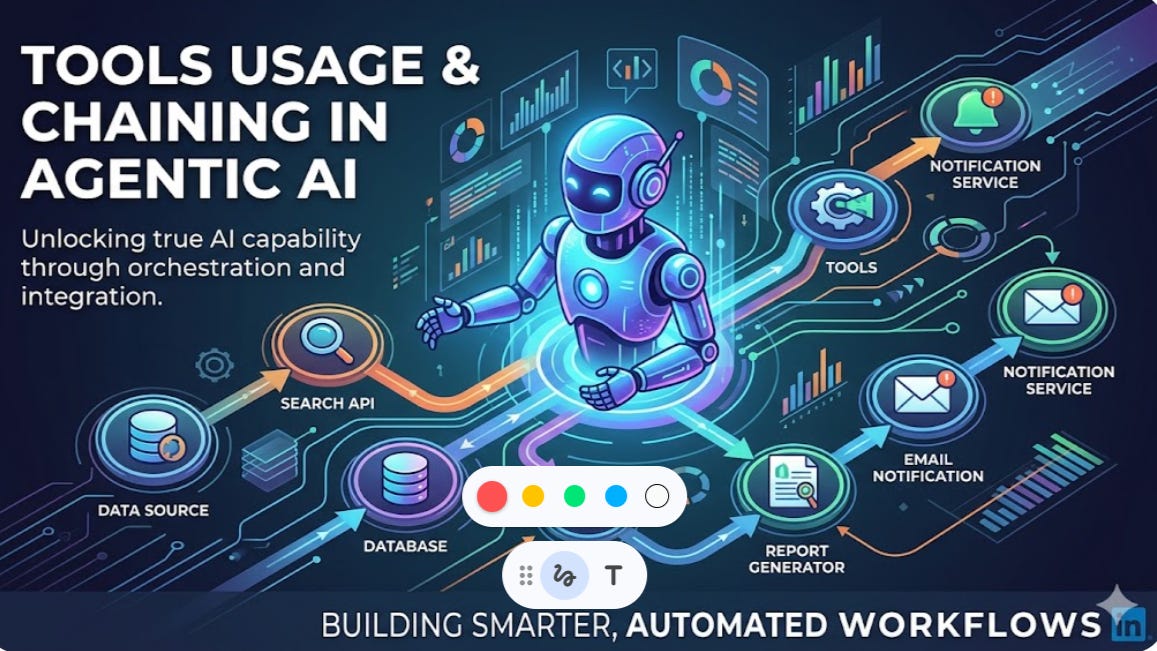
Introduction: The Bridge Between Intelligence and Impact
A compelling analogy sits at the heart of Agentic AI architecture, one I often return to when teaching this subject: if the core large language model (LLM) is the brain, and memory is the mind, then tools are the hands.
This is not merely a metaphor. It is a precise architectural truth.
Without the ability to use tools and invoke external APIs, even the most sophisticated LLM remains confined to text, images, and video. It becomes what I call "a philosopher that talks about solving problems but never actually solves them." It can reason brilliantly about liquidity risk, regulatory compliance, or customer churn. However, it cannot do anything about any of it. Tool use changes that equation entirely. It is the mechanism through which cognitive insight becomes operational impact, and through which thought becomes action.
This article explores the architecture, patterns, risks, and real-world applications of tool use and tool chaining in Agentic AI systems. Whether you are an enterprise leader designing AI strategy, a practitioner building agent-based workflows, or a governance professional assessing risk, understanding this layer of the agentic stack is not optional. It is foundational.
What Are Agentic AI Tools?
In the context of agentic AI, a tool is any external function, API, or resource that an AI agent can call upon to perform specific actions or retrieve information that lies beyond its internal reasoning capabilities.
Modern agents can access a wide range of tools:
Search engine APIs(such as Google Search or Brave Search) for retrieving real-time information
Calculator tools for executing precise mathematical operations
Database query toolsfor reading from or writing to structured data sources
Code interpreters (such as Python REPL environments) for executing logic dynamically
Calendar and scheduling APIs for autonomous task management
Financial data APIs for accessing market prices, risk metrics, and trading data
Secure messaging APIs for internal enterprise communication
The conceptual role of tools in agentic systems is equally important to understand. LLMs are powerful reasoning engines, but they are limited in precision and scope. Tools extend their capabilities by enabling external action. Chaining multiple tools together creates workflows that mirror human problem-solving at scale.
Tools enable task specialization, allowing agents to operate more efficiently.
Tool Use in the PRAT Cycle
Understanding where tool use fits within the broader agentic reasoning cycle is critical for AI engineers and governance professionals alike. In the PRAT cycle (Perceive, Reason, Act, Think/Reflect), tool use sits squarely in the Act stage, but its influence extends throughout the cycle.
Consider this example from finance and risk management:
Perceive: "The client's liquidity ratio has dropped by 12%."
Reason: "This may breach a risk threshold and warrants an investigation."
Act: Call an API to fetch historical liquidity trend data.
Reflect: Analyze the retrieved data and determine whether escalation is warranted.
Each API call in this cycle is what can be described as a ‘micro-act of agency'. It is a deliberate, context-driven decision to extend reasoning into action. The agent does not simply acknowledge the liquidity drop. It acts on it, retrieves evidence, and reasons further.
This feedback loop between action and reflection is what distinguishes a truly agentic system from a simple chatbot or query engine.
The Architecture of the Action Engine
For organizations deploying Agentic AI at enterprise scale, understanding the internal architecture of tool use is not a technical curiosity. It is a governance imperative. The Action Engine consists of five integrated layers:
Tool Registry (Discovery): A structured catalog of approved tools, including APIs, functions, scripts, and data connectors. It enables agents to know what tools exist, what they do, and under what conditions they may be used. It functions as the agent’s professional toolkit, curated and governed.
Invocation Engine (Execution): The middleware responsible for securely invoking the selected tool, handling inputs and outputs, and ensuring operational continuity. This mechanism converts the agent’s decision into an actual system call.
Authorization Layer (Control): Defines who can use what. It implements authentication, access policies, and permission scopes to prevent misuse. In regulated industries like financial services, this layer is where SR 11-7 compliance, data access governance, and audit trail requirements are enforced.
Observation Interface (Feedback): Captures tool outputs, converts them into interpretable data, and feeds them back to the LLM for reasoning or reflection. This is how the agent "sees" the results of its actions and updates its reasoning accordingly.
Error and Recovery Logic (Resilience): Detects failed calls, retries when safe, and logs errors. This layer ensures graceful degradation instead of systemic failure, which is essential for enterprise reliability standards.
Together, these five components form the Action Engine. The Tool Registry gives visibility, the Invocation Engine executes, the Authorization Layer ensures compliance, the Observation Interface closes the cognitive loop, and the Error Logic guarantees resilience.
Tool Use as Cognitive Augmentation
One of the most intellectually compelling aspects of tool use in Agentic AI is its parallel with what cognitive scientists call Extended Mind Theory.This theory, developed by philosophers Andy Clark and David Chalmers, proposes that intelligence emerges not only from the brain, but from how the brain interacts with its environment.
Agentic tool use mirrors this precisely when integrated properly:
Tools become procedural memory, encoding repeatable actions that the agent can execute reliably.
APIs become learned behaviors, functions the agent can call as naturally as a human professional might open a spreadsheet.
The environment becomes an extension of cognition, with the agent's "mind" effectively expanding to include every tool in its registry.
This is not merely a marketing metaphor. It is a practical architectural reality that should inform how enterprise leaders design, govern, and scale their agentic systems.
Why Tool Chaining Matters
A single tool call is powerful. But the true potential of Agentic AI is unlocked when agents can intelligently sequence multiple tools in chains to achieve complex, multi-step objectives.
Tool chaining empowers agents in ways that single-tool use simply cannot:
Access real-time information: An agent can query live market data, regulatory updates, or customer records at the moment they are needed.
Perform precise calculations: By delegating arithmetic to a dedicated calculator tool, the agent ensures accuracy that probabilistic generation alone cannot guarantee.
Interact with enterprise systems: Agents can read from databases, write records, trigger workflows, and send notifications, all within a single orchestrated task.
Break down complex problems: Multi-step problems are solved by using the right tool at the right stage, just as a skilled professional would select the appropriate instrument for each phase of their work.
The distinction between an agent that reasons and an agent that reasons and acts is the difference between a consultant who gives advice and one who actually implements the solution.
Core Patterns of Tool Chaining
Practitioners and architects need to understand three foundational patterns of tool chaining, as the choice of pattern directly affects performance, resilience, and governance design.
Sequential Pipeline Chaining
In this pattern, each tool feeds directly into the next. The output of one action becomes the input for the following action.
Consider an assembly line in a manufacturing facility:the frame is assembled, then the engine is installed, then the vehicle is painted, then quality inspection occurs. Each step depends on the previous one.
In agentic terms, the mapping is as follows:
The worker at each station represents the tool being invoked.
The product being assembled represents the data or task being processed.
The conveyor belt represents the orchestration logic connecting the steps.
The supervisor represents the agent controlling the overall process.
Sequential pipelines are highly efficient when tasks naturally depend on each other. However, they are vulnerable to single-point failures. If any tool in the chain breaks, the entire workflow stalls.
Parallel Chaining
In this pattern, multiple tools execute simultaneously, and their results are aggregated or compared afterward.
A restaurant kitchen serves as an effective analogy: multiple chefs work on different components of the same meal at the same time, each specializing in their domain, with the dishes combined at service time.
In enterprise AI, parallel chaining is particularly powerful for tasks like simultaneous fraud signal analysis, where multiple detection models evaluate the same transaction from different angles before a consensus output is produced.
Key resilience advantage:if one parallel branch encounters an issue, the other branches continue executing, and partial results can still be used or escalated appropriately.
Hybrid Chaining
Hybrid chaining combines sequential and parallel patterns within the same workflow.
The analogy here is an airport: passengers must move through a fixed sequence of stages (check-in, then security, then boarding), but within each stage, multiple parallel options exist (multiple security lanes, multiple check-in counters).
A common enterprise example: data collection occurs first (sequential), then parallel fraud analysis runs across multiple models simultaneously, then results are aggregated, and finally a compliance report is generated. The workflow respects necessary dependencies while maximizing throughput where parallelism is safe.
Tool Chaining Mechanisms: How Agents Reason and Act
Understanding how agents implement tool chaining reveals both its sophistication and its risks.
ReAct and Chain-of-Thought Reasoning: Agents use explicit reasoning steps to plan which tool to use before invoking it. This "think before you act" pattern improves accuracy and reduces tool misuse.
Dynamic Tool Selection: Rather than following a fixed script, agents select tools based on current context, making real-time decisions guided by tool registry descriptions.
Parameter Generation: The agent not only selects the correct tool but also constructs the precise inputs required, drawing on its understanding of the current task state.
Error Handling and Retries: Sophisticated agents can detect execution failures, reason about the likely cause, and either retry with modified parameters or switch to an alternative tool.
Intermediate Result Processing: The agent parses the output of one tool to inform its decision about the next. This requires robust observation and feedback loops to function reliably.
Collaborative Tool Use in Multi-Agent Systems
When Agentic AI moves beyond single agents into multi-agent ecosystems, tool use becomes fundamentally collaborative.This is where enterprise-scale orchestration becomes truly powerful and governance requirements become correspondingly more complex.
In multi-agent environments:
Agents may share tools through common API gateways, requiring centralized access control and monitoring.
Executor or Operational Agents may specialize in tool usage, handling the mechanics of API calls while other agents focus on reasoning.
Supervisor or Meta-Agents coordinate tool outcomes, aggregating results from multiple agents into coherent decisions.
A concrete example from a Finance and Risk context illustrates the architecture clearly:
A Research Agent retrieves market and counterparty data using a Search API.
An Analyst Agent interprets and models the data using an ML analytics API.
A Strategist Agent synthesizes implications through LLM-based reasoning.
A Controller Agent aggregates results and triggers reporting or escalation workflows.
This distributed cognition system, as I often describe it, is a symphony of tool-using agents performing specialized actions harmoniously. But like any symphony, it requires a conductor, a score, and disciplined rehearsal to perform without errors.
The Emerging Frontier: Self-Expanding Agentic Ecosystems
Advanced Agentic AI architectures are beginning to push the boundaries of what we currently consider "tool use."
The frontier capabilities now emerging include:
Tool self-discovery: Agents that can identify and evaluate new tools automatically based on task requirements.
Dynamic tool composition: Agents that generate new tools through code synthesis when existing tools are insufficient.
Negotiated tool access: Agents that coordinate shared access to tools across agent teams, managing contention and prioritization.
Tool performance benchmarking: Agents that learn which tools yield optimal results for specific task types and update their selection logic accordingly.
These capabilities point toward truly self-expanding ecosystems, AI systems capable of continuously learning, integrating, and improving their own operational scope. The governance implications of this trajectory are significant and deserve careful, proactive attention from enterprise risk and compliance leaders.
Failure Modes and Guardrails: Governing the Action Engine
Tool use without governance is not a capability; it is a liability. Enterprise leaders must understand the failure modes of agentic tool use and implement corresponding guardrails as a non-negotiable element of deployment design.
Common Failure Modes:
Infinite loops, where a tool repeatedly calls itself without a termination condition
Tool misuse, where the agent selects the wrong tool for a given task due to poor tool descriptions or insufficient reasoning
Hallucinated tool calls, where the agent fabricates the existence of a tool that does not exist in the registry
Security breaches,arising from uncontrolled external API calls that expose sensitive data or bypass authorization controls
Essential Guardrails:
Rate Limits: Restrict the frequency of tool usage to prevent runaway loops and resource exhaustion.
Human-in-the-Loop Approval Steps: Require human authorization for high-impact or irreversible actions, particularly in regulated domains.
Sandboxing: Execute tools in isolated environments to contain the blast radius of failures or misuse.
Monitoring and Logging: Maintain comprehensive audit trails for compliance, explainability, and continuous improvement.
Defined Tool Boundaries: Specify explicitly what each agent can and cannot do, and enforce those boundaries at the authorization layer.
The analogy I use in training is apt here:tools are like power tools in a professional workshop. They dramatically amplify what a skilled practitioner can accomplish. However, without proper safety measures, training, and supervision, they pose serious risks to everyone in the environment.
Real-World Enterprise Applications
The value of tool use and chaining is not theoretical. Across industries, these patterns are already delivering measurable enterprise impact.
Financial Services and Risk Management
Workflow: Pull market data via analytics API, run risk exposure model, generate compliance report automatically.
Business Value: Dramatically improves speed and consistency, reduces manual report generation, and enables near-real-time risk visibility.
Software Engineering and DevOps
Workflow: Agent reviews code, calls a static analysis tool, applies automated fixes, runs unit tests, and escalates failures.
Business Value:Increases developer productivity, reduces defect rates, and shortens release cycles.
Customer Service and CRM
Workflow: Agent retrieves the CRM record, queries the pricing database, and generates a personalized offer.
Business Value: Enhances customer satisfaction, accelerates resolution time, and reduces agent handling burden.
Fraud Detection
Workflow: Rule-based detection triggers first, followed by an ML model assessment, then graph analysis of transaction networks, resulting in a consensus fraud signal.
Business Value:Reduces false positives, improves explainability of decisions, and strengthens regulatory defensibility.
Frameworks Supporting Tool Use and Chaining
For practitioners and architects, the choice of implementation framework has significant implications for governance, scalability, and integration.
The leading frameworks in the enterprise space each serve distinct needs:
LangChain: Offers modular building blocks for chains and agents, with ready-made toolkits for calculators, search, SQL databases, and more.
LangGraph: Provides graph-based orchestration with conditional branching, well-suited for complex decision workflows that require non-linear tool paths.
CrewAI: Enables multi-agent collaboration, where each agent may use its own tools and contribute specialized outputs to a shared objective.
Microsoft AutoGen: Supports conversational multi-agent orchestration, particularly useful for dialogue-based workflows that require iterative reasoning.
Framework selection should be driven by the complexity of the use case, the integration requirements of the enterprise environment, and the governance constraints applicable to the deployment context.
Best Practices for Enterprise Tool Chaining
Drawing on both the theoretical architecture and the practical lessons of enterprise deployment, the following best practices deserve emphasis:
Invest in tool descriptions: The quality of tool descriptions is the single most critical factor in reliable tool selection. Vague descriptions produce incorrect usage. Each tool must have a precise, unambiguous statement of its purpose, inputs, and outputs.
Apply the single responsibility principle: Each tool should perform one function clearly and well. Multipurpose tools create ambiguity that leads to misuse.
Manage the context window actively: Long chains of tool calls fill the LLM's context window, degrading performance. Summarization strategies and context pruning are necessary for extended workflows.
Optimize for latency: Every tool call introduces processing delay. Use parallel chaining where possible to reduce total workflow latency.
Enforce security at the tool boundary: Every tool interacting with sensitive enterprise systems requires authentication, authorization, and rate limiting as baseline requirements, not optional enhancements.
Implement comprehensive observability: Logging and tracing of tool decisions and outcomes are essential for debugging, compliance, and continuous improvement.
Design feedback mechanisms: Allow human feedback to inform tool usage patterns over time, supporting model risk management and ongoing governance obligations.
Closing Perspective: The Foundation of Enterprise Autonomy
Tool use is not merely a technical feature of Agentic AI systems. It is the architectural layer that determines whether an AI system is genuinely useful in the real world or simply intellectually impressive in a demonstration.
The key insights I leave with practitioners and enterprise leaders are these:
Tool use transforms passive intelligence into active intelligence. It is the bridge between reasoning and execution.
Tool chaining enables multi-step workflows and complex problem-solving at enterprise scale, mirroring how skilled human professionals sequence their actions to achieve sophisticated outcomes.
Without governance,tool use is a source of risk as much as capability. Security, authorization, observability, and human oversight are not optional add-ons. They are architectural requirements.
The future of Agentic AI lies in self-expanding ecosystems, systems that discover, compose, and benchmark their own tools continuously. Enterprise leaders who understand this trajectory now will be better positioned to govern it safely.
The Agentic AI systems that will deliver lasting enterprise value are not those that reason most brilliantly in isolation. They are those that act with precision, safety, and accountability in the real world. Tool use is how that happens.
This article is part of my Agentic AI Architecture and Governance Training Series, an ongoing thought leadership publication dedicated to the responsible design, deployment, and governance of Agentic AI systems in enterprise and regulated environments.

Explore more: Start Here · Topics · Archive · About