


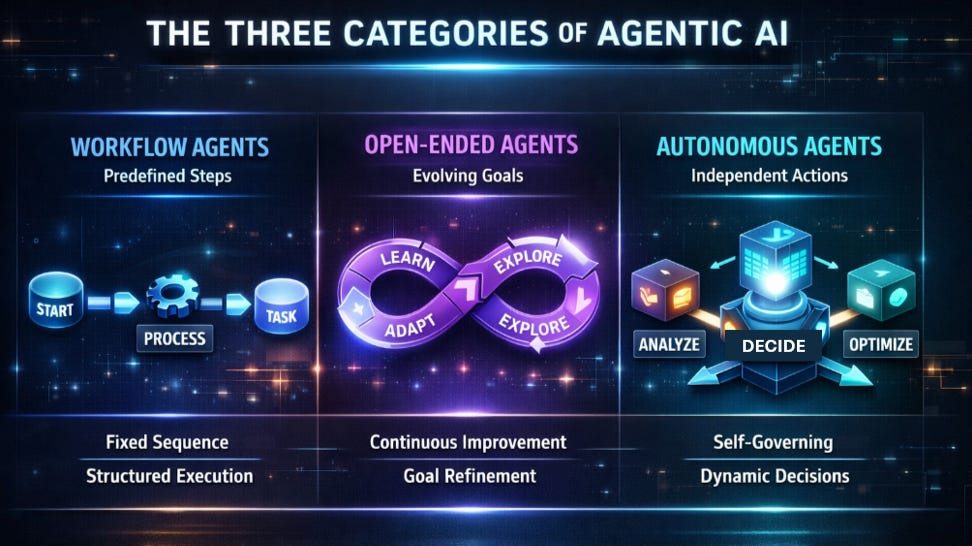


In this article we will discuss which systems can be described as “Agentic AI Systems” and compare the three main types of Agents: Workflow Agents, Open-Ended Agents and Autonomous Agents.
What Makes a System "Agentic"?
The simplest definition of AI Agents is Programs where LLM outputs control the workflow. But not all agentic systems are created equal. A program qualifies as agentic if one or more of the following features is present:
Multiple LLM Calls: Sequential, parallel, or conditional LLM interactions
Tool Use: The LLM can invoke external tools, APIs, or actions
Multi-Role Assignment: Models with different roles exchanging information
Planner-Based Systems: A planner component decides task sequence, assignment, and coordinates tools and other models
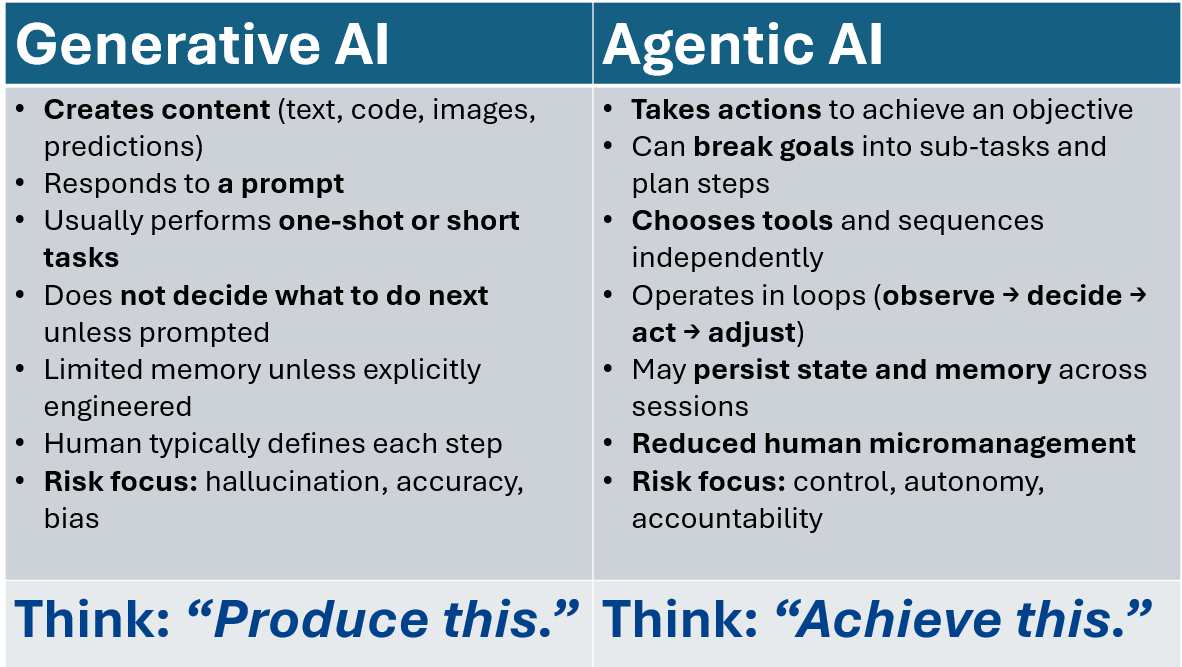
Generative AI vs. Agentic AI
Before examining agent types, it helps to be clear on the distinction between Generative and Agentic AI:

The Three Categories of Agents:
Workflow Agents
Open-Ended Agents
Autonomous Agents
In the rest of this article, we will discuss features, advantages and limitations, risks and use cases of each of these three categories.
1- Workflow Agents:
Definition:
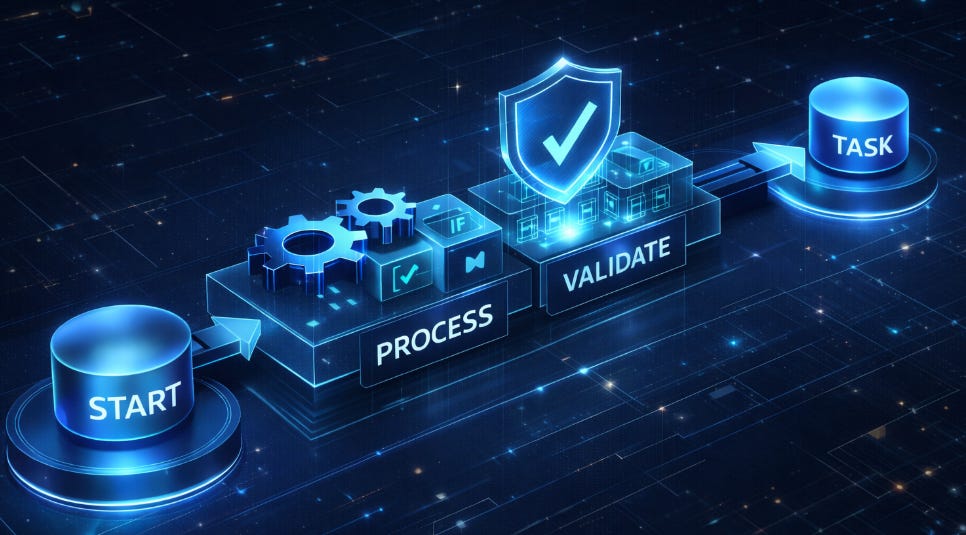
Workflow agents follow a predefined sequence of steps which are linear or with conditional branching based on the LLMs output. They are rule-driven, deterministic and process-bound.
Advantages:
Predictable, reliable and less risky
Easier to test and control.
Best for structured processes with clear start, finish and goal.
Ease of auditing, traceability and control
Limitations:
Rigid (limited flexibility for deviation).
Unexpected events can cause process failure.
Examples of Workflow Agents:
A Loan Approval AI Workflow Agent:Collect applicant details → Verify identity → Check credit history → Approve or reject loan application
Analogy: Assembly-Line workers (Step-by-step reliable and expected execution)
Best for: Routine, repeatable tasks
Risks: Operational risk e.g. Process Failure.
Risk Mitigation:
Thorough sandbox and UAT testing; robust exception handling; real-time failure notifications; version control.
Guardrails and Controls:
Validation Rules
Human review of final output (Human-In-The-Loop)
Compliance and Regulatory Provisions:
Easy to align with Standard Operation Procedures (SOPs)
Fits traditional Model Governance
Low complexity of Model Risk Management
Human Role and Involvement:
Design and Implementation Phases:Define and design the objective, step-by-step sequence, decision & branching rules, inputs/outputs, escalation paths, and error handling to ensure deterministic behavior.
Governance and Controls:Risk Assessment, approvals, and change management documentation
Testing and Validation Phase:Functional testing, edge-case testing, data quality validation, compliance validation, signoffs by responsible owners.
Execution Phase:Monitoring, exception handling, and manual overrides.
Ongoing Oversight:Performance monitoring, output validation sampling, change management approvals, version controls updates and audit logs review.
Key Insight:
Workflow agents reduce operation workload, but they DO NOT reduce governance responsibility.
2- Open-Ended Agents
Definition:
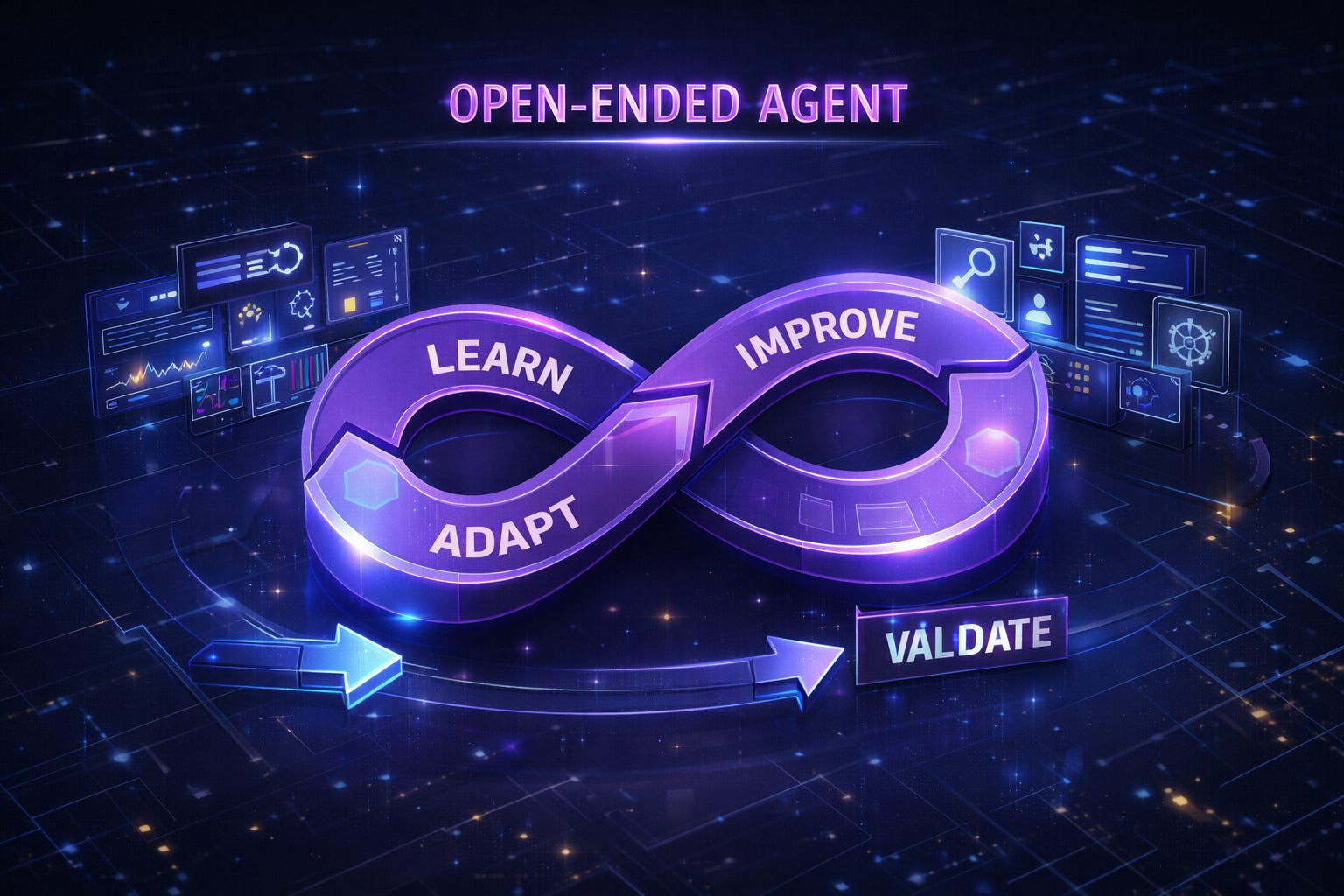
Open-ended agents operate without a predefined fixed endpoint. They pursue goals that may evolve, expand, or branch over time. They refine goals, explore possibilities, and may continuously improve or evolve objectives. They are about goal structure.
Core Characteristics and Capabilities
No strict final stopping condition
Iterative or exploratory behavior
Often long-running
May refine their own goals based on internal persistent memory
Explore possible strategies
Continuously monitor their own progress, explore strategies, and optimize performance
Capabilities:
May refine their own goals and objectives
Learn and adapt over time (Based on their internal persistent memory)
Goals may evolve over time.
Continuously monitor its own progress and outcome
Explore possible strategies
Optimize and improve its own performance
Example Use Cases
A research agent continuously exploring new scientific hypotheses
A trading strategy optimizer that keeps testing new parameters
A creative design agent that keeps iterating improvements
Risks
Primary risk: Goal drift and scope expansion — the agent pursues paths beyond the intended mission
Secondary risk: Unpredictability from long-running adaptation cycles which might lead to unexpected costs
Risk Mitigation
Establish resource limits (time, compute, cost) upfront; define escalation triggers; monitor goal evolution actively; sandbox or restrict in regulated environments
Human Role and Involvement:
Design and Implementation Phases:Define the initial goal, set scope boundaries, establish resource limits (time, compute, cost), and identify escalation triggers.
Execution Phase:Monitor performance, review evolution of the outputs, evaluate whether goal drift remains acceptable and intervene if scope expands beyond tolerance.
Ongoing Governance:Documentation of objective changes, control testing and audit traceability of adaptation logic.3- Autonomous Agents.
Key Insight:
Open-ended agents introduce scope expansion risk and goal drift. In financial institutions, they are typically restricted or sandboxed because regulators require deterministic behavior and clear explainability.
3- Autonomous Agents
Definition
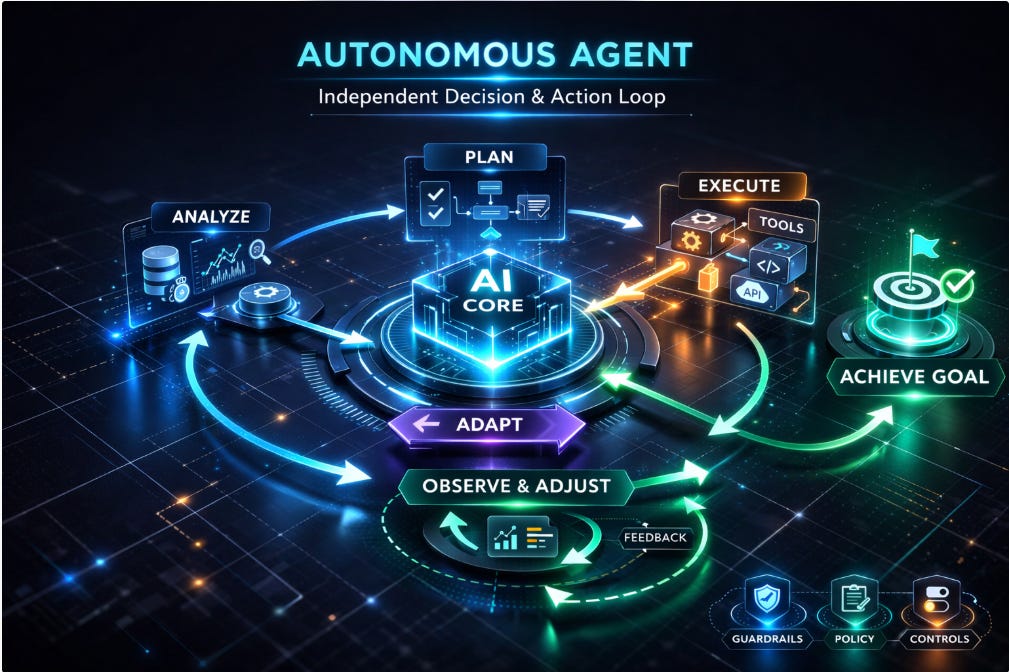
Autonomous agents operate independently without human intervention once deployed. Unlike Open-Ended agents which are focused on Goal Scope,Autonomous agents are about control and decision authority.They select tools, plan steps, and execute tasks without human micromanagement.
Core Characteristics:
Self-directed action selection
Chooses tools and sequence of steps
Makes decisions without step-by-step human approval
May operate within predefined constraints
Example Use Cases:
A customer support agent resolving tickets end-to-end
A compliance monitoring agent flagging regulatory issues
A scheduling agent coordinating calendars and bookings
Risks
Primary risk: Control risk — agent takes consequential actions without human review
Secondary risk:Accountability gaps — difficult to trace which decision led to which outcome
Human Role and Involvement:
Goal Definition – Humans define the mission, constraints, and success criteria before deployment.
Boundary Setting – Establish guardrails, permissions, risk thresholds, and escalation rules.
Tool & Access Configuration – Approve APIs, data sources, system integrations, and execution rights.
Governance & Compliance Oversight – Ensure alignment with legal, ethical, and regulatory standards.
Model Training & Fine-Tuning – Provide curated data, feedback, and alignment tuning.
Testing & Validation – Conduct scenario testing, red-team exercises, and performance benchmarking.
Deployment Approval – Sign off before live operation (especially in regulated environments).
Monitoring & Audit Review – Review logs, decision traces, and performance metrics periodically.
Exception Handling – Intervene when the system escalates edge cases or breaches thresholds.
Continuous Improvement – Refine objectives, update models, adjust autonomy levels over time.
Kill-Switch Authority – Retain the ability to pause or terminate the agent if needed.
Strategic Recalibration – Re-align agent objectives with evolving business or policy changes.
The "Both Open-Ended & Autonomous" Scenario: When Agents Combine Properties
Autonomy and open-endedness are orthogonal architectural properties — not synonyms. An agent can be:
Autonomous but NOT open-ended — completes a fixed task independently (e.g., a robotic process that runs end-to-end but always follows the same goal)
Open-ended but NOT fully autonomous — proposes evolving strategies but requires human approval at each iteration
Both autonomous AND open-ended— a self-directed system that improves itself continuously
Think of it this way:Autonomy = Who decides? Open-Endedness = Does the goal stop?
In Enterprise Context (especially regulated industries):
This distinction between Open-Ended and Autonomous agents matters
Open-ended systems introduce scope expansion risk, unpredictability and goal drift
Autonomous systems introduce control risk, governance requirements and accountability challenges.
In financial institutions, for example:
Autonomous agents must operate within guardrails.
Open-ended agents are often restricted or sandboxed.
Because regulators care deeply about:
Deterministic behavior
Explain-ability
Clear accountability
A Simple Mental Model:
Autonomy = Who decides?
Open-Endedness = Does the goal stop?
To Recap:
The three categories of agents are Notlevels of intelligence. They serve different business purposes.
They represent different architectural properties:Structure (Workflow), Adaptation (Open-Ended) and Authority (Autonomous).
The more you move towards autonomy, the more Human Governance must mature alongside it.
The Human Roleshifts from Designer (Workflow)to Steward (Open-Ended)to Accountable Overseer (Autonomous)
Hence, human involvement does Notdecrease linearly as agents become more advanced.
Instead:Execution effort decreases, and Governance effort increases (This is the paradox of Agentic AI).
In other words:
The more independent the system, the more deliberate the human accountability structuremust be:
Workflow Agents -> "We Design the process".
Open-Ended agents -> "We Supervise evolution".
Autonomous Agents -> "We Authorize decisions".
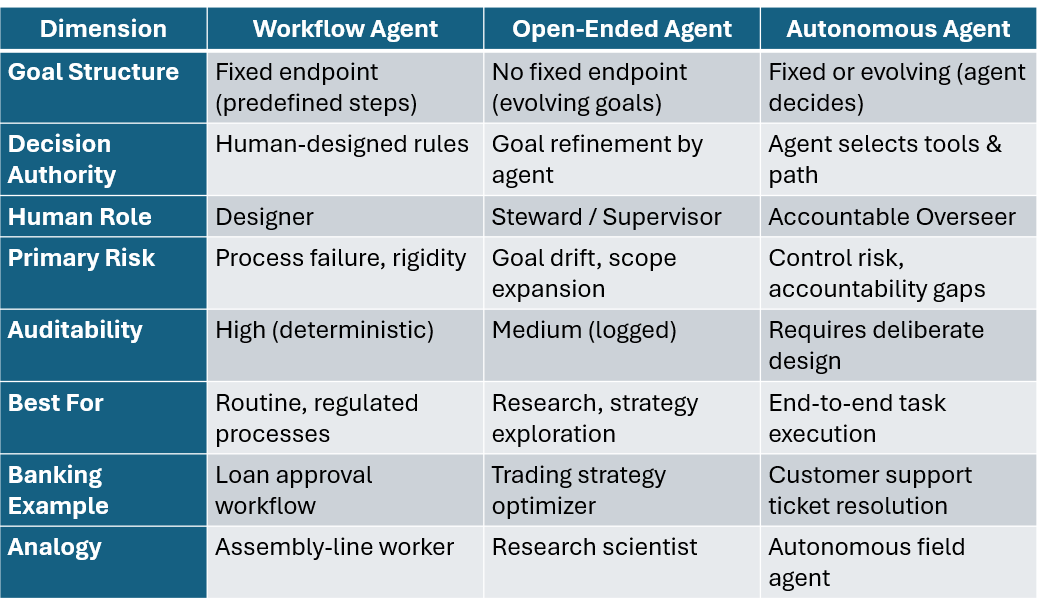
Let's end this article with a summary of features
Conclusion
As discussed throughout this article the three categories of Agentic AI — Workflow, Open-Ended, and Autonomous — are not levels of intelligence, but distinct architectural choices built around structure, adaptation, and authority. The key takeaway is simple: as systems gain independence, governance must mature alongside them. Execution effort may decrease, but accountability does not. In Agentic AI, the more the system decides, the more deliberately humans must design, supervise, and authorize those decisions
Explore more: Start Here · Topics · Archive · About