


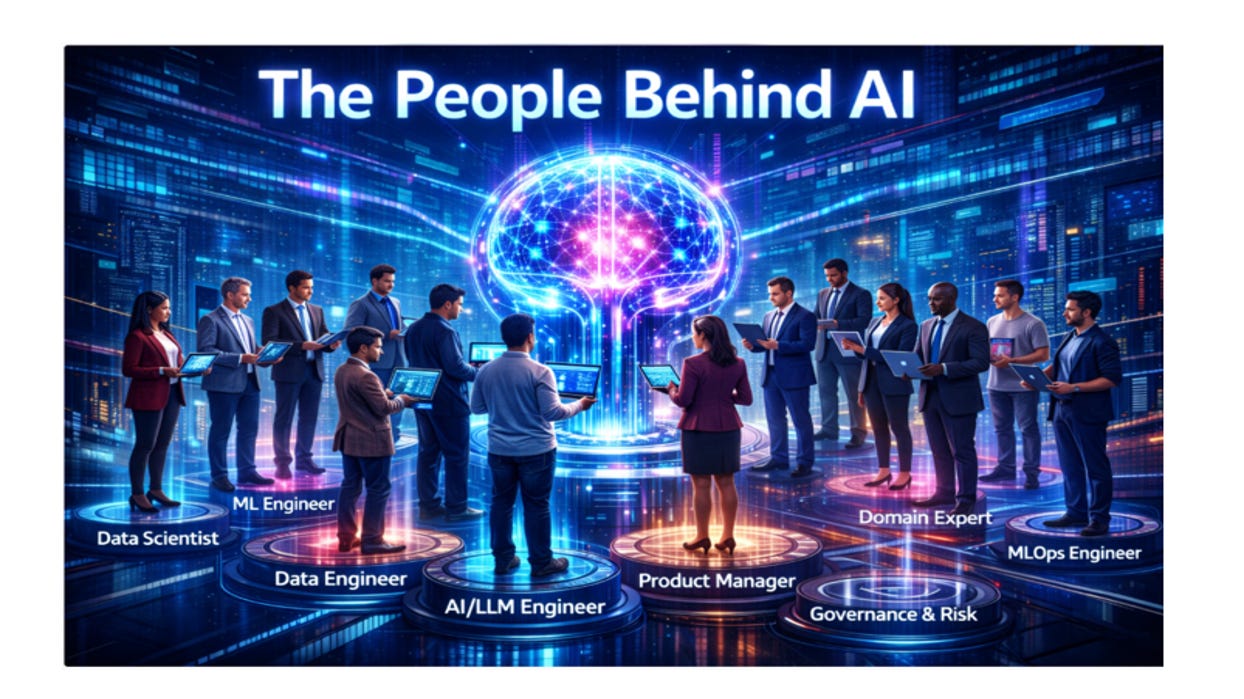

We started the AI Strategist Series by asking a foundational question: what does it actually take to build, govern, and scale AI inside a real enterprise? Over the course of this series, we explored process evaluation frameworks, organizational readiness, technology selection, capability fit assessment, roadmap design, and governance structures. We examined the regulatory landscape, the risk dimensions unique to AI, and the operational imperatives that separate AI initiatives that deliver from those that quietly fade into the organizational graveyard.
And now, for this final article, we arrive at what was always the most important topic of all.
If there is one truth that every AI leader learns, often the hard way, it is this: you can have the most sophisticated models, the most modern infrastructure, and the most generous AI budget in your industry, and still fail spectacularly if you have not solved the human equation.
Research consistently shows that approximately 70 percent of AI implementation challenges stem from human and organizational factors, not technical ones. That number should stop every executive in their tracks.
This article closes our series with a direct, practitioner-level look at the roles, structures, governance mechanisms, talent realities, and leadership postures that determine whether AI actually works inside your organization.
Organizational Models: How Structure Shapes AI Success
There is no universal organizational model for AI. The right structure depends on your enterprise's maturity, the nature of your use cases, and the degree of cross-functional coordination your initiatives require.What matters is that you choose deliberately, understand the trade-offs, and expect to evolve. The three most common models are explained below:
1. Centralized: AI Center of Excellence
AI Centers of Excellence concentrate expertise in a single organizational unit. They enable knowledge sharing across projects, cross-project learning, and governance coherence.Well-suited to organizations in early AI maturity stages where establishing consistent standards is the priority.The risk is distance from business units, which can produce technically impressive but operationally irrelevant outputs.
2. Embedded: Line of Business Alignment
In the Embedded model, AI teams sit within specific business divisions. Stakeholder alignment is strong, domain relevance is high, and decision-making is faster. The cost is reduced cross-pollination of ideas, techniques, and lessons learned across the enterprise, and the risk of fragmented expertise over time.
3. Hybrid: The Most Common Model in Mature Organizations
Most mature AI organizations converge on a hybrid structure that balances innovation, governance, and business alignment. The three most common variants are:
Hub and Spoke:A central AI hub provides governance, tooling, and standards. Distributed spokes within business units handle domain-specific delivery.
Matrix Reporting:Embedded teams maintain dotted-line reporting to central AI leadership, preserving strategic alignment without full centralization.
Product-Led AI:Product-specific teams supported by a central capability and standards layer.
Governance: The Structural Discipline That AI Projects Require
Governance has a reputation problem. In many organizational cultures, it is associated with bureaucracy, slow decisions, and unnecessary process overhead. In AI, that perception is not just wrong. It is dangerous.
AI projects carry a distinctive risk profile: outcomes are uncertain, model behavior can shift over time, data quality affects everything, ethical and bias considerations are ever-present, and cross-stakeholder impact is substantial.
Without governance, these risks compound silently until they become crises. And in regulated industries, governance is not just good practice. It is a regulatory expectation.
Effective AI governance operates across three levels:
Executive Steering Committee (monthly or quarterly):Sets strategic direction, approves escalations, and holds executive sponsors accountable. This is where senior leadership provides strategic oversight and major decisions are made. The chief data officer, chief AI officer, and senior business sponsors engage at this level.
Cross-Functional Working Group (weekly):Project managers and team leads track milestones, manage dependencies, surface risks, and escalate issues upward. This is the connective tissue of the initiative, and where cross-team alignment is built and maintained.
Team Standups (daily or bi-weekly):Tactical coordination covering progress, plans, and blockers. The operational heartbeat of the team, ensuring rapid issue resolution and continuous momentum.
The tools are familiar: milestone scorecards, Gantt charts, RAG status ratings, and risk and issue registers. What distinguishes effective AI governance is not the tools. It is the discipline of using them consistently, escalating early, and treating governance as a genuine risk management mechanism rather than a reporting ritual.
The AI Talent Crisis: The Risk That Creeps Up Quietly
Despite widespread public discourse about automation displacing human workers, the reality inside organizations tells a strikingly different story. The AI labor market is experiencing acute, sustained scarcity, and that scarcity is one of the most underestimated project risks in enterprise AI today.
The numbers illustrate the scale of the challenge. AI-related job postings surged from approximately one million in 2023 to seven million in 2025, a sevenfold increase in two years. Year-over-year demand grew more than 25 percent. Despite this extraordinary surge in demand, approximately 50 percent of AI positions remained unfilled in 2024. As of 2025, only around 74 percent of specialized AI roles in the United States hadqualified candidates available.
The real talent gap is not just in technical skills or data science. It lies in hybrid professionals who combine genuine technical knowledge with business understanding.These crossover professionals are the truly scarce resource of the AI economy, and the organizations that cultivate and retain them will have a structural advantage over those that simply chase credentials.
This is not a background condition. It is an active, ongoing project risk. Falling behind on hiring often goes unnoticed at first. By the time a project leader recognizes the hiring gap, project timelines may already be at risk.
The best-practice response is clear but rarely applied with sufficient rigor:
Monitor the hiring funnel weekly:track candidates in the pipeline, in interview stages, and pending offers. Treat recruitment as you would any critical project milestone.
Communicate staffing status early and transparentlyin every steering committee update. Unexpected hiring delays can undermine delivery credibility.
Treat recruitment as a formal project risk with a named owner and a documented mitigation plan in the risk register.
Evaluate vendors and partners as a viable supplement to internal staffing. This should be supported by a clear cost-benefit analysis and governance structure.
Map talent requirements to project phases: different skills are required at different stages. Front-loading the wrong skill profiles wastes budget and creates early team imbalances that are difficult to correct.
AI Roadmaps and the Human Alignment Imperative
Successful AI initiatives follow structured roadmaps, but the common mistake is treating these roadmaps as primarily technical plans. At every phase of delivery, coordination between science, engineering, and business teams determines whether the initiative succeeds or quietly becomes a "graveyard project" that never reaches adoption.
The canonical AI initiative roadmap spans six phases, each with distinct talent and alignment requirements:
Business Case and Strategic Approval:Domain experts and executive sponsors must align on the problem definition before any technical work begins. Misalignment here propagates downstream into every subsequent phase.
Planning and Resourcing:The full talent map must be built before the execution plan is finalized. Resourcing gaps at this stage are the leading predictor of delivery failure.
Research and Feasibility:AI engineers and scientists lead this phase, working closely with domain experts who validate that the hypothesis being tested maps to a real business need.
Build and Integration:AI engineers, data engineers, and software engineers collaborate to transition experimental models into production-ready systems. Governance checkpoints must be embedded here, not added afterward.
Deployment and Adoption:This is the most organizationally demanding phase. Change management, training, and active leadership engagement determine whether the system is actually used or simply deployed.
Measurement and Continuous Improvement:KPIs must be defined before deployment, not after. Operations and platform engineers maintain production reliability while business stakeholders assess ongoing value delivery.
Leading AI Adoption: Overcoming the Human Barriers
Even a perfectly staffed, well-governed AI initiative can fail at the final hurdle: organizational adoption. The implementation challenges that most commonly derail AI projects are not technical. They are human.
The Adoption Barriers Leaders Must Anticipate
Job Displacement Concerns:Fear of automation is real, pervasive, and rarely addressed with the directness it requires. Leaders who minimize or dismiss these concerns do not eliminate them. They drive them underground, where they become harder to manage and more corrosive to adoption.
Skepticism and AI Fatigue:Years of overblown promises have produced warranted skepticism in many organizations. Leaders must demonstrate value through concrete, visible outcomes before expecting broad organizational enthusiasm. Hype-driven communication creates skeptics, not champions.
Cross-Team Alignment Failures:Large AI initiatives require multiple teams to move in coordinated lockstep. Small misalignments compound quickly. What starts as a minor dependency issue becomes a delivery crisis.
Ethical, Bias, and Explainability Risks:Stakeholders are increasingly sophisticated about AI fairness and transparency. Leaders who treat these concerns as afterthoughts create trust deficits that are extraordinarily difficult to recover from.
Organizational Inertia:Established processes and habits resist disruption even when the case for change is clear. Inertia is not malice. It is the natural response of systems under stress. Leaders who understand this respond with patience, persistence, and visible early wins rather than mandates.
The Leadership Response That Actually Works
Transparent Communication:Provide frequent, candid updates on both the benefits and the risks. Avoid hype. Stakeholders who feel they are being sold to become skeptics. Stakeholders who feel genuinely informed become partners.
Employee Upskilling and Engagement:Invest in training and reskilling. Make AI augmentation a visible, recognized, and rewarded capability. When people feel equipped for the future, their relationship to change shifts fundamentally. The goal is to move from a culture of fear of replacement to one of excitement about augmentation.
AI Governance and Ethical Oversight:Establish dedicated resources for bias review, ethics assessment, and explainability. These are not compliance formalities. They are trust-building mechanisms that signal leadership takes AI risks seriously.
Role Modeling and Recognition:Leaders who use AI visibly and celebrate employees who leverage it effectively create a culture of adoption. Culture change starts at the top, but it is sustained by the middle.
Metrics That Matter:Define and track KPIs that reflect real business impact before deployment. Progress that cannot be measured cannot be communicated. Progress that cannot be communicated does not create organizational momentum.
Change Leadership, Not Just Change Management:Turn skeptics into champions through proactive, inclusive, and genuinely open leadership engagement. The distinction matters: management implements a process. Leadership builds a movement.
Closing AI Strategist Series: The Lesson That Runs Through Everything
Over the course of the AI Strategist Series, we have covered a great deal of ground. We explored how to evaluate business processes for AI suitability, how to assess organizational readiness, how to select technology, how to design governance frameworks, how to navigate regulatory requirements, and how to build AI roadmaps that account for genuine uncertainty.
But every article in this series, if you look carefully, has been about people.The process evaluation frameworks are tools that human strategists apply. The governance structures are mechanisms that human leaders must design and commit to. The regulatory frameworks are obligations that human professionals must interpret and enforce. The roadmaps are artifacts that human teams must own and adapt.
AI, at its core, is a human initiative. The models are powerful. The technology is genuinely transformative. But it is the teams that build it, the leaders who govern it, the professionals who adopt it, and the organizations that support it who ultimately determine whether the promise of AI becomes real value or merely a very expensive lesson.
The most advanced model in the world cannot fix a poorly aligned team.AI amplifies human intelligence and human judgment. It does not replace them. The organizations that understand this, and build their AI strategies accordingly, are the ones that will lead in the years ahead.
Explore more: Start Here · Topics · Archive · About