


Before diving into technologies, architectures, or governance frameworks, every AI professional must first build the correct strategic mindset. Tools will evolve. Models will change. Regulations will shift. But the mindset of an AI Strategist is what ensures long-term impact.
This article helps readers understand:
The critical role of AI Strategists
How they create value in modern enterprises
The mental models that separate professionals from leaders
How to think in systems, patterns, and outcomes
How strategic AI differs from tactical or operational AI initiatives
By the end of this article, you will be able to approach problems not as “How do I use AI here?” but rather “What value should be created, and is AI even the right solution?"
What Is an AI Strategist (and What It Is Not)
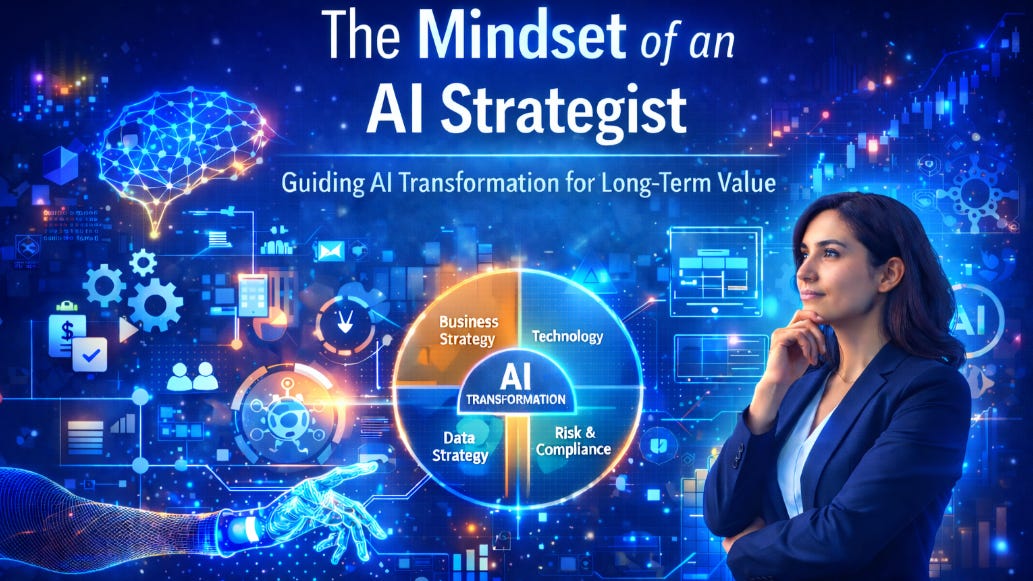
An AI Strategist is a professional who guides organizations in identifying, prioritizing, and designing AI-driven solutions that support strategic business objectives. They sit at the intersection of:
Business strategy
Technology capabilities
Data strategy
Risk & compliance
Organizational change
Think of the AI Strategist as the architect of AI-driven transformation. They do not need to code models, but they must understand how models, data, workflows, governance, and organizational incentives fit together.
What AI Strategists Are Not
They are not prompt hobbyists.
They are not “AI tool testers.”
They are neither purely technical nor purely business-oriented.
They are not optional. AI transformation requires someone who sees the big picture.
In Summary
An AI Strategist identifies where AI creates meaningful value, ensures it can be implemented safely, and aligns it to business outcomes, governance expectations, and long-term enterprise goals.
They protect organizations from wasting money on flashy AI projects that fail to deliver value.
The Rising Pressure on Enterprises
AI is moving faster than any prior technology wave. Enterprises face:
Regulatory scrutiny
Rapid model evolution
Internal demand for automation
Talent shortages
Cost pressures
Transformation risks
Competitive threats from AI-native companies
Without strong AI strategy, organizations default to scattered pilots, inconsistent standards, unmanaged risk, and missed opportunities.
The AI Strategist’s Mandate
Provide clarity on where to invest
Ensure transformation aligns with enterprise risk appetite
Articulate long-term roadmaps
Establish prioritization frameworks
Guide leaders through ambiguity
Facilitate cross-functional collaboration
In short, where others see hype, the strategist sees architecture, risk, and business pathways.
The Core Duties of an AI Strategist
AI Strategists bridge the gap between potential and reality. Their responsibilities include:
Identifying High-Value Opportunities
Translating Business Goals into AI Strategies
Establishing Value Metrics & Success Criteria
Ensuring Responsible & Safe AI Adoption
Guiding Technology & Architecture Choices
Managing Stakeholder Alignment
Communicating With Executive Leadership
Supporting Organizational Change
How AI Strategists Think
Great AI Strategists share common thinking patterns.They approach AI not as a tool, but as a lever for transformation.There are three core mental models:
Mental Model 1: Systems Thinking
Systems thinking means seeing how people, processes, data, systems, incentives, and risks interact.
Strategists understand that:
A workflow is not a single process; it is a network
Fixing one bottleneck may create another
Data quality issues ripple across multiple teams
Automating one step often changes upstream and downstream dependencies
They think in terms of:
End-to-end journeys
Dependencies
Interconnected risks
System behavior rather than isolated tasks
Mental Model 2: Value-Backwards Thinking
This mindset starts with the question: "What value must be delivered?" rather than "Which AI tool should we use?"
Value-backwards thinking ensures:
Problems are well-defined
Success metrics are clear
AI is used where it matters
Solutions stay anchored to outcomes, not tech experimentation
Mental Model 3: Responsible Acceleration
Strategists balance two competing forces:
Innovation pressure (“Move fast!”)
Risk realities (“Don’t break the bank”)
Responsible acceleration means:
Moving quickly, but with governance
Experimenting, but with oversight
Scaling, but only after risk assessment
Maintaining ambition while remaining compliant
Building controls into the architecture early
AI Strategist Role vs. Other AI Roles
What Good Looks Like: Attributes of a High-Impact AI Strategist
High-performing AI Strategists and leaders typically demonstrate:
Curiosity:Not just interest in AI, but a hunger to understand processes, constraints, and real-world pain points.
Pattern Recognition:The ability to quickly see where AI can deliver improvement, and where it cannot.
Business Acumen:Understanding cost structures, value levers, KPIs, and strategic priorities.
Communication:Clarity, precision, and the ability to translate complexity.
Governance Mindset:Understanding that AI requires structure, transparency, and responsible design.
Change Leadership:AI is not just technology; it is transformation of work. Strategists help teams adapt and succeed.
Outcome Orientation:Always anchored in measurable business impact.
General Technical Understanding:They don’t need to build models, but they must understand the following well enough to ask informed questions and make strategic calls:
Model types
Data flows
Integration patterns
Risks
Platform capabilities
Common Pitfalls for New AI Strategists
New strategists often fall into predictable traps:
Tool Obsession:Getting excited about tools rather than outcomes. Symptom:“Where can we use this new model?” Strategist alternative: “What problem are we solving?”
Pilot Addiction:Running endless pilots that never scale. Symptom:A portfolio of “proofs-of-concept” that remain eternally in POC-land.
Underestimating Data Challenges:AI without data readiness is like trying to cook without ingredients: you can stir the pot, but you won't get dinner.
Ignoring Risk:By the time governance is added, the project is already too complex or too risky. Start early.
Missing Stakeholder Alignment:AI touches many teams. Missing even one critical stakeholder can derail the entire initiative.
Overpromising:Avoid claiming that AI can do everything except make coffee. (Although to be fair, it's getting pretty close.)
Practical Exercise: Shifting to the Strategist Mindset
Step 1: Choose an operational process you know well.
Examples:
Account reconciliation
KYC or onboarding
Contract review
Customer email triage
Quality assurance
Forecasting or reporting
Step 2: Describe its purpose
What is the process trying to achieve?
Step 3: Identify pain points
Where is the friction?
Where are errors produced?
Where is time wasted?
Where are people stuck doing repetitive work?
Step 4: Ask value-oriented questions
What outcome needs to improve?
How would we measure success?
Which parts require judgment vs. brute-force effort?
What would an improved version of this process look like?
Step 5: Identify whether AI is relevant
Not every problem is an AI problem.
Strategists explore opportunities, but they do not force AI into problems where it does not belong.
Step 6: Draft a concise strategic insight statement
One sentence that captures the opportunity. For example: “By introducing AI-driven extraction and summarization, we can reduce document review cycle time by 40% while improving quality.”
Step 7: Assess organization readiness
Technical Readiness
Data Readiness: Is our data accessible, reliable, and sufficient for AI training and validation?
Leadership Readiness: Do executives understand AI's potential and limitations? Is there sponsorship for experimentation?
Human Resources Readiness: Do teams have the skills to work alongside AI? Is there openness to change, or resistance?
Operational Readiness: Can existing workflows accommodate AI outputs? Are processes documented well enough to integrate AI? Do we have monitoring and feedback loops in place?
Step 8: Identify risks and mitigation methods
Technical Risks: Model errors, data quality issues, system integration failures, scalability limitations. How will we monitor and address these?
Operational Risks: Process disruption during implementation, dependency on AI systems, business continuity if AI fails. What fallback mechanisms exist?
Compliance / Regulatory Risks: Data privacy violations, regulatory requirements, audit trail gaps, explainability mandates. What governance controls are needed?
Human Behavioral Risks: Resistance to adoption, over-reliance on AI outputs, skill gaps, loss of human judgment. Where must humans remain in the loop? How do we maintain human agency?
Step 9: Develop your action plan and secure alignment
Share the insight: Share your strategic insight with stakeholders. Test assumptions. Gather feedback from process owners, technical teams, and leadership.
Build the business case: Quantify expected benefits (time saved, error reduction, cost avoidance) against estimated investment (tools, training, time).
Define success criteria: What specific, measurable outcomes will indicate the pilot succeeded or failed?
Plan the next 90 days: Outline immediate next steps such as securing budget, assembling the pilot team, preparing data, selecting tools, establishing baseline metrics.
Commit to learning: AI strategy is iterative. Plan for course correction. Document what works and what does not, and share the findings across the organization.
Remember: The goal is not to deploy AI everywhere. It is to deploy AI where it creates genuine value, with appropriate controls, and in partnership with the humans who know the work best.
Conclusion
Artificial intelligence alone does not create transformation. Strategic thinking does.
The true role of an AI Strategist is to ensure that AI initiatives are aligned with business value, organizational readiness, and responsible governance.Rather than chasing tools or trends, strategists focus on outcomes, systems, and long-term impact. They identify where intelligence should strengthen processes, where risks must be contained, and where human judgment must remain the ultimate authority.
As AI capabilities continue to evolve, the tools will change, models will improve, and new possibilities will emerge. What will remain constant is the need for leaders who can connect technology to strategy, innovation to responsibility, and experimentation to measurable results.
In the end, successful organizations will not be defined by how much AI they deploy, but by how thoughtfully and strategically they choose to use it.
Explore more: Start Here · Topics · Archive · About