


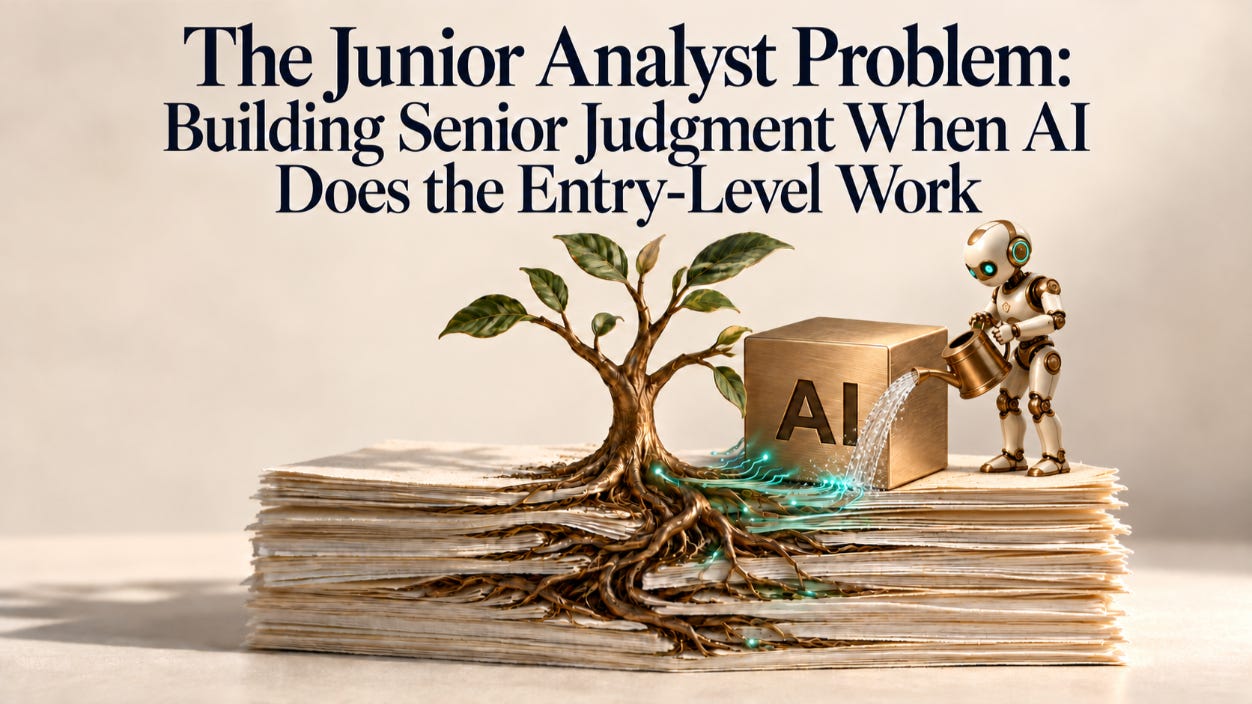
If AI does the work that used to train beginners, how does anyone become an expert? Here is how to rebuild the apprenticeship on purpose, and how to keep beginners from becoming so reliant on AI that they miss the chance to build deep knowledge and expertise.
Introduction: The Apprenticeship Nobody Wrote Down
Think back to your first job. Chances are you spent long hours on work nobody wanted: building a spreadsheet model line by line, reading contracts for one clause, reconciling numbers that refused to tie, fixing someone else’s code, or cleaning a messy data set before anyone could use it.
It felt like drudgery. It was actually your training.Every profession has an apprenticeship that nobody wrote down, and it lives inside that tedious work.
Today, AI agents can do much of that work in minutes. That is good news for productivity. It also raises a question every leader should be asking: if AI does the entry-level work, how will anyone build the judgment we expect from senior people? I call this the junior analyst problem, and it applies to banks, law firms, accounting firms, consultancies, software teams, hospitals and any organization that grows its own experts.
There is a second, quieter risk. Even when juniors keep their jobs, they can become so reliant on AI that they never build deep knowledge of their own line of business.They learn to produce the deliverable without learning why it is right. Over time, that turns promising professionals into operators of tools rather than experts in their field, and it leaves them exposed the day the tool is wrong, unavailable or out of its depth.
Every profession hides its apprenticeship inside its most tedious work. Automate the work carelessly and you automate away the training.
In this article, you will learn:
Why the "boring" work was the real training ground
How over-reliance on AI can quietly stop juniors from building deep expertise
What the latest evidence says about AI and early-career jobs
Five skills that used to come for free and now must be taught on purpose
A practical playbook for leaders to redesign the apprenticeship
What early-career professionals can do right now to stay ahead
1. The Tedious Work Was the Training
Judgment is compressed experience. Senior people are not smarter than juniors. They have simply seen thousands of cases, made hundreds of small mistakes, and learned where things usually go wrong. That experience came from repetitive work done by hand.
Here is what that work quietly taught in different fields:
Banking and finance: building a financial model from scratch teaches how a business actually makes money, and why one wrong assumption can move a valuation.
Law: reading hundreds of contracts teaches what a dangerous clause looks like, often before you can explain why.
Accounting: working through reconciliations teaches where errors hide and which numbers deserve a second look.
Software engineering: fixing bugs in other people’s code teaches how systems fail in real life, not just in theory.
Consulting and analytics: cleaning data teaches healthy skepticism about every number in a chart.
Healthcare and operations: handling routine cases builds the pattern recognition needed to spot the unusual one.
Remove the experience, and the judgment does not form. That is the heart of the problem.
Judgment is not a talent people are born with. It is experience, compressed one tedious task at a time.
2. The Over-Reliance Trap: When AI Becomes a Crutch
The first risk is that juniors get less of the work that trains them. The second risk is subtler: they still do the work, but AI does the thinking. A junior who accepts a polished AI answer without understanding it gets the task done today and misses the lesson that task was meant to teach.
Psychologists call this cognitive offloading: handing mental effort to a tool. A calculator is a healthy example, because you already know what multiplication means. Offloading becomes a trap when you hand over the understanding itself, before you have ever built it.
What the research suggests
Confidence in AI can lower critical thinking. A 2025 survey of 319 knowledge workers by researchers from Microsoft Research and Carnegie Mellon University found that the more people trusted the AI on a task, the less critical thinking effort they reported. People who were confident in their own skills were more likely to question the output. The authors warned that over-reliance could weaken problem-solving skills over time.
Easy answers may mean shallow learning. In a 2025 experiment from the MIT Media Lab, students who wrote essays with ChatGPT showed weaker brain engagement than those who wrote unaided, and more than 80% struggled to accurately recall a quote from the essay they had just written. The researchers called this "cognitive debt." The study was small and not yet peer reviewed, so treat it as an early signal rather than proof.
The warning signs in a junior professional
They can produce the deliverable but cannot explain how it was built or why it is right.
They produce a volume of work that no person could realistically produce by hand, but the quality is mediocre: generic, shallow, or full of small errors nobody caught.
They accept an answer because it sounds plausible, not because they checked it.
They stall when the case is unusual, the data is messy, or the AI tool is unavailable.
They know how to prompt the tool, but not how the business, the client, the product or the regulation actually works.
Their questions are about the tool ("how do I get it to do X?") rather than the work ("why does X happen?").
What they lose, and why it matters
Depth of domain knowledge: the detailed understanding of their line of business that makes advice credible and decisions sound.
Mental models: the internal map of how things connect, which lets an expert reason about a new situation instead of searching for a precedent.
The ability to spot nonsense: without their own expertise, they cannot tell when the AI is confidently wrong, which is exactly when it matters most.
Career resilience: expertise travels with you to the next role, the next firm and the next tool. Prompting skill for one tool does not.
This trap is hard to see because everything looks fine. The deadlines are met, and performance metrics usually reward speed. The cost shows up years later, when that person is promoted into a role that requires the expertise they never built.
Use AI to go faster, never to skip understanding. The tool should raise your ceiling, not replace your foundation.
The good news is that over-reliance is a design problem, not a character flaw. The playbook later in this article is built to keep AI as an accelerator of learning rather than a substitute for it.
3. What the Evidence Says, and What It Does Not
The data so far tells a more careful story than the headlines.
The warning signs
Young workers in AI-exposed jobs are falling behind. Researchers at the Stanford Digital Economy Lab found that employment for workers aged 22 to 25 in AI-exposed occupations is about 19% below where it would be had it kept pace with less-exposed peers. Experienced workers show no comparable gap.
The effect depends on how AI is used. The same research found declines concentrated where AI mainly replaces tasks, while employment is flat or rising where AI mainly helps people do their jobs.
The change is coming through hiring, not layoffs. Fewer young people are being hired into these roles, rather than more people being let go.
Some firms have considered smaller junior classes. In 2024, The New York Times reported that some large banks were weighing cuts of up to two-thirds to incoming analyst classes. The report relied on unnamed sources, and at least one bank said it had no current plans to change its analyst classes.
The counter-signals
Some firms are hiring more juniors because of AI. In May 2026, the chief executive of BNY said the bank had hired more analysts and interns over the past two years, because graduates arrive with AI skills that help the firm move faster.
Others are widening the front door. DBS in Singapore announced plans to hire more than 500 young people in 2026, and to more than double its usual intake of management associates.
My reading of the evidence
Headcount is not the real story.Even firms that keep hiring juniors are changing what juniors do all day. The risk is not fewer juniors. The risk is juniors who never do the work that builds judgment. That gap will not show up this year. It will show up in five to ten years, when organizations need experienced people and find a hollow middle where their future seniors should be.
The evidence does not say AI ends careers. It says the first rung of the ladder is getting harder to reach.
4. The Supervision Paradox
In my previous article on AI agents in the virtual data room, almost every control depended on one thing: a qualified human who could check the agent’s work, catch what it missed, and sign off with confidence. The same is true for AI in credit, audit, legal review, software releases and clinical documentation.
Here is the paradox. AI output is only safe when it is reviewed by someone who could have done the work themselves. If we stop training people to do the work, we also stop producing the people who can supervise the AI.
Aviation learned this lesson early. As autopilot became more capable, safety regulators pushed airlines to make sure pilots kept practicing manual flying, because skills that are never used fade, and they are needed most at the exact moment the automation fails. Every profession adopting AI agents now faces the same choice.
You cannot supervise work you have never learned to do.
5. Five Skills That Used to Come for Free
These skills were once a by-product of grunt work. Now they must be taught deliberately:
Error intuition: the sense that a number, clause or result is wrong before you can prove it.
Source discipline: the habit of tracing every claim back to where it came from.
Structural understanding: knowing how the pieces fit together, whether in a model, a contract, a codebase or a business process.
Judgment under ambiguity: recognizing when the honest answer is "it depends," and knowing what it depends on.
Ownership and credibility: earning trust by standing behind your work from start to finish, including the parts an AI drafted.
The skills that once came free with the grunt work must now be taught on purpose.
6. A Playbook for Leaders: Redesign the Apprenticeship
The goal is not to ban AI for juniors. The goal is to make sure the learning still happens.
Here are seven practices that work in any field:
Build it by hand, once. Before juniors use agents for a core task, have them complete it manually at least once: a model, a contract review, a reconciliation, a code fix. Think of it as manual flying practice.
Turn verification into a curriculum. Give juniors AI outputs with deliberately planted errors from a golden set, and score them on what they catch. Catching mistakes becomes the skill you train and measure.
Require an explain-back. For every AI-assisted deliverable, the junior explains why it is right and where it could be wrong. The most valuable question a senior can ask is "how do you know?"
Read the agent’s work, not just its answer. Reviewing an agent’s execution trace (what it read, which steps it took, where it hesitated) teaches the workflow the junior did not do by hand.
Route the exceptions to juniors. The cases an agent cannot handle are the best teaching material in the building. Let juniors work them with a senior alongside.
Measure learning, not just output. Track judgment milestones (for example, can this person review a model, a contract or a pull request unsupervised?) alongside productivity.
Reinvest saved time into teaching. When AI saves senior people hours, protect part of that time for coaching, and make teaching part of how seniors are evaluated and rewarded.
One more step belongs in workforce planning. Model your talent pipeline ten years out. Ask how many experienced reviewers you will need to supervise AI agents, and where they will come from. Cutting junior intake today is borrowing against your future ability to govern AI.
Do not ban AI for juniors. Design the work so the learning still happens.
7. Advice for Early-Career Professionals
If you are early in your career, you have an advantage: you are likely more fluent with AI than many of your managers.
Here is how to turn that fluency into real expertise:
Do the first version yourself sometimes. Then compare it with the AI version. The differences are where you learn.
Always ask "how would I check this?" Never pass along an AI answer you could not defend in a meeting.
Learn the domain, not just the tool. Tools change every few months. Understanding how your business, client or system works lasts a career.
Volunteer for the messy cases. Exceptions, escalations and unusual requests build judgment faster than routine work ever did.
Keep a log of the AI mistakes you catch. It sharpens your error intuition, and it becomes a powerful story in your next performance review or interview.
Aim to be known as right, not just fast. Speed is now cheap. Reliable judgment is not.
Speed is now cheap. Be the person whose answers can be trusted.
Conclusion: Judgment Is the Scarcest Asset
AI will keep getting better at entry-level work, and that is a good thing. But organizations that treat junior roles purely as a cost to automate may find, a decade from now, that they have no one ready to lead, review or govern the AI they depend on.
The organizations that win will redesign the apprenticeship on purpose.They will use AI to remove the drudgery while protecting the learning inside it. In a world where answers are cheap, judgment becomes the scarcest asset you have. The time to start building it is now.
When answers become cheap, judgment becomes the most valuable thing an organization can grow.
How is your organization making sure its next generation still learns the craft? I would love to hear what is working in your field in the comments.
Explore more: Start Here · Topics · Archive · About