


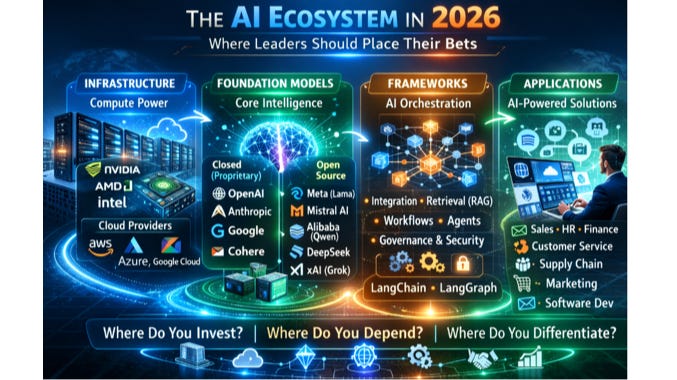

Artificial Intelligence is no longer a standalone tool. It is an ecosystem—a layered, interconnected stack of infrastructure, models, frameworks, and applications that together determine cost, capability, speed, risk, and competitive advantage.
This article breaks down how enterprises should evaluate compute dependencies, closed vs. open-source LLMs, orchestration frameworks like LangChain and LangGraph, and AI-native applications driving real business value.
For decision-makers, clarity begins with understanding the structure of that stack.
We will discuss how to navigate build vs. buy decisions, manage vendor lock-in, optimize ROI, and identify strategic differentiation points across the AI stack.
If you’re a business leader, decision maker, AI strategist, or transformation executive, this guide will help you place smarter bets in an increasingly competitive AI landscape.
The Four-Layer AI Ecosystem
Layer 1: Infrastructure — The Compute Engine
Layer 2: Foundation Models — The Intelligence Layer
Layer 3: Frameworks — The Orchestration Layer
Layer 4: Applications — The Experience Layer
Layer 1: Infrastructure — The Compute Engine

Role of the Infrastructure:
This layer provides the raw computing power to train and run massive AI models.
Key Players:
Chipmakers:NVIDIA holds a dominant position with its high-performance GPUs (Graphics Processing Units), the "gold" of the AI boom. Competitors include AMD and Intel.
Cloud Hosts:Microsoft Azure, Amazon Web Services (AWS), and Google Cloud are the primary providers. They buy GPUs in bulk and rent access to them, making this power accessible to everyone else.
Note:A CPU (Central Processing Unit) is designed for general-purpose computing, handling a wide variety of tasks sequentially with a small number of powerful cores optimized for flexibility and control.
On the other hand, a GPU (Graphics Processing Unit), by contrast, contains thousands of smaller cores built for parallel processing, making it far more efficient for heavy mathematical computations like gaming and training / running large AI models.
Executive Takeaway:
This layer is a high-cost, high-barrier-to-entry market. For your organization, this is a critical cost center and vendor dependency. In addition to the cost, infrastructure represents a strategic vendor dependency and a potential sovereignty risk.
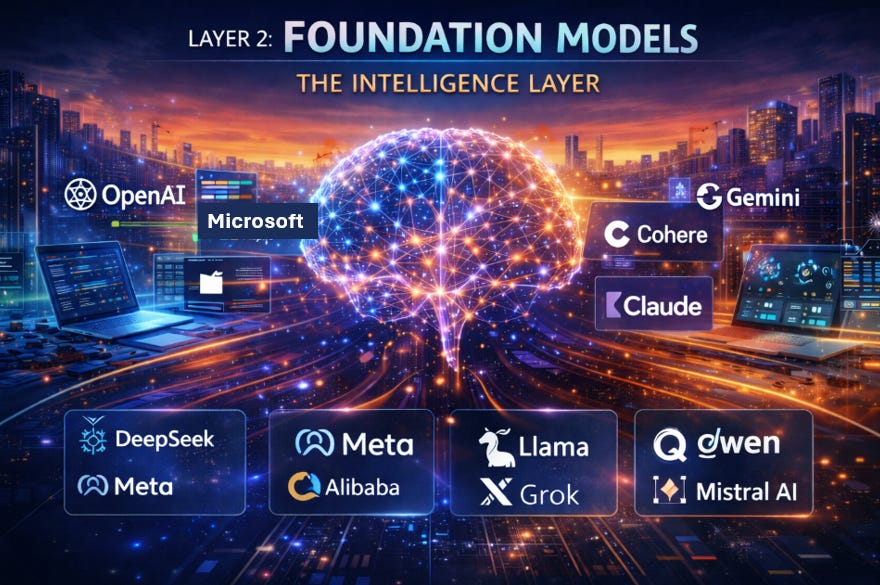
Layer 2: Foundation Models — The Intelligence
Role of the Foundational Models:
This is where core intelligence is built — massive, large language models (LLMs) that power downstream systems.
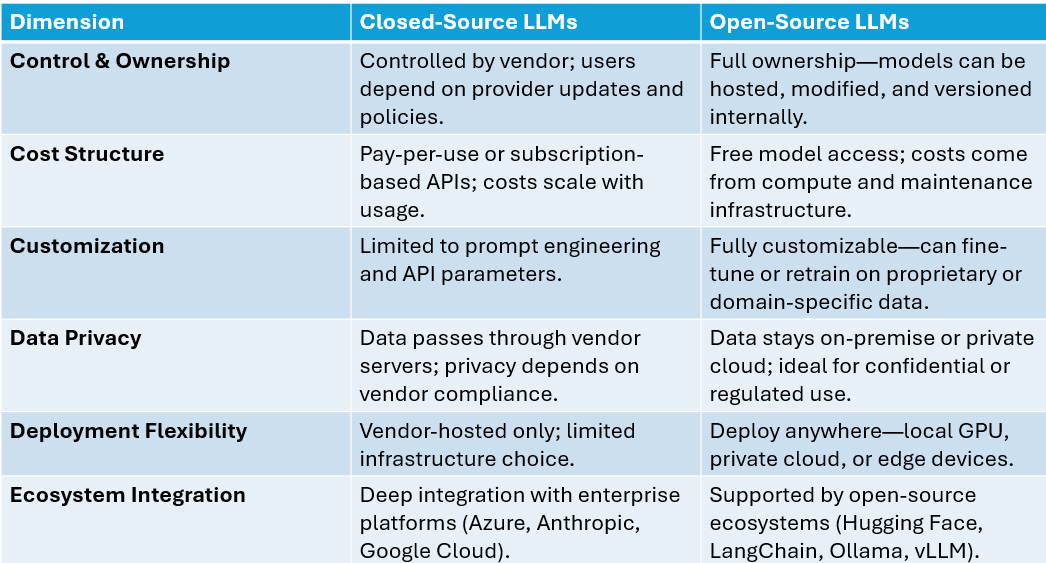
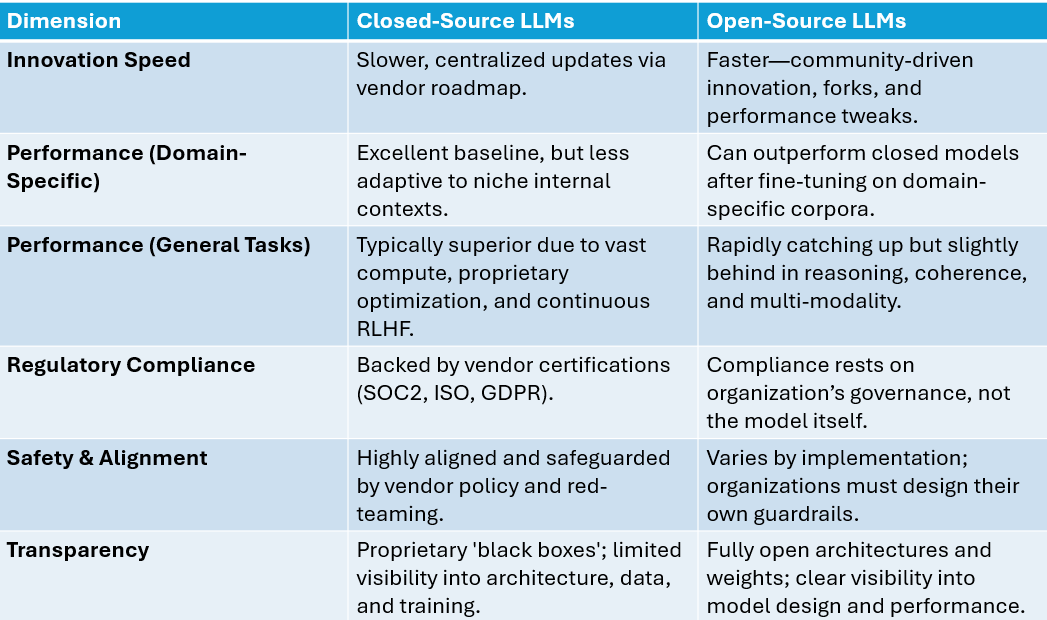
There are Two Strategic Paths:
Closed (Proprietary / API-Based) or Open-Source (Self-Hosted / Customizable)
Layer 3: The Frameworks — The Orchestration Layer
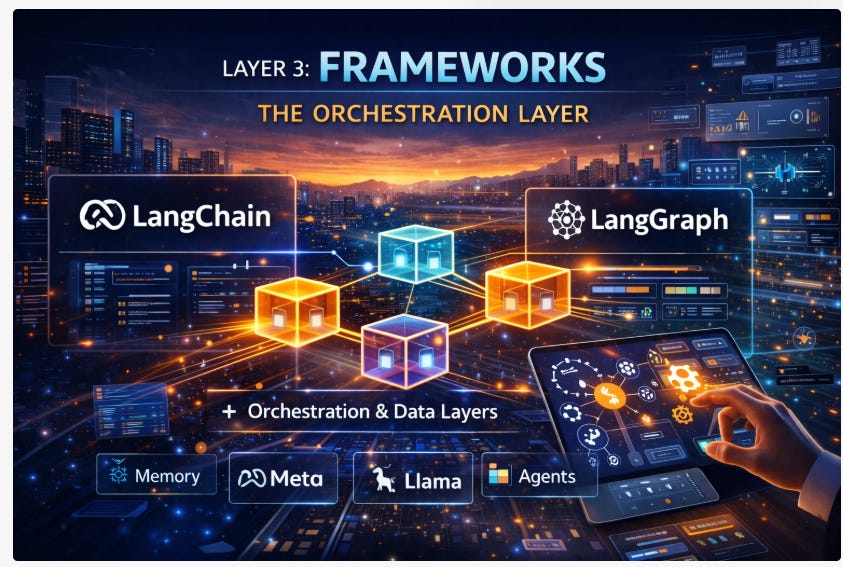
Modern AI applications are built on frameworks—think of them as the “operating systems” or building kits that help companies design, connect, and scale intelligent systems.
Instead of coding everything from scratch, organizations use these frameworks to integrate large language models (LLMs), automate reasoning, connect to company data, and even create AI agents that can make decisions and perform tasks.
Role of Frameworks:
Connect LLMs to internal data
Enable retrieval-augmented generation
Add memory and tool use
Orchestrate AI agents
Standardize governance
Why This Layer Matters
Frameworks transform static models into:
Copilots
Decision-support systems
Autonomous agents
They Deliver:
Speed (reduced development cycles)
Scalability (pilot → production)
Governance and Controls (guardrails and consistency)
Innovation (multi-agent collaboration)
Data Utilization (Combine internal data with advanced models)
Most Popular AI Frameworks:
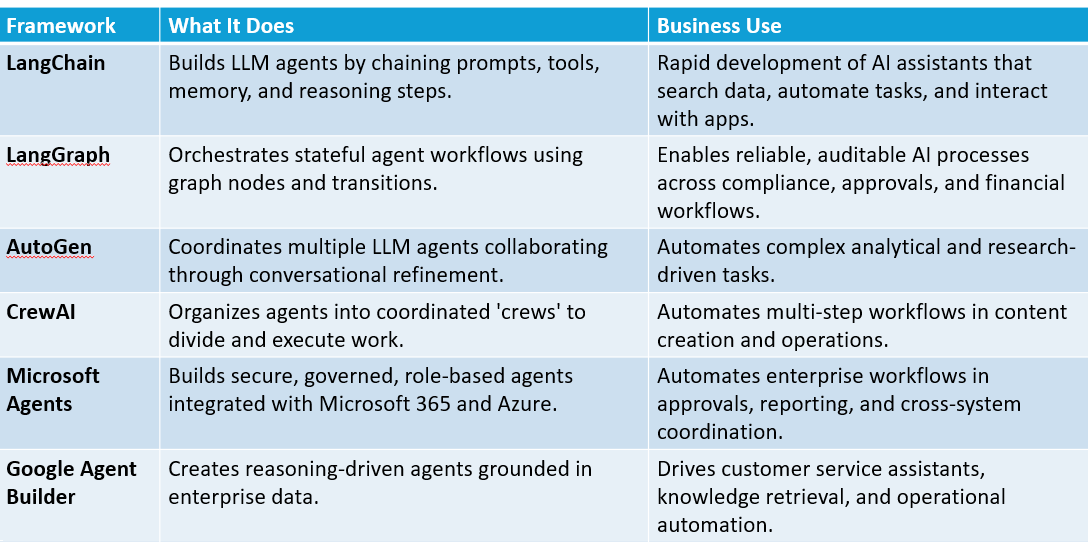
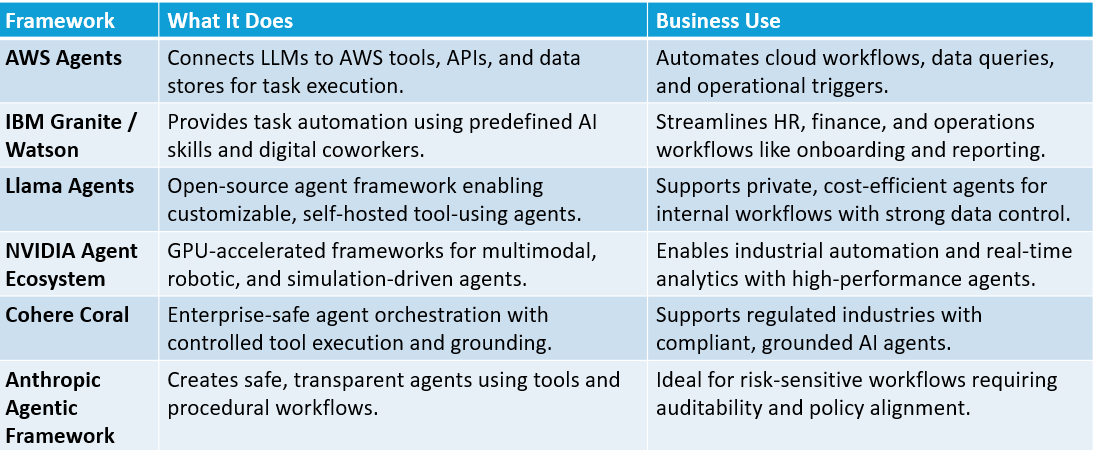
If Infrastructure is the Power Grid and Models are the Brain, Frameworks are the Nervous System and the Connective Tissue between data, tools and powerful AI models. If this layer was ignored, the implementation will remain as a demo.
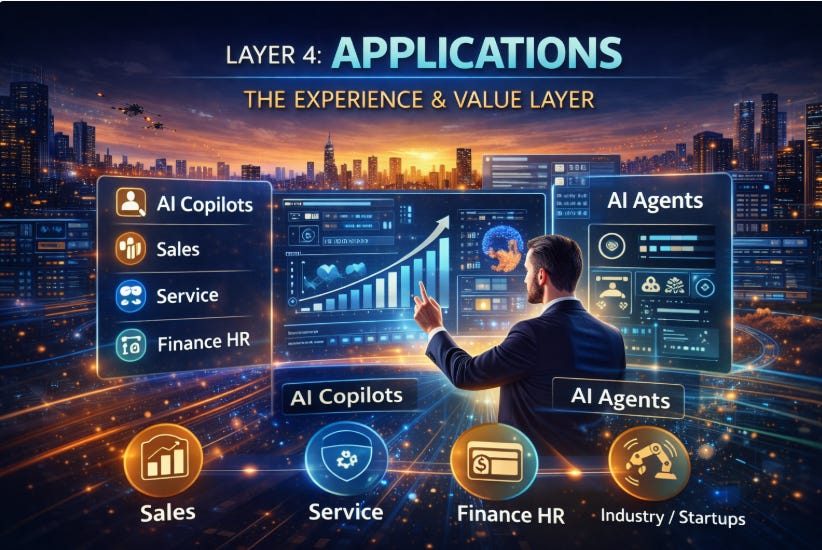
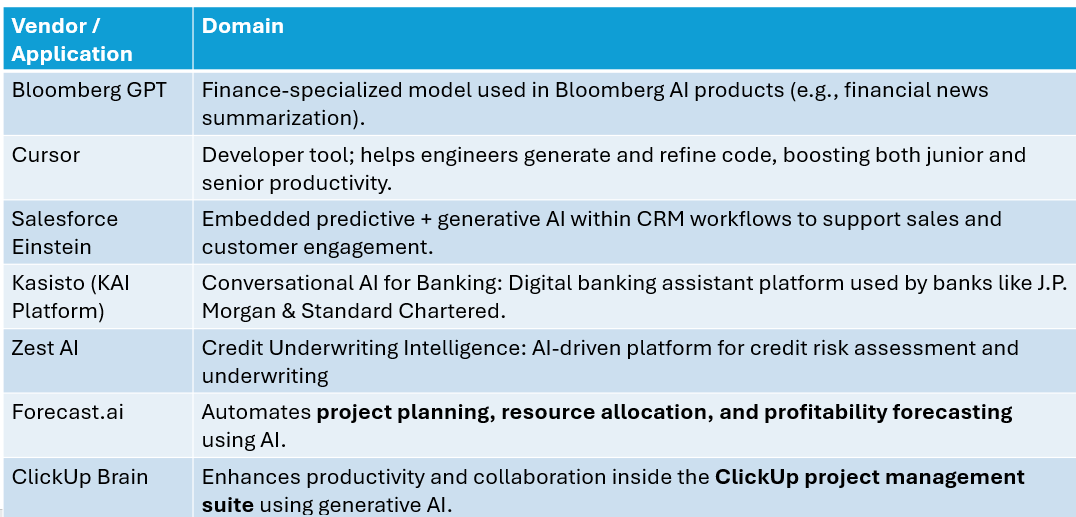
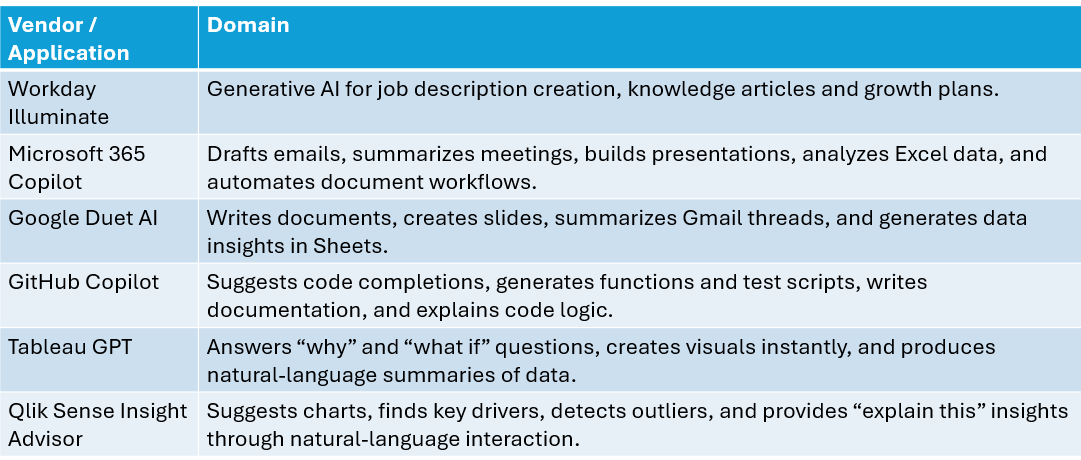
Layer 4: Applications — The Experience & Value LayerExamples of applications (layer 4) offerings by AI vendors
Role:
This is the layer employees and customers will touch.
These are the tools and platformsthat integrate AI to solve a specific business problem.
These applications are usually industry specific vertical offerings.
Key Players:
Software As a Service (SaaS):Salesforce, Microsoft (Copilot), Adobe, Workday, etc., are all embedding AI features into their products.
Specialized Startups:A massive, fast-moving ecosystem of new companies building AI-native solutions for everything from legal contract review and software development to marketing and customer service.
Executive Takeaway:
This is where most value will be captured and where competition will be fiercest.
Your role as a leader is to identify which workflows to "augment" (with a Copilot-like tool) and which to "automate" (with an AI Agent).
Examples of applications (layer 4) offerings by AI vendors
Recap of what this article discussed
We explored the four-layer AI ecosystem—Infrastructure, Foundation Models, Frameworks, and Applications—and understood how each layer contributes to enterprise capability and cost.
We learned how Layer 1 (Infrastructure) defines compute constraints, vendor dependencies, and the economics of scaling intelligent systems.
We examined Layer 2 (Foundation Models) and the strategic trade-offs between closed (API-based) and open-source (self-hosted/customizable) models, framing the critical Build vs. Buy decision.
We gained clarity on Layer 3 (Frameworks) such as LangChain, LangGraph, and orchestration platforms that enable memory, tools, retrieval, workflows, and multi-agent collaboration.
We recognized Layer 4 (Applications) as the real battleground for competitive advantage—where augmented workflows (copilots) and autonomous workflows (agents) directly create business value.
Why this Matters
You can now see where innovation happens and where value is created—helping them prioritize investments across the stack.
You can evaluate vendors and partners more intelligently by understanding the hidden dependencies, trade-offs, and long-term implications at each layer.
You can avoid costly mistakes such as over-indexing on infrastructure, underestimating frameworks, or relying too heavily on a single model ecosystem.
Most importantly, you can identify the strategic leverage points where their organization can differentiate—whether through proprietary models, smarter frameworks, or AI-powered applications.
This understanding forms the foundation for enterprise-scale transformation, enabling leaders to orchestrate a cohesive AI strategy instead of scattered experiments.


Explore more: Start Here · Topics · Archive · About