


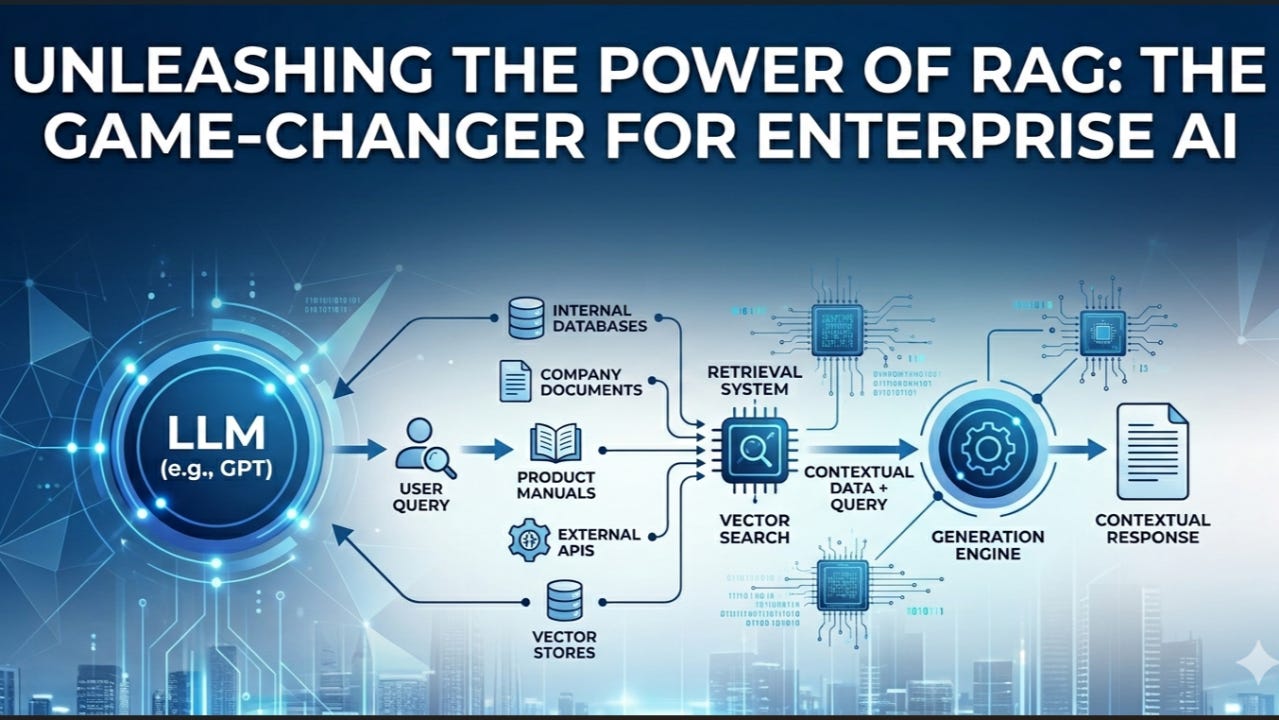
There is a quiet shift underway in leading enterprises. This shift is not about building larger models or chasing benchmarks. It is about teaching AI to verify before it speaks.
This is Part 1 of a three-part deep dive into RAG. In this article, we will cover what RAG is and why it matters, the strategic business case, how the technical pipeline works, how RAG compares to fine-tuning and prompt engineering, and the major design patterns shaping enterprise deployments. Part 2 and Part 3 will focus on enterprise implementation, governance, evaluation, advanced techniques, and real-world use cases.
1. Introduction to Retrieval-Augmented Generation (RAG)
1.1 What is RAG
Retrieval-Augmented Generation (RAG) is an AI architecture pattern that enhances the output of Large Language Models (LLMs) by grounding their responses in external, real-time, or enterprise-specific data retrieved at query time. Rather than relying solely on what a model learned during training, RAG allows the model to pull relevant information from authoritative data sources before generating its response.
In simpler terms: RAG gives AI a research library.Instead of answering from memory alone, the model looks up relevant facts, documents, and data in the organization's knowledge base before responding.
This is a fundamental shift that makes RAG a highly effective, scalable, and cost-effective approach compared to retraining or modifying the model itself.
While LLMs rely on “parameterized knowledge” learned during training, RAG provides “source-grounded” answers by allowing the AI to reference enterprise-specific, authoritative data before generating its output. This distinction is fundamental: parameterized knowledge is static and general, while source-grounded knowledge is dynamic, enterprise-specific, and verifiable.
1.2 Why RAG Matters
RAG matters because it addresses the core failure modes of standalone LLMs in enterprise environments:
Knowledge Cutoff:LLMs are trained on data up to a certain date. RAG allows access to current, up-to-date information.
Hallucination Reduction: By grounding responses in retrieved documents, RAG significantly reduces fabricated or inaccurate outputs, often referred to as “AI theatre,” where models produce confident but unsupported answers.
Enterprise Specificity: LLMs do not know your organization's internal policies, procedures, or proprietary data. RAG bridges that gap.
Auditability and Traceability: RAG responses can cite their sources, enabling transparency and compliance.
Cost Efficiency: RAG avoids the expense of fine-tuning or retraining models every time knowledge changes.
1.3 RAG as a Strategy
The AI value chain consists of six components:
Data
Models, Tools, and Actions
Workflows and Orchestration
Guardrails and Safety Controls
Monitoring
Feedback Loops
RAG is the operational bridge between enterprise data and model reasoning. It ensures that decisions are made on current, relevant, and verifiable information, not static training artifacts.
From a cost perspective, data-related expenses, including cleaning, labeling, grounding (RAG), and storage represent key cost drivers for enterprise AI.
Additionally, knowledge requirements serve as a core dimension of capability fit analysis, recognizing that tasks requiring domain-expert judgment, contextual interpretation, or institutional wisdom often benefit from retrieval-augmented approaches rather than relying on the model's parametric knowledge alone.
1.4 The Strategist’s Mindset for RAG
RAG should never start with architecture. It should start with a business problem.
An AI Strategist must approach RAG using Value-Backwards Thinking,starting with the business problem rather than the technology. This means identifying the specific workflow pain point, knowledge gap, or compliance need first, and then determining whether RAG is the right architectural solution to address it.
By contrast, technology-first thinking leads to the common trap of “unstructured experimentation”, where teams build RAG prototypes without a clear connection to organizational priorities or measurable outcomes.
Two complementary principles guide this mindset:
Alignment:Ensure the RAG initiative is tightly connected to organizational priorities. Every RAG project should trace directly to an enterprise goal, a functional objective, and a specific workflow improvement. Without this alignment, RAG projects risk becoming disconnected technical exercises that fail to deliver measurable business value.
Systems Thinking:Understand how RAG interacts with existing data systems, people, and processes across the enterprise. A RAG system does not operate in isolation. It depends on data quality from upstream sources, integrates with downstream workflows, and affects the roles and responsibilities of the people who use it. Strategists must consider these interdependencies when designing and deploying RAG solutions.
2. The Business Case for RAG
2.1 Strategic Alignment
AI succeeds when treated as a strategic enabler, not a standalone technology.RAG directly supports this principle by ensuring that AI outputs are grounded in the organization's own knowledge assets, policies, and data.
RAG aligns with enterprise priorities:
Efficiency and Productivity:Reduces time spent searching for information; delivers instant, grounded answers from enterprise knowledge bases.
Risk Reduction and Control:Ensures AI responses are anchored in verified source documents rather than model hallucinations. Enables traceable citation tracking.
Customer and Client Experience:Provides faster, more accurate, and personalized responses to client queries by drawing on product documentation and service records.
Growth and Innovation:Enables new AI-powered products such as intelligent search, knowledge assistants, and automated advisory tools.
Workforce Enablement: Empowers employees with AI tools that have access to institutional knowledge, reducing ramp-up time and improving decision quality.
Regulatory and Compliance: Enables grounded, auditable outputs aligned with internal policy documents and regulatory guidance.
2.2 Where RAG Fits in Use Case Categorization
RAG is not confined to a single category of use cases. It is a horizontal capability that spans augmentation, automation, decision support, and autonomous workflows.
Augmentation Use Cases: RAG powers intelligent search, document Q&A, and knowledge assistants that help humans work smarter.
Automation Use Cases: RAG enables automated extraction, classification, and summarization grounded in enterprise policy.
Decision Support Use Cases: RAG provides analysts with evidence-based insights sourced from internal and regulatory documents.
Autonomous Agentic Workflows: Agentic AI systems use RAG as a core tool to retrieve context before planning and executing multi-step tasks.
2.3 RAG Use Case Prioritization
To prioritize RAG opportunities effectively, strategists should apply a Value vs. Complexity Grid that ranks candidate use cases on two axes:
The business value the RAG solution would deliver (e.g., time savings, risk reduction, compliance improvement)
The implementation complexity involved (e.g., data readiness, integration effort, governance requirements).
Use cases that fall in the high-value, lower-complexity quadrant should be prioritized as early wins, while high-value, high-complexity use cases should be planned as phased initiatives with clear milestones.
Key viability factors to assess for each candidate use case include:
Data availability and quality
Task complexity
The number of reasoning steps required
Whether the task demands high factual accuracy versus creative or generative output
The regulatory sensitivity of the domain
2.4 ROI Considerations for RAG
The ROI of RAG is measurable and multi-dimensional. When building a business case for RAG, strategists should quantify value across several dimensions:
Time Savings: Reduction in time employees spend searching for documents, policies, and answers.
Accuracy Improvement: Measurable reduction in hallucination rates and error rates compared to standalone LLM responses.
Compliance Risk Reduction: Avoided regulatory penalties and audit findings through grounded, traceable AI outputs.
Reduced Fine-Tuning Costs: RAG updates knowledge without retraining the model, which can cost tens of thousands of dollars per training cycle.
Scalability: A single RAG pipeline can serve multiple use cases across departments.
3. How RAG Works: Technical Architecture
3.1 The RAG Pipeline Overview
A RAG system follows a consistent pipeline pattern with three core phases: Indexing (offline), Retrieval (at query time), and Generation (combining retrieved context with the LLM).
At its core, every RAG system follows a simple three-stage pipeline:
Stage 1: Indexing (Offline / Batch)
Before any queries are answered, enterprise documents must be prepared and stored in a searchable format.
This phase can be understood as a specialized ETL (Extract, Transform, Load) pipeline: documents are extracted from enterprise repositories, transformed through cleaning, chunking, and embedding, and loaded into a vector database for retrieval.
Organizations with mature data engineering practices can leverage existing ETL infrastructure and governance patterns when building their RAG indexing pipelines.
Document Ingestion:Collect source documents (PDFs, Word files, web pages, wikis, databases, emails, Slack messages, or any structured and unstructured data).
Chunking: Split documents into smaller, meaningful segments (chunks). Common strategies include fixed-size chunking, sentence-based chunking, semantic chunking, and recursive character splitting.
Embedding: Convert each chunk into a numerical vector (embedding) using an embedding model. This vector captures the semantic meaning of the text.
Storage: Store the vectors and their associated metadata in a vector database (such as Pinecone, Weaviate, ChromaDB, Milvus, pgvector, or Qdrant).
These vectors can be thought of as “coordinates of meaning”in a high-dimensional mathematical space, where similar concepts are placed close to each other. A classic illustration of this property is vector arithmetic: in well-trained embedding spaces, the relationship “King − Man + Woman ≈ Queen” holds true. This demonstrates that embeddings encode not just individual word meanings but the deeper conceptual relationships between them, which is what enables a vector database to search by intent rather than by keywords alone.
Stage 2: Retrieval (At Query Time)
When a user submits a question or request:
Query Embedding: The user's query is converted into a vector using the same embedding model.
Similarity Search: The vector database performs a similarity search (typically cosine similarity or approximate nearest neighbors) to find the top-K most relevant chunks.
Reranking (Optional): A reranker model rescores the retrieved chunks for relevance, improving precision.
Context Assembly: The top-ranked chunks are assembled into a context block to be passed to the LLM.
The similarity search step relies on vector distance metrics to identify relevant chunks. The two most common metrics are cosine similarity,which measures the angle between vectors and is best suited for text where directional meaning matters more than vector magnitude, and Euclidean distance (L2), which measures the straight-line distance between points in embedding space and is useful when the absolute magnitude of data points is significant. The choice of metric affects retrieval quality and should be evaluated during tuning.
Stage 3: Generation (LLM Response)
The LLM receives both the user's original query and the retrieved context:
Prompt Construction:A system prompt instructs the LLM to answer based on the provided context, cite sources, and indicate when information is insufficient.
Response Generation: The LLM synthesizes the retrieved information into a coherent, grounded response.
Citation and Attribution: Well-designed RAG systems include source citations, page numbers, or document references in the output.
3.2 Key Technical Components
Embedding Model:Converts text into numerical vectors that capture semantic meaning. (Examples: OpenAI text-embedding-3, Cohere Embed, BGE, Sentence-Transformers, GTE)
Chunking Engine:Splits large documents into retrievable segments. (Examples:LangChain splitters, LlamaIndex, Unstructured.io, custom parsers)
Vector Database:Stores and retrieves vectors efficiently via similarity search. (Examples:Pinecone, Weaviate, ChromaDB, Milvus, Qdrant, pgvector, Azure AI Search)
LLM (Generator):Synthesizes retrieved context into a coherent response. (Examples:GPT, Claude, Gemini, Llama, Mistral)
Orchestration Framework:Coordinates the retrieval and generation pipeline. (Examples: LangChain, LlamaIndex, Semantic Kernel, Haystack, custom code)
4. RAG vs. Fine-Tuning vs. Prompt Engineering
4.1 Understanding the Options
When an enterprise needs to customize LLM behavior, there are three primary approaches. These are complementary approaches, each serving a distinct role for shaping model behavior. Each has distinct strengths, limitations, and cost profiles. The three approaches are Prompt Engineering, RAG, and Fine-Tuning
4.2 When to Use Each Approach
Use Prompt Engineering when the task is straightforward and the model's base knowledge is sufficient.
Use RAG when the task requires access to current, proprietary, or large-volume external knowledge that cannot fit in a prompt.
Use Fine-Tuning when the model needs to learn new patterns, specialized vocabulary, or domain-specific reasoning styles.
Combine approaches: In practice, many enterprise deployments use all three together. A fine-tuned model with RAG retrieval and well-crafted prompts often delivers the best results.
5. RAG Design Patterns and Architectures
As RAG matures, it evolves from a simple retrieval mechanism into a composable architecture with multiple design patterns.
5.1 Naive RAG (Basic Pattern)
The simplest RAG architecture follows the standard retrieve-then-generate pattern.
A user query is embedded, similar chunks are retrieved from a vector store, and the LLM generates a response using those chunks as context.
This approach works well for straightforward Q&A and document search use cases but has limitations with complex queries, multi-hop reasoning, or noisy retrieval results.
5.2 Advanced RAG
Advanced RAG introduces pre-retrieval and post-retrieval optimizations:
Query Transformation: Rewriting, expanding, or decomposing user queries before retrieval to improve match quality.
Multi-Query Retrieval: Generating multiple variations of a user’s question to retrieve a broader and more diverse set of relevant documents, increasing the likelihood of capturing all pertinent context.
Hybrid Search: Combining vector similarity search with keyword-based (BM25) search for better coverage.
Reranking: Applying a cross-encoder or specialized reranking model to reorder retrieved chunks by relevance.
Context Compression: Summarizing or filtering retrieved chunks to reduce noise and fit within context window limits.
Metadata Filtering: Using document metadata (date, department, classification) to narrow search scope before retrieval.
5.3 Modular RAG
Modular RAG treats each stage of the pipeline as an interchangeable module, allowing organizations to swap components (embedding models, vector stores, rerankers, LLMs) without redesigning the entire system.
This approach is highly recommended for enterprises that need flexibility as technology evolves rapidly.
5.4 Agentic RAG
Agentic RAG combines retrieval with agent capabilities:
The agent decides whether retrieval is needed and which data sources to use.
The agent can perform multi-hop retrieval, query multiple sources, and combine results.
The agent can self-evaluate retrieval quality and retry with different queries or sources.
The agent can use RAG as one of many tools (alongside calculators, APIs, databases) in an orchestrated workflow.
In agentic architectures, RAG also serves as the agent’s long-term memory layer, sometimes called its semantic memory.
This allows the agent to reference past interactions, corporate knowledge, and historical data when making autonomous decisions.
RAG thus represents a foundational step in the paradigm shift from static AI assistants to autonomous, context-aware agents that can reason over an organization’s full knowledge base.
5.5 RAG with Tool Chaining
A closely related concept is Tool Chaining, where the agent treats RAG as one tool in a multi-step reasoning workflow.
For example, an agent might first use RAG to retrieve a relevant policy document, then invoke a calculation tool to apply that policy to a specific transaction and finally use a communication tool to report the result.
This mirrors the way human professionals solve complex problems by consulting references, performing analysis, and communicating conclusions in sequence.
5.6 Graph RAG
Graph RAG structures knowledge as a graph (nodes and relationships) rather than flat document chunks.
This is particularly powerful for domains with complex entity relationships, such as financial regulations, organizational hierarchies, or supply chain networks.
It enables more precise retrieval by traversing relationships rather than relying solely on semantic similarity.
5.7 Multi-Index RAG
Enterprise deployments often require retrieval across multiple data sources, each with its own index.
Multi-Index RAG routes queries to the appropriate index (or indexes) based on the query type, domain, or intent.
For example, a financial services firm might maintain separate indexes for regulatory guidance, internal policies, product documentation, and client correspondence.
Recap
In this article, we established RAG as a foundational architecture for enterprise AI.
We explored:
The core concept of grounding LLMs in external knowledge
The business case across efficiency, risk, and compliance
The technical pipeline of indexing, retrieval, and generation
The role of RAG alongside prompt engineering and fine-tuning
The evolution from basic to advanced and agentic RAG architectures
Conclusion
RAG is not just a technical pattern. It is a strategic capability that transforms AI from a general-purpose tool into an enterprise-aligned system. For leaders, the priority is unmistakable. Start with the business problem and align to measurable outcomes. Design for integration, governance, and scale from day one. Organizations that do this well will not just experiment with AI. They will operationalize it with confidence.
What we will cover in Part 2 of this RAG article series:
In Part 2, we move from concept to execution.
We will explore how to build, scale, and govern RAG in real enterprise environments, including implementation challenges, regulatory considerations, and performance evaluation.

Explore more: Start Here · Topics · Archive · About