


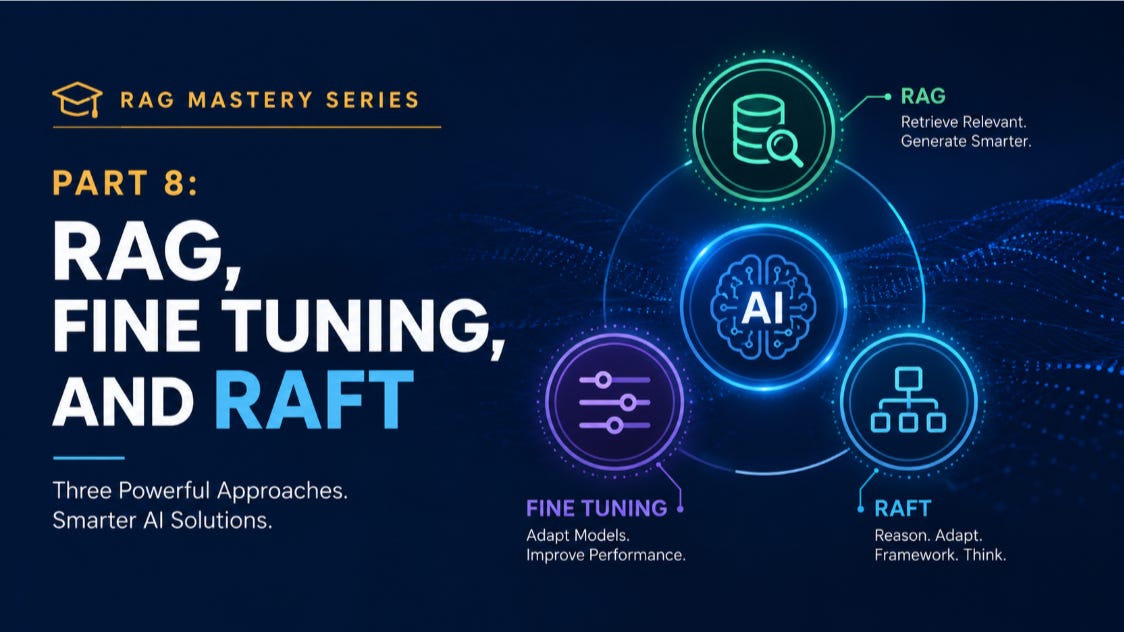
Eight articles into this series, you have seen RAG from foundations to agentic patterns. The natural closing question is when to use RAG at all, when to fine tune the model instead, and when to combine the two.
This final article frames the strategic choice between RAG, Fine Tuning, and a hybrid called RAFT. It also covers the governance, risk, and production considerations that determine whether a RAG investment will survive contact with regulators, model risk managers, and reality.
The Three Options on the Table
1. RAG
Retrieves external knowledge at query time and grounds the model in that retrieved context. The model weights are unchanged. Knowledge updates by re-indexing documents, not by retraining.
2. Fine Tuning
Continue training a pretrained model on a specialized dataset to adapt it to a specific domain or task. The model weights change. The new knowledge or behavior is embedded into the model itself.
3. RAFT, Retrieval Augmented Fine Tuning
A hybrid approach developed by researchers at UC Berkeley. The model is fine tuned to use retrieved context effectively, then deployed in a RAG pipeline that supplies that context at inference time. RAFT combines the strengths of both and addresses many of the challenges of using language models in specialized settings.
The Exam Analogy
The clearest mental model for choosing among these comes from comparing them to exam preparation.
1. Fine tuning only
A closed book exam. You cannot use your notes, so you must memorize everything in advance. If you studied the wrong material, you would not do well.
2. RAG only
An open book exam you did not study for. You have the book but did not attend lectures, so even with the material in front of you there is no guarantee you can find the right information quickly.
3. RAFT
An open book exam you did study for.You attended the lectures, read the materials, and can also use the book on test day. This is the optimal scenario.
RAFT teaches the model how to use retrieved documents to generate an answer. Teach the model to fish, rather than just giving it the answer.
How RAFT Training Data Works
Each RAFT training example consists of three things: a query, a set of documents, and an answer.
Documents in the training set fall into two categories:
Core documentscontain information directly relevant to the query, for example documents on paid leave or benefit eligibility if the query is about parental leave.
Tangent documentscontain information that is unrelated or off topic, for example documents on retirement accounts or internal code.
Training examples are organized into two document sets:
Set oneincludes both core and tangent documents. This teaches the model to filter past irrelevant content.
Set twoincludes tangent documents only, with no core documents. This teaches the model when to rely on internal knowledge or to say I do not know, rather than forcing an answer from irrelevant retrieved content.
The expected answer in each training example is constructed using chain of thought reasoning. This teaches the model to filter past tangent documents, focus on core ones, and reason step by step. The complete training set is used to train the model via supervised fine tuning. The approach is adaptable, so a wide variety of base models and fine-tuning techniques can be plugged in.
Three Keys to RAFT's Success
Including tangent documents:teaches the model to distinguish relevant from irrelevant content, increasing accuracy on domain specific questions.
Including the no relevant docs set:teaches the model when to fall back on internal knowledge or to refuse, rather than forcing an incorrect answer. Substantially reduces hallucinations.
Chain of thought guidance:minimizes overfitting and increases transparency by encouraging the model to cite the specific documents from which it drew its answer.
RAFT creates a model that is both highly scalable and highly robust for enterprise tasks. It combines the strengths of fine tuning, namely domain knowledge embedded in the model itself, with the strengths of RAG, namely up to date, traceable context at inference time.
Efficient Fine-Tuning Techniques You Should Know
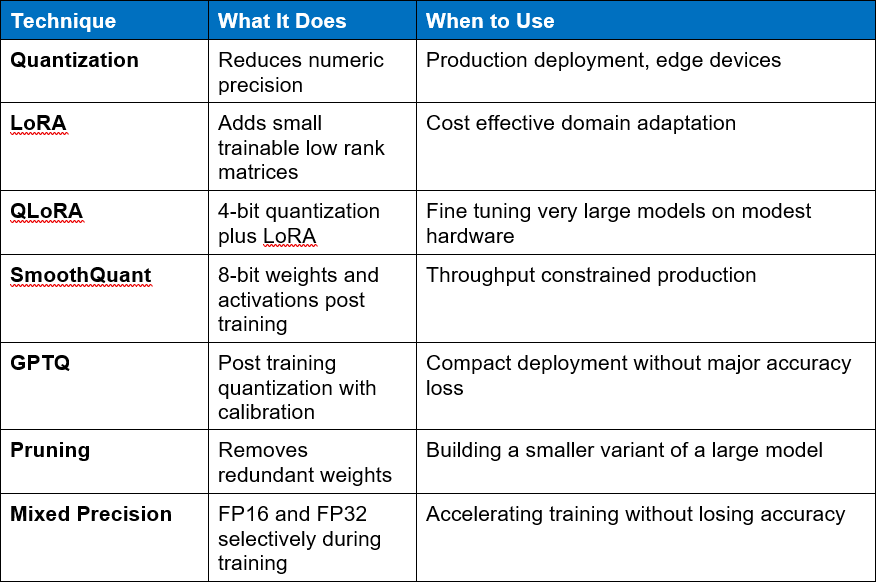
Fine tuning is expensive in its naive form. Several efficient techniques bring the cost down to something most enterprises can afford.
1. Quantization
Quantization reduces the numeric precision used to represent each weight in the model. FP32 to FP16, FP16 to INT8, INT8 to INT4. Lower precision means smaller memory footprint, faster inference, and lower power consumption, at a small accuracy cost. Reducing weight precision has a smaller accuracy impact than reducing activation precision, because weights are stable while activations change frequently and errors accumulate across layers.
2. LoRA (Low Rank Adaptation)
Adds a small number of trainable low rank matrices alongside the frozen original weights. Only the small matrices are updated during fine tuning. Result: cost effective domain adaptation with much smaller compute and memory needs, and no degradation of the base model.
3. QLoRA
First quantizes the base model weights to 4-bit precision, then applies LoRA on top. The heavy lifting is still done in 16-bit precision to maintain accuracy. The combination makes it possible to fine tune very large models on modest hardware.
4. SmoothQuant and GPTQ
Post training quantization techniques. SmoothQuant quantizes both weights and activations to 8-bit precision and balances the load between them, enabling faster inference with smaller memory footprint. GPTQ is a calibration-based post training method that supports very compact 4-bit formats while preserving accuracy, useful for diverse deployment platforms.
5. Pruning
Like trimming a tree. Removes the least useful weights to make the model smaller and faster without losing meaningful performance. NVIDIA Minitron is a known example, pruning Megatron and retraining briefly to recover accuracy.
6. Mixed Precision Training
Uses lower precision such as FP16 for most of the model to save time and memory, while keeping higher precision FP32 where accuracy is critical. NVIDIA Apex and TensorFlow mixed precision APIs automate the split.
7. Knowledge Distillation
Trains a smaller student model to mimic a larger teacher model, rather than training the student on the ground truth dataset directly. The student becomes almost as good as the teacher but is far lighter and easier to deploy. Meta encourages distilling massive Llama models into smaller, more deployable versions.
8. Graph Optimization and Layer Fusion
Combines multiple operations into a single more efficient operation, reducing the number of times data has to pass between layers and lowering both latency and memory pressure. ONNX Runtime and NVIDIA TensorRT perform these fusions automatically at deployment time.
Fine Tuning Techniques at a Glance
Decision Framework
A simple framework for choosing among the three options.
RAG only:fast-changing knowledge, large external corpora, low training budget. Quality depends heavily on retrieval performance.
Fine tuning only:stable domain knowledge, narrow tasks, strict latency or offline needs. Cannot incorporate new information without retraining.
RAFT:domain specific applications that benefit from both retrieval and deep adaptation. Requires careful training data design and supervised fine tuning.
RAG in Financial Services, the Highest Value Use Cases
Five use cases consistently rise to the top when I work with financial institutions on their RAG portfolios.
Regulatory policy Q&A.Index Basel, SR 11-7, SR 26-2, the EU AI Act, OCC guidance, and supervisory letters. Perfect alignment with regulatory and compliance adherence.
Internal policy and procedure search.Index wikis, policies, and procedure manuals for instant grounded retrieval. Strong alignment with efficiency and workforce enablement.
Client inquiry response assistance.Retrieve from product docs, FAQs, and client history to draft accurate responses. High strategic fit with client experience priorities.
Risk and compliance report generation.Retrieve from risk databases, audit findings, and regulatory submissions to draft grounded narrative summaries. Strong alignment with risk reduction and control enhancement.
Contract and legal document analysis.Index templates, precedents, and regulatory requirements for clause comparison and risk flagging. Strong alignment with risk reduction and growth.
Closing Thought
The question is no longer whether organizations should use RAG, fine-tuning, or RAFT. The real question is whether they can make the right architectural choice for the problem they are trying to solve. RAG provides access to ever-changing institutional knowledge, fine-tuning embeds specialized expertise directly into the model, and RAFT bridges the two by teaching models how to reason effectively over retrieved information. The organizations that will lead the next generation of AI adoption will not be the ones deploying the most sophisticated models, but those that combine retrieval, adaptation, governance, and operational discipline into a sustainable capability. In an era where knowledge has become one of the most valuable assets an institution possesses, the ability to transform that knowledge into trusted, explainable, and actionable intelligence may become the defining competitive advantage of the decade.

Explore more: Start Here · Topics · Archive · About