


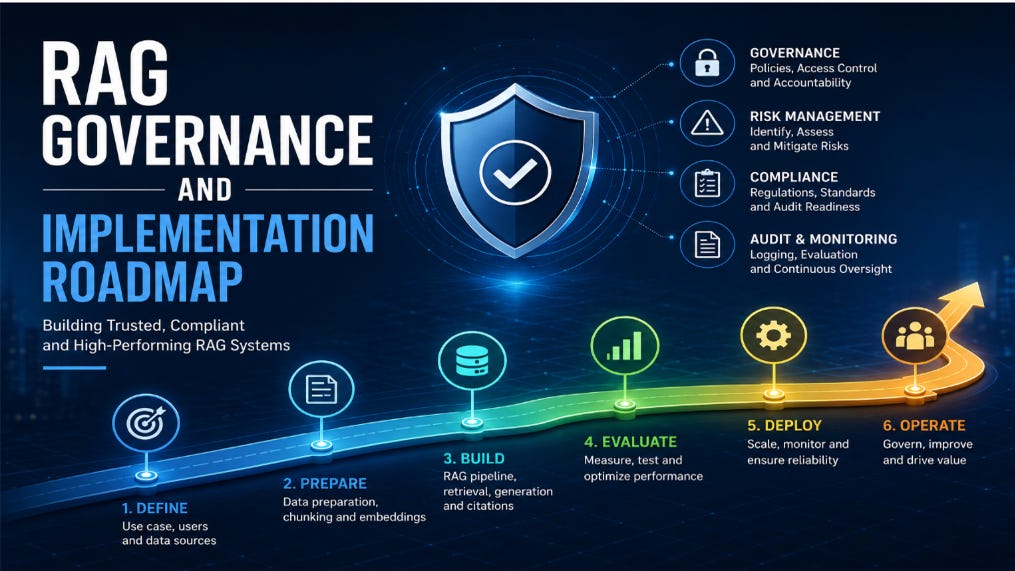
Retrieval-Augmented Generation (RAG) has rapidly evolved from an experimental AI technique into one of the most important architectural patterns for enterprise Generative AI. RAG looks deceptively simple, which makes it easy to underestimate the governance demands. Five risk categories warrant explicit controls. As organizations move RAG systems from proof of concept to production, technical performance alone is no longer enough. Questions of governance, risk management, compliance, security, auditability, and accountability become just as critical as retrieval accuracy and response quality. In highly regulated industries such as banking, healthcare, and insurance, a poorly governed RAG system can create operational, regulatory, and reputational risks that far outweigh its benefits. In this final installment of the RAG Mastery Series, we explore the controls, frameworks, best practices, and implementation strategies required to build trustworthy, secure, and compliant RAG solutions that can operate confidently at enterprise scale.
RAG Specific Risks
Hallucination despite grounding, when the model writes beyond the evidence or misreads it.
Stale knowledge, when the index is not refreshed and answers reference outdated policy.
Access control leakage, when chunks the user is not entitled to see end up in their generated answer.
Prompt injection through ingested content, where a malicious document smuggles instructions into the model via retrieval.
Data lineage and citation integrity, when the system cannot reliably point back to the source paragraph behind each claim.
Governance Controls
Document level access control, enforced at retrieval time.
Source citations required in every response.
Versioned knowledge bases with refresh schedules and staleness alerts.
Prompt hardening and input validation to limit injection risk.
Continuous evaluation across retrieval and generation, with thresholds and alerts.
Human review for high stakes outputs.
Audit logging of every query retrieved context, and generated response.
Regulatory Considerations
Several frameworks shape the design of RAG systems in financial services.
SR 11-7and the new principles-based SR 26-2 on model risk management for generative AI.
The EU AI Act,with its risk-based classification and obligations for high-risk systems.
NIST AI Risk Management Frameworkas a structured way to organize controls across the AI lifecycle.
ISO 42001for AI management systems certification.
BCBS 239for risk data aggregation and reporting, which intersects with RAG when the system supports risk processes.
An End-to-End RAG Implementation Roadmap
A practical sequence I use to move RAG initiatives from idea to production.
Define the use case clearly: user population, questions to be answered, available data sources.
Prepare and chunk source documents, then choose an embedding model appropriate for the domain.
Select a vector index method based on scale, latency, and accuracy requirements. Start with HNSW for most production cases.
Build the basic RAG pipeline:retrieval, prompt assembly, generation, citation enforcement.
Establish a monitoring and evaluation framework before optimizing, covering retrieval metrics, generation metrics, and human review.
Log real user queries and analyze them to focus optimization where it matters most.
Consider fine tuning, RAFT, or efficient adaptation techniques such as LoRA and QLoRA when the data and the business case justify the investment.
Apply post training quantization, pruning, distillation, or graph optimization at deployment time to meet performance and cost targets.
Layer in advanced techniques and agentic patternsdeliberately, only when measurable gains justify them.
Operate under a defined governance framework with controls, evaluation, and audit trails appropriate to the risk class of the use case.
The Maturity Curve
Organizations typically progress through four stages of RAG and AI maturity.
Experimental:scattered pilots with unclear ROI, limited governance, and ad hoc implementation. Most organizations begin here.
Repeatable:standardized processes, defined governance frameworks, consistent evaluation practices, and documented best practices replicated across teams.
Scalable:a unified AI platform supports strong adoption across business units, with centralized infrastructure, enterprise grade governance, and measurable business outcomes.
Autonomous enterprise:multi agent systems with self-optimizing RAG pipelines operate at scale, enabling the organization to function as an intelligent network where every workflow is supported by the full breadth of institutional knowledge.
Understanding this curve helps strategists set realistic expectations, plan phased investments and avoid the common trap of expecting enterprise scale outcomes from experimental stage implementations.
Best Practices to Carry Forward
Always evaluate retrieval and generation separately and together.Improvement in one does not guarantee improvement in the other.
Treat the evaluation dataset as a living artifact.Update it as you learn what users actually ask.
Use an LLM judge to scale evaluation,but anchor with human review on a representative sample.
Start with the simplest approachthat meets the need, and add complexity only when measurable gains justify it.
Document every design decision, from chunking strategy to indexing method to fine tuning configuration, so the system can be reproduced and audited.
Avoid pilot purgatory. Set explicit criteria for graduating from a RAG pilot to production, including performance benchmarks, governance sign off, and operational readiness reviews.
Establish clear KPIs from the outset, tied to efficiency gains, risk reduction, and financial outcomes. Without predefined KPIs it becomes impossible to assess whether the implementation is delivering value or needs course correction.
Closing Thought
RAG is no longer the new kid in the enterprise AI portfolio. It is the architectural foundation that turns institutional knowledge into a competitive asset. RAFT, fine tuning, and the broader set of efficient adaptation techniques extend that foundation into truly domain native systems.
The firms that will lead generative AI in financial services over the next five years are the ones treating RAG as the strategic capability it has become, not as a tactical chatbot project. They are investing in the engineering disciplines this series has walked through: chunking, indexing, evaluation, advanced retrieval, agentic patterns, governance, and the careful choice of when to enrich the model itself rather than the retrieval layer.
Thank you for following along. If this series was useful, share it with your team and let me know which topic you would like to see next. I read every comment.

Explore more: Start Here · Topics · Archive · About