


In the previous article, we explored the most common design patterns behind Workflow Agents, the structured, governed architectures that turn LLMs into reliable execution engines. In this article, we shift from structure to exploration. We will examine the most widely used design patterns for the Open-Ended Agents category which are systems designed not around fixed steps, but around evolving goals, iterative refinement, and adaptive strategy. While Workflow Agents are about deterministic execution, Open-Ended Agents are about controlled exploration. Understanding their patterns is essential for designing intelligent systems that can adapt without losing alignment.
Design Pattern 1: ReAct Loop
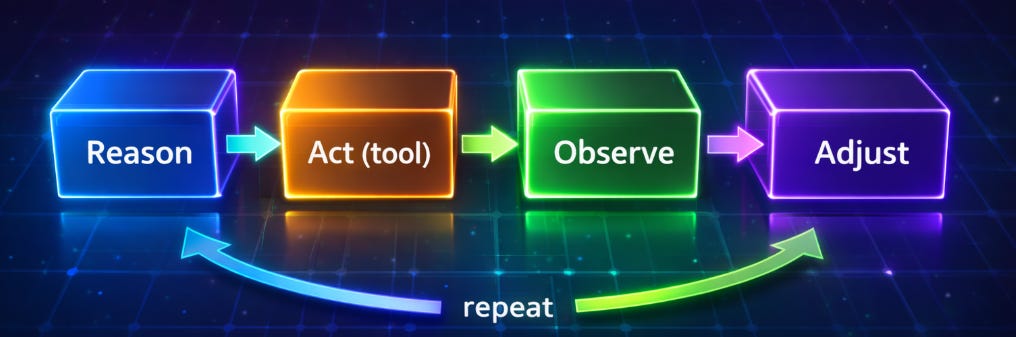
ReAct represents the foundational open-ended control loop for tool-augmented reasoning. It operationalizes adaptive reasoning by tightly coupling decision-making with real-time tool execution and feedback.
1. Path:
Reason → Act (tool) → Observe → Adjust → repeat.
2. Definition:
ReAct Agent is a smart helper that doesn’t just generate quick answers. It thinks step by step, takes actions, and then adjusts based on what it sees.
The name ReAct comes from two things it does:
Reasoning → It stops to think: “What’s the next smart step?”
Acting → It does something, like looking something up, running a calculation, or using a tool.
Then it observes the result and adjusts its plan before moving forward.
So instead of guessing all at once, it’s like a detective working clue by clue.
3. How it works (loop):
Reason (think aloud): break the problem into sub-steps.
Act (call a tool): search, retrieve, calculate, query an API.
Observe (read tool output).
Adjust (update the plan and repeat).
4. Example of a ReAct Agent in Action: Booking a Flight
Let’s say you ask the agent: “Book me a flight to Paris in June from JFK airport”
Here is how the agent responds:
(Reason):“Okay, to plan a trip, I need flights, hotels, and things to do.”
(Act):It searches for flight options.
(Observe):Finds flights are too expensive → Adjusts the plan.
(Adjust):Checks alternative dates and/or other airports.
(Reason again):“Better flights available two days later. Let’s pick that.”
(Act):Confirms the alternative dates with you then books the flights if you accept an alternative date.
Rather than producing a one-shot response, the agent iteratively reasons, verifies, and adapts.
5. Where Reflection Agent Delivers the Greatest Value:
Tool-using tasks that need tight feedback (search → summarize → verify).
Retrieval-Augmented Generation (RAG) with citations. (We will explore RAG in detail in an upcoming article).
Multi-step analytics (e.g., “find 3 policy changes, compute impact, summarize risks”).
6. Advantages of ReAct Pattern:
You get transparent answers (it shows its steps).
It can use tools like calculators, databases, or APIs.
It avoids big mistakes because it keeps checking itself.
Controllable, debug-able, and adaptable to guardrails.
7. Risks inherent in ReAct Agents:
ReAct agents are powerful because they can think and act together, but that also makes them risky. Here are the main risks you should know about:
Hallucination Risk: The agent might “make things up” when reasoning.
Excessive Action Loops:The agent might get stuck in a loop of actions (search → think → search → think forever).
Tool Misuse: It might call the wrong tool or use a tool incorrectly.
Security & Privacy Risks: If connected to sensitive systems (databases, emails, payments), it could accidentally leak or misuse data.
Unpredictable Costs: Because the agent may generate multiple model calls and tool requests, token usage and compute costs can escalate unexpectedly.
8. Risk Mitigation Techniques & Methods:
Guardrails & Policies: Define clear rules on what the agent can and cannot do. Example: Allowed: Search public web. Not Allowed: Touch payroll system.
Stop Conditions: Set a maximum number of steps or retries to avoid infinite loops. Example: If more than 5 tool calls, stop and escalate to human.
Validation & Factchecking: Cross-check important outputs before acting.Example: If it finds a flight price, compare against two sources before booking.
Human-in-the-Loop: For high-risk actions, require human approval. Example: AI drafts an email, but a person hits “Send.”
Sandboxing: Test the agent in a safe, limited environment before giving real access. Example: Use Unit Testing environment and User Acceptance Testing environment before promoting to production environment.
Monitoring & Logging: Track what the agent does for audits and troubleshooting. Example: Review the audit logs that explain how the agent reached a decision and create dashboards to monitor its activities.
9. To Recap:
A ReAct agent resembles a chess player: it thinks about the next move, makes the move, looks at what happened, and then decides what to do next.
Design Pattern 2: Reflection
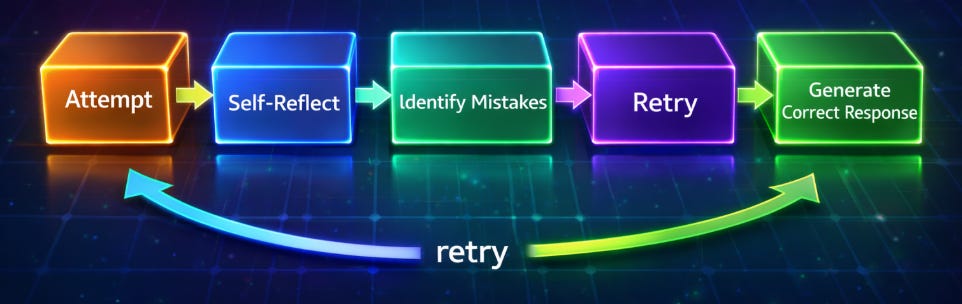
Reflection institutionalizes self-improvement by embedding structured critique and iterative refinement directly into the reasoning loop.
1. Path:
Attempt → Self-Reflect → Identify Mistakes → Retry → Generate Correct Response
2. Definition:
A Reflection Agent is an AI system that improves its own output by reviewing, critiquing, and refining its work before delivering a final response. Instead of producing a one-shot answer, it follows an iterative loop — attempt, self-evaluate, correct, and retry — enabling higher quality, reduced errors, and structured self-improvement over time.
3. How Reflection Agent works (loop):
Attempt task
Self-reflect to identify errors/gaps
Produce a refined strategy
Retry with that guidance and corrections until it gets a better result
4. Example of Reflection Agent in Action: Writing a Short Essay
You ask the agent: “Write me a short essay about climate change.”
Here is how the agent thinks and behaves:
Attempt: The Reflection Agent writes 2 paragraphs.
Review: It checks: “Oops, I forgot to mention renewable energy. Also, my conclusion is weak.”
Retry: It rewrites the essay, adding renewable energy and a stronger ending.
You get a better essay because it learned from its own critique.
5. Where Reflection Agent Delivers the Greatest Value:
Tasks with tests, evaluators, unit checks.
Long-form outputs that benefit from post-hoc critique (analysis, code fixes).
Iterative research or planning with a “review → revise” cadence.
6. Advantages of Reflection Pattern:
Great for tasks where quality matters (essays, reports, code).
Keeps improving without needing a human to correct every small error.
More reliable than “one-shot” answers.
Rapid quality lift, structured improvement as it uses cheap “reflection” tokens instead of brute-force retries.
7. Inherent Risks:
Reflection Agents are powerful because they can learn from their mistakes, but that also means they can accidentally learn the wrong lessons, overthink, or overload themselves.
Bad Notes = Bad Habits: If the agent writes down the wrong lesson (“2+2 = 5”), it will repeat that mistake again and again.
Overthinking Loop: The agent might spend too much time reflecting instead of just doing the task, slowing everything down and increasing the inference costs.
Memory Overload: If it stores too many reflections, it may become confused or inconsistent, resembling a notebook filled with disorganized notes.
Bias Reinforcement: If its first reflections are biased or flawed, it might keep reinforcing them instead of correcting.
Security & Privacy Risks: Reflections might contain sensitive info (like user data) that shouldn’t be stored long-term.
8. Risk Mitigation Techniques & Methods
Validation of Reflections:Check if the “note to self” makes sense before saving it. Example:Double-check with another model or a set of rules.
Limit Memory:Don’t let it store unlimited reflections. Use only the most recent or the most relevant notes.
Human-in-the-Loop:For critical decisions, a human reviews the reflection. Example: AI drafts “lesson learned,” but a human approves it before the AI reuses it.
Guardrails & Rules:Set boundaries for what the agent can reflect on. Example:“Don’t reflect on personal user data. Only reflect on task performance.”
Sandbox Testing:Let the agent practice in a safe environment before using reflections in real-world tasks.
Monitoring & Logging:Track what the agent writes in its reflection notebook, so you can detect and fix problems early.
9. Recap:
Reflection is the diligent student who red pens their own essay, then rewrites it better. Use it when you can measure improvement between drafts.
Design Pattern 3: Research Agent (Browse–Synthesize)
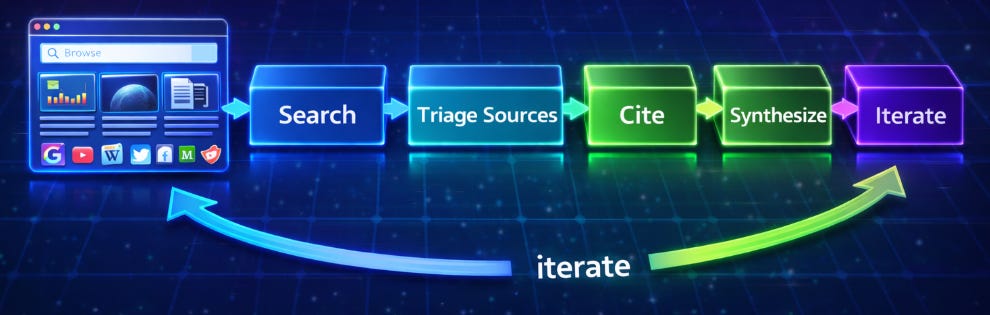
The Research Agent transforms open-ended inquiry into structured intelligence through iterative retrieval, evaluation, and synthesis across diverse information sources.
1. Path:
Search → Triage Sources → Cite → Synthesize → Iterate
2. Definition:
Open-Ended Research Agent (Browse–Synthesize) is an AI agent designed to explore broad or loosely defined goals by autonomously searching, retrieving, evaluating, and synthesizing information from multiple sources.
Unlike linear workflow agents, it does not follow a rigid sequence of steps. Instead, it iteratively refines its understanding, expands or narrows scope dynamically, and produces structured insights from heterogeneous data sources.
It is particularly suited for discovery, analysis, and knowledge generation tasks where the answer is not predefined and the path to insight is adaptive.
3. How It Works:
At a high level, the agent follows an adaptive loop:
Goal Interpretation:Parse the user’s high-level objective and break it into research sub-questions.
Browse / Retrieve:Perform search queries by accessing APIs, databases, or documents and collect relevant information and data.
Evaluate & Filter:Rank source credibility, remove duplicates or low-quality content and detect contradictions.
Synthesize:Extract themes, compare perspectives and generate summaries or structured outputs.
Refine & Expand:Identify knowledge gaps, launch additional searches and iterate until stopping criteria is met.
This loop continues until confidence thresholds, time limits, or quality standards are satisfied. In architecture terms, it typically includes:
Planner LLM
Retrieval module (search tools, RAG pipelines)
Memory store (temporary + persistent)
Synthesis model
Optional human oversight checkpoints
4. Example of the Agent in Action:
Use Case: Strategic AI Adoption Landscape Analysis
Goal: “Analyze how large financial institutions are implementing Agentic AI and identify emerging governance patterns.”
Agent Behavior:
It breaks objective into sub-areas (governance, tooling, regulatory alignment, ROI evidence)
It searches industry reports, regulatory releases, thought-leadership articles
It retrieves policy documents and public case studies
It compares approaches across institutions
It identifies recurring themes (risk controls, human oversight, phased deployment)
It synthesizes findings into:
This is not a single search result. It is structured research with layered synthesis.
5. Where Research Agent Delivers the Greatest Value:
Open-ended research agents are strongest in environments where:
The problem space is ambiguous
Multiple viewpoints must be compared
The solution requires synthesis, not extraction
Emerging domains lack clear structured answers
Thought leadership or strategic insight is needed
6. Typical applications:
They are particularly powerful for knowledge workers, strategists, researchers, and leadership teams.
Competitive intelligence
Regulatory analysis
Academic research
Market landscape reports
Policy comparison studies
Innovation scouting
7. Advantages of Research Agents
Exploratory Intelligence: Can investigate unknown terrain rather than execute fixed steps.
Multi-source Reasoning: Aggregates insights across diverse documents and perspectives.
Iterative Refinement: Improves research depth through self-directed follow-up queries.
Structured Synthesis: Produces organized outputs: tables, frameworks, executive briefs.
Scalability: Can review hundreds of documents faster than human researchers.
Adaptive Scope: Expands or narrows research dynamically based on findings.
9. Inherent Risks
Because these agents operate with high autonomy in open environments, several risks emerge:
Hallucinated Synthesis:May blend inaccurate or weak sources into confident conclusions.
Source Credibility Risk:Cannot always distinguish peer-reviewed research from opinion blogs.
Confirmation Bias Amplification:If poorly guided, may overweight initial direction.
Information Overload:May generate overly broad or unfocused outputs.
Data Contamination:May incorporate outdated, misleading, or adversarial content.
Governance Blind Spots:Without controls, it may research or surface restricted information.
9. Risk Mitigation Strategies
1. Source Ranking & Attribution:Require citation tracking, display confidence scores, and prioritize authoritative sources.
Human-in-the-Loop Review:Executive checkpoint before publication and analyst validation of synthesized insights.
Guardrails & Domain Constraints:Restrict data source and apply allow list and filter prohibited topics.
Iteration Limits & Stopping Criteria:Define research depth boundaries and avoid runaway exploration
Fact-Verification Layer:Cross-check claims across multiple sources and use contradiction detection prompts
Memory Governance:Control what is stored persistently and audit trails for retrieval activity
10. Recap
An Open-Ended Research Agent (Browse–Synthesize) is a discovery-oriented AI system designed for adaptive exploration and structured synthesis across diverse information sources.
It differs from workflow agents in that it:
Does not follow a fixed sequence
Iteratively refines research direction
Expands or narrows scope dynamically
It excels in strategic analysis, market intelligence, regulatory research, and thought leadership generation.
However, its strengths—autonomy, breadth, and synthesis—also introduce risks related to hallucination, bias, credibility assessment, and governance.
With proper guardrails, human oversight, source attribution, and stopping controls, it becomes a powerful knowledge amplifier, especially in complex, ambiguous problem spaces.
Design Pattern 4: Multi-Agent Collaboration (Swarm / Team-of-Agents)
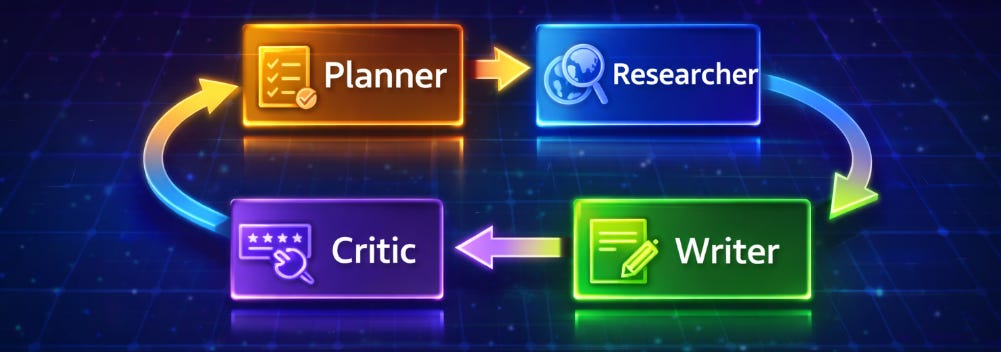
1. Path
decompose → parallel work → synthesize → critique → iterate → deliver
2. Definition:
A Multi-Agent Collaboration system (Swarm / Team-of-Agents) is an agentic architecture where multiple specialized AI agents work together toward a shared objective. It distributes cognition across specialized roles to simulate structured deliberation, internal challenge, and collective reasoning.
Instead of one model doing everything, responsibilities are divided into explicit roles such as:
Planner → decomposes objectives
Researcher → gathers evidence
Critic → evaluates reasoning and quality
Writer / Synthesizer → produces structured output
This mirrors high-performing human teams:Specialization + Coordination + Review cycles.
3. How It Works
The system typically follows a structured collaboration loop:
Planner:Interprets the goal, breaks it into sub-tasks, assigns responsibilities, and defines success criteria.
Researcher(s):Retrieve data and analyze sources and produce structured findings.
Writer / Synthesizer:Drafts output and structures narrative and integrates research into coherent form.
Critic / Reviewer:Evaluates logic, checks factual consistency, identifies gaps or weak reasoning and requests revisions.
Iterative Refinement:Agents loop until quality threshold is met and final output delivered
Under the hood, this often includes:
Shared memory space
Message passing between agents
Role-specific prompts
Orchestrator that manages turn-taking
Optional human checkpoints
4. Where It Delivers the Greatest Value
Multi-agent collaboration excels in:
Complex, multi-dimensional problems
High-quality content generation
Strategic analysis
Research + critique workflows
Decision support systems
Software design and code review
Policy drafting
It is particularly strong where quality assurance and structured reasoning are required.
5. Advantages
Specialization Improves Depth: Each agent focuses on a defined cognitive role.
Built-in Self-Critique: Critic agents reduce hallucination and weak reasoning.
Parallelization: Multiple researchers can operate simultaneously.
Structured Deliberation: Enables debate-like reasoning.
Higher Output Quality: Multiple passes often produce more robust outputs.
Transparency of Reasoning: Clear traceability of which agent contributed what.
6. Inherent Risks
Despite its strengths, swarm systems introduce new complexity risks:
Coordination Overhead: Too many agents can create inefficiency or message bloat.
Amplified Errors: If flawed assumptions originate early (Planner stage), all agents may propagate them.
Emergent Groupthink: Agents may converge prematurely without meaningful critique.
Cost & Latency: Multiple LLM calls significantly increase computational cost and response time.
Governance Complexity: Tracking decisions across agents complicates auditability.
Role Drift: Agents may deviate from assigned specialization without strict prompting.
7. Risk Mitigation Strategies
Clear Role Contracts: Strict prompt boundaries, defined input/output formats, and explicit evaluation criteria.
Orchestrator Control Layer: Central coordination, turn-based communication, and stop conditions.
Independent Critic Agent: Separate model instance, different prompting style, and contradiction detection.
Budget & Iteration Limits: Cap message rounds and token usage.
Logging & Traceability: Persist decision trails and attribute conclusions to source agents.
Human Oversight Gate: Final validation before deployment.
8. Recap
A Multi-Agent Collaboration (Swarm / Team-of-Agents) system distributes intelligence across specialized AI roles: Planner, Researcher, Critic, Writer. This creates a structured deliberation environment.
It differs from single-agent systems by:
Introducing specialization
Enabling internal debate
Reducing single-point reasoning failures
It excels in complex strategic, analytical, and content-heavy tasks where quality and robustness matter more than speed.
However, its power comes with tradeoffs: increased orchestration complexity, higher cost, latency, and governance challenges.
With strong orchestration, defined roles, logging, and human checkpoints, multi-agent collaboration becomes a powerful AI equivalent of a high-performance advisory team.
Design Pattern 5: The Voyager
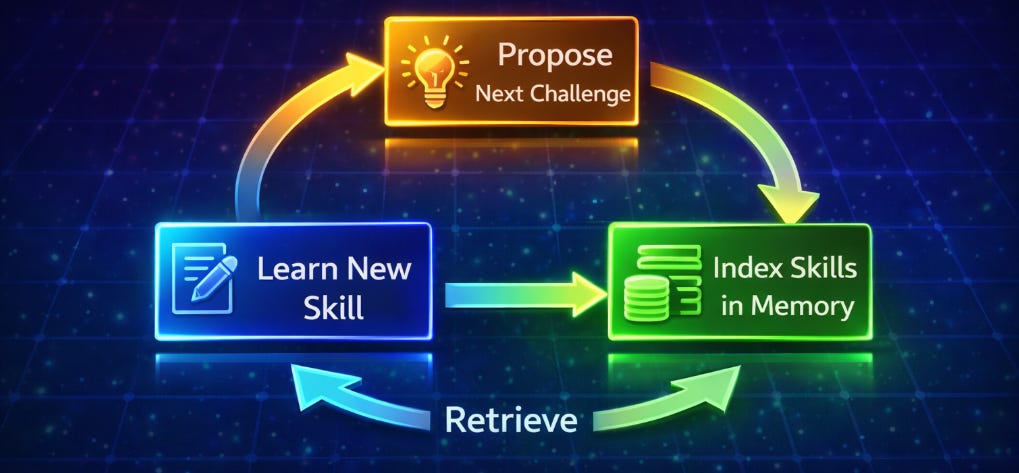
Voyager introduces compounding capability by converting task execution into persistent skill accumulation and long-term strategic learning.
1. Path
Propose Challenge → Attempt → Reflect → Extract Skill → Store & Index → Retrieve & Reuse → Expand Frontier → Repeat
2. Definition
Voyager represents a new class of AI agents designed for continuous improvement. With every new task it undertakes, the agent does more than simply produce an output — it extracts lessons from the experience.
Those lessons are then structured, indexed, and stored as reusable “skills” that can be retrieved and applied to future challenges.
Over time, this growing library enables the agent to operate with increasing speed, sophistication, and efficiency.
Unlike conventional agents that effectively reset after each task, a Voyager-style system compounds its capabilities. It does not merely execute. It evolves.
In essence, Voyager transforms task completion into capability accumulation.
3. Where It Delivers the Greatest Value
Voyager-style agents are particularly powerful in environments where repetition leads to refinement and accumulated expertise. They excel in:
Repetitive, structured domains where reusable skills compound in value (e.g., ETL workflows, recurring analytical tasks, validation routines, policy compliance checks)
Progressive knowledge base development, where outputs evolve into structured assets including playbooks, reusable macros, optimized prompts, modular code snippets, and procedural templates
In these contexts, performance improves not just through execution, but through systematic capability accumulation. Over time, the agent becomes increasingly efficient, consistent, and strategically aligned with the domain it operates within.
4. Advantages
Voyager-style agents derive their power from cumulative intelligence rather than isolated execution. Their strengths include:
Compounding capability growth: Each completed task expands the agent’s toolbox, creating measurable returns over time.
Long-term learning orientation: Designed to retain, structure, and reuse knowledge across engagements.
Experience-driven improvement: Performance improves with exposure, enabling greater efficiency and sophistication.
Error reduction over time: By reflecting on prior attempts and codifying lessons learned, the agent minimizes repeated mistakes.
High suitability for recurring domains: Particularly effective in environments characterized by repeated workflows such as data analysis, customer service interactions, software development, and operational processing.
In essence, the more it works, the more valuable it becomes.
5. Inherent Risks
Voyager-style agents are designed for iterative, step-by-step learning. This enables continuous improvement and long-term capability accumulation.
However, the same mechanisms that drive growth can introduce meaningful risks if not properly governed.
While these agents become more capable over time, they may also internalize flawed assumptions, pursue inefficient learning paths, or accumulate unnecessary complexity.
Key risks include:
Skill Overload: As the agent accumulates reusable skills, its internal library can become cluttered with redundant, low-value, or poorly generalized capabilities. Without periodic pruning and optimization, performance and clarity may degrade.
Learning the Wrong Lesson: If early outputs are incorrect and subsequently codified as reusable skills, the agent may institutionalize flawed logic. Errors can compound over time if validation controls are insufficient.
Unpredictable Exploration Paths: Exploratory learning can lead agents into irrelevant or low-priority areas. Without directional constraints, learning cycles may consume resources without advancing strategic objectives.
Slower Goal Achievement: Trial-and-error refinement improves robustness but may delay final outcomes. In time-sensitive environments, this iterative approach must be carefully balanced with delivery expectations.
Security and Safety Exposure: In sensitive or regulated environments, unconstrained learning poses operational and compliance risks. Agents interacting with production systems or real data require strict boundaries and oversight.
6. Risk Mitigation Methods and Techniques
Voyager-style agents must operate within a controlled framework that balances autonomy with accountability.
Effective safeguards include:
Structured learning pipelines with defined objectives
Skill validation and approval mechanisms
Bounded exploration parameters
Periodic checkpoints and performance audits
Human oversight for high-impact decisions
Continuous monitoring and governance controls
7. Recap
The Voyager pattern represents the shift from task execution to capability accumulation. Rather than completing a task and resetting, the agent extracts lessons from each experience, converts them into reusable skills, and stores them in structured memory for future retrieval. Over time, this creates compounding intelligence: performance improves not just because the model reasons better, but because it remembers better. Voyager transforms isolated outputs into a growing strategic asset — turning learning into leverage and repetition into refinement.
Article Recap and Takeaways
As agentic systems evolve from structured workflows to adaptive exploration and cumulative learning, the real differentiator is no longer raw model capability — it is architectural intent.
ReAct refines reasoning through action. Reflection strengthens quality through self-critique. Research agents expand insight through adaptive discovery. Multi-agent systems institutionalize deliberation. Voyager compounds capability over time.
Each pattern represents a deliberate choice about autonomy, governance, and strategic ambition.
The organizations that will lead in the agentic era will not simply deploy smarter models — they will design smarter control systems.
Intelligence may power the engine, but architecture determines the destination.

Explore more: Start Here · Topics · Archive · About