


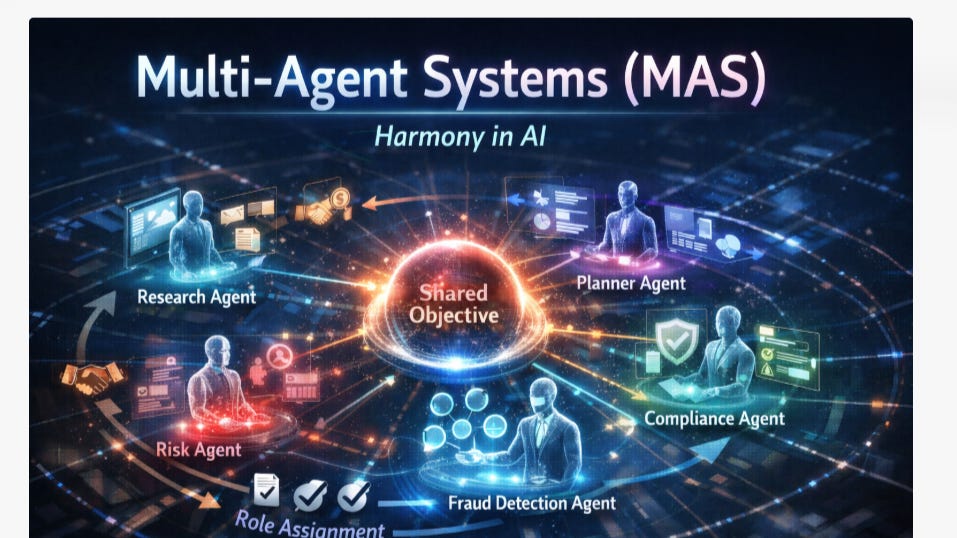
In this module we will introduce Multi-Agent Systems (MAS).They represent one of the most powerful design patterns in Agentic AI, where multiple autonomous agents collaborate, coordinate, or even compete to achieve complex goals.
Instead of relying on a single model to handle every step of a process, MAS distributes tasks among specialized agents—each with unique roles, expertise, and decision-making abilities.
This approach enables dynamic teamwork, negotiation, and collective intelligence, making systems more resilient, scalable, and adaptive.
From financial risk analysis teams to enterprise-wide simulations and fraud detection networks, MAS mirrors real-world organizations by leveraging diversity and cooperation to solve problems more effectively than any single agent could alone.
Key Concepts
A Multi-Agent System (MAS) is a network of autonomous agents that interact with each other.
Each agent can be:
Collaborative (working together toward a shared goal).
Competitive (competing for resources or outcomes).
Coordinated (synchronizing tasks for efficiency).
The Key Idea behind Multi-Agent Systems
Instead of one powerful agent doing everything, Multi-Agent Systems distribute intelligence across multiple specialized agents.
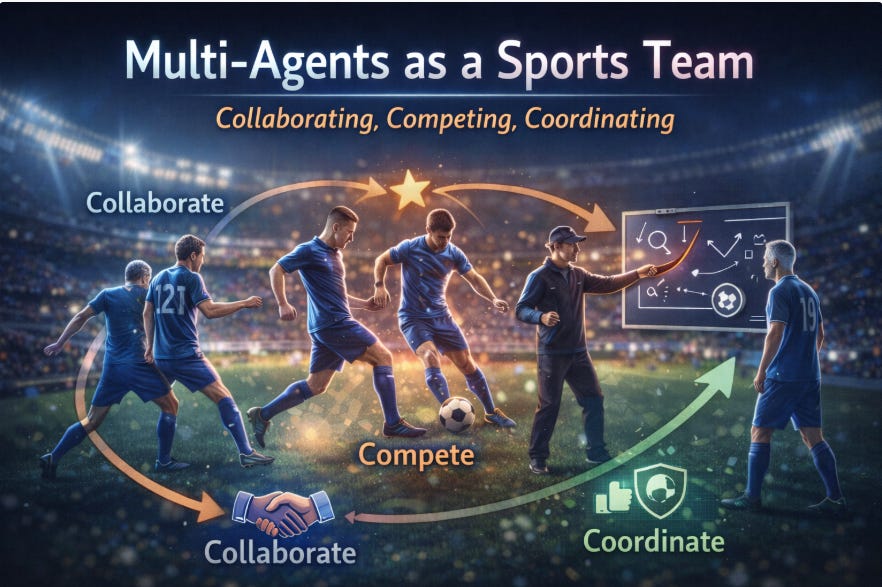
Analogy 1: A Sports Team
The players (agents) each have unique roles.
Sometimes they collaborate to score goals.
Sometimes they compete internally for starting positions.
They coordinate strategies with the coach to win the game.
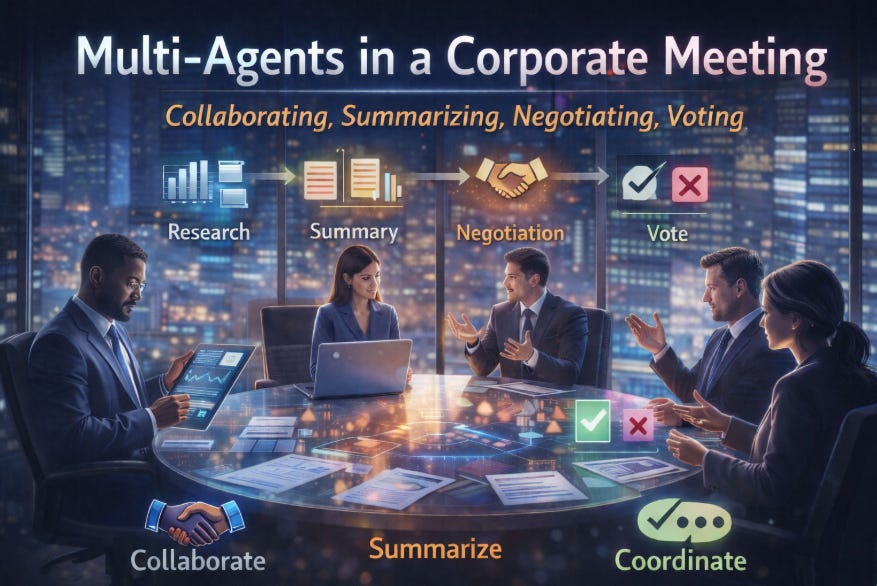
Analogy 2: A Corporate Meeting
Some participants research data.
Others summarize findings.
Some negotiate priorities.
Finally, the team votes on a decision.
Multi-Agent Systems - Interaction Categories
1. Role Assignment
Assign agents specific functions based on expertise. Example roles:
Researcher Agent: Gathers raw data.
Summarizer Agent: Converts data into digestible insights.
Planner Agent: Decides next steps.
Implementation:
Roles are defined at design-time or dynamically based on context.
Implementation can be rule-based (“if task requires fact-finding → assign researcher”).
Implementation can also be self-adaptive (agents self-select roles).
2. Negotiation Protocols
Agents may have different goals and therefore need structured negotiation.
Techniques include:
Contract Net Protocol: One agent announces a task, others bid to perform it.
Bilateral Bargaining: Two agents make offers and counteroffers until agreement.
Coalition Formation: Groups of agents join forces to achieve larger objectives.
Analogy: Corporate departments negotiating budgets: Finance, Marketing, and IT each push their priorities, but negotiation rules ensure a final compromise.
3. Voting Systems
When multiple agents propose solutions, collective decision-making is required. Voting methods include:
Majority Vote: Simple, fast, but can ignore minorities.
Ranked Choice: Agents rank options → balances preferences.
Weighted Vote: Expert agents get more influence.
Example: Risk assessment and fraud detection agents vote on whether a transaction is suspicious; the final outcome is a consensus score.
Enterprise Use Case Examples
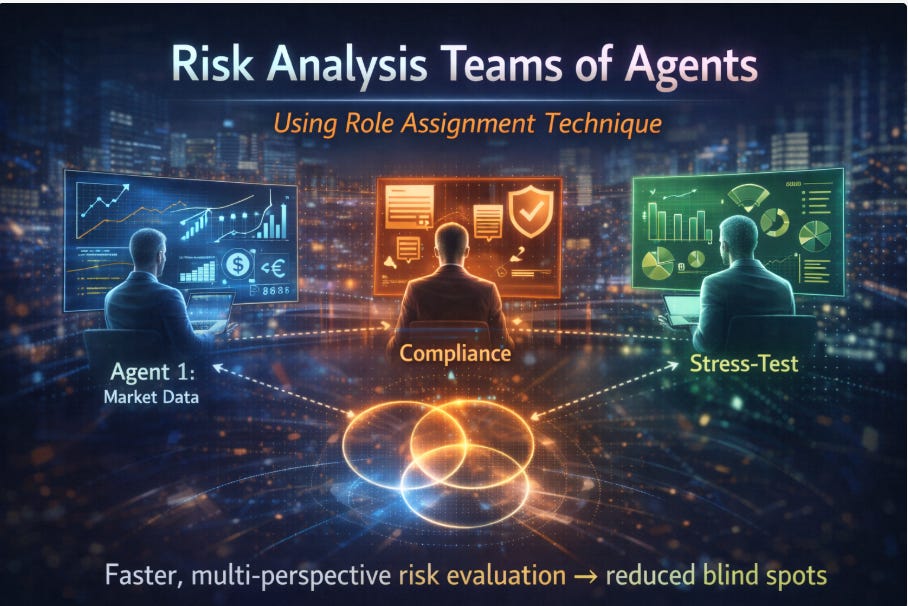
1. Risk Analysis Team of Agents Using Role Assignment Technique
The roles of participating agents:
Agent 1:Collects market data.
Agent 2:Evaluates regulatory compliance.
Agent 3: Runs stress-test scenarios.
Benefit: Faster, multi-perspective risk evaluation → reduced blind spots.
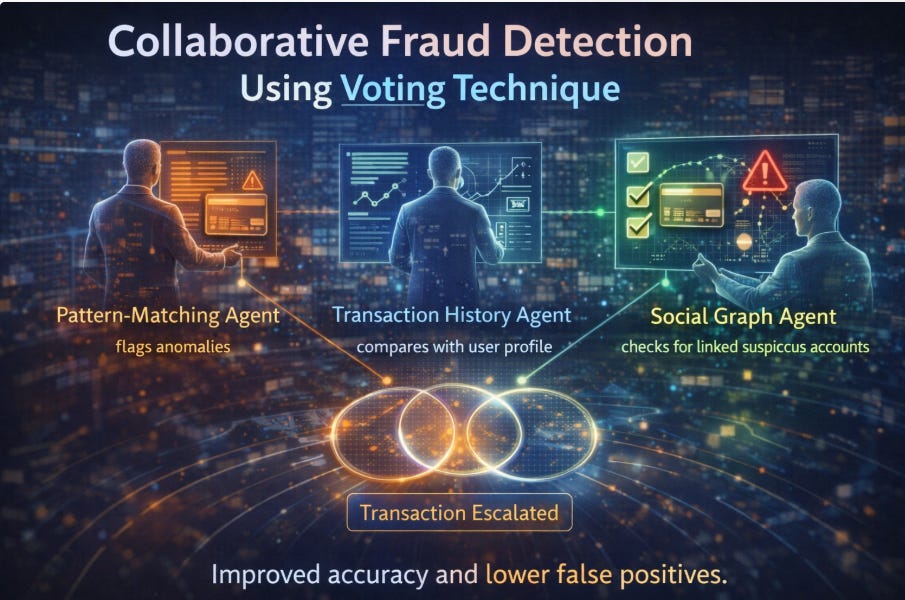
2. Collaborative Fraud Detection Using Voting Technique
Scenario: Detecting credit card fraud.
Agents involved:
Pattern-Matching Agent (flags anomalies).
Transaction History Agent (compares with user profile).
Social Graph Agent (checks for linked suspicious accounts).
Decision: If multiple agents raise flags, the transaction is escalated.
Benefit: Improved accuracy, faster decision-making, and lower false positives.
3. Dynamic Vendor Contract Optimization in Procurement Using Negotiation Technique
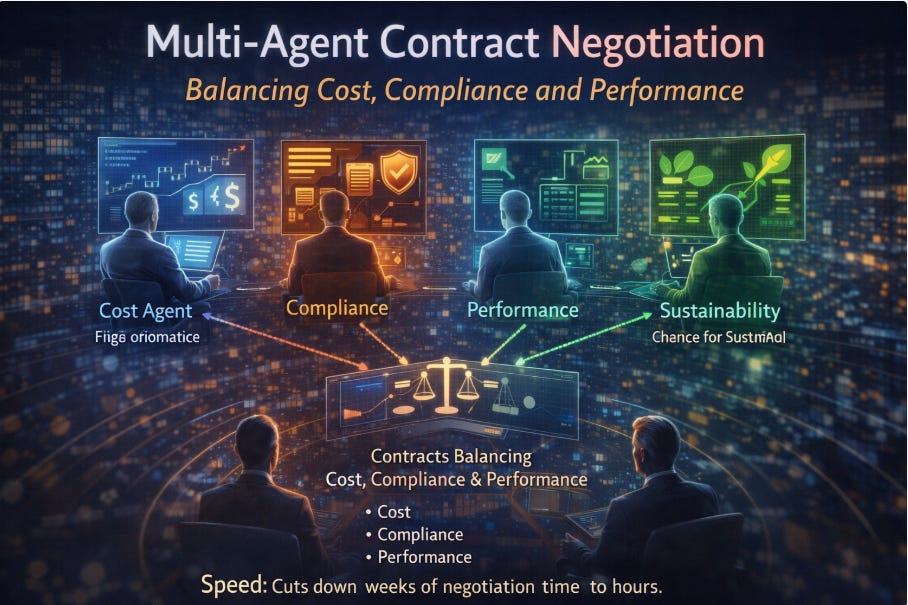
A global bank is negotiating contracts with multiple software vendors who provide cloud services, security tools, and data analytics platforms. The goal is to minimize costs, maximize service reliability, and ensure regulatory compliance.
How Agents Negotiate
Cost Agent: Prioritizes minimizing subscription and licensing fees.
Compliance Agent: Ensures vendors meet legal, regulatory, and data privacy requirements.
Performance Agent: Focuses on uptime, scalability, and integration speed.
Sustainability Agent: Advocates for vendors with green IT practices (increasingly a board priority).
These agents represent different stakeholder perspectives within the enterprise.
Outcome
The system converges on a contract structure that balances cost, compliance, performance, and sustainability.
The final decision is then presented to human executives for approval.
Business Benefits
Speed: Cuts down weeks of back-and-forth vendor negotiations to hours.
Balance: Prevents one department’s priorities (like cost-cutting) from overpowering others (like compliance).
Auditability: Logs every negotiation round → provides transparent reasoning for regulators and auditors.
Risks & Governance Considerations in Multi-Agent Systems
Multi-Agent Systems unlock remarkable capabilities, but their power comes with responsibility. As enterprises deploy MAS in high-stakes environments like financial risk, fraud detection, and procurement, understanding the failure modes is as important as understanding the benefits.
1. Coordination Failures and Deadlocks
When agents hold conflicting objectives or insufficient information, they may fail to converge on a decision.
A deadlocked negotiation between a Cost Agent and a Compliance Agent, for example, doesn't just slow things down in time-sensitive financial contexts; it can mean missed risk signals or delayed transaction reviews.
Mitigation Techniques:
Design explicit escalation protocols that trigger when agents fail to converge within a defined time window or iteration threshold.
Introduce adedicated Arbitration Agent or a human-in-the-loop escalation path as a tiebreaker of last resort.
Timeout mechanisms should be treated as first-class design requirements, not edge case handling.
Contract Net Protocolimplementations should include bid expiration rules that prevent indefinite negotiation cycles.
2. Error Propagation Across Agent Chains
Unlike a single-model system where errors are contained, MAS architectures pass outputs between agents sequentially.
A flawed data collection by a Researcher Agent doesn't stay isolated; it flows downstream into the Summarizer, the Planner, and ultimately the decision layer.
This cascading effect amplifies the impact of what might appear to be a minor upstream error.
Mitigation Techniques:
Implement inter-agent validation checkpoints at each handoff stage, where receiving agents assess the quality and confidence of inputs before processing them.
Adopt confidence scoring so that low-certainty outputs trigger a verification loop rather than passing downstream unchallenged.
Considerredundant parallel agents for critical data collection tasks, cross-validating their output before any downstream agent consumes them, a pattern similar to maker-checker controls already familiar in financial services operations.
3. Misaligned Agent Objectives
Each agent in a MAS is optimized for its own objective function.
Without strong coordination governance, a well-intentioned Cost Agent can systematically crowd out the Compliance Agent's signals.
This is particularly dangerous in regulated industries like banking, where a cost-optimized vendor contract that ignores data residency requirements can trigger regulatory sanctions.
Mitigation Techniques:
Explicitly encode priority hierarchies within the system's coordination logic, establishing that certain agent objectives, particularly compliance and regulatory adherence, carry veto weight that cannot be overridden by aggregated preferences from other agents.
Define non-negotiable constraint boundaries at design time, so that cost or performance optimization only operates within a pre-approved compliance envelope.
Regularly audit agent decision patterns to detect objective drift, where an agent's effective behavior diverges from its intended design over time.
4. Opacity in Collective Decision-Making
The auditability of individual agent logs does not automatically translate into explainability of collective outcomes.
As agent count scales and interaction rounds multiply, reconstructing the exact reasoning path behind a decision becomes exponentially complex.
Regulators and auditors expect clear, traceable explanations, not just raw logs.
Model Risk Management frameworks like SR 11-7 will increasingly scrutinize whether MAS decision trails meet explainability standards, particularly when used in credit, fraud, or capital allocation decisions.
Mitigation Techniques:
Architect a dedicated Decision Provenance Layer that captures not just what each agent decided, but why: including the inputs considered, the alternatives evaluated, and the weighting applied.
Adopt structured reasoning templates for each agent type so that outputs are consistently formatted for downstream audit consumption.
Conduct regular explainability stress tests where compliance or model risk teams attempt to reconstruct a decision trail from logs alone, using the gaps they find to drive design improvements.
Where possible, favor interpretable coordination mechanisms over black-box ensemble methods.
5. Voting Mechanism Blind Spots
Majority and weighted voting systems can silence statistically minority-but-correct agent signals.
In fraud detection, the agent that flags an unusual but subtle behavioral pattern may be outvoted by agents seeing no anomaly in isolation.
This creates a dangerous false confidence in consensus outcomes, where the system appears decisive but has systematically suppressed its most sensitive signals.
Mitigation Techniques:
Replace pure majority logic with confidence-weighted escalation protocols, where any agent registering a high-certainty flag, even as a minority voice, automatically triggers human review rather than being absorbed into consensus.
Implement dissent logging, ensuring that minority agent positions are recorded and periodically reviewed to assess whether they were systematically correct in cases that later proved to be true positives.
Calibrate voting weights dynamically based on each agent's historical accuracy in similar decision contexts, rather than relying on static role-based weighting assigned at design time.
6. Human Oversight Boundaries
Perhaps the most critical governance question is: where exactly does the agent network stop and human judgment begin?
The absence of a clearly defined human-in-the-loop threshold isn't an implementation detail; it is a governance failure waiting to happen.
In high-impact decisions, autonomous agent consensus is not a substitute for accountable human judgment.
Mitigation Techniques:
Define and document Human Oversight Trigger Conditions at system design time, specifying the decision types, risk thresholds, and confidence levels that mandate human review before any action is taken or recommendation is surfaced.
Adopt a tiered autonomy model:low-risk, high-confidence decisions can proceed autonomously; medium-risk decisions surface to a human reviewer for approval; high-risk or low-confidence decisions escalate to senior oversight with full decision provenance attached.
Review and recalibrate these thresholds regularly as the system accumulates operational history and as the regulatory landscape evolves.
The Governance Imperative - Closing Thoughts
MAS is not a technology decision alone; it is an organizational and governance-level decision.
Enterprises that treat agent coordination as purely an engineering problemwill eventually encounter the moment where a well-designed system produces an outcome that looks compliant but is incorrect, with no clear accountability trail.
The same diversity and specialization that makes MAS powerful also makes it susceptible to collective blind spots that no single agent would have produced alone.
Designing for resilience means building in contestability: the ability for any agent, any human reviewer, and any auditor to challenge, override, and learn from the system's decisions.
In the end, a Multi-Agent System is only as trustworthy as the governance framework surrounding it.

Explore more: Start Here · Topics · Archive · About