


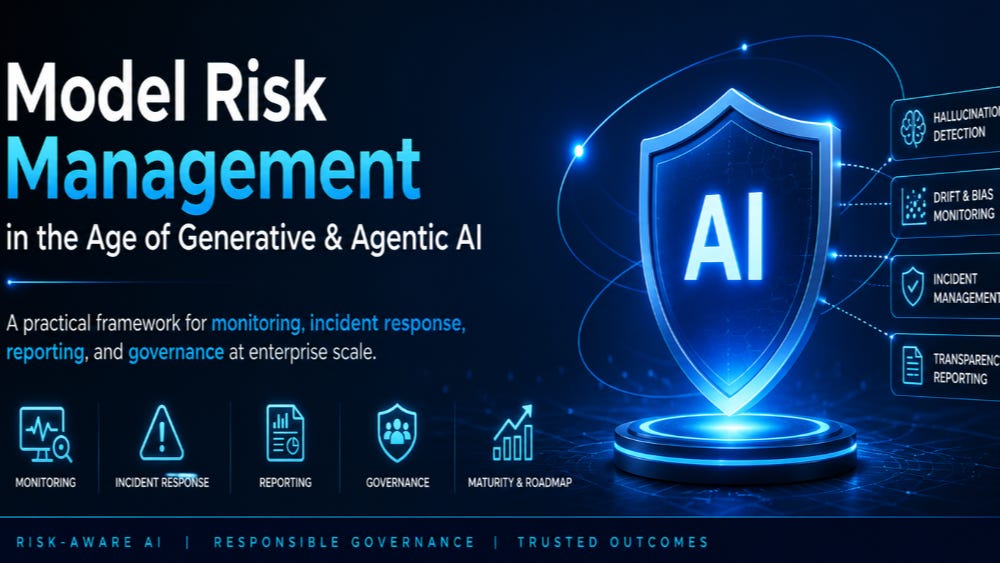
Most organizations investing in Generative and Agentic AI focus their governance energy on the front end: model selection, validation, and initial deployment. But the harder question, and the one regulators will ask first, is what happens after go-live. How do you detect hallucinations in production? What does your incident classification look like when an agentic system executes an unauthorized action? And how do you measure whether your MRM program is actually maturing, or simply existing? In this third installment of the MRM for Generative and Agentic AI series, we move from framework design into operational reality, covering the monitoring dimensions that SR 11-7 and the EU AI Act demand, the incident response protocols that distinguish a resilient AI program from a reactive one, and the five-level maturity model that gives institutions a clear roadmap from ad hoc deployments to regulatory excellence. If your AI systems are live, this is where governance gets real.
This article walks through how to monitor AI systems across seven critical dimensions, how to classify and respond to AI incidents by severity, how to structure risk reporting from the MRM function to the board, and how to assess and advance your institution's MRM maturity through a phased implementation roadmap.
1. AI Monitoring Framework
Post-deployment monitoring is where MRM governance translates into operational risk management. For AI systems, monitoring must cover a broader surface area than traditional models and must be capable of detecting qualitative degradation in output quality, not just quantitative performance drift.
Monitoring Dimensions:
1.1 Hallucination Rate
What to Measure:Frequency of outputs containing factual errors or ungrounded claims
Detection Methods:Automated fact-checking model; sampled human review
1.2 Output Quality
What to Measure:Adherence to format, tone, completeness, and accuracy requirements
Detection Methods:Rubric-based sampling; user feedback signals; LLM-based evaluation (automated evaluator)
1.3 Input Distribution Drift
What to Measure:Changes in the distribution of inputs that may move the model outside its validated operating range
Detection Methods:Statistical distribution monitoring; semantic clustering of inputs
1.4 Anomalous Tool Use (For Agentic AI)
What to Measure:Unexpected or unauthorized tool invocations; tool use patterns deviating from validated behavior profiles
Detection Methods:Tool invocation logging; deviation from behavioral baseline
1.5 Latency and Availability
What to Measure:Response time; error rates; API availability (for third-party models)
Detection Methods:Infrastructure monitoring; API health checks
1.6 Bias Signal Monitoring
What to Measure:Changes in output patterns across demographic groups; differential error rates
Detection Methods:Demographic parity monitoring; regular bias audit sampling
1.7 User Override Rate
What to Measure:Frequency with which human reviewers reject or override AI outputs; indicator of output quality and automation bias
Detection Methods:Override logging; trend analysis
2. Incident Classification and Response
AI incidents require a specialized classification and response framework that accounts for the unique characteristics of Generative and Agentic AI failures.
The following incident classification framework is recommended:
2.1 Severity: P1 Critical
Definition:AI system causes or has a high probability of causing material financial harm, regulatory violation, or client injury
Example:Agentic system executes unauthorized financial transactions; LLM provides materially incorrect regulatory guidance acted upon by the business
Initial Response SLA: Immediate;System suspension within 15 minutes; executive notification within 30 minutes
2.2 Severity: P2 High
Definition: AI system produces outputs with significant quality issues or demonstrates anomalous behavior with material risk potential
Example:Elevated hallucination rate detected; prompt injection attempt identified; significant bias signal in regulated decision outputs
Initial Response SLA:Enhanced monitoring within 1 hour; business owner notified; assessment within 4 hours
2.3 Severity: P3 Medium
Definition:Output quality degradation or behavioral anomaly without immediate material impact; monitoring threshold breach
Example:Output consistency declining; user override rate increasing; third-party model performance degradation
Initial Response SLA:Investigation within 24 hours; model owner review; corrective action plan within 5 days
2.4 Severity: P4 Low
Definition:Minor quality issues, isolated incidents, or observations that require tracking but not immediate action
Example:Individual hallucination in low-stakes context; formatting inconsistency; user-reported minor error
Initial Response SLA:Logging and trend tracking; included in periodic model review
3. Risk and Incident Reporting Requirements
AI risk reporting must provide governing bodies with sufficient visibility to exercise meaningful oversight. Reports should be calibrated to the audience and frequency appropriate to each governance layer:
3.1 Board / Risk Committee (Quarterly)
AI risk landscape overview; material incidents and near-misses in the period; new high-risk deployments approved; regulatory developments affecting AI risk; AI risk appetite metrics vs. thresholds
3.2 AI Governance Committee (Monthly)
Model inventory additions and retirements; validation findings and open issues; monitoring metric summaries; incident register; vendor model change notifications; policy exception requests
3.3 CRO / CAIO (Weekly)
Active incident status; monitoring metric trends; emerging risk signals; resource and capacity issues in MRM function
3.4 Model Risk Management (Ongoing)
Real-time monitoring dashboards; alert queues; validation pipeline status; change request tracking
4. The Generative and Agentic AI MRM Maturity Model
Institutions at different stages of AI adoption will have different levels of MRM maturity. The following maturity model provides a structured framework for assessing current capability and planning the path to a fully mature AI risk management program:
4.1 Level 1: Initialized
Characteristics:Ad hoc AI deployments; limited awareness of model risk implications; no specialized framework
MRM Capabilities Present:Basic model inventory may exist; some validation activity; no AI-specific policies
Priority Gaps to Address:Immediate: inventory all AI deployments; establish AI risk policy; identify highest-risk systems
4.2 Level 2: Developed
Characteristics:AI-specific policies emerging; risk tiering framework in place; validation methodology being built
MRM Capabilities Present:AI inventory established; risk tiering applied; hallucination testing incorporated; basic monitoring
Priority Gaps to Address:Near-term: agentic AI governance; third-party model policy; red-team capability; monitoring automation
4.3 Level 3: Defined
Characteristics:Comprehensive AI MRM framework in place; consistent application across business lines; monitoring is operational
MRM Capabilities Present:Full validation methodology; red-team program; bounded autonomy framework; incident classification; reporting
Priority Gaps to Address:Medium-term: advanced bias monitoring; multi-agent governance; regulatory examination readiness; MLOps integration
4.4 Level 4: Managed
Characteristics:Quantitative risk metrics for all AI systems; proactive risk identification; regulatory engagement on AI risk
MRM Capabilities Present:Quantitative monitoring; predictive risk indicators; regulatory-grade documentation; hub-and-spoke fully operational
Priority Gaps to Address:Advanced: AI-powered MRM (using AI to monitor AI); continuous validation; industry thought leadership
4.5 Level 5: Optimized
Characteristics:Industry-leading AI risk management; continuous improvement; regulatory excellence; competitive advantage through responsible AI
MRM Capabilities Present:Automated validation pipelines; real-time risk quantification; regulatory partnership; cross-industry benchmarking
Priority Gaps to Address:Sustaining: regulatory leadership; external publication; MRM as enabler of accelerated responsible AI adoption
5. Implementation Roadmap
The following phased roadmap provides a practical path from initial state to a mature AI MRM capability. The timeline is indicative and should be adjusted based on the institution's current maturity, resource availability, and risk profile.
5.1 Phase 1 (Months 1-3): Foundation
Key Deliverables:Complete AI inventory; adopt AI risk policy; apply risk tiering to all active deployments; identify top 10 highest-risk systems for priority validation
Success Metrics:100% of AI systems inventoried; risk tier assigned to all systems; policy approved by governance
5.2 Phase 2 (Months 3-6): Validation Capability
Key Deliverables:Develop Generative AI validation methodology; build red-team capability; conduct priority validation of Tier 3+ systems; establish monitoring baselines
Success Metrics:Validation methodology documented; red-team program operational; top 10 systems validated; monitoring dashboards live
5.3 Phase 3 (Months 6-12): Governance Maturity
Key Deliverables:Implement hub-and-spoke governance; deploy prompt change management controls; launch third-party model assessment program; establish incident classification and response
Success Metrics:Governance structure operational; all prompt changes subject to controls; vendor assessments complete for top providers; incident playbooks tested
5.4 Phase 4 (Months 12-18): Operational Excellence
Key Deliverables:Automate monitoring and alerting; integrate AI validation into MLOps pipeline; conduct examination readiness assessment; publish internal AI risk metrics
Success Metrics:Monitoring automation exceeds 70%; validation fully integrated into deployment pipeline; examination-ready documentation for all Tier 2+ systems
5.5 Phase 5 (Months 18-24): Continuous Improvement
Key Deliverables:Implement quantitative risk scoring; launch AI-powered monitoring capability; engage regulators proactively; benchmark against industry peers
Success Metrics:Quantitative risk scores for all systems; continuous validation operational; regulatory engagement meetings scheduled
6. Critical Success Factors
Executive Sponsorship:AI MRM transformation requires active executive support. The CRO and Chief AI Officer must jointly sponsor the program and visibly prioritize it against competing business pressures.
Cross-Functional Alignment:AI risk management cuts across technology, business, legal, compliance, and risk functions. A siloed MRM function cannot govern AI effectively. Cross-functional working groups and shared accountability are essential.
Talent and Capability Building:Effective AI validation requires a new skill profile: practitioners who combine traditional model risk expertise with AI/ML technical fluency. Investment in training, hiring, and partnership with external experts is critical.
Technology Enablement:The volume and complexity of AI monitoring exceed the capacity of manual processes. Institutions must invest in monitoring platforms, evaluation tooling, and eventually AI-powered risk management capabilities.
Regulatory Engagement:Proactive engagement with regulators, sharing the institution's AI governance framework and inviting regulatory feedback, builds credibility and reduces the risk of examination findings.
Conclusion
Production governance is where Model Risk Management proves its value or exposes its gaps. In this article, we covered the monitoring framework that keeps Generative AI and Agentic AI systems under continuous oversight, a four-tier incident classification protocol designed for the unique failure modes of Generative systems, and the reporting cadence that gives every governance layer the visibility needed to exercise meaningful oversight. We closed with a five-level maturity model and a phased 24-month implementation roadmap that gives institutions a structured path from ad hoc deployments to operational excellence. The takeaway is straightforward: deploying Generative AI responsibly does not end at validation. It begins there. The institutions that build these capabilities into their governance DNA will not only satisfy regulatory expectations but also turn responsible AI into a competitive advantage.

Explore more: Start Here · Topics · Archive · About