



Ask almost any financial institution whether Artificial Intelligence (AI) is paying off and the answer is yes. NVIDIA's 2026 State of AI in Financial Services survey of more than 800 industry professionals found that 89% say AI is helping increase revenue and lower operating costs.
Yet Broadridge's 2026 Digital Transformation and Next-Gen Technology Study, covering more than 900 financial services technology and operations leaders, found that only 28% of firms are seeing benefits or returns from their generative AI investments, and only 25% from agentic AI.
Both numbers can be true at once. The gap between them is the gap between believing AI works and proving it works. That is a measurement problem, and in a regulated industry it quickly becomes a credibility problem.
MIT's Project NANDA, a research initiative at the MIT Media Lab, framed the issue sharply in its 2025 report,
The GenAI Divide: State of AI in Business 2025. In its research sample, 95% of organizations saw no measurable return from generative AI, while about 5% of integrated pilots were extracting millions in value. The researchers pointed to brittle workflows, weak contextual learning, and poor fit with daily operations rather than model quality. They also found the largest returns in back-office automation, not in the sales and marketing tools where more than half of budgets were going. That is good news for finance, risk, and treasury functions, but only if we measure value properly.
1. Why "Hours Saved" Is the Wrong Headline
Most AI business cases start and end with one number. A tool saves each analyst 30 minutes a day, multiply by 2,000 analysts and a loaded hourly cost, and a pilot is suddenly worth tens of millions of dollars. The math is simple. The problem is that almost none of that money ever appears in the Profit and Loss (P&L) statement. Four reasons:
Saved time is not saved money. Unless hours are redeployed to measurable work, avoided in hiring, or removed from a contractor or outsourcing bill, the cost base does not change.
The numbers are usually self-reported. Users estimate savings in surveys, and estimates run high.
There is no counterfactual. Volumes, staffing, and processes change during the same period, so a simple before and after comparison is contaminated.
Quality is ignored. A faster draft that needs heavier review, or introduces errors caught later, can cost more than it saves.
Hours saved is a useful leading indicator. It is not a return.
2. Count the Full Cost, Not Just the License
The denominator is often as wrong as the numerator. Pilot business cases usually include licenses and build effort. The full Total Cost of Ownership (TCO) of a production AI system in a bank includes much more:
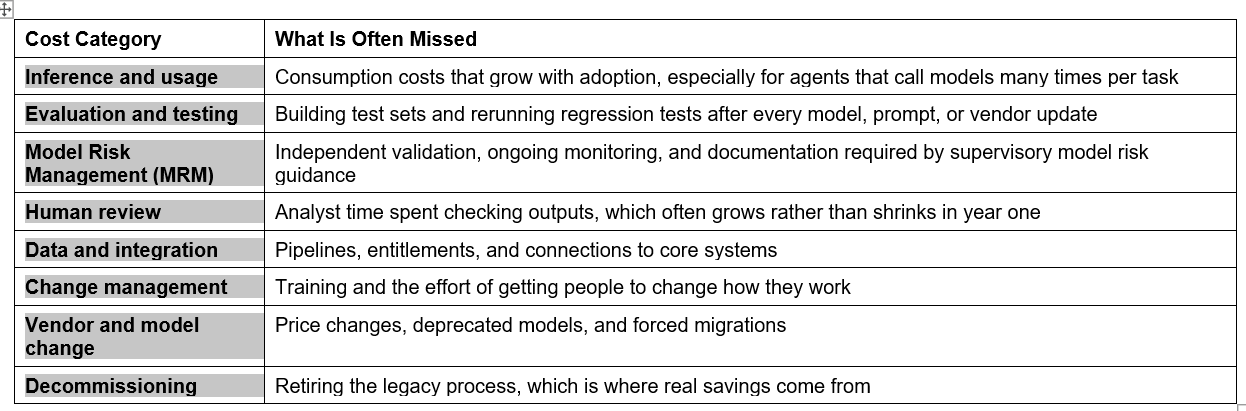
A simple rule: if the business case does not show year two and year three run costs, it is not a business case.
3. A Four-Layer AI Value Scorecard
Replace the single headline number with a scorecard that separates what is proven from what is hoped for.
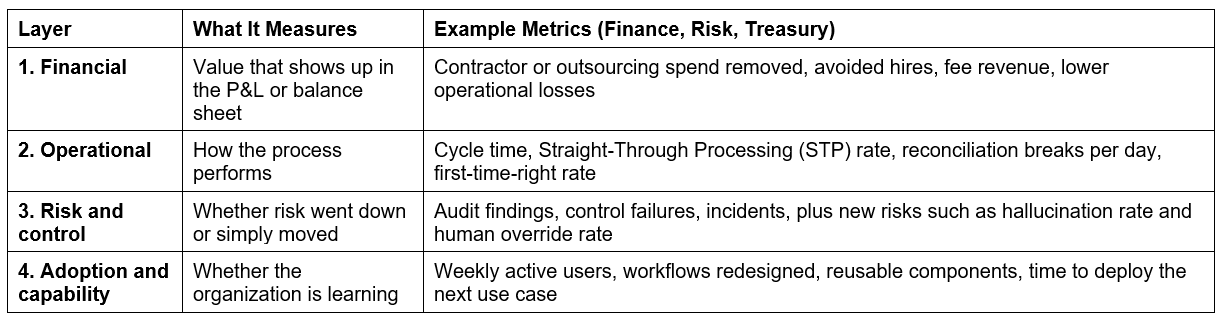
Only Layer 1 is return on investment. Layers 2 through 4 explain why Layer 1 will or will not happen. Reporting all four keeps everyone honest: strong adoption with no financial impact is a conversion problem, while financial impact with rising control failures is a risk problem.
4. Measure Against a Baseline, Not a Memory
Capture the baseline before go-live: cycle time, volumes, error rates, staffing, and unit cost (cost per reconciliation, per credit memo, per regulatory report).
Use a comparison group: roll out to one desk, region, or team first and compare it with teams still on the old process.
Normalize for volume: report cost per unit of work rather than total cost, because volumes swing.
Agree on the method with Finance before launch, not after the results arrive.
5. Separate Projected, Enabled, and Realized Value
Projected value: the estimate in the business case.
Enabled value: capacity the system has created, for example 4,000 analyst hours per quarter.
Realized value: what has actually left the cost base or been added to revenue, confirmed by Finance.
Most AI portfolios report projected or enabled value as if it were realized. Strong organizations track all three and make the business owner, not the AI team, accountable for turning enabled value into realized value. That conversion is a management decision (ending a contractor engagement, absorbing volume growth without hiring, redeploying a team), and no model can make it for you.
6. A Worked Example
Consider an AI assistant that drafts commentary for the monthly finance variance analysis. The figures below are illustrative.

The honest number is roughly a third of the headline. It is also the one that survives scrutiny from the Chief Financial Officer (CFO) and Internal Audit, and it is the number that keeps funding flowing next year.
7. Agentic AI Changes the Math
• Cost per task, not cost per seat: agents call models, tools, and data sources many times, so track the cost of each completed task.
• Price in the cost of failure: an agent that books an entry, sends a payment instruction, or changes a limit can cause losses. Expected losses from errors belong in the return calculation.
• Human oversight is a real cost: approval steps reduce risk but also reduce savings, so design them deliberately rather than by default.
• Measure completed work: the right unit is a task completed correctly without rework, not the number of agent actions.
8. Five Questions Every Board Should Ask
1. How much of the reported value is realized and confirmed by Finance, versus projected or enabled?
2. What is the full run cost in years two and three, including validation, monitoring, and human review?
3. What was the baseline, and was there a comparison group?
4. What new risks did the system introduce, and how are they measured?
5. Who in the business owns turning freed capacity into financial results?
Closing Thought
AI does create value in financial services. The firms that keep investing will be the ones that can prove it in terms a CFO, a Chief Risk Officer (CRO), and a regulator will accept. Hours saved starts the conversation. Realized, risk-adjusted, unit-cost results finish it.
Your turn: how does your organization measure AI value today, and which of the four layers is hardest to report? Share your experience in the comments.
Explore more: Start Here · Topics · Archive · About