


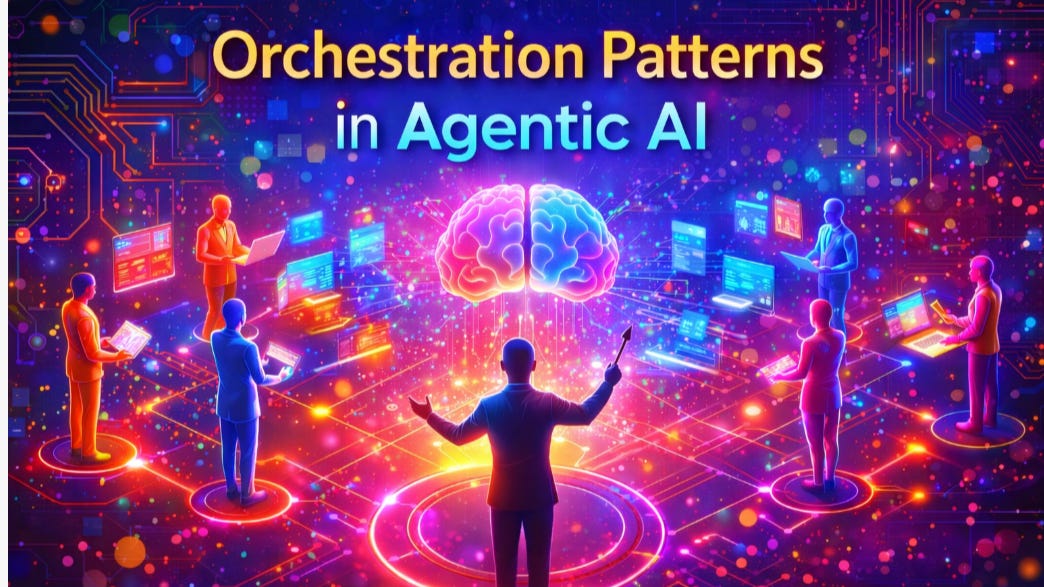
There is a moment in every enterprise AI journey when a single, powerful model simply is not sufficient. Real-world challenges are multi-layered, data-intensive, and governed by processes that no single intelligence can navigate alone. This is where Agentic AI moves beyond conventional automation into a more compelling paradigm: coordinated collaboration of specialized AI agents working in concert toward a shared goal.
But collaboration without structure is chaos. And that is where orchestration becomes the defining architectural discipline of enterprise-grade agentic systems. In this article, I share a framework I have developed as part of my Agentic AI curriculum.
This framework covers eight core orchestration patterns that practitioners must understand to design, govern, and scale agentic workflows.
This article also explores leading industry frameworks that support Agentic AI Orchestration: LangGraph, CrewAI, and AutoGen.
What Is Orchestration, and Why Does It Matter?
Orchestration is the discipline of coordinating multiple AI agents so that they collaborate effectively, activate at the right time, communicate without confusion, and produce outcomes that are aligned with enterprise objectives. Think of it as a conductor standing before an orchestra: without that conductor, even the most gifted musicians produce noise rather than music.
An orchestration system is built on three foundational components:
Orchestrator: The central brain that receives the high-level request, decomposes it into sub-tasks, assigns those tasks to the appropriate agents, and synthesizes the results into a coherent output.
Agents: Specialized AI units with a defined role, a set of tools, and a bounded scope of responsibility. In a financial services context, you might have a Data Retrieval Agent, a Risk Assessment Agent, and a Report Generation Agent operating within the same workflow.
Tools and APIs: The instruments that allow agents to interact with the external world, whether by accessing a database, triggering an API call, sending communications, or performing calculations.
The power of orchestration lies in its ability tounlock emergent capabilities across coordinated agents. No single agent needs to know everything.Instead, each agent does what it does best, and the orchestrator ensures the whole is greater than the sum of its parts.
The Eight Core Orchestration Patterns
I have identified eight foundational orchestration patterns that are most commonly used in robust agentic ecosystems. Each carries a distinct logic, a set of trade-offs, and a natural fit for specific enterprise use cases. Understanding these patterns is the difference between deploying agentic AI confidently and stumbling through expensive trial and error.
1. Centralized Orchestration
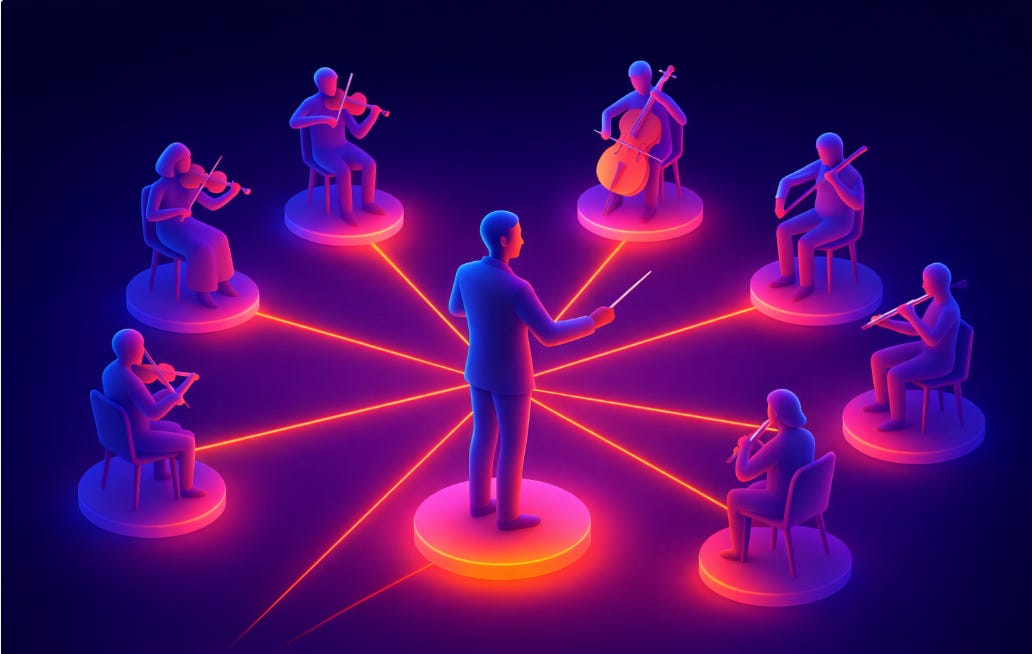
Analogy:
A conductor leading an orchestra where every musician looks at the conductor.
How it works:
A single controller or orchestrator agent delegates tasks to specialist agents or tools.
Pros:
Easy to monitor and debug
Consistent control and governance
Best suited for mission-critical systems (e.g., finance, compliance)
Cons:
Single point of failure
Can become a bottleneck at scale
Example Use Case:
Automated financial reporting where one master agent delegates data fetching, validation, formatting, and submission.
2. Decentralized Orchestration
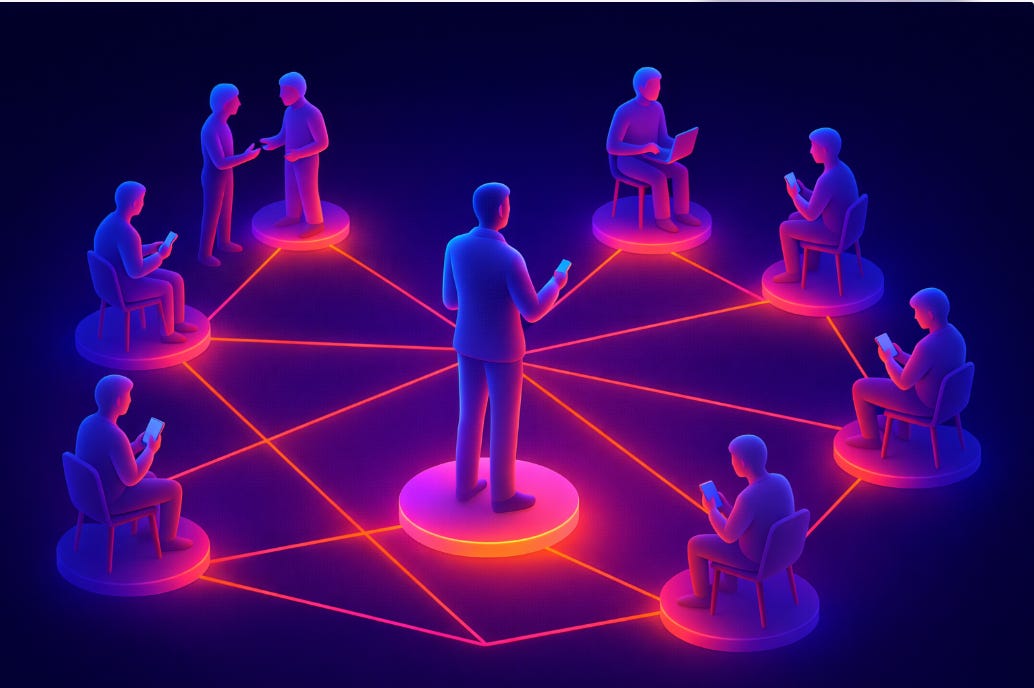
Analogy:
A jazz band improvising where each musician listens to others and adjusts in real time.
How it works:
Agents self-organize, communicate peer-to-peer, and coordinate decisions without a central authority.
Pros:
Scalable and fault-tolerant
More adaptive to unexpected situations
Enables emergent intelligence
Cons:
Harder to govern and debug
Risk of excessive inter-agent communication (infinite loops due to "agent gossip")
Example Use Case:
Fraud detection swarm where multiple agents monitor transactions, flag anomalies, and vote on suspicious activity.
3. Hybrid Orchestration
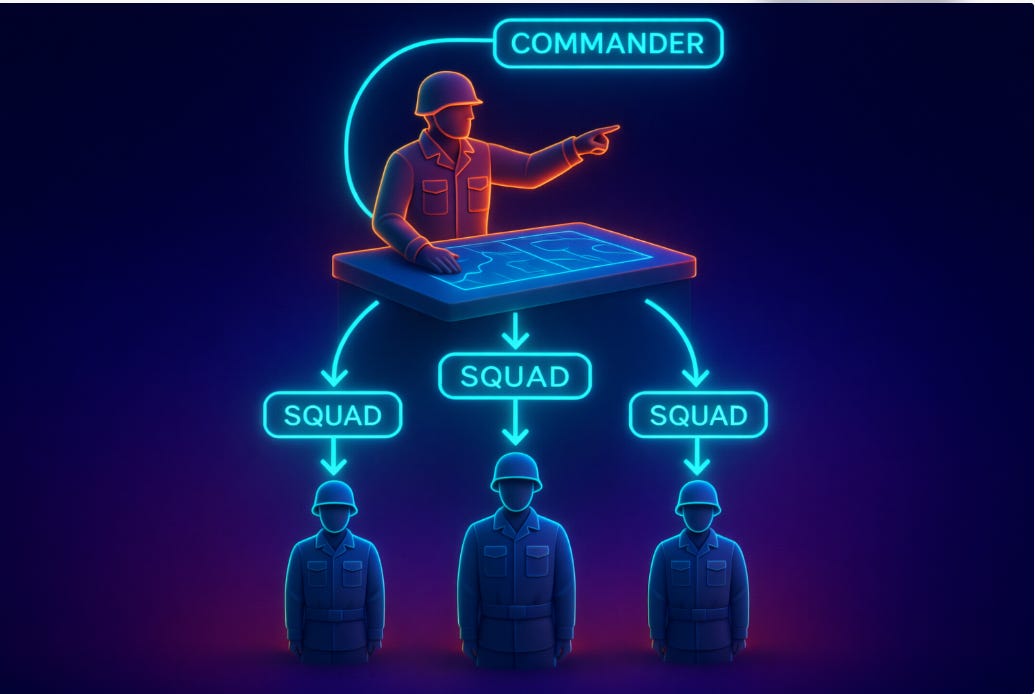
Analogy:
A military unit where a commander sets strategy, and squads adapt in the field.
How it works:
It combines centralized coordination for high-level goals with decentralized execution of sub-tasks.
Pros:
Balances control and adaptability
Prevents bottlenecks while maintaining oversight
Cons:
More complex to design and implement
Example Use Case:
A financial institution deploys a hybrid orchestration model to handle customer inquiries:
The Central Orchestrator (Control Layer): Receives the customer request, classifies intent (billing, fraud, general inquiry), and routes the task to the appropriate agent group.
Decentralized Agent Execution (Flexible Layer): Billing agents collaborate to retrieve invoices and explain charges. Fraud agents coordinate to analyze transactions and flag risks. Support agents dynamically pull FAQs or escalate to human support.
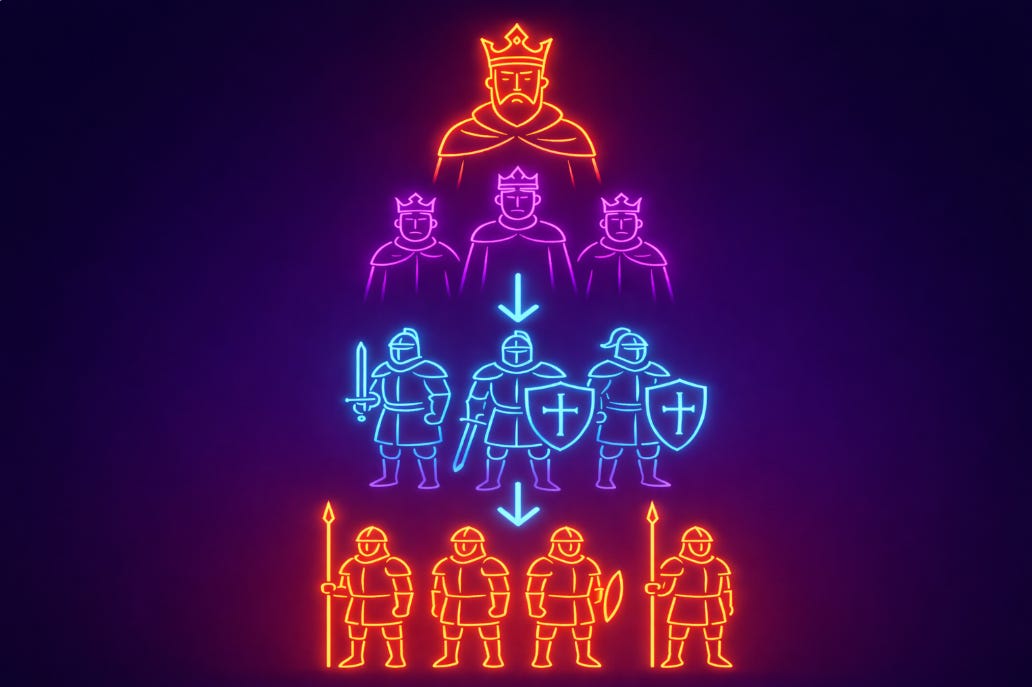
4. Hierarchical Orchestration
Analogy:
A medieval kingdom: King → Nobles → Knights → Soldiers.
How it works:
It uses a hierarchical structure of agents with task delegation from top-level to lower-level agents.
Pros:
Clear responsibility and accountability
Good for long, complex, multi-step workflows
Cons:
More complex to design and implement
Example Use Case:
Enterprise compliance reporting where a master orchestrator assigns sub-tasks to a Data Validation Agent, a Risk Scoring Agent, and a Report Generation Agent, each operating within its defined tier and reporting results back up the chain.
5. Event-Driven Orchestration
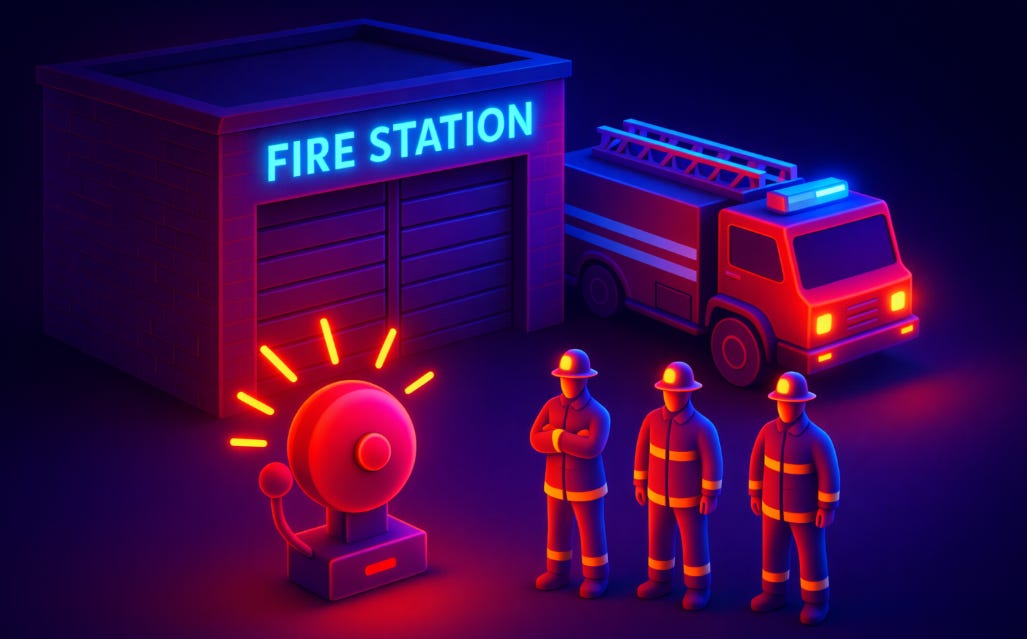
Analogy:Firefighters (agents) stay on standby. The fire alarm (event) triggers action. Once the alarm rings, the right units respond instantly. No action happens until an external signal arrives.
How it works:
Agents are triggered by events in a workflow (new data, API signals, or detected anomalies).
Pros:
Efficient and responsive
Scalable with asynchronous systems
Cons:
Requires robust monitoring and logging
Example Use Case:
Real-time risk management where agents only activate when market data crosses thresholds.
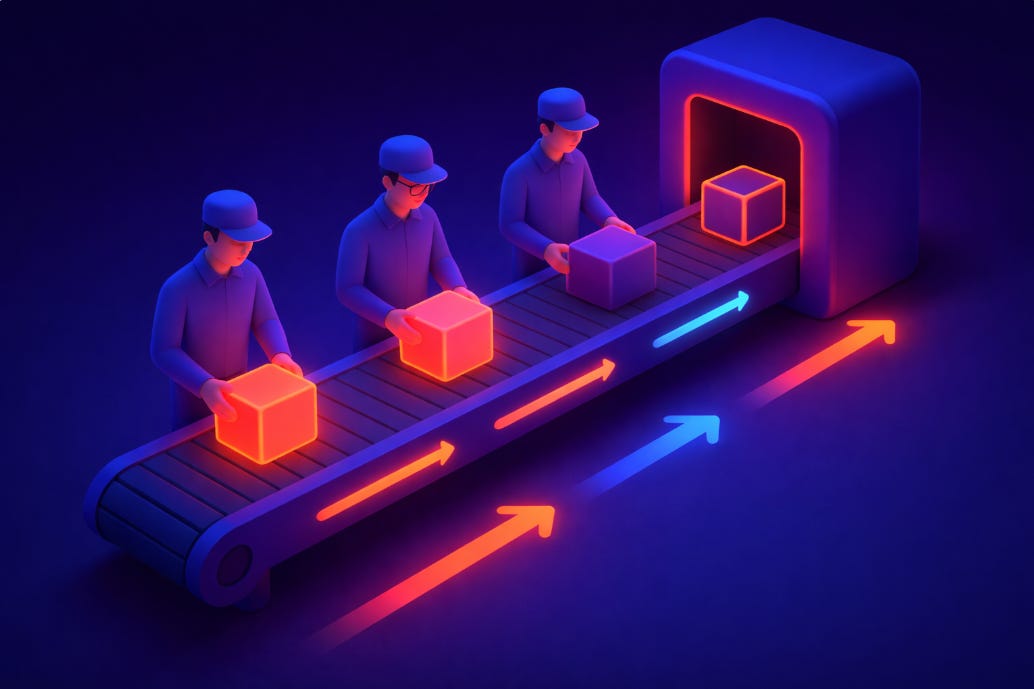
6. Sequential Pipeline Orchestration
Analogy:
A factory assembly line:
Each worker does one task in sequence.
The product moves forward step by step.
If one worker stops, the whole line halts.
How it works:
The output of one agent becomes the input for the next, like a linear assembly line.
Agents (or tools) are arranged in a strict sequence.
Each step must complete before the next begins.
It works best for multi-step processes such as data collection, analysis, and report formatting.
Pros:
Simplicity: Easy to design and reason about.
Predictability: Each step runs in a known order.
Traceability: Clear audit trail where you know exactly what happened at each stage.
Good for compliance-heavy flows (finance, healthcare).
This is ideal for scenarios where every step must occur in strict order and auditability is critical.
Cons:
Bottlenecks: If one step is slow, the whole pipeline waits.
Fragility: If one step fails, everything downstream breaks.
Lack of flexibility: No branching, adapting, or skipping steps.
Scalability limits: Cannot parallelize tasks easily.
Example Use Case:
Financial Document Processing:
Step 1: Extract data from regulatory filings (Agent 1).
Step 2: Validate data against rules (Agent 2).
Step 3: Summarize into a report (Agent 3).
Step 4:Format and export to compliance systems (Agent 4).
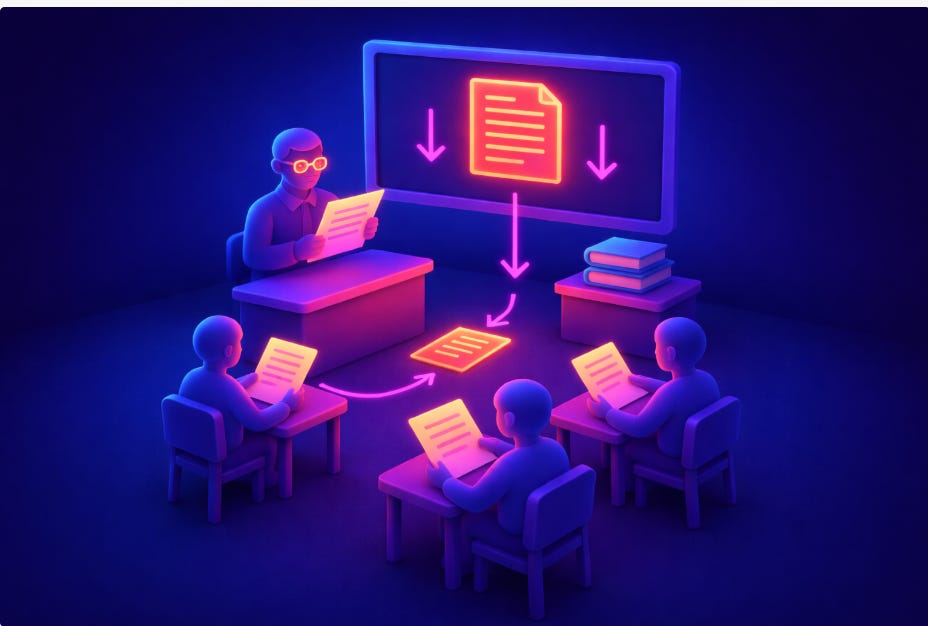
7. MapReduce Orchestration
Analogy:
A group project with a coordinator (teacher):
A teacher assigns a big report to the class.
Each student writes a section (Map phase).
The teacher (or editor) collects all sections and compiles them into one paper (Reduce phase).
Faster than one student writing everything, but requires a good editor to merge seamlessly.
How it works:
The task is split among multiple agents (map), and their results are then combined by a final agent (reduce).
Map Phase:A large task is broken into smaller sub-tasks and distributed to multiple agents. Each agent processes its portion in parallel.
Reduce Phase: Results are collected and combined by a coordinator agent into a final unified output.
It is inspired by distributed computing paradigms such as Hadoop and Spark.
Ideal for large-scale data analysis or parallel processing.
Pros:
Scalability: Can handle very large workloads efficiently by parallelizing.
Speed:Tasks are completed faster since they run simultaneously.
Modularity:Sub-tasks can be processed independently, even with different tools/agents.
Fault Tolerance:If one subtask fails, it can often be retried independently.
Cons:
Complexity:Requires a reduce step that can merge outputs correctly.
Overhead:Splitting and recombining tasks adds orchestration cost.
Limited to certain problems:Works best for tasks that can be naturally divided into smaller independent chunks.
Inconsistency risk:If sub-tasks vary in quality or timing, merging becomes harder.
Example Use Cases:
Customer Sentiment Analysis at Scale: Map:Split 1 million customer reviews into batches; multiple agents analyze sentiment in parallel. Reduce: Aggregate results into a dashboard showing % positive/negative/neutral.
Financial Risk Simulation: Run 10,000 parallel Monte Carlo scenarios, which are then combined into a risk distribution.
Document Summarization: Agents summarize chunks of a large report → a final agent merges into one executive summary.
8. Consensus Orchestration
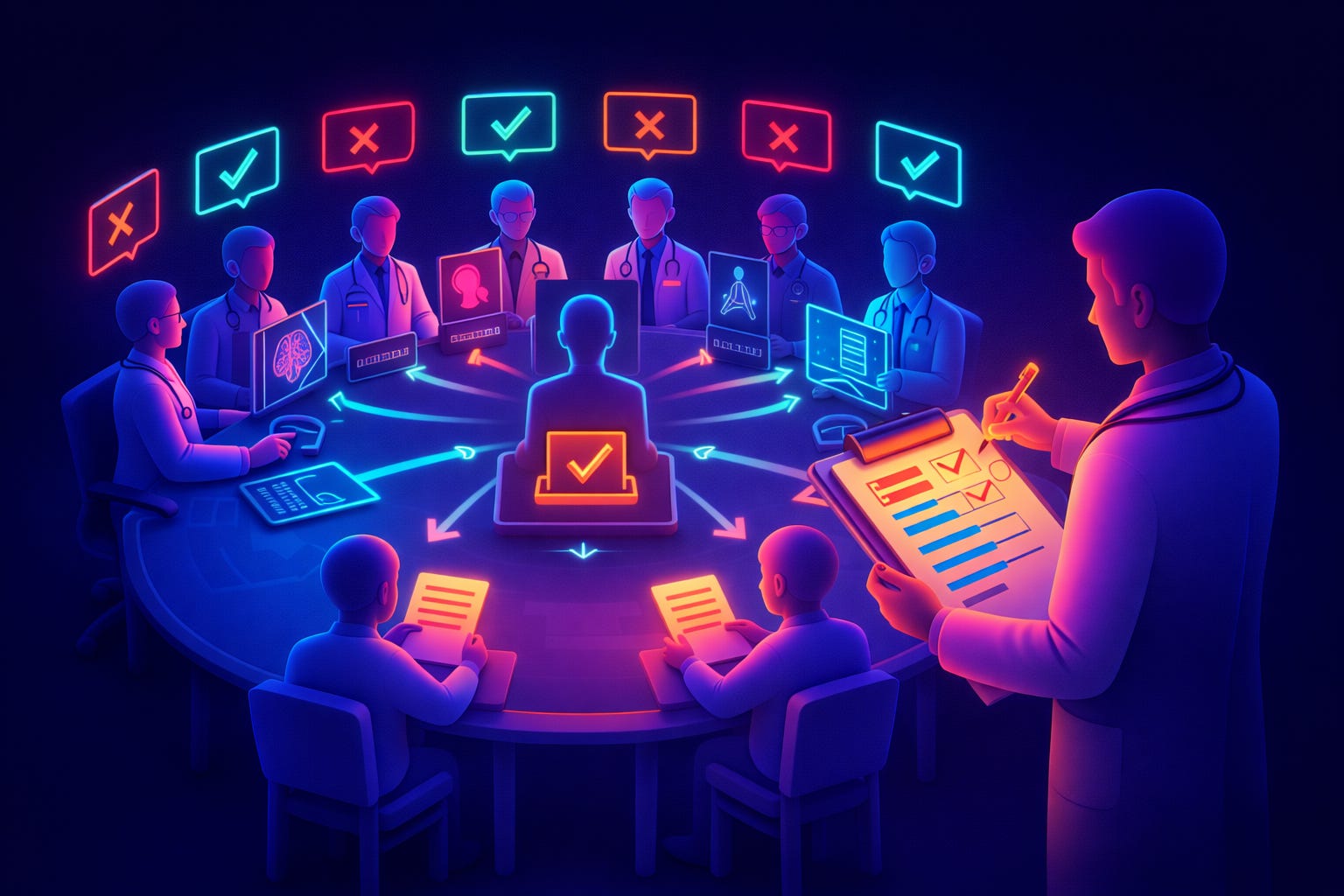
Analogy:
Medical Board Consultation:Several specialists independently assess a patient; they then discuss, vote, and have a lead physician synthesize a final treatment plan. It is smarter than one doctor alone, but it takes time and coordination (and someone has to sign the chart).
How it works:
Multiple agents independently solve the same task, and the orchestrator compares their answers to reach a more reliable, consensus-based conclusion.
This is useful for tasks requiring high accuracyor for validating critical decisions.
The task is posed, and a coordinator (or simple dispatcher) sends the same prompt/problem to multiple independent agents or diverse “personas.”
Parallel proposals→ Each agent returns a candidate answer and a short rationale/uncertainty score.
Aggregation→ A consensus module merges results using a rule:
Majority/Pluralityvote (simple, robust)
Weighted vote(weights by agent reliability/confidence/domain fit)
Rationalized consensus(an LLM summarizes points of agreement, flags conflicts)
A Judge/Referee model(a separate model evaluates and chooses)
Adjudication loop (optional)→ Disagreements trigger revision rounds: agents critique, update, and re-vote.
Guardrails → Consistency checks, constraints, and policy filters run post-consensus before final output.
Telemetry → Log per-agent scores, agreement rate, and hallucination flags for continuous tuning.
Pros:
Higher accuracy via diversity:Independent views reduce single-agent bias and hallucinations.
Graceful under uncertainty:If signals conflict, the system exposes disagreement instead of hiding it.
Modular reliability:You can drop in domain-specialist agents and let consensus arbitrate.
Auditable decisions:Votes, rationales, and tiebreakers form a transparent paper trail.
Parallelizable:Latency is often similar to a single pass (N agents in parallel).
Cons:
Cost multiplier:You pay (tokens/compute) for N agents in addition to a judge/aggregator.
Coordination overhead:Designing good aggregation rules and critique prompts requires careful design.
Risk of groupthink:If agents share the same training/prompting, “diversity” is illusory.
Latency from additional critique cycles: Multiple review rounds can add seconds to minutes.
Accountability diffusion:When everyone is responsible, no one is. Clear ownership and accountability rules should be defined.
Example Use Cases:
Fraud Detection in Banking Transactions
Agents (Specialists):
Agent A→ Rule-based analysis (flags based on thresholds).
Agent B→ Machine learning model predicts fraud probability.
Agent C→ Graph-analysis agent checks network of transactions.
Agent D→ LLM explains suspicious behavior in natural language.
Consensus Step:
Each agent outputs a fraud score (0–1).
Scores are aggregated via weighted voting.
If the final consensus score > threshold, the transaction is flagged.
Final Output:
Transaction flagged as potentially fraudulent (82% consensus confidence).
An explanation agent attaches a rationale summary.
Benefits in this Case
Reduced false positives → avoids blocking legitimate transactions.
Explainability → combines numeric scoring with natural language reasoning.
Resilience → one weak model cannot derail the system if others disagree.
Agentic AI Orchestration Frameworks
Several frameworks have emerged to simplify the creation of agentic systems. Some popular choices include:
🔷 LangGraph
A framework built on top of LangChain for designing agentic AI applications as graphs (nodes and edges).
Each node can represent:An agent, a tool, or a decision step.
Supports workflows beyond linear pipelines:Branching, loops, and stateful execution.
Enables complex orchestration patterns such as: Retries, conditional flows, and multi-agent collaboration.
Strong focus on control and observability: Monitor agent reasoning, inject guardrails, and ensure reproducibility.
Particularly suited for enterprise environments requiring high control, observability, reliability, compliance, and transparency.
🔷 CrewAI
An open-source framework for building multi-agent, collaborative systems.
Agents operate as a coordinated “crew” with defined roles:Researcher, planner, reviewer, and executor.
Moves away from a single-agent approach toward role-based specialization.
Uses structured workflows to coordinate agent interactions.
Mirrors human team dynamics: division of responsibilities, communication between roles, and iterative problem-solving.
Supports advanced execution patterns: branching, parallel execution, and role-based collaboration.
Enables the creation of scalable and modular agent ecosystems.
Well-suited for business use cases requiring: Transparency, adaptability, and collaboration.
🔷 Microsoft AutoGen
An open-source framework for building multi-agent conversational AI systems.
Enables orchestration of multiple specialized agents instead of a single model.
Agents can represent: LLMs, humans, and tools (APIs, databases, etc.).
Agents collaborate through structured dialogue and message exchange.
Provides abstractions for: Defining agent behaviors, managing tool usage, and controlling orchestration flows.
Supports multiple orchestration patterns: Sequential pipelines, consensus, and hierarchical control.
Ideal for complex AI applications such as: Autonomous coding assistants, data analysis systems, and decision-support platforms.
Improves outcomes through: Higher accuracy, better reliability, and greater explainability.
Functions as a “multi-agent operating system” for LLMs.
Enables flexible experimentation and scalable agentic workflows.
Implementing and Managing Orchestration
Key Implementation Steps
Define the Goal: Clearly articulate the end-to-end task the system will perform.
Decompose the Task: Break the high-level goal into a series of smaller, discrete sub-tasks.
Design the Agent Team: Define the roles and responsibilities of each specialized agent required to handle the sub-tasks.
Select a Framework: Choose a framework (e.g., CrewAI, LangGraph) that fits the project’s complexity and the skills of the team.
Develop the Agents and Orchestrator: Write code for each agent, provide access to necessary tools, and build the orchestrator to manage the flow.
Test and Refine: Rigorously test the entire system to ensure seamless collaboration and accurate results.
Orchestration Challenges
Interoperability: Ensure agents can communicate effectively, even if they use different tools or data formats.
Data Quality: Agent performance is highly dependent on the quality of the data it can access. Poor data leads to hallucinations or other incorrect actions.
Workflow Complexity: Certain orchestration patterns, such as loops or retries, can introduce significant design and debugging complexity if not carefully managed.
State Management: Managing agent states can become complex and may require thoughtful design and implementation.
Orchestration Best Practices
Security and Governance: Implement robust access controls and monitoring to ensure agents operate within defined parameters, especially with sensitive financial data.
Human-in-the-Loop: Design workflows with checkpoints where human oversight is required for critical decisions or to handle exceptions. This builds trust and ensures accountability.
Continuous Monitoring: Agentic systems are not static. They require continuous monitoring to identify bottlenecks, optimize performance, and adapt to changing requirements.
Conclusion
Agentic AI orchestration is the discipline that transforms isolated intelligent agents into coordinated systems capable of delivering meaningful enterprise outcomes. It is not merely about connecting models or automating tasks. It is about designing how specialized agents collaborate, when they activate, how they communicate, and how their outputs are governed so that the overall system remains aligned with business objectives, operational controls, and real-world constraints.
The most important takeaway is this: there is no single orchestration pattern that fits every scenario. The right choice depends on the business objective, the risk profile, the scale of the workflow, the required speed of response, and the level of governance needed. Mature organizations will not approach orchestration as a fixed template. They will approach it as a strategic design decision.

Explore more: Start Here · Topics · Archive · About