


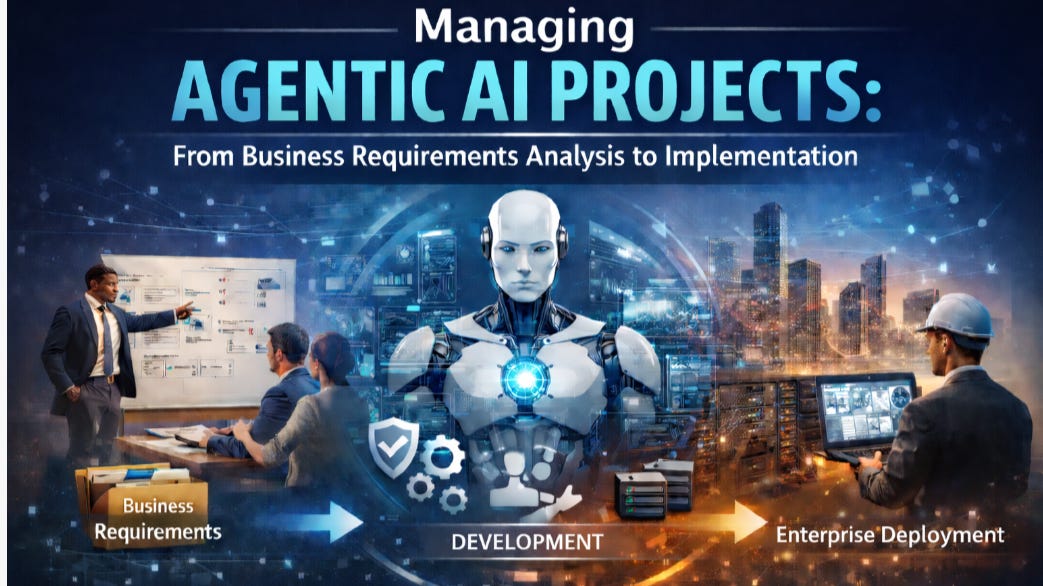
Managing an Agentic AI implementation project is fundamentally different from managing traditional software. These systems do not simply execute instructions. They reason, iterate, make decisions, and interact with other systems in ways that can be difficult to predict.
That means the real challenge is not just building intelligent agents. It is designing the governance, guardrails, and operational structure that keep those agents aligned with business intent.
Managing an Agentic AI project is therefore a bit like conducting a jazz band. There is structure. There is a score. But there is also improvisation, real-time adaptation, and the constant need for a conductor who knows when to let the music breathe and when to rein it in. And if you do not set guardrails early, you risk the trumpet solo lasting until next Tuesday.
This article is part of the Agentic AI Guardrails and Governance Series. In this installment, we move from concept to execution. We explore a structured enterprise approach to planning, building, piloting, and scaling Agentic AI projects, covering project management methodology, business requirements analysis, and a phased implementation framework with governance at every stage.
Part 1: Managing the Project
Agentic AI is fundamentally different from traditional software deployment. Agents reason, loop, make decisions, and invoke tools, sometimes in ways that are difficult to predict in advance. That autonomy is precisely what makes them powerful and precisely what makes project management more demanding.
The following structured approach is designed to reflect these realities:
1. Define Scope and Use Cases
Clarity first:Identify upfront whether the project involves Workflow agents (bounded, predictable, and automating repeatable sequences) or Open-Ended and Autonomous Agents (dynamic, iterative, and less deterministic in behavior).
Prioritize:Begin with bounded use cases such as internal knowledge assistants or reconciliation bots before progressing to high-autonomy tasks.
Success criteria:Define KPIs around accuracy, time saved, cost avoided, compliance adherence, and risk reduction.
2. Build the Right Team
Every Agentic AI project needs many roles working in concert:
Executive Sponsor: Owns the business case, secures funding, and ensures organizational alignment with the AI strategy.
Product Owner: Defines and prioritizes the agent's scope, use cases, and value delivery across the project lifecycle.
Project Manager: Serves as the human governance anchor, defining task boundaries, managing escalation protocols, and ensuring that the work remains aligned with business intent, risk tolerance, and regulatory compliance throughout execution.
Domain Expert:Occupies a distinct and critical role that bridges technical AI capability with real-world operational context.
Business Analyst:Translates stakeholder needs and operational requirements into clearly defined agent objectives, workflow boundaries, and success criteria that guide both technical design and governance decisions.
AI Engineer/Architect:Designs, builds, and integrates the technical components of the agent system, including model selection, orchestration logic, tool-calling frameworks, memory architecture, and API connections, while ensuring the system performs reliably, securely, and within the behavioral boundaries defined by the domain expert and business analyst.
Risk and Compliance Partner:Identifies, assesses, and mitigates the regulatory, operational, and ethical risks introduced by agents' behavior, ensuring that system design, model validation, audit trails, and human oversight mechanisms satisfy applicable compliance frameworks, internal model risk policies, and emerging AI governance regulations before and after deployment.
End Users:Contribute to requirements in the design phase and perform User Acceptance Testing (UAT).
3. Change Management and Communication
Pilot phase:Start with one agent in a sandbox, measure performance, track errors, and demonstrate ROI before expanding.
Scale phase:Roll out multiple agents, introduce multi-agent collaboration, and integrate with enterprise systems.
Continuous improvement:Establish monitoring dashboards covering accuracy, efficiency, and end-user feedback.
Transparency:Explain clearly to all stakeholders what the agent can and cannot do.
Training:Provide employees with playbooks, worked scenarios, and escalation procedures.
Feedback loops:Build channels for users to report issues, flag anomalies, and suggest improvements.
Part 2: Business Requirements Gathering for Agentic AI
Analyzing business needs for Agentic AI goes far beyond traditional requirements analysis. You are not just asking what the system should do. You are asking how autonomous it should be, where the risks live, and how you maintain control while delivering measurable Return On Investment (ROI). The following methodology provides a structured approach.
1. Business Context Clarification
Problem statement:What pain point or inefficiency are we solving? Examples: excessive manual reconciliation, bottlenecked customer queries, reactive risk monitoring.
Business outcomes:What measurable KPIs matter? Cost savings, reduced processing time, improved compliance, customer satisfaction.
Constraints:Budget, data access, security standards, regulations, and time-to-market constraints must all be surfaced early.
2. Functionality Identification
Agentic AI is not a single category. The business requirements process must identify which architecture is appropriate:
Workflow Agents:Bounded, predictable agents that automate repeatable steps with high determinism
Open-Ended and Autonomous Agents: Capable of adaptation, multi-step reasoning, and iterative loops
Multi-Agent Systems:Specialized agents that collaborate on distinct subtasks such as data retrieval, summarization, and decision support
3. Stakeholder Analysis
Who benefits:End-users, clients, analysts, and managers who benefit from the agent's output
Who is impacted:Compliance, legal, IT, and data governance teams who are impacted by autonomy
4. Risk Identification
Compliance breaches from unexplainable autonomous actions
Hallucinations or false recommendations surfaced to decision-makers
Over-reliance on autonomy creating new categories of operational risk
Job impact and organizational change resistance that can undermine adoption
5. Functional Requirements
Every Agentic AI system must have clearly defined functional requirements across four dimensions:
Inputs:What data sources, documents, or prompts does the agent need to operate?
Capabilities:Retrieve information, reason, decide, execute tasks, call APIs, escalate to humans
Outputs:Structured responses, completed workflows, or triggered downstream actions
Feedback loops:How does the agent learn, retry, request clarification, or handle ambiguity?
Example:The AI agent must reconcile transactions across three systems, escalate mismatches above $10M to a human reviewer, and produce a daily audit report.
6. Non-Functional Requirements
Because autonomy amplifies risk, non-functional requirements are especially critical for Agentic AI:
Accuracy and reliability:Target accuracy thresholds, such as greater than 95% accurate categorization
Explainability:Audit trails and decision logs that enable post hoc review
Security and compliance:GDPR, SOX, model card governance, and enterprise InfoSec standards
Boundaries:Clear stop conditions and escalation triggers that prevent runaway behavior
Scalability:Capacity to support parallel agents and high-volume task loads
7. Guardrails and Control Mechanisms
Role boundaries:Define explicitly what the agent cannot do. Example: it can recommend but not approve trades.
Human-in-the-loop:Document all escalation points where human oversight is mandatory
Monitoring dashboard:Combine business KPIs with AI performance metrics including drift detection and error logging
Kill switch:A business and compliance requirement. Not optional.
8. Feasibility and ROI Analysis
Technology feasibility:Do we have the right LLM APIs, connectors, data pipelines, and infrastructure?
Business value:Is the complexity justified by the expected gain?
ROI dimensions:Cost savings, processing speed, customer trust, and competitive positioning
Pilot vs. scale:Always start scoped. Deploy a bounded workflow agent in a sandbox before scaling to open-ended architectures.
Part 3: The Agentic AI Implementation Phases
What follows is a six-phase implementation framework designed specifically for enterprise Agentic AI deployments. It is built to feel familiar to teams accustomed to phased delivery and governance checkpoints, while accounting for Agentic AI's unique challenges: open-ended workflows, guardrail design, multi-agent orchestration, and continuous model monitoring.
Phase 1: Business Case and Alignment
Objective of the phase:Justify the investment and align with strategic goals before any technical work begins.
Key participants:Business Sponsor, Finance Partner, and Risk Officer
Key Deliverables: -Problem Statement and Use Case Charter - ROI and KPI definitions: time saved, FTE impact, control improvement - Risk Appetite Statement defining how much autonomy is acceptable
Risk Mitigation and Controls -Involve compliance and risk teams from day one - Align with the AI Center of Excellence (if one exists) and enterprise AI strategy - Secure executive sponsorship before proceeding to design
Phase 2: System and Guardrails Design
Objective of the phase:Define architecture, operational boundaries, and safety mechanisms.
Key participants:AI Architect, Risk & Compliance Partner, and Domain Expert
Key Deliverables -System Blueprint specifying agent categories (workflow vs. open-ended vs. autonomous agents) - -- Guardrail Matrix covering permissions, data access, and escalation paths - Governance RACI identifying who signs off and who monitors
Risk Mitigation and Controls -Tool and API access whitelisting - Maximum recursion depth and bounded loops - Mandatory human-in-the-loop for critical decisions
Phase 3: Build and Test in Sandbox
Objective of the phase:Develop, test, and iterate in a fully controlled environment.
Key Participants:AI Engineer, DevOps, QA and Testing Team
Key Deliverables -Minimum Viable Product (MVP) agents with limited scope - Test harness covering unit tests and adversarial stress tests - Monitoring dashboards with logs, error tracking, and explainability reports
Risk Mitigation and Controls -Red / Amber / Green gating for performance thresholds - Synthetic and adversarial test data scenarios - Audit trail logging from the first line of code - Red team testing
Phase 4: Pilot and Human-in-the-Loop
Objective of the phase:Prove value and refine risk controls with real users in a controlled environment.
Key Participants:Pilot Users, Change Manager, Product Owner, and End Users
Key Deliverables -Pilot Report covering accuracy, efficiency, and adoption feedback - Human-in-the-loop workflows documented and tested - Updated ROI vs. Risk tracker compared against Phase 1 targets
Risk Mitigation and Controls -Escalation procedures documented and tested - Bias and fairness testing results reviewed - Rollback plan prepared and rehearsed
Phase 5: Production and Scale
Objective of this phase:Deploy to the business at scale with enterprise-grade monitoring and support.
Key Participants:Change Management team, Operations Support, AI Site Reliability Engineer, Compliance Partner
Key Deliverables -Production Deployment Playbook - Enterprise Monitoring Dashboard - User Training Guides and FAQ documentation - Procedures Manual
Risk Mitigation and Controls -Continuous monitoring alerts for model drift, hallucination rate, and rogue tool use - Fail-safe design ensuring deterministic end states - Integration with enterprise control frameworks including IRM and InfoSec
Phase 6: Continuous Improvement
Objective of this phase:Ensure long-term resilience, measurable ROI, and sustained organizational trust.
Key Participants:Product Owner, AI Engineer, Business Analyst, AI Ops, Compliance, Audit, and Model Risk Management
Key Deliverables -Quarterly Model Risk Reviews - - Business Value Scorecard with ROI tracked against original forecast - Improvement Roadmap covering multi-agent collaboration and new tool integrations
Risk Mitigation and Controls -Regular retraining and fine-tuning cycle - Ongoing compliance testing and regulatory alignment - Decommissioning policy for underperforming agents
Governance Accountability: The RACI Matrix
Clear accountability is one of the most critical and most commonly overlooked dimensions of Agentic AI governance. The following RACI matrix defines who is Responsible, Accountable, Consulted & Informed at each phase of implementation.
Key Takeaways
Agentic AI projects are not traditional IT deployments. They require a fundamentally different approach that accounts for autonomy, adaptability, feedback loops, and guardrails from the first day.
Business requirements analysis must address both what the agent does and how autonomous it is permitted to be, alongside explicit boundaries, escalation triggers, and control mechanisms.
The six-phase implementation framework provides enterprise teams with a structured, governance-rich path from business case through continuous improvement.
Human-in-the-loop oversight is not a concession to caution. It is a design requirement at every phase until trust and track record have been established at scale.
Accountability must be explicit. Every phase of an Agentic AI project needs named owners who are responsible for outcomes, not just execution.
Treat every Agentic AI system as a living product. Monitoring, retraining, and governance do not end at go-live. They begin there.
A Question for the Community
As you think about your own Agentic AI initiatives, which phase of this framework presents the greatest challenge for your organization?
Is it securing stakeholder alignment and risk appetite early in Phase 1?
Is it defining effective guardrails in Phase 2 before the system is built?
Or is it the ongoing governance and continuous improvement discipline required in Phase 6?
I would welcome your perspective in the comments. The community insight shared here consistently shapes how practitioners think about these problems in practice.
About this Article
This article is part of the Agentic AI Systems, Guardrails and Governance Series, a practitioner-focused body of work exploring how enterprise organizations can deploy autonomous AI systems responsibly. The series covers risk management, compliance frameworks, human-AI collaboration, accountability structures, and the governance disciplines required to scale Agentic AI with confidence.
Explore more: Start Here · Topics · Archive · About