


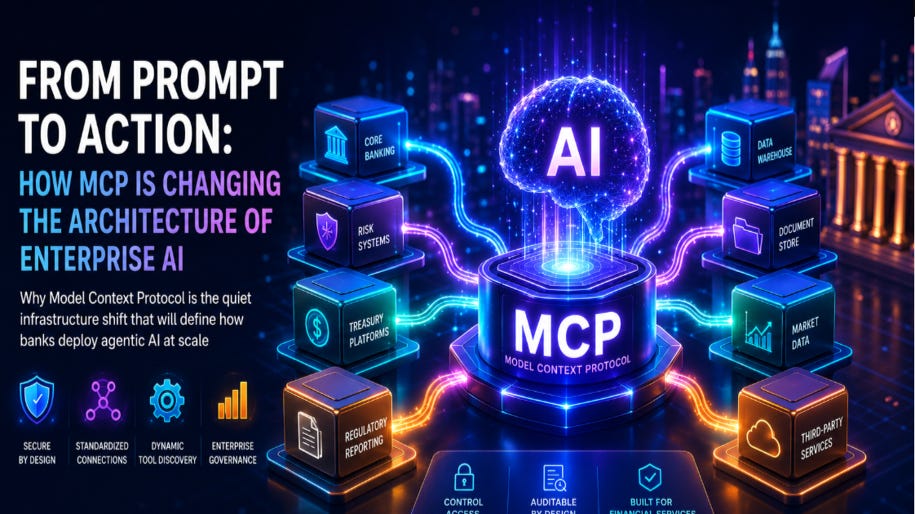
There is a moment every enterprise AI leader recognizes. You have deployed a powerful language model. It performs brilliantly in a sandbox. Then someone asks the obvious question: can it actually connect to our systems?
And the answer, far too often, is: not without months of custom engineering.
Every tool integration was a bespoke build. Every new data source meant new glue code. Every time you wanted your AI to reach into a core system, a risk platform, a regulatory reporting engine, you were starting from scratch. You gave the model intelligence, but the enterprise kept it isolated. The dream of AI that could act, not just answer, kept hitting the same wall.
That wall now has a name. And more importantly, it has a solution. It is called Model Context Protocol, or MCP, and it is quietly reshaping the architecture of enterprise AI.
What MCP Actually Is
MCP is an open protocol introduced by Anthropic that standardizes how AI models connect to external tools, data sources, and services. Before MCP, connecting an AI model to an enterprise system required a custom integration for every single pairing: one build for your data warehouse, another for your risk system, another for your document store, and so on. Each integration was fragile, expensive to maintain, and invisible to governance.
MCP changes the architecture fundamentally. Developers expose capabilities through MCP servers, small, standardized connectors that sit in front of a tool or data source. The AI model can then discover and invoke those capabilities dynamically, without a new custom build for each one.
The simplest analogy
MCP is to AI agents what USB was to hardware peripherals.Before USB, every device needed its own proprietary port and driver. After USB, you plugged anything into anything. MCP does the same for AI and enterprise systems: it creates a universal adapter layer between the model and the environment it needs to operate in.
Why This Matters More in Financial Services Than Anywhere Else
Most industries have legacy technology challenges. Banks have legacy technology as a defining characteristic. Risk systems, treasury platforms, liquidity reporting engines, core banking infrastructure: these were built across decades, by different vendors, to different standards, and almost none of them were designed to interoperate, let alone to receive instructions from an AI agent.
This fragmentation has been the primary reason AI in financial services has remained largely in pilot mode. The model capability exists. The business use cases are clear. The blocker has been the connection layer.
MCP changes the question from 'can we integrate AI with system X' to 'does system X have an MCP server.' That is a far faster, far cheaper, and far more governable question to answer.
But there is a deeper reason MCP matters specifically in financial services, and it has nothing to do with convenience. It has to do with control.
Regulators expect banks to demonstrate that AI systems, especially agentic ones, operate within defined boundaries, that their actions are auditable, and that there are meaningful controls on what they can access and do. A patchwork of custom integrations makes that nearly impossible to assure. A standardized connection layer built around MCP makes it structurally achievable.
The Architecture Shift in Practice
Before MCP
The team spends six months building custom integrations to the liquidity system, the FX platform, the regulatory reporting database, and the document repository. Each integration requires security review, API contract negotiation, and ongoing maintenance. The AI pilot is scoped to one system because connecting more is too costly. Governance cannot get comfortable because no one can easily explain what the model is touching or how.
After MCP
Each system exposes an MCP server with a defined scope: read access to positions, write access to a specific workflow queue, retrieval access to a document store. The AI agent discovers available tools at runtime and invokes them within those defined permissions. The connection layer is standardized, auditable, and controlled at the server level. Governance can review what each MCP server exposes, set boundaries on it, and revoke access without touching the model.
The shift is not just technical efficiency. It is a governance architecture decision. And in a regulated institution, those two things are inseparable
What Leaders Get Wrong About MCP
Three misconceptions are slowing adoption among enterprise AI leaders in financial services.
Misconception 1: it is just another API standard
It is not.Traditional REST APIs are static contracts between a caller and a service.MCP introduces dynamic tool discovery, structured context passing, and a standardized protocol that the model itself can reason about. The AI does not just call a function; it understands what tools are available and selects among them based on the task. That is a fundamentally different architecture, not a naming convention
Misconception 2: it is an engineering concern, not a strategy concern.
Wrong. The decision of which systems get MCP servers, what scope those servers expose, and how access is permissioned is a governance and strategy decision with direct regulatory implications. Chief Data Officers, AI strategy leads, and model risk teams need to be in that conversation from the start, not handed a finished architecture to review after the fact.
Misconception 3: we can wait.
The banks that build MCP-ready infrastructure now will have a compounding advantage as agentic AI matures. Every system that gets an MCP server becomes immediately available to any future agent use case. Every system that remains outside the standard becomes a drag on adoption. The gap between MCP-ready institutions and those treating it as a future concern will widen quickly, and retrofitting at scale is significantly more expensive than building right the first time.
The Governance and Control Implications
The Federal Reserve's emerging guidance on AI governance emphasize the need for explainability, auditability, and defined boundaries around AI system behavior. Agentic AI creates new challenges for all three, because agents do not just generate outputs; they take actions, and those actions can cascade through connected systems.
MCP's architecture directly supports the governance controls regulators are asking for:
1. Scoped permissions per agent
Each MCP server exposes only what it is configured to expose. An agent can be granted access to read positions but not write them, to retrieve documents but not modify them. Permission is structural, not aspirational.
2. Auditability of tool invocations
Every MCP tool call is a discrete, logged event. Compliance and model risk teams can reconstruct exactly what tools an agent called, in what sequence, with what inputs, and what outputs were returned.
3. Kill-switch control at the server level
Disabling an MCP server immediately removes agent access to that capability, without retraining the model or modifying application code. This is the kind of rapid remediation control that governance frameworks require.
4. Alignment with boundary-setting expectations
SR 11-7 specifically calls for defined operating boundaries for agentic systems. MCP server scope definitions are, structurally, exactly that.
The Strategic Takeaway
The banks that win the agentic AI race will not be the ones with the most powerful models. Model capability is increasingly a commodity. They will be the ones that built the connective tissue between AI and enterprise systems in a way that is controlled, auditable, and scalable from day one.
The question for enterprise AI leaders is not whether MCP will matter. It already does, and its adoption is accelerating across the AI ecosystem. The question is whether your organization is building toward it intentionally, or whether you will find yourself retrofitting a fragmented integration landscape when the pressure to deploy agentic AI at scale arrives in force.
My recommendation
Start the MCP conversation nowand make sure it includes not just your architects and engineers, but your Chief Data Officer, your model risk team, and your compliance leadership. The decisions you make about your connection architecture today will determine how fast and how safely you can move tomorrow.

Explore more: Start Here · Topics · Archive · About