


Generative AI has moved beyond experimentation and into the operational core of modern enterprises. Yet the true competitive advantage is no longer defined by who uses AI, but by who understands how to optimize it—for accuracy, efficiency, compliance, and scale.
As organizations accelerate their adoption of Generative AI and Large Language Models (LLMs), understanding how these systems are trained, optimized, and adapted for real-world business use has become essential for leaders, technologists, and decision-makers alike. This article explores the core mechanics behind LLM intelligence—parameters, weights, training, and inference—before diving into the enterprise techniques that make AI practical at scale, including fine-tuning, knowledge distillation, Retrieval-Augmented Generation (RAG), LoRA, quantization, and QLoRA. Together, these approaches transform powerful but generic models into efficient, cost-effective, and domain-aware intelligence assets capable of delivering accurate, compliant, and strategically aligned outcomes across modern enterprises.
Understanding the “Brain” of Large Language Models
At the heart of every LLM are parameters and weights—the internal structures that determine how language is interpreted, relationships are recognized, and responses are generated. Training adjusts billions of these internal settings using vast datasets, creating a learned representation of language, reasoning, and knowledge.
Once training is complete, the model enters inference mode, where it applies learned intelligence to new prompts without further learning.
The following distinction is critical:
Training builds intelligence
Inference applies intelligence
Making AI Enterprise-Ready: Efficiency & Adaptation Techniques
1. Fine-Tuning for Domain Precision
Fine-tuning is the process of adapting a pre-trained Large Language Model (LLM) to perform better within a specific industry, organization, or use case. It adapts a general model using curated organizational / data—policies, documents, workflows, and terminology—so outputs reflect business context, compliance standards, and professional tone. This turns generic AI into a domain-specialized intelligence asset capable of delivering meaningful enterprise value. While the base model understands general language, fine-tuning teaches it to understand your language — your terminology, workflows, tone, and priorities.
What It Means in Practice: Instead of training a model from scratch (which is extremely expensive), you:
Start with a powerful pre-trained model.
Provide curated, domain-specific data (policies, manuals, customer interactions, technical documents).
Adjust selected internal parameters to align outputs with your business context.
Validate performance and deploy.
The model doesn’t relearn language — it refines how it applies language within your domain.
Why It Matters: Fine-tuning enables:
Higher relevance and contextual accuracy
Industry-specific terminology mastery
Alignment with regulatory and compliance requirements
Consistent tone and brand voice
Reduced need for repeated prompt correction
For regulated industries, this is particularly powerful:
The model can be aligned with approved policy language.
Responses can reflect internal risk frameworks.
Outputs become more controlled and predictable.
The Trade-Off
Requires high-quality curated data.
Can be costly if done at full scale without parameter-efficient methods.
Must be governed carefully to prevent overfitting or bias.
Fine-tuning is powerful — but it should be strategically applied where precision truly adds business value.
Simple Analogy:Think of a base LLM as a highly educated generalist. Fine-tuning turns that generalist into a domain expert who understands your industry’s jargon, expectations, and standards.
2. Knowledge Distillation for Speed & Scale
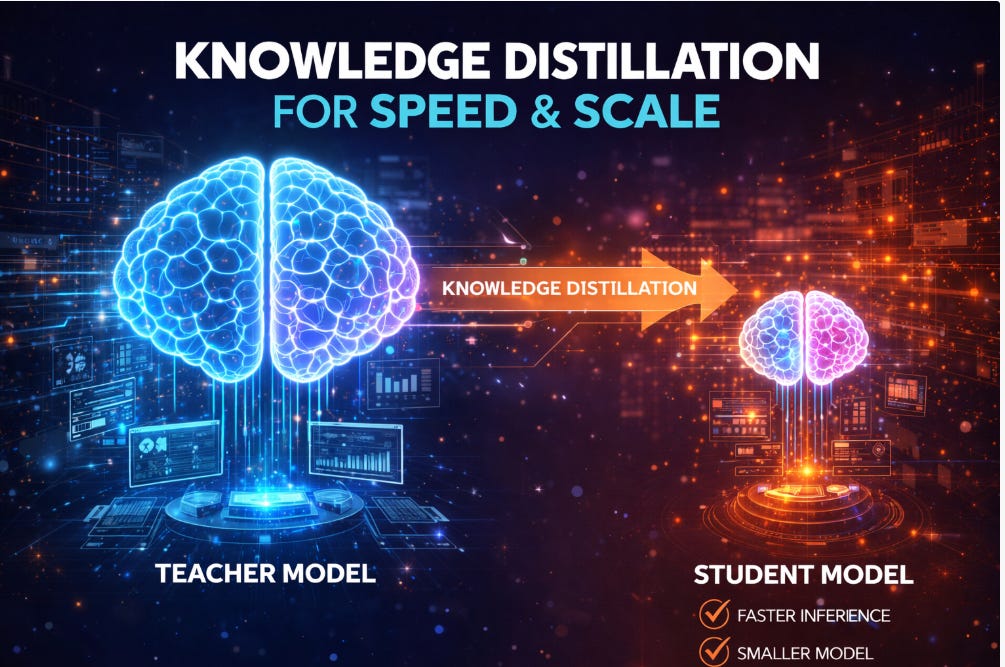
Knowledge Distillation is a model compression technique where a large, powerful LLM model (the teacher) transfers its learned intelligence to a smaller, faster LLM model (the student).
The goal: preserve most of the performance while dramatically improving efficiency.
What It Means in Practice
Instead of training a smaller model only on raw data, you:
Use a high-performing large model (teacher).
Have it generate predictions, probabilities, or embeddings.
Train the smaller model (student) to mimic those outputs — not just the final answers, but the teacher’s confidence patterns.
Deploy the smaller model in production.
The student learns how the teacher thinks — not just what the correct answer is.
Why It Matters: Knowledge distillation enables:
Faster inference
Lower latency
Reduced memory footprint
Lower serving costs
Easier deployment at scale
For enterprises, this means:
Production-ready AI without heavyweight infrastructure
Real-time applications (chatbots, risk alerts, fraud detection)
Scalable AI access across departments
Distillation is often the bridge between research-grade AI and operational AI.
The Trade-Off
Some performance loss compared to the full teacher model
Risk of transferring biases or blind spots
Requires careful evaluation during compression
However, the efficiency gains often outweigh the marginal performance reduction — especially in large-scale environments.
Simple Analogy: Think of the teacher model as a world-class professor. Distillation is like having that professor summarize years of expertise into structured notes — so a talented student can perform almost as well, but much faster and at lower cost
3. Retrieval-Augmented Generation (RAG) for Accuracy & Freshness
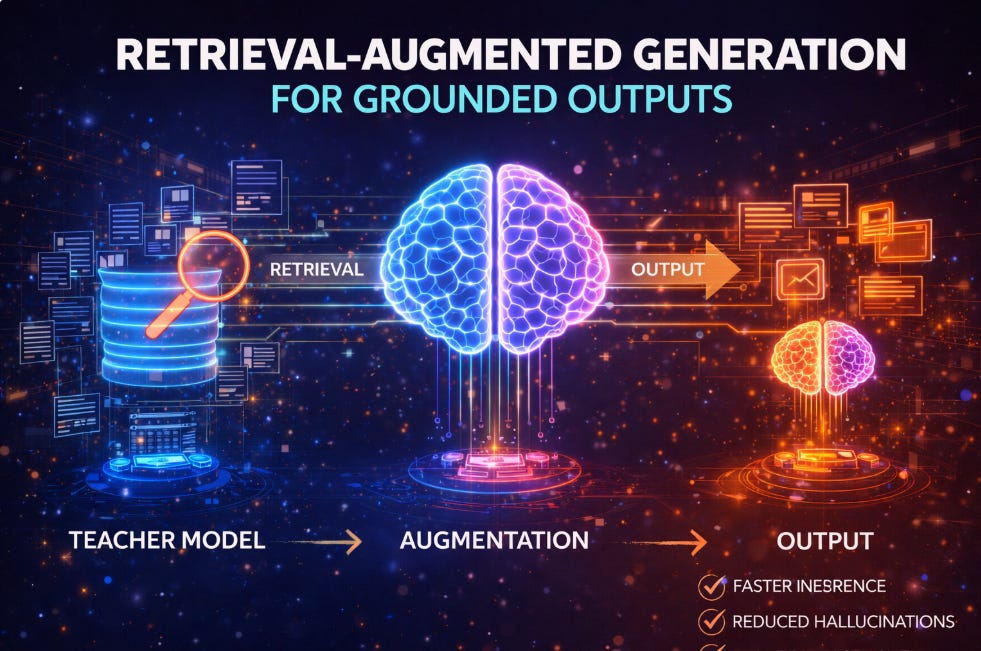
RAG extends model intelligence by connecting it to trusted internal and external knowledge sources such as enterprise documents, databases, or real-time data. Instead of guessing, the AI retrieves facts first—then generates grounded responses.
What It Means in Practice
When a user asks a question:
Retrieval – The system searches trusted data sources (enterprise documents, databases, knowledge bases, APIs).
Augmentation – The most relevant content is injected into the model’s prompt.
Generation – The LLM produces a response based on both retrieved data and its general knowledge.
The model is no longer “guessing.” It is answering based on evidence.
Why It Matters: RAG enables:
More accurate and grounded responses
Reduced hallucinations
Access to up-to-date information
Control over approved knowledge sources
Better alignment with compliance and governance requirements
For enterprises, especially in regulated environments, this is critical. It ensures the model only responds using vetted, policy-aligned, and current information. RAG is often the bridge between innovation and trust.
The Trade-Off
Requires well-structured, high-quality data sources
Retrieval system design (vector databases, indexing, embeddings) must be robust
Adds architectural complexity compared to a standalone LLM
But the benefit is substantial: improved reliability and trust.
Simple Analogy
Think of a traditional LLM as a highly knowledgeable expert relying on memory. RAG turns that expert into someone who checks the latest approved documents before answering — ensuring accuracy and relevance.
Summary
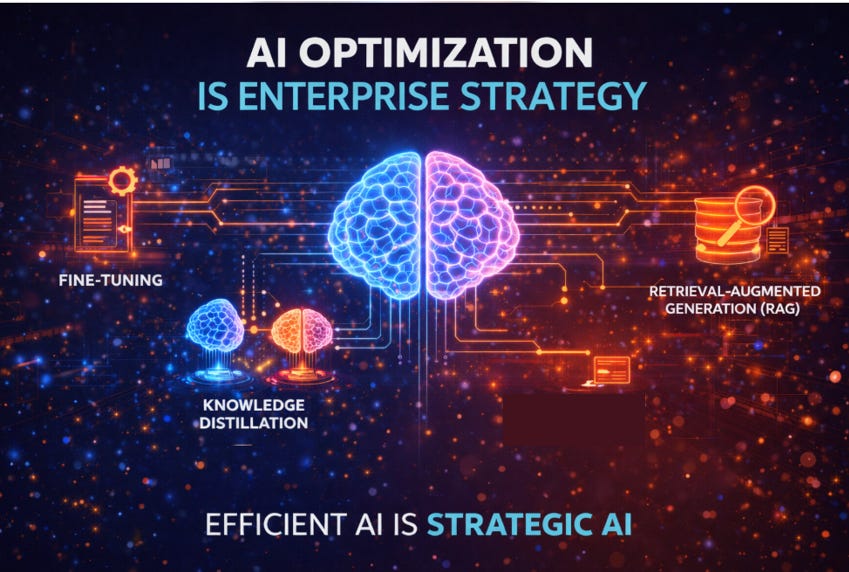
Generative AI is not just about powerful models — it is about understanding how to optimize them for real-world impact. In this article, we explored the enterprise techniques that transform raw AI capability into practical business value:
Fine-Tuning enables domain precision and brand alignment.
Knowledge Distillation delivers speed and scalable deployment.
Retrieval-Augmented Generation (RAG) grounds outputs in trusted, real-time enterprise knowledge.
Each technique addresses a different dimension of the AI optimization equation: accuracy, cost, latency, governance, scalability, and strategic alignment.
The real insight is this: AI capability is not one-size-fits-all. Optimization is a leadership decision, not just a technical one.
Conclusion
The future of enterprise AI will not be defined by who uses the largest models — but by who deploys them most intelligently.
Leaders must evaluate trade-offs across performance, compliance, infrastructure cost, and business value. They must decide when to customize, when to compress, when to retrieve knowledge dynamically, and when to prioritize efficiency over raw scale.
Optimization is not about cutting capability. It is about aligning capability with enterprise reality.
Organizations that master these techniques will move beyond experimentation and into scalable, responsible, and strategically aligned AI deployment.
And in the AI era, efficiency is not a technical detail — it is a competitive advantage.

Explore more: Start Here · Topics · Archive · About