


Introduction
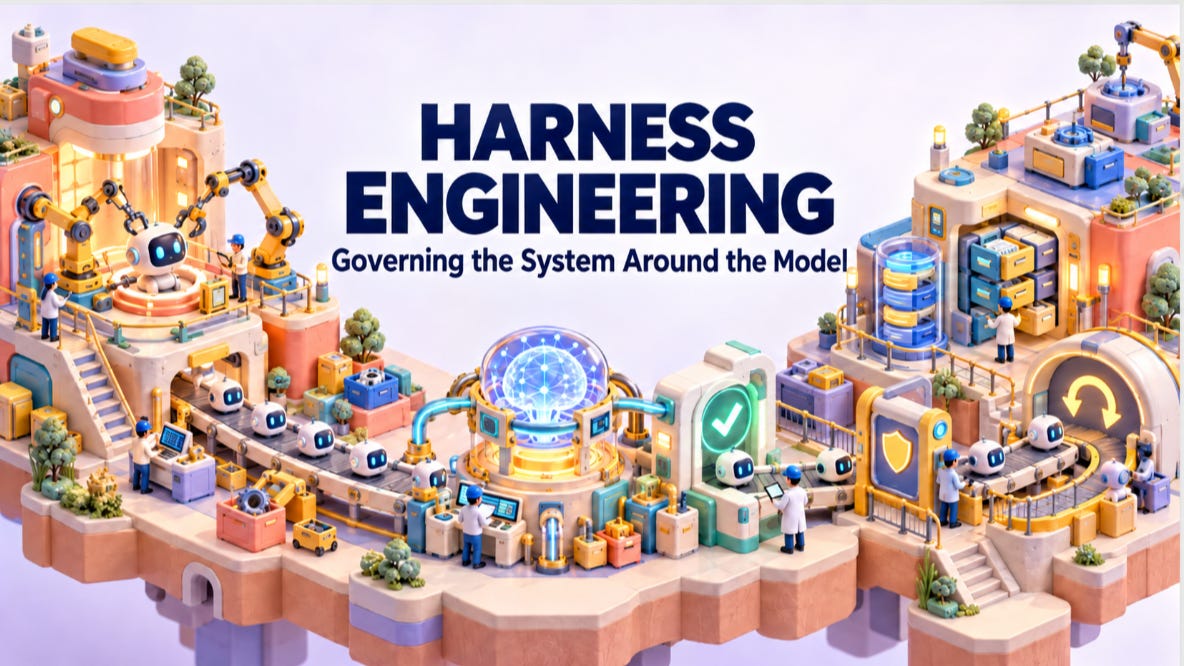
In my last two articles, I discussed Context Engineering. This article takes the next step: Harness Engineering. Prompt engineering shapes instructions. Context engineering shapes the information the model receives. Harness engineering extends the scope to tools, memory, execution, and controls.
In the context engineering articles, I argued that context engineering replaced prompt engineering as the discipline that determines whether an AI system performs reliably. There is now a further step in that progression. Once an organization moves from answering questions to taking actions, the object of engineering shifts again, from what the model sees to the entire operating environment the model acts within. That discipline is harness engineering, and for financial institutions it is where most of the real governance work lives.
A Note on Maturity
Harness engineering is a young term. It has been formalized largely through research published in 2026 and through practitioner writing, and the scope of the definition still varies between sources. The framing used here, of prompt, context, and harness as expanding concentric scopes, is the one with the most consistent support across the literature. Practitioners adopting the vocabulary should expect it to continue settling.
The progression: prompt, context, harness
The three disciplines are best understood as expanding concentric scopes rather than competing schools of thought. Prompt engineering changes the instructions given to the model. Context engineering changes what evidence is presented to the model. Agentic harness engineering treats the operating environment itself as the object of analysis, including tool schemas, planning artifacts, memory policies, retrieval strategies, sandbox configuration, verification sensors, permission tiers, routing rules, multi-agent workflows, and human-review gates.
Researchers describe the relationship directly. Harness engineering extends context engineering, broadening the focus from a model context to the full set of mechanisms configured around it. Nothing from the earlier disciplines is discarded. Each becomes a layer inside a larger system.
What a harness is
An agent harness is the runtime infrastructure that wraps a large language model to transform it from a stateless text-completion engine into a stateful, goal-directed agent capable of multi-step reasoning, tool use, memory retrieval, and interaction with external systems.
The name borrows from equestrian equipment. A horse is powerful and fast, but without reins, a saddle, and a bridle it goes wherever it pleases. The model is the horse. The harness is everything that channels its power productively. The engineer is the rider who provides direction. The metaphor is useful because it captures the dual purpose of a harness. It constrains, and by constraining it also enables.
The components of a harness
In practical terms, a harness comprises a recognizable set of components. Each is an engineering decision, and each is also a control point.
The loop
The harness repeatedly calls the model, parses its output, executes the tool calls it requests, feeds the results back in, and decides when to stop. This cycle is the fundamental mechanism that turns a single completion into sustained agentic behavior.
Tool and function calling
The harness exposes the capabilities available to the agent, such as search, code execution, internal APIs, and connected servers, and routes the model requests to them. The tool surface defines the outer bound of what the agent can ever do.
Context management
System prompts, conversation history, retrieved documents, and compaction or summarization when the window fills. This is where context engineering sits as a subsystem of the harness.
State and memory
The harness maintains short-term memory in the context window, working memory in scratchpads and task lists, and long-term memory in vector stores or databases.
Control flow
Retries, error handling, timeouts, maximum step limits, budget caps, and stop conditions. These are the mechanisms that keep a long-running agent from looping indefinitely or consuming unbounded spend.
Observability
The harness instruments every step for logging, tracing, and debugging, producing the record that makes agent behavior reviewable after the fact. A well-designed harness also enforces a clean separation of concerns. Reasoning is delegated entirely to the model, and the harness does not second-guess model outputs. Execution, sandboxing, memory, message routing, and instrumentation belong to the harness. That separation is what makes the system testable and auditable.
Why agent projects fail
The strongest argument for treating the harness as a first-class engineering concern is empirical. Analysis of failures in production coding agents finds that many arise from missing repository context, brittle tool interfaces, weak validators, excessive token cost, poor retry policies, or mismatched permission boundaries rather than from model generation. The failure is in the scaffolding, not the brain.
The commercial picture reinforces this. Market data indicates that up to 88 percent of enterprise AI agent projects fail to reach production. Infrastructure strategists attribute this production gap to years spent developing powerful brains while neglecting the nervous system and exoskeleton those brains require to interact with the real world. Institutions that respond to disappointing agent pilots by shopping for a better model are frequently solving the wrong problem.
The governance case
For a regulated institution, the most important observation is that nearly every control a risk function would ask for is a harness component rather than a model feature. This reframes AI governance from a model-validation problem into an architecture problem.
Permission tiers and sandboxingare how least-privilege access is enforced on an agent. What an agent can read, write, or execute is a property of the tool schema and the execution environment, both of which live in the harness.
Human-review gatesare harness routing decisions. Whether a given action proceeds automatically or pauses for approval is configured in the control flow, not requested politely in a prompt.
Verification sensors and validatorsdetermine whether the agent work is checked before it takes effect. Weak validators are a documented failure mode, and strengthening them is a harness change.
Budget caps, step limits, and stop conditionsare the operational risk controls for autonomous processes. They bound the blast radius of a misbehaving agent in both cost and action.
Observability and tracingproduce the audit trail. Without harness-level instrumentation, an institution cannot reconstruct why an agent did what it did, which is the first question any examiner or internal audit function will ask.
The practical implication for governance frameworks is that controls must be specified and tested at the harness layer. A policy that addresses only model selection and prompt review leaves the majority of the actual control surface unexamined.
The strategic thesis
There is a further claim emerging in the research that deserves attention from anyone setting AI strategy. If harness engineering can reliably substitute for model capability on a significant class of tasks, it changes the economics of agentic deployment, the incentive structure for model development, and the competitive dynamics between large frontier models and smaller, cheaper alternatives.
Read plainly, this suggests that a well-engineered harness around a modest model can outperform a weak harness around a frontier model, at materially lower cost. For institutions weighing where to invest, that points toward building durable internal capability in orchestration, tooling, evaluation, and controls rather than concentrating spend on model access alone. Harness capability also transfers across model generations, while model-specific tuning largely does not.
Takeaway
When an AI system moves from producing answers to taking actions, the engineering problem moves outward from the prompt, past the context window, and into the operating environment. That environment, the harness, is where reliability is won and where governance is actually implemented. For financial institutions, the priority is to recognize that permissions, gates, limits, validators, and audit trails are architectural components to be designed, tested, and evidenced, not policy language to be written. The organizations that build this capability will move agents into production. The ones that do not will keep running impressive demonstrations.
Explore more: Start Here · Topics · Archive · About