



The Mindset of a Leader
AI can feel overwhelming.Everyone is talking about it, vendors are making big promises, and expectations are high. You might be asking yourself: - “Where do I even start?” - “What if I make a wrong decision?” - “Do I need to understand the technology deeply?” You’re not alone. Every leader faces these questions.The difference between success and struggle is having clear frameworks to think through decisions instead of reacting to pressure or hype. That’s what this training is about.
AI leadership is a journey, not a one-time event. You will evolve from awareness to experimentation, from pilots to scale, and ultimately to enterprise transformation. Each phase demands different leadership skills, but the foundations you’ll learn today—strategy, decision-making, and people leadership—will guide you through all of them.
Artificial Intelligence – Origins and Key Concepts
1. AI (Artificial Intelligence)
A branch of computer science dedicated to building systems that can perform tasks requiring human-like intelligence.
The concept was first explored by Alan Turingin 1950, who proposed a test to determine whether a machine’s responses could be indistinguishable from a human’s response.
Its modern emergence began in the 2000s, fueled by three key breakthroughs:
2. Machine Learning (ML)
A subset of Artificial Intelligence that enables systems to learn from data and improve over time without explicit programming.
It relies on algorithms that detect patterns, make predictions, and refine outputs through experience.
Core ML techniques include:

3. Deep Learning
Deep Learning (DL) is an advanced branch of Machine Learning that uses multi-layered artificial neural networks inspired by how the human brain processes information.
First conceptualized in the 1950s, but early progress was limited by computing power and lack of sufficient data.
Experienced a major resurgence around 2010 due to powerful GPUs, large datasets, and algorithmic breakthroughs.
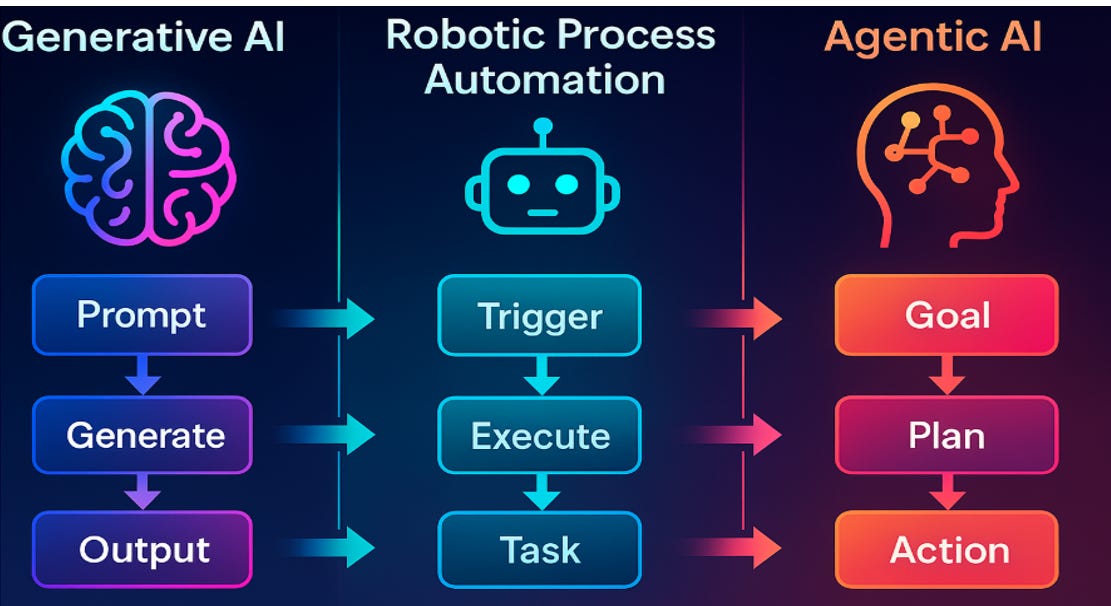
4. Generative AI (The "Creator")
Generative AI is a type of artificial intelligence that can create new content such as text, images, music, code, or videos.
It learns patterns from vast amounts of existing data and uses them to generate original outputs.
Unlike traditional AI that only analyzes or classifies data, Generative AI produces brand-new contentthat appears human-made.
In essence, Generative AI gives a computer the ability to imagine and create, not just calculate or repeat.
5. Large Language Models (LLMs)
Large Language Models (LLMs) are the brain and backboneof Generative AI.
They are designed to interpret and generate human language.
They are trained on massive text datasets,including books, articles, and websites.
They learn grammar, facts, reasoning patterns, tone, and style.
They use probabilistic algorithmsto predict the most relevant and coherent words or sentences.
6. Transformers
Introduced by Google in 2017, they rely on a mechanism called attention.
Attention allows the model to focus on the most relevant words in a sentence, even if those words are far apart.
This gives transformers superior ability to capture context and meaningcompared to older neural networks.
In Large Language Models (LLMs), transformers act as the core enginepowering the understanding of vast amounts of text.
They enable models to analyze relationships between wordsand generate coherent, context-aware responses.
In essence, transformers gave modern AI the power to read, reason, and respond like a human—but at digital speed and scale.
7. Attention mechanism
Attention is the key innovation inside Transformer modelsthat helps them determine which words in a sentence matter most.
Unlike older neural networks that read text one word at a time, attention lets the model focus on the most relevant parts of the input.
This mechanism enables the model to link related words, even when they appear far apart in a sentence.
For example, in the sentence “The cat sat on the mat because it was tired,” attention correctly identifies that “it” refers to “the cat,” not “the mat".
By dynamically weighing relationshipsbetween words, attention gives Transformers—and therefore LLMs—strong context awareness, coherence, and deeper understanding.
This makes their responses far more accurate and human-like than previous generations of neural networks.
8. Agentic AI ("The Doer")
Agentic AI refers to a new generation of AI systemsthat can plan, act, and make decisions autonomouslyto achieve a goal.
Unlike traditional AI tools that wait for explicit commands, Agentic AI can break down complex tasks into smaller steps.
It can choose which actions to take, use external tools or data sources, and adapt its approach.
Agentic AI systems can also collaborate with other AI agentsto complete multi-step tasks.
This gives machines a level of initiative and flexibility, making them function more like proactive partners rather than passive tools.
9. Agentic AI Ecosystems
Agentic Ecosystems are interconnected networks of multiple AI agentsthat collaborate, communicate, and coordinate to achieve shared goals.
Instead of relying on a single AI system, the ecosystem operates like a digital teamwhere each agent has a defined role—planning, reasoning, executing, or validating outcomes.
These agents can share information, delegate tasks to one another, and negotiate solutionsto complex, cross-domain problems.
An Agentic Ecosystem behaves like a self-organizing enterprisemade of AI specialists working together.
It can manage workflows end-to-end, including research, analysis, execution, and optimization.
The ecosystem continuously adapts to new data, conditions, and objectives in real time, enabling more resilient and intelligent automation.
Why This Knowledge Matters for You
You can now speak the languageof modern AI with confidence and precision.
You understand the capabilities—and limits—of LLMs, enabling better decisions around investment, risk, and adoption.
You are equipped to identify where AI can create value, where it needs guardrails, and where it must remain under human oversight.
You are ready to build on this foundationas the next articles move from “What AI is” to “How enterprises use it to transform work".
Closing Thought
“AI is no longer a mysterious black box—it is a strategic lever. In this article, we unlocked the fundamentals needed to lead with clarity in the AI era. Now the journey shifts from understanding to application, and from curiosity to capability".

Explore more: Start Here · Topics · Archive · About