



In this article, you will learn five prompt frameworks that turn vague requests into reliable, repeatable Artificial Intelligence (AI) outputs: RTF, CO-STAR, RISEN, CRISPE and PICOR. For each one, you will see what the letters stand for, where it shines, its advantages, when to avoid it, and a complete financial services example with both the prompt and the response you can expect.
These frameworks work in any industry and any role. I chose the financial sector for every example because it is where precision, tone and guardrails matter most, and where a weak prompt can quickly turn into a compliance problem.
Why Prompt Frameworks Matter
A Large Language Model (LLM) only knows what you put in front of it. When a prompt leaves out the audience, the data or the rules, the model fills the gaps with guesses. Prompt frameworks are simply checklists that stop you from leaving out the pieces that matter.
Her
e is the secret most people miss: almost every framework is built from the same five ingredients.
A role (Persona): who the AI should act as
A task: what you want done
Context: the background the AI needs
Constraints: tone, style, length, rules and limits
An output format: what the answer should look like
What changes from one framework to the next is the emphasis. Some focus on speed, some on audience, some on process, some on creativity and some on control. Once you know which problem you are solving, choosing the right framework becomes easy.
Note: All companies, clients and figures in the examples are fictional. The expected responses show what a well-prompted model typically returns; actual outputs vary by model, and in regulated work every output still needs human review.
1. RTF: Role, Task, Format
RTF is the simplest framework, and often the best place to start. You tell the AI who to be, what to do and how the answer should look.
Framework Components

Use Cases
Quick questions, definitions and explanations
Short summaries and first drafts
Frontline staff who need fast, consistent answers, such as branch and call center teams
Introducing prompting to people who have never used a framework
Advantages
Fast to write: three lines are enough
Easy to teach and remember, which drives adoption
Short prompts use fewer tokens, so they are cheaper and faster to run
The Format element alone fixes the most common complaint: answers that are too long
When to Avoid It
When the AI must work from specific data or documents
When compliance rules or policies apply to the output
When the audience and tone are critical, such as client communications
When the task requires several reasoning steps
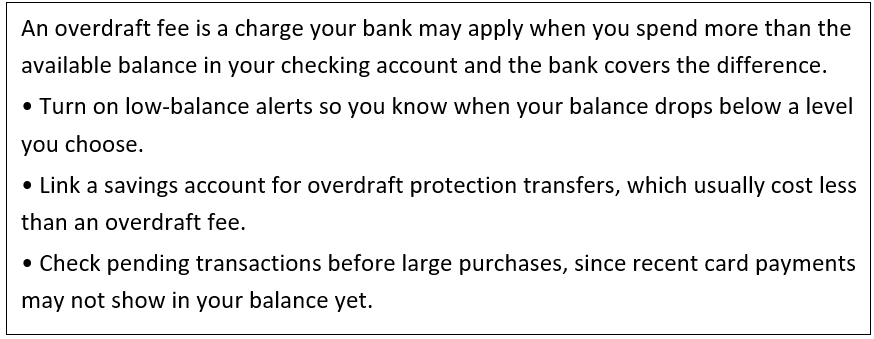
Example: Retail Banking Customer Service
Prompt:

Sample AI Response:
Why It Works
The role sets a helpful, customer-friendly voice, the task is specific, and the format keeps the answer short enough to read on a phone.
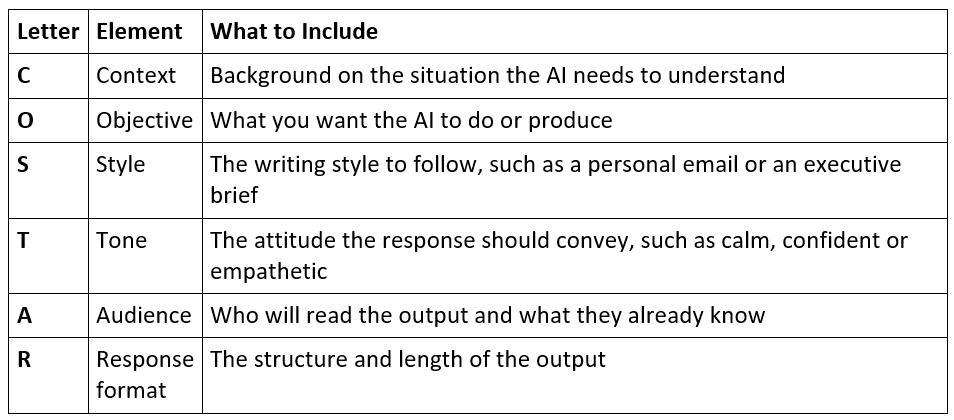
2. CO-STAR: Context, Objective, Style, Tone, Audience, Response Format
CO-STAR was popularized by the Government Technology Agency of Singapore (GovTech), which features it in its Prompt Engineering Playbook. Its strength is communication: it makes you think about who will read the output and how it should sound, not just what it should say.
Framework Components
Use Cases
Client emails and letters
Executive summaries and board notes
Marketing copy and product announcements
Internal communications during change, such as reorganizations or system migrations
Advantages
Separates style (how it is written) from tone (how it feels), which gives you fine control over voice
Forces you to name the audience, the single biggest driver of a useful response
Produces consistent, on-brand messaging across teams
Reduces rewrites, because the first draft already fits the reader
When to Avoid It
Quick factual questions, where six elements are overkill
Data-heavy analysis, because CO-STAR has no dedicated slot for input data or compliance rules
Multi-step processes, where the order of the work matters more than the voice
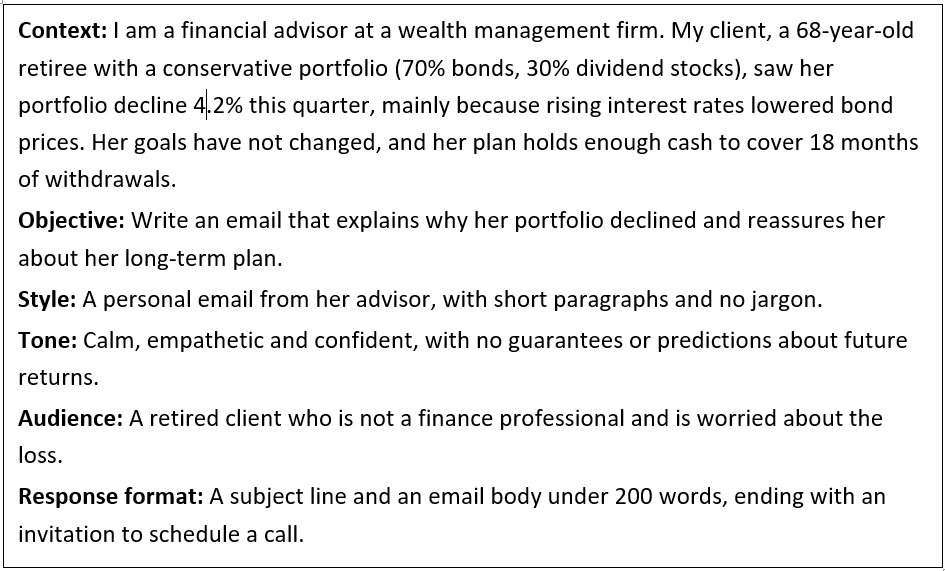
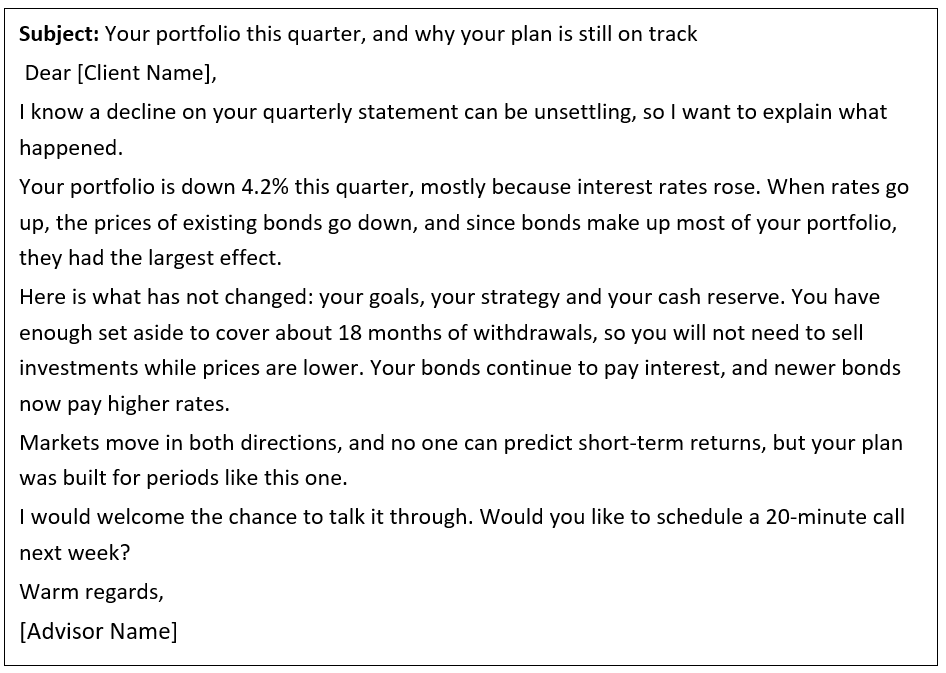
Example: Wealth Management Client Email
Prompt:
Sample AI Response:
Why It Works
The tone element keeps the email reassuring without making promises a compliance team would reject, and the audience element keeps the explanation free of jargon.
Note about the CO-STAR Framework
Variation I Use: P-CO-STAR (Persona + CO-STAR)
CO-STAR has no letter for a role or persona. Context describes the situation, but nothing tells the AI who to be while it writes. In my own work, I add one line at the top and call it P-COSTAR.
A persona sets the expertise, judgment and professional standards the AI should bring. In regulated communications, that matters: a seasoned advisor knows not to promise returns before the Tone element even says so.
For the wealth management example above, the prompt simply gains one new first line:
Persona: You are a senior wealth advisor with 20 years of experience, known for clear, calm and compliant client communication.
Everything else in the prompt stays the same. Use P-COSTAR whenever the voice of an expert matters as much as the message.
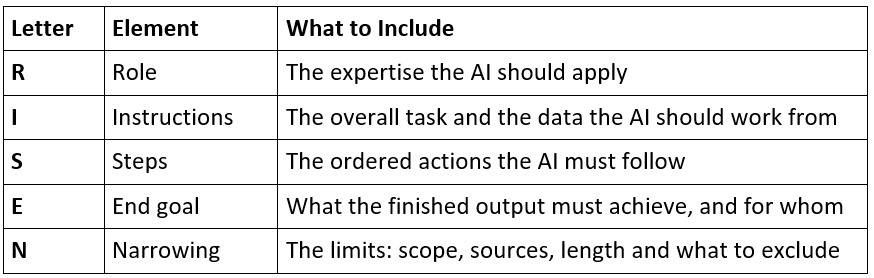
3. RISEN: Role, Instructions, Steps, End Goal, Narrowing
RISEN is built for process. Instead of hoping the AI follows the right method, you spell the method out step by step, then narrow the scope so the model stays inside the lines.
Framework Components
Use Cases
Credit reviews and covenant testing
Account reconciliations and variance analysis
Know Your Customer (KYC) periodic reviews
Any standard operating procedure you want applied the same way every time
Advantages
Makes the reasoning transparent, so a reviewer can check each step
Reduces skipped steps and shortcuts
The Narrowing element limits scope creep and unsupported assumptions
Translates naturally into reusable templates and, later, into agentic AI workflows
When to Avoid It
Simple, one-step requests
Creative or exploratory work, where a fixed path limits good ideas
When you do not know the right steps yourself: a flawed process produces confidently wrong results
Audience-sensitive communications, where CO-STAR is a better fit
Example: Commercial Lending Annual Credit Review
Prompt:
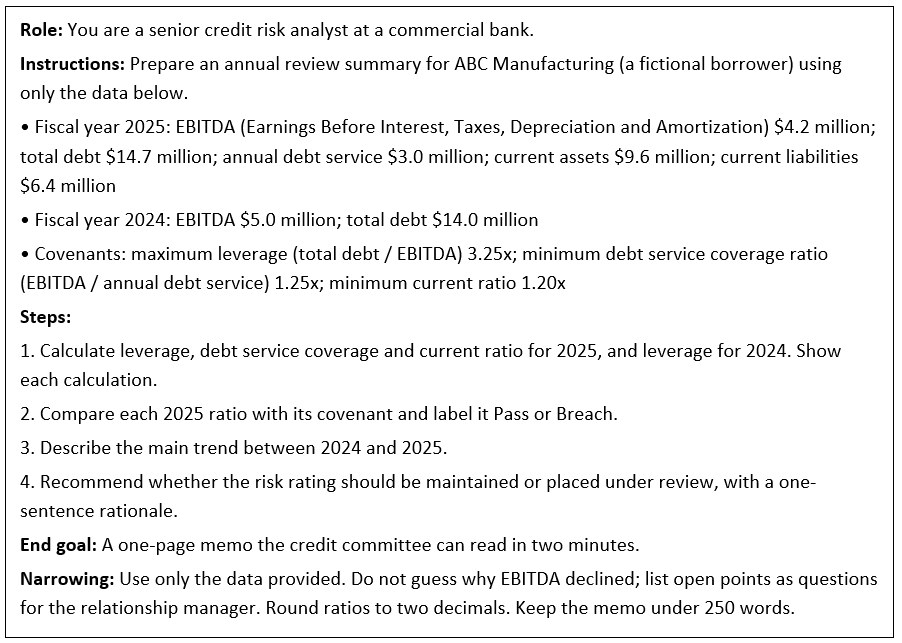
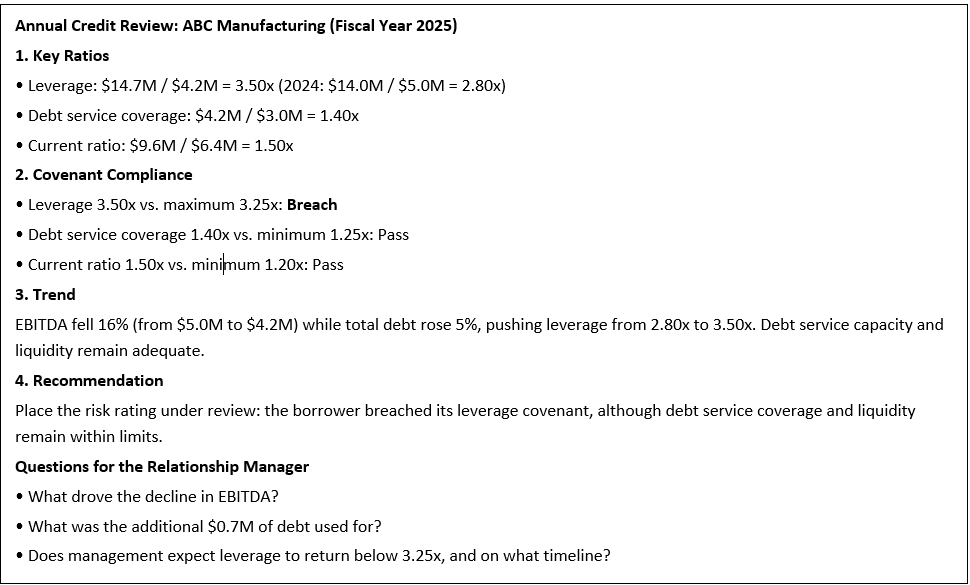
Sample AI Response:
Why it works
The steps force the model to show its math, so the committee can verify every number, and the narrowing element turns unknowns into questions instead of invented explanations.
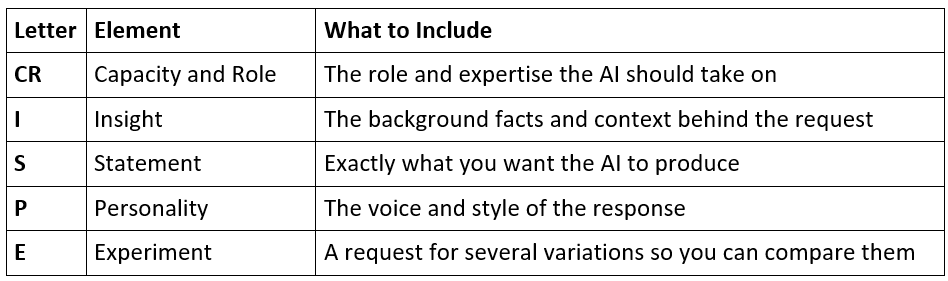
4. CRISPE: Capacity and Role, Insight, Statement, Personality, Experiment
CRISPE stands out because of its last letter. The Experiment elementasks the AI for several versions of the answer, so you can compare options side by side instead of rewriting one draft over and over.
Framework Components
Use Cases
Messaging options for investor relations, marketing or internal communications
Openings for presentations and earnings calls
Alternative framings for a recommendation or a difficult message
Brainstorming product names, taglines or campaign angles
Advantages
Several variations in a single prompt saves drafting time
Comparing versions helps leaders choose the right message deliberately
The Insight element grounds every version in the same facts
The Personality element keeps the voice consistent across versions
When to Avoid It
When there is one correct answer, such as calculations, reconciliations or regulatory filings
In automated pipelines that expect a single, predictable output
When reviewing multiple versions adds more work than it saves
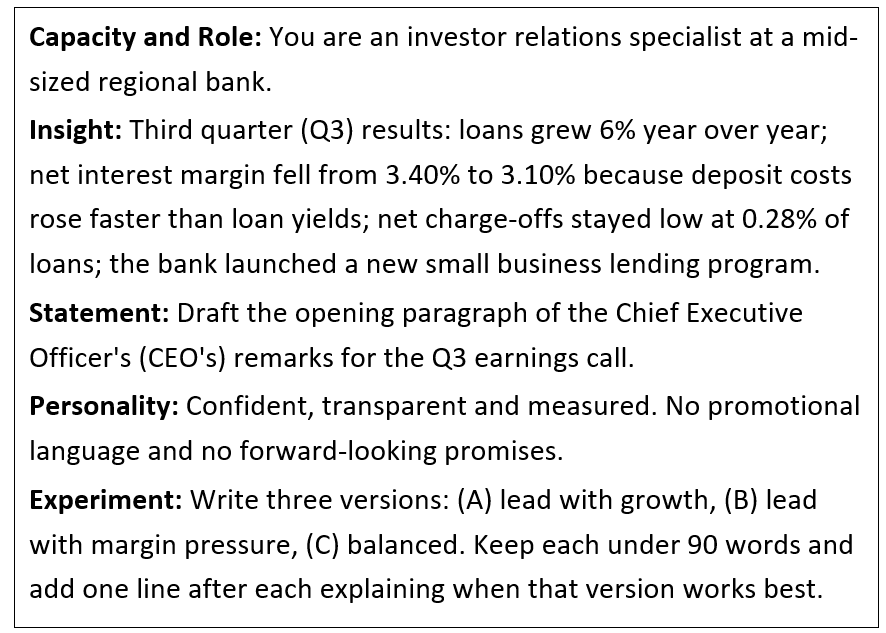
Example: Earnings Call Opening Remarks
Prompt:
Sample AI Response:
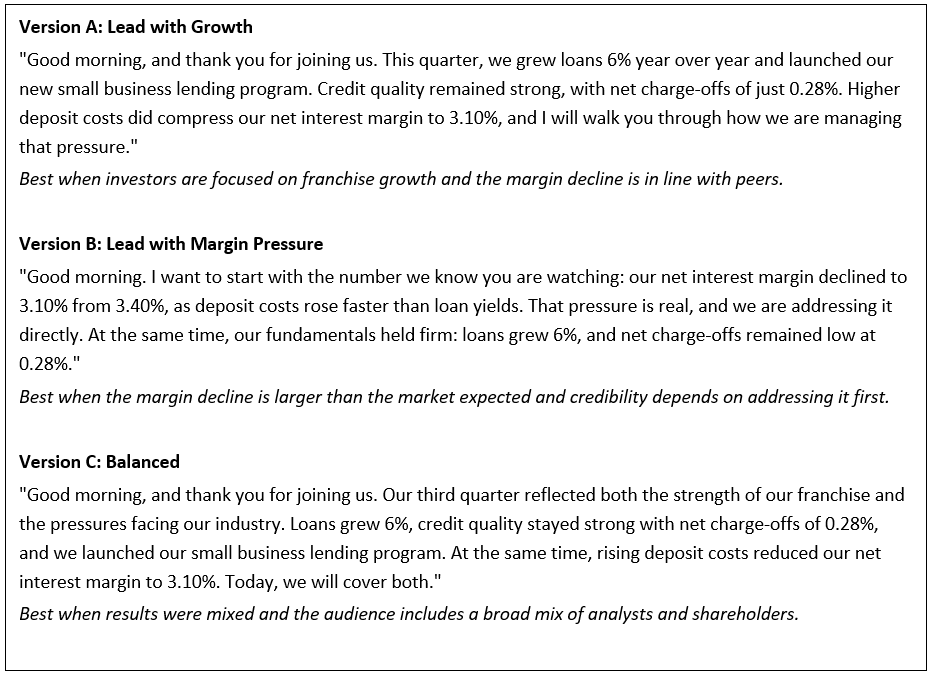
Why it works:
Every version uses the same facts, but each one sends a different signal. Leadership can now choose the message deliberately instead of accepting whatever the first draft happened to emphasize.
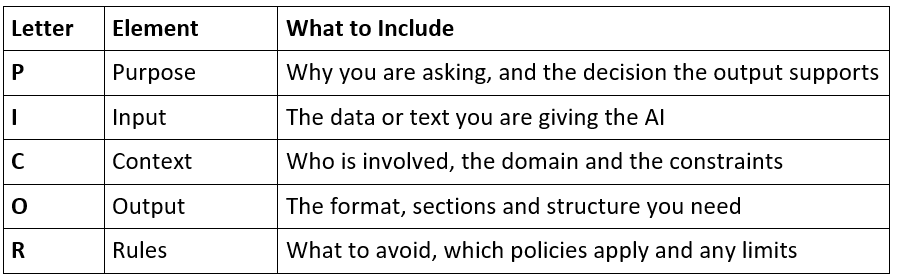
5. PICOR: Purpose, Input, Context, Output, Rules
PICOR is the framework I teach in my expert-level prompt engineering course, and it is designed for regulated, data-driven work.
Two features set it apart: a dedicated Inputslot that separates the data from the instructions, and a dedicated Rules slot for guardrails and policies.PICOR does not include a role letter, so I recommend adding a one-line role at the top of every PICOR prompt.
Framework Components
Use Cases
Anti-Money Laundering (AML) alert summaries and investigation notes
Audit findings, risk assessments and control testing write-ups
Policy interpretation and regulatory change impact analysis
Governed
A simple rule of thumb:
• Need a quick answer? Use RTF.
• Writing for a specific reader? Use CO-STAR.
• Following a defined process? Use RISEN.
• Want options to choose from? Use CRISPE.
• Working with data in a regulated environment? Use PICOR.
You can also combine them. A PICOR prompt can borrow RISEN-style numbered steps when the analysis has a defined sequence. Frameworks are a starting point, not a cage.
One rule that strengthens any framework: if it has no role or persona letter, add one line that tells the AI who to be. That is why the PICOR example above opens with a role, and why I use P-COSTAR instead of plain CO-STAR for expert communications.
Final Thoughts
The quality of your prompts defines the quality of your results. Frameworks will not replace judgment, domain expertise or human review, especially in financial services, but they will make your prompts clearer, your outputs more consistent and your AI use far easier to govern.
Start with RTF for everyday work, then reach for the framework whose emphasis matches the problem in front of you.
Which prompt framework do you use most often, and for what kind of work? Share your experience in the comments.
rompt templates stored in a shared prompt library
Advantages
Separating input from instructions reduces the chance that the model confuses data with commands or invents facts
The Rules element puts compliance guardrails directly into the prompt
Consistent structure makes prompts auditable, repeatable and easy to version
Purpose ties every output to a business decision, which keeps responses focused
When to Avoid It
Casual or quick questions, where RTF is faster
Creative brainstorming, where strict rules limit good ideas
When voice and audience are the main challenge, where CO-STAR is a better fit
When there is no input data to provide
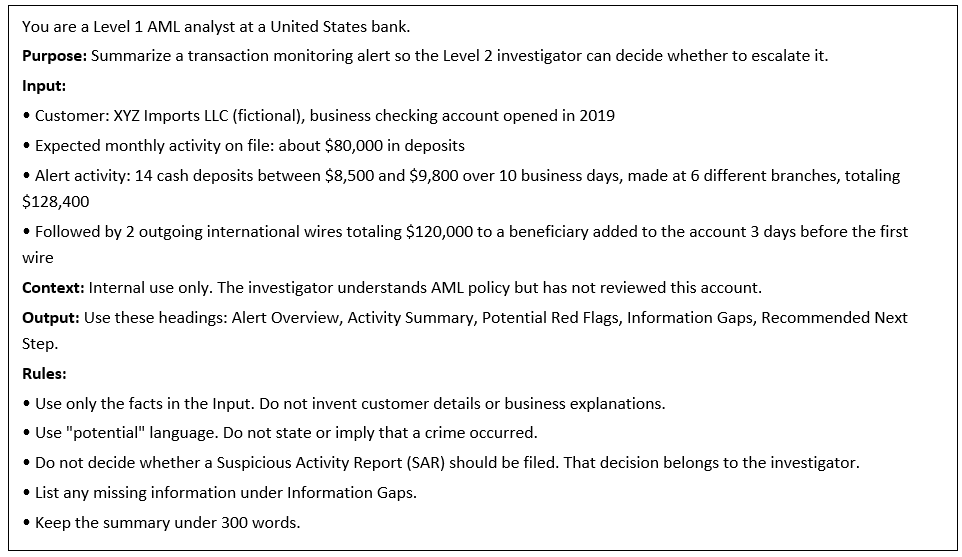
Example: Anti-Money Laundering Alert Summary
Prompt:
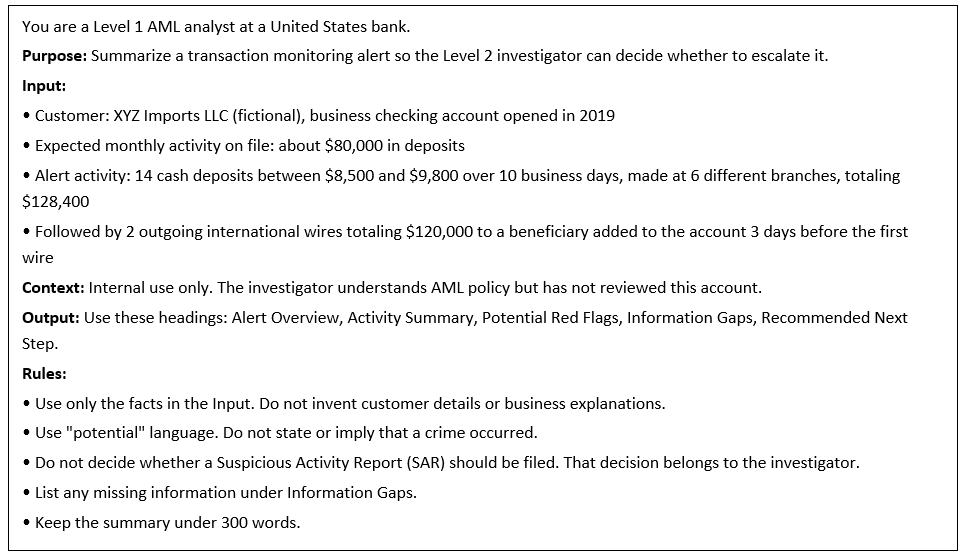
Sample AI Response:
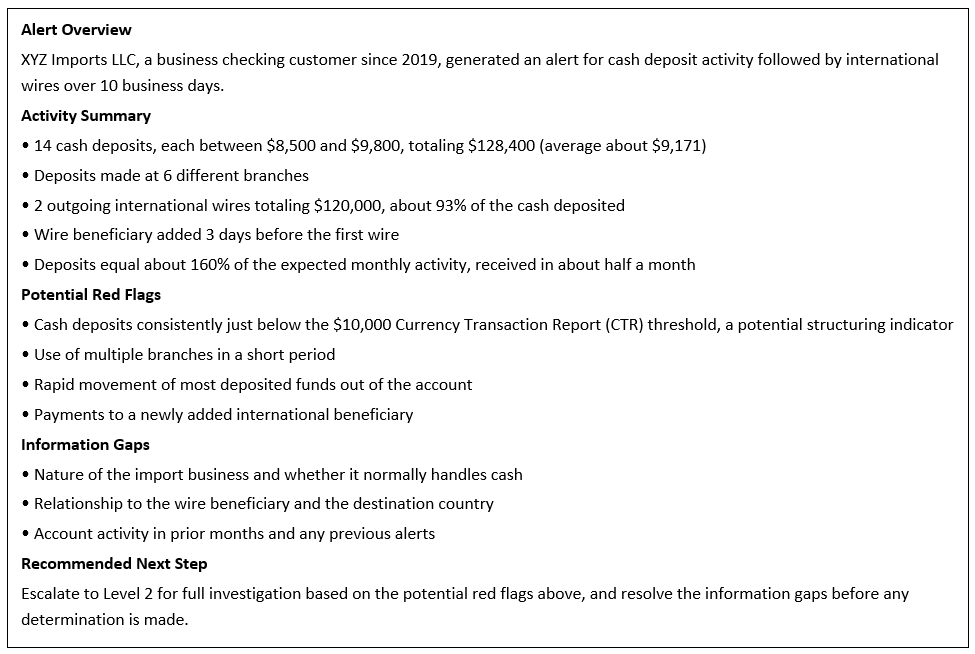
Why it works:
The input is clearly fenced off from the instructions, every number in the response can be traced back to the input, and the rules keep the language neutral and leave the filing decision with a human investigator.
The 5 Frameworks at a Glance
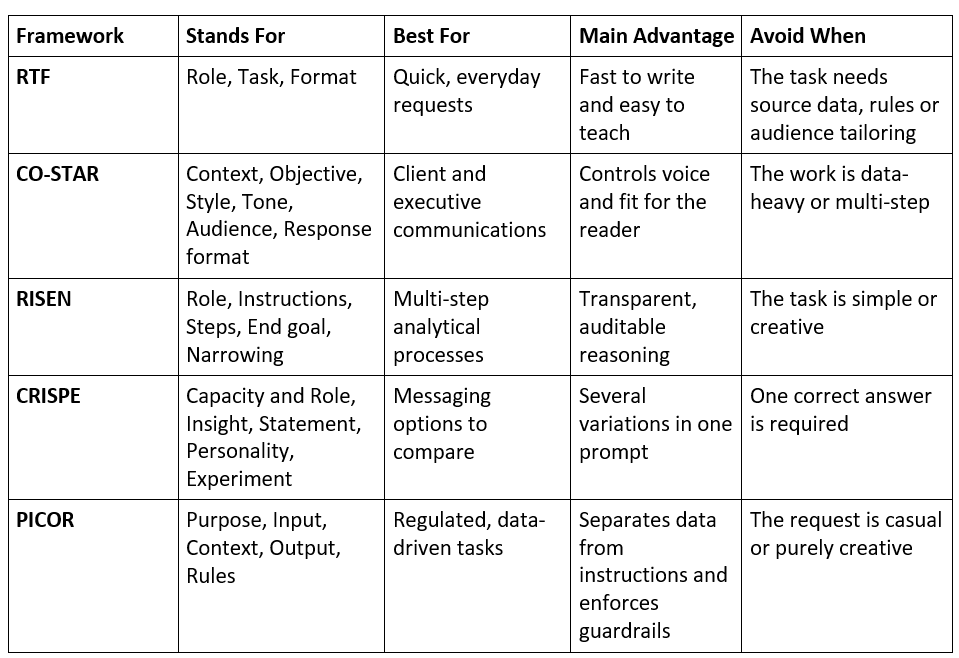
A simple rule of thumb:
Need a quick answer? Use RTF.
Writing for a specific reader? Use CO-STAR.
Following a defined process? Use RISEN.
Want options to choose from? Use CRISPE.
Working with data in a regulated environment? Use PICOR.
You can also combine them. A PICOR prompt can borrow RISEN-style numbered steps when the analysis has a defined sequence. Frameworks are a starting point, not a cage.
One rule that strengthens any framework: if it has no role or persona letter, add one line that tells the AI who to be. That is why the PICOR example above opens with a role, and why I use P-COSTAR instead of plain CO-STAR for expert communications.
Final Thoughts
The quality of your prompts defines the quality of your results. Frameworks will not replace judgment, domain expertise or human review, especially in financial services, but they will make your prompts clearer, your outputs more consistent and your AI use far easier to govern.
Start with RTF for everyday work, then reach for the framework whose emphasis matches the problem in front of you.
Which prompt framework do you use most often, and for what kind of work? Share your experience in the comments.
Explore more: Start Here · Topics · Archive · About