


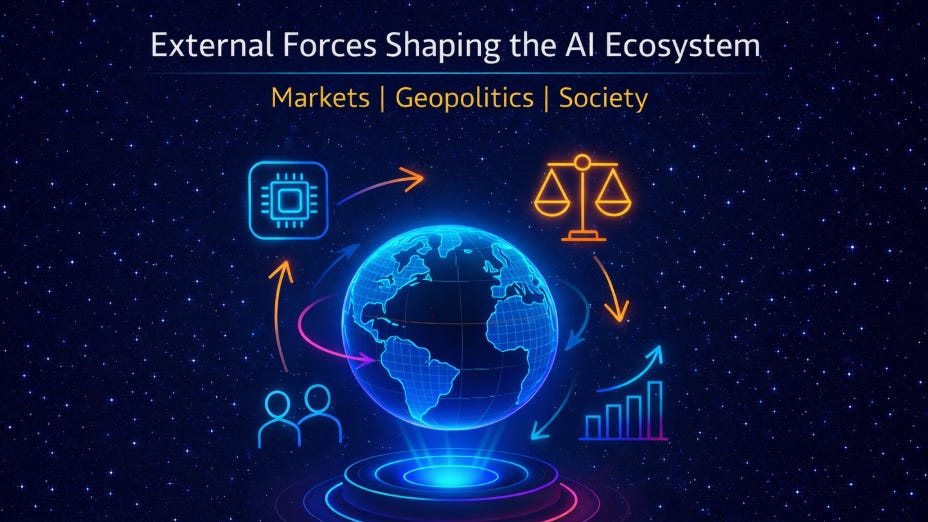
The success of enterprise-scale Generative and Agentic AI is not determined solely by technology. It is equally defined by external pressures—markets, regulation, geopolitics, social expectations, and rapid innovation cycles. Leaders must understand these macro forcesto anticipate disruption, maintain compliance, and seize strategic advantage

1. Market Consolidation and Competitive Dynamics
The New Power Centers:
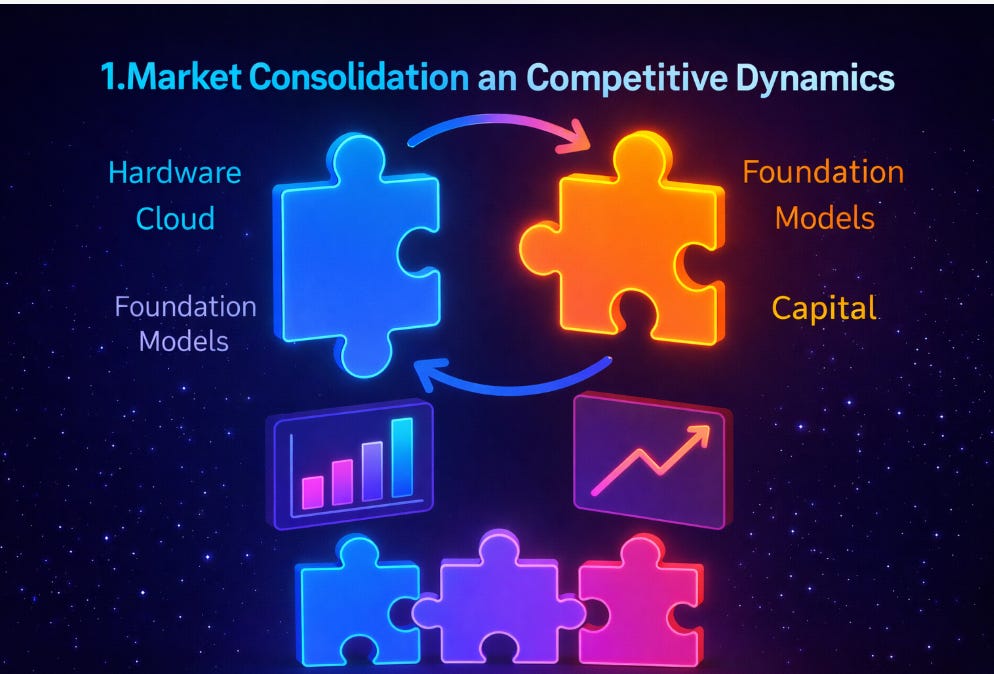
The AI landscape has rapidly consolidated around a few dominant “power centers” that combine model research, compute infrastructure, and distribution channels. These include:
Hardware Gatekeepers—NVIDIA, AMD, Intel, and emerging chipmakers driving compute supply.
Hyperscale Cloud Providers—Microsoft (Azure + OpenAI), Google Cloud (Gemini + Vertex AI), Amazon (AWS + Bedrock), IBM
Frontier Research Labs—OpenAI, Anthropic, Google, X & Cohere
Together, these entities define the pace of model innovation and the economics of access.
The Rise of Open Source and Decentralization:
Countering consolidation, the open-source movement (Llama 3, Mistral, Falcon, Gemma & Deep Seek) democratizes access, enabling enterprises to fine-tune private models without sending data to third-party clouds. The tension between closed frontier models and open-source innovation will shape cost structures, Intellectual Property (IP) strategies, and regulatory posture and innovation speed.
Strategic Implications for Enterprises:
Dependency Risk: Over-reliance on a single ecosystem increases vendor lock-in.
Sovereignty: Institutions may require on-prem or sovereign-cloudAI to meet data-residency rules.
Differentiation: Competitive advantage will stem from how AI is integrated,not which model is used.
2. Geopolitical and Economic Forces (Digital Sovereignty and National AI Strategies)

Countries now treat AI as a strategic asset akin to energy or defense capability. The U.S., China, and EU are leading parallel tracks—each emphasizing data control, model competitiveness, and ethical standards.
Implications:
Fragmentation of Standards: Divergent AI taxonomies and certification regimes.
Cross-Border Compliance: Firms operating in multiple jurisdictions must harmonize policy stacks.
Talent Migration: Global competition for AI talent will reshape labor markets.
For multinational enterprises, this means harmonizing policy stacks across jurisdictions — while keeping innovation velocity high.
3. Capital Flows & ROI Pressure

AI investment now exceeds $200 billion globally (as of 2025). However, funding distribution is uneven (concentrated in North America and China, with Europe emphasizing regulation).
We should expect:
Mergers & Acquisitions: Smaller AI startups absorbed into platform ecosystems.
Capital Efficiency Pressures: Boards will demand ROI evidence, not experiments.
Shift to Value Realization: Focus moves from capability to profitability of AI initiatives.
4. Societal and Workforce Implications
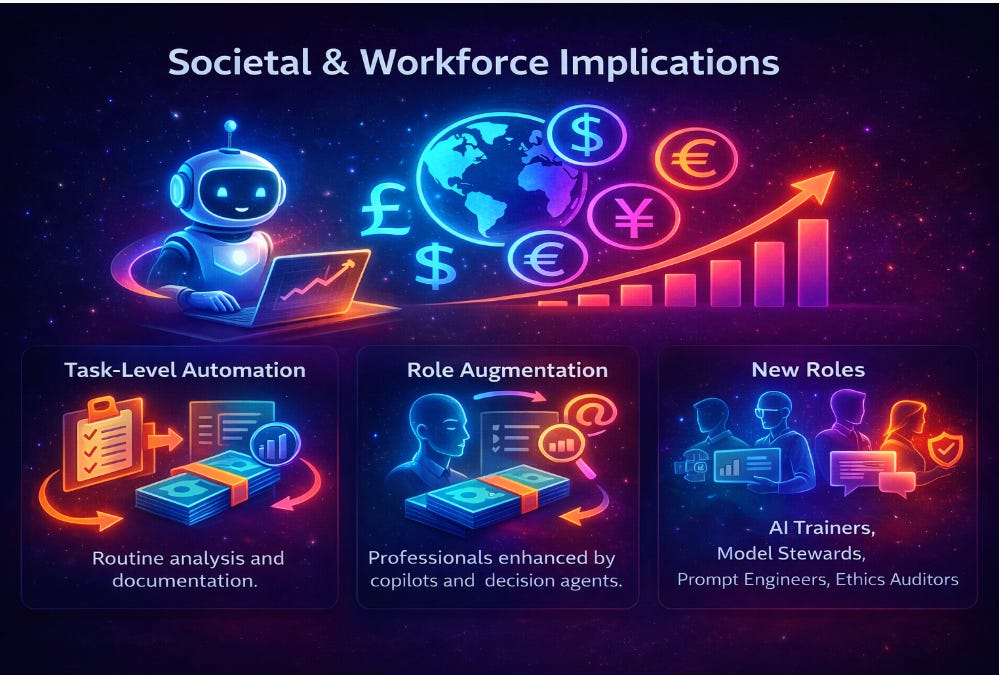
Agentic AI automates not only manual tasks but cognitive orchestration: scheduling, analysis, documentation, and compliance verification.
This Creates:
Task-Level Automation: Routine analysis and documentation.
Role Augmentation: Professionals enhanced by copilots and decision agents.
New Roles: AI Trainers, Model Stewards, Prompt Engineers, Ethics Auditors.
5. Trust, Transparency, and Human Perception

Pblic acceptance depends on perceived fairness, safety, and accountability.Leaders must communicate transparently explaining why an AI recommendation was made and how it aligns with policy.
Building trust requires:
Visible Oversight: Human accountability statements in AI workflows.
Explainable Outputs: Simplified rationales behind complex predictions.
Feedback Channels: Mechanisms for employees and customers to flag AI errors.
The Ethics of Human-AI Collaboration:
As agents gain autonomy, the line between “assistant” and “decision-maker” blurs.
Leaders must define principles ensuring:
Human Primacy: Final decisions rest with accountable humans.
Symbiotic Design: AI complements human judgment rather than replaces it.
Psychological Safety: Employees feel empowered, not threatened, by AI presence.
6. Emerging Technological Trends Influencing the AI Ecosystem
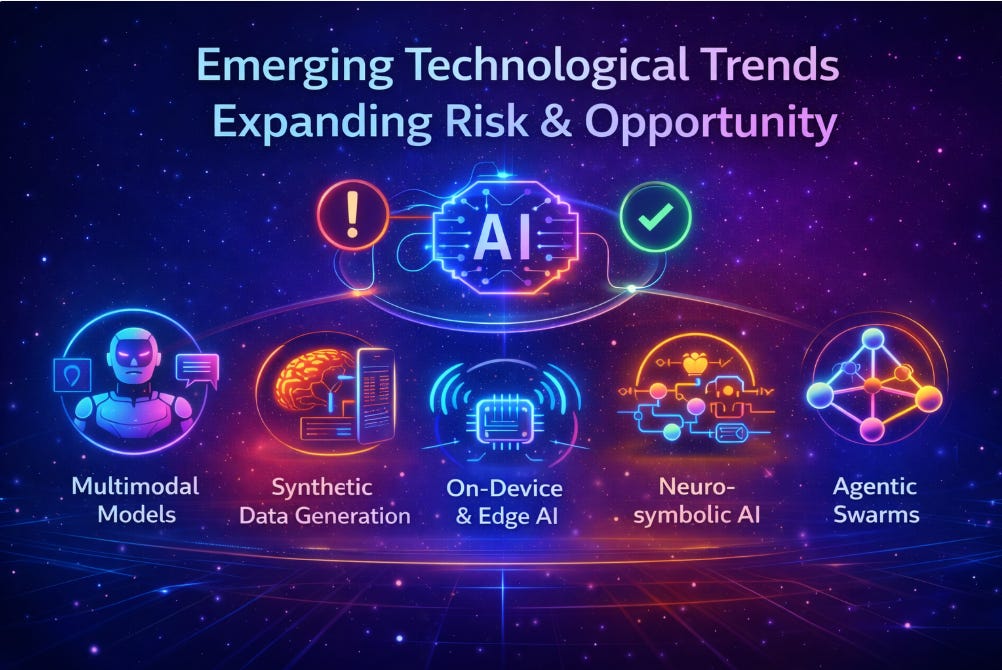
Multimodal Models: Unified reasoning across text, image, audio, and sensor data.
Synthetic Data Generation: Balancing privacy with data sufficiency.
On-Device and Edge AI: Bringing intelligence closer to data sources for speed and sovereignty.
Neuro-symbolic AI: Combining logic reasoning with deep learning to enhance explainability.
Agentic Swarms: Multiple agents collaborating for complex, adaptive tasks.
Each trend expands both potential and risk—demanding new governance playbooks.
Leadership Imperatives
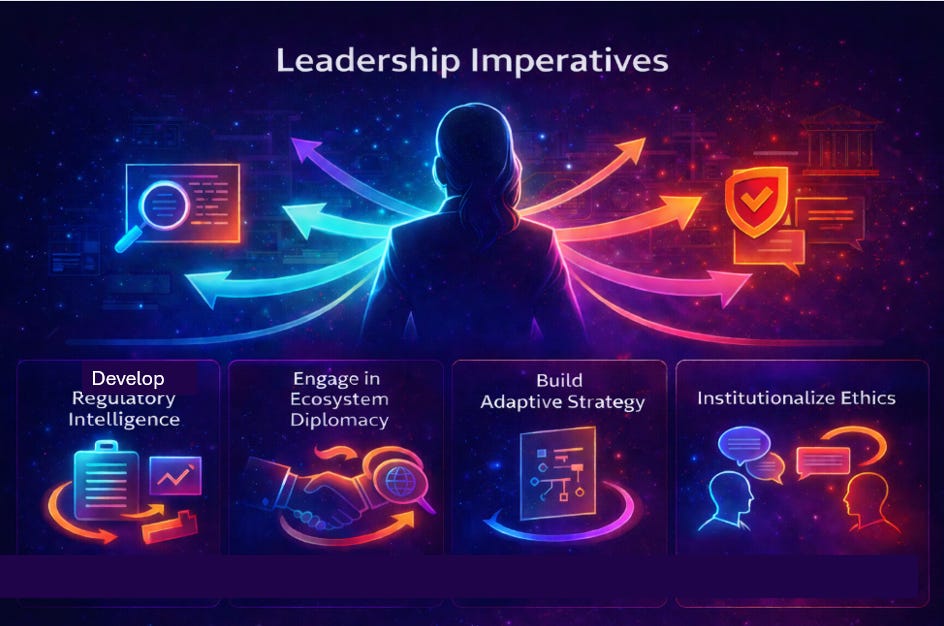
To thrive in this dynamic landscape, leaders must:
Develop Regulatory Intelligence: Continuously monitor AI policy shifts.
Engage in Ecosystem Diplomacy: Participate in cross-industry alliances and ethical councils.
Build Adaptive Strategy: Use scenario planning to model regulatory, market, and technology futures.
Institutionalize Ethics: Embed fairness, transparency, and accountability into every AI process.
Lead Societal Dialogue: Proactively communicate AI’s role, impact, and safeguards to employees and the public.
Recap
We examined how market consolidation is creating new AI power centers across chips, cloud, and foundation model providers—and what that means for dependency and bargaining power.
We explored the impact of geopolitics, digital sovereignty, and national AI strategies, and how fragmented regulations shape enterprise choices.
We analyzed capital flows and competitive dynamics, including the shift from experimentation to value realization and ROI pressure on AI investments.
We understood the societal and workforce implications of Agentic AI—from task automation and role augmentation to the emergence of new AI-focused jobs.
We deepened our understanding of trust, transparency, and human perception, including explainability, oversight, and ethical human–AI collaboration.
We reviewed emerging technological trends (multimodal models, edge AI, synthetic data, agentic swarms) and how these expand both opportunity and risk.
Why this Matters:
Leaders should see AI not just as a technology choice, but as a strategic environment shaped by regulation, geopolitics, and platform ecosystems.
They should be equipped to anticipate disruption, manage vendor lock-in, and design strategies that preserve sovereignty, resilience, and flexibility.
They should understand that sustainable advantage will come from how their organization uses AI within this environment—not from any single tool or model.
They should be prepared to craft balanced narratives on AI’s impact on the workforce, trust, and society, strengthening both internal alignment and external reputation.
This positions leaders to move from reactive compliance to proactive, scenario-based AI strategy that can adapt as the external landscape shifts



Explore more: Start Here · Topics · Archive · About