


Scalability in this field isn't a single dimension; it's a multi-layered challenge that plays out differently depending on whether you're scaling models, infrastructure, agents, or organizational adoption.
Most discussions oversimplify scalability into "more compute" or "more users." In reality, scalable AI systems must balance performance, cost, accuracy, governance, resilience, and trust simultaneously.
In this article, we will explore four levels of Scalability:
Model-Level Scalability: Beyond Brute Force
Agentic Scalability: The Real Frontier
Infrastructure Scalability: The Hidden Constraint
Organizational Scalability: The Hardest Problem
Let us break down how each layer is evolving and why the real bottlenecks are no longer purely technical.
1. Model-Level Scalability: Beyond Brute Force
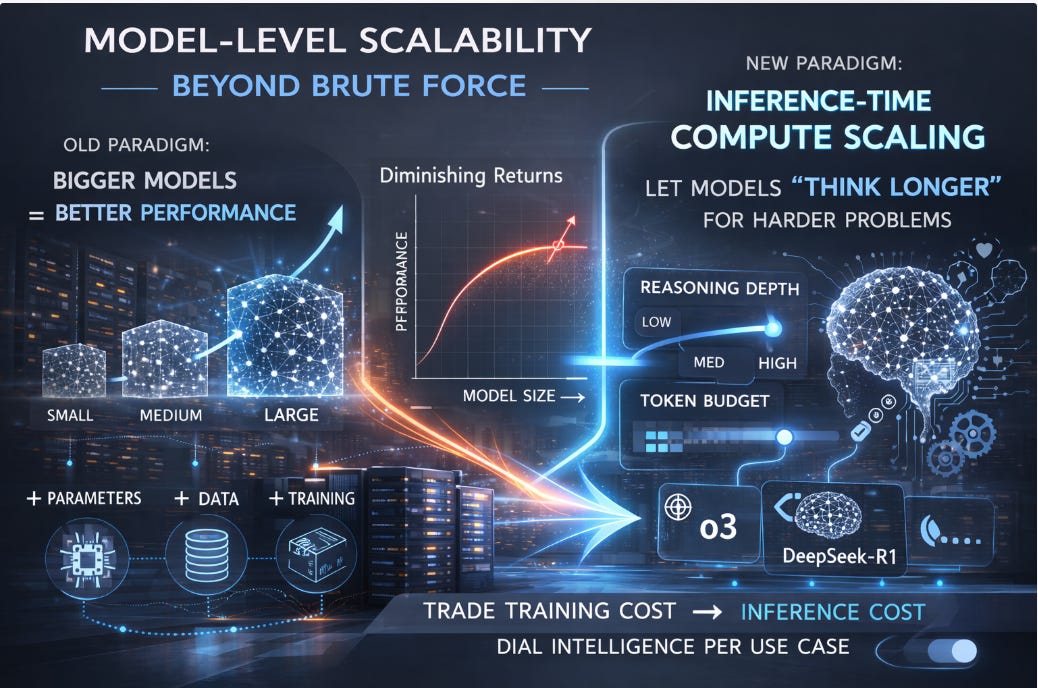
The early assumption was simple: bigger models equal better performance. Scaling laws, such as those established by Chinchilla research during the GPT-4 era, gave us the mathematical intuition: compute, data, and parameters needed to scale together in balance.
But we're hitting diminishing returns on pure parameter scaling. The cost curve is steep. The marginal gains are shrinking. The industry is pivoting.
The Shift: Inference-Time Compute Scaling
The new paradigm is inference-time compute scaling, letting models "think longer" for harder problems rather than just being bigger.
Instead of:One massive static model, we now have:
Dynamic reasoning depth
Adaptive token budgets
Structured tool use
Chain-of-thought expansion on demand
You trade inference cost for capability rather than training cost. That’s more enterprise-friendly because it allows cost-controllable economics per use case.
This introduces a new dimension of scalability: elastic intelligence that adjusts to task complexity.
But this also creates governance challenges:
Who controls reasoning depth?
How do you prevent runaway inference costs?
How do you measure marginal value per extra token?
Scalability now becomes a cost-performance optimization problem, not just a capability race.
2. Agentic Scalability: The Real Frontier
This is where things move from complicated to genuinely complex.
Horizontal scaling of agents (more agents working in parallel) is architecturally straightforward.
What’s difficult is:
Scaling coordination
Preserving coherence
Preventing cascading failure
Maintaining verifiability
The Supervisor–Worker pattern and Hierarchical Task Networks help structure decomposition. But three core tensions remain.
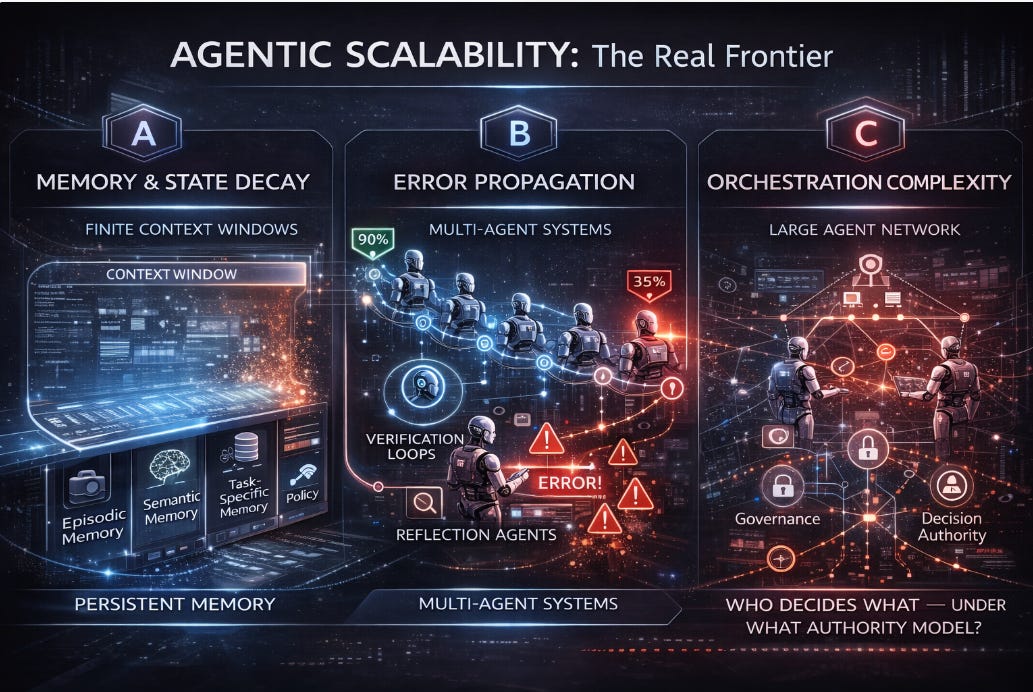
A. Context Window & Memory Architecture
Agents running long-horizon tasks accumulate state. Context windows are finite. Memory systems introduce trade-offs:
Raw transcript storage → too large
Summarization → lossy compression
Vector recall → semantic approximation
Persistent memory design becomes an architectural decision:
Episodic memory
Semantic memory
Task-specific memory
Policy memory
Scalability depends on how well you manage state decay without losing coherence. This cannot be permanently resolved. It can only be mitigated.
B. Error Propagation in Multi-Agent Systems
An agent with 90% accuracy may seem adequate. But in a 10-agent pipeline: 0.9¹⁰ ≈ 35% system-level accuracy. That’s catastrophic at enterprise scale.
Scalable agentic systems require:
Verification loops
Reflection agents
Cross-agent auditing
Redundant reasoning paths
Confidence scoring not just retries.
True scalability demands error containment architectures.
C. Coordination Overhead & Orchestration Complexity
As you add agents:
Message passing increases
Latency compounds
Governance boundaries blur
Decision authority diffuses
Event-driven architectures decouple agents but introduce state synchronization challenges.
The core scalability question becomes:Who decides what, and under what authority model?
At small scale, this is an engineering decision. At enterprise scale, this becomes policy.
3. Infrastructure Scalability: The Hidden Constraint
Most enterprises underestimate infrastructure friction.
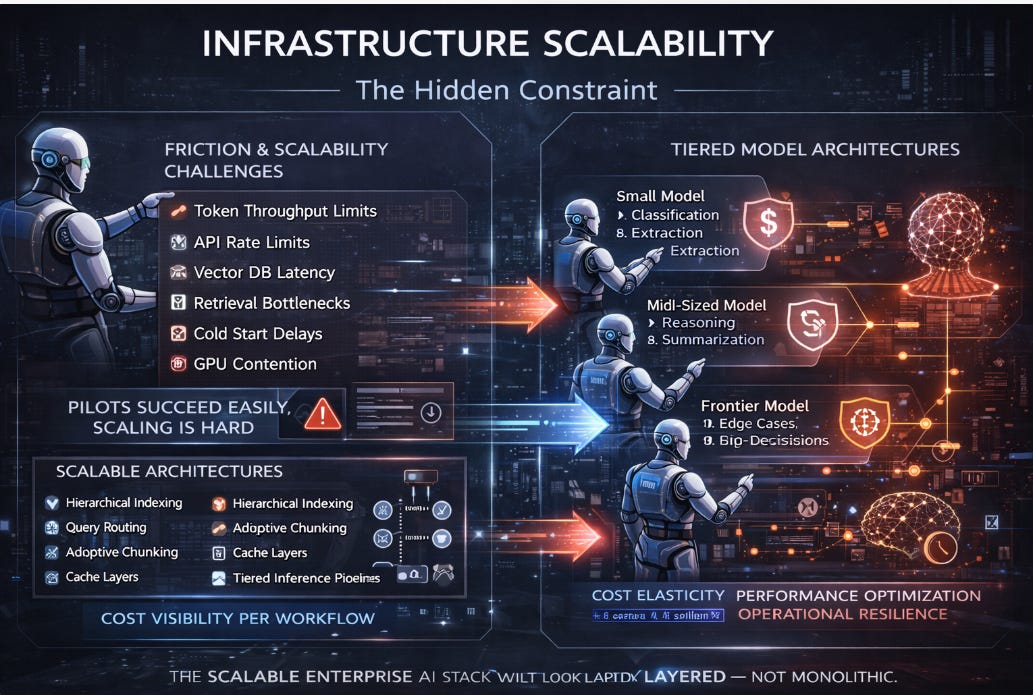
Pilots succeed easily. Production scale exposes:
Token throughput limits
API rate limits
Vector DB latency
Retrieval bottlenecks
Cold start delays
GPU contention
RAG systems that work in demos often collapse under real-world load.
Scalable architectures require:
Hierarchical indexing
Query routing
Adaptive chunking
Cache layers
Tiered inference routing
Async execution pipelines
And critically: Cost visibility per workflow.
If you cannot allocate or track cost per agent workflow, you cannot scale economically.
Tiered Model Architectures
You do not scale by running frontier models indiscriminately.
You scale by routing tasks:
Small models → classification, extraction
Mid-sized models → reasoning & summarization
Frontier models → edge cases & high-impact decisions
This creates:
Cost elasticity
Performance optimization
Operational resilience
The scalable enterprise AI stack will look layered, not monolithic.
4. Organizational Scalability: The Hardest Layer
Technically, you can scale an agentic system. Organizationally, most enterprises cannot absorb the complexity.This is where initiatives stall.
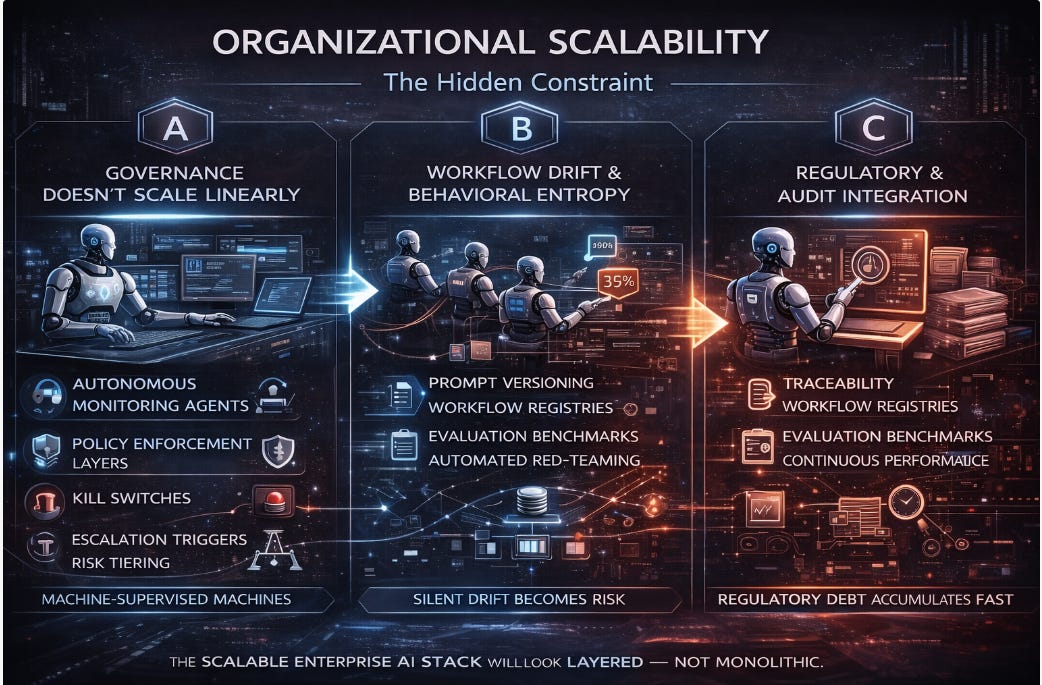
A. Governance Does Not Scale Linearly
If you double the number of agents, you cannot double human oversight.
You need:
Autonomous monitoring agents
Policy enforcement layers
Kill switches
Escalation triggers
Risk tiering
Scalable oversight requires "machines that supervise other machines", with humans reviewing anomalies, not everything.
B. Workflow Drift & Behavioral Entropy
As agent systems scale:
Prompts evolve
Policies update
Tools change
Dependencies shift
Without version control, evaluation pipelines, and regression testing, behavior drift goes undetected.At enterprise scale, drift becomes risk.
Scalability demands:
Prompt versioning
Workflow registries
Evaluation benchmarks
Automated red-teaming
Continuous performance scoring
C. Regulatory & Audit Integration
In regulated industries, every decision agent must provide:
Traceability
Decision logs
Rationale transparency
Policy alignment
Model documentation
If you scale without this, you accumulate regulatory debt.And regulatory debt compounds faster than technical debt.
The Economics of Scalability
ROI compressionis an often-overlooked dimension of scaling.
As systems scale:
Marginal cost per task must decrease
Marginal risk per task must not increase
Marginal oversight effort must decrease
If any one of those fails, scaling collapses.
Where We Are Heading (Next 2–3 Years)
The next frontier will not be bigger models.
It will be:
Learning Feedback Loops at operational scale
Self-optimizing agent policies
Standardized agent protocols (MCP and similar frameworks)
Cost-aware orchestration engines
Governance-first design architectures
The breakthrough will not be raw intelligence. It will be controlled autonomy at scale.
The Core Insight
The technical scaling problem is largely solvable through engineering.
The human-in-the-loop scaling problem is not.
The organizations that succeed will not be those with the largest GPU clusters.
They will be those that:
Solve governance before scaling
Design verification before autonomy
Engineer cost transparency before deployment
Build trust infrastructure before agent proliferation
Scalability is no longer about “Can it run?”.It’s about whether the organization can absorb it, govern it, audit it, and afford it continuously.
That is the real frontier.
Thank you for making it all the way here.

Explore more: Start Here · Topics · Archive · About