


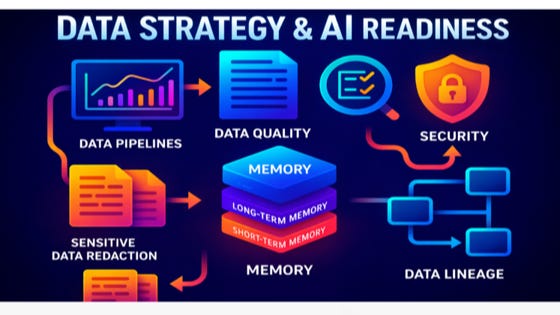
Many enterprise AI initiatives eventually run into the same inconvenient truth:the model is not the problem. The data is.
This is the central insight of this article in the AI Strategist training series. Before an organization can deploy a model, before it can automate a process, before it can scale an agentic workflow, it must first reckon honestly with the quality, architecture, governance, and security of the data that will feed that system. This article provides AI Strategists with the diagnostic tools, conceptual frameworks, and practical methods to make that reckoning rigorous rather than reactive.
Why Data Readiness Determines AI Success
There is a persistent and dangerous myth in enterprise AI adoption: that deploying a large language model is sufficient to drive transformation. It is not. AI does not generate insight from nothing. It amplifies the consequences of bad data.
When organizations feed high-quality, well-structured, semantically rich data into an AI system, they get powerful and reliable outputs. When they feed fragmented, inconsistent, poorly governed data into that same system, they get errors, hallucinations, and outputs that are worse than useless because they carry a veneer of authority without the substance to back it up.
The uncomfortable reality is that no amount of prompt engineering, model fine-tuning, or orchestration sophistication can compensate for a broken data foundation.
AI performance is a direct reflection of:
The accuracy and completeness of the underlying data
The consistency and integrity of data across systems
The timeliness of information and acceptable lag tolerances
The accessibility of data to the AI systems that need it
The existence of security controls governing who and what can touch that data
The presence of organizational discipline around data documentation, classification, and lineage
The Eight Dimensions of Enterprise Data Quality
AI Strategists must evaluate data systematically before recommending any investment in AI-driven automation.
A thorough data quality assessment examines eight critical dimensions:
Accuracy: Is the data factually correct? How frequently do errors appear, and in which systems?
Completeness: Are all relevant fields populated? Are entire categories of information missing?
Consistency: Do different systems record the same data in compatible ways, or does each team maintain its own version of the truth?
Timeliness:Is the data current? Is there acceptable lag, and does that lag create decision risk?
Lineage: Can you trace where the data originated, who modified it, and how it evolved over time?
Accessibility: Can AI systems retrieve the data securely, efficiently, and without manual intervention?
Governance: Are there clear, enforced rules about how data can be accessed, used, and shared?
Sensitivity: Does the data contain personally identifiable information (PII), regulated content, or confidential business intelligence requiring special safeguards?
These dimensions are not independent. A gap in any one of them can cascade into failures across the others. A strategist who assesses all eight dimensions before recommending an AI solution avoids costly and reputationally damaging failures.
Data Architecture Foundations for AI
Recognizing the importance of data quality is necessary but not sufficient. AI Strategists must also understand the architectural components that make high-quality data usable by AI systems.This is not about building infrastructure. It is about evaluating whether the infrastructure in place supports the AI ambitions of the organization.
The key architectural components that AI systems depend on include:
Data Sources: Internal systems such as ERP platforms, CRM tools, risk engines, and document repositories, as well as external feeds including market data, financial benchmarks, and regulatory datasets.
Data Pipelines: Systems for extracting, transforming, and loading data (ETL and ELT processes) that move information reliably from source systems to consumption layers.
Feature Stores and Knowledge Layers: Structured repositories for information used repeatedly across models, reducing redundancy and improving consistency.
Vector Databases: Specialized storage for embeddings used in retrieval-augmented generation (RAG), enabling semantic search across large document corpora.
Metadata Management: Descriptions, classifications, and lineage tracking that make data discoverable, interpretable, and auditable.
Access Controls: Role-based permissions, encryption standards, and key management practices that ensure data is accessed only by authorized systems and users.
AI Strategists do not need to build these systems.However, they must understand how each component influences the feasibility, cost, performance, and governance profile of any proposed AI solution.
Retrieval-Augmented Generation (RAG): The Enterprise AI Lifeline
Among the technical concepts that AI Strategists must understand deeply, Retrieval-Augmented Generation (RAG) stands out as the most consequential for enterprise deployments. RAG solves a foundational problem: general-purpose language models are trained on broad public data, and they do not know your organization's policies, processes, documents, or institutional knowledge.
RAG bridges that gap by connecting AI models to enterprise knowledge sources in real time. At its core, RAG works by:
Reading and indexing organizational documents, policies, and records
Extracting semantically meaningful information and storing it as searchable embeddings
Retrieving the most relevant knowledge snippets in response to a query
Grounding model responses in that retrieved content rather than relying solely on parametric memory
Providing source citations that make outputs auditable and explainable
Enabling knowledge updates without requiring expensive model retraining
The business case for RAG is compelling and well-established. Model responses become measurably more reliable. Organizations avoid the significant cost and complexity of fine-tuning or training proprietary AI models. Implementation timelines are faster, outcomes are more explainable, and audit trails are cleaner.
Real-world enterprise RAG applications include policy lookup, compliance guidance, contract review, customer inquiry responses, risk and finance documentation search, and analyst workflows.
Memory Systems in Modern AI
As AI systems become more sophisticated and agentic in their design, understanding how they store, retrieve, and apply information becomes a strategic imperative. Modern AI increasingly mimics the structure of human cognitive memory, operating across four distinct memory types that AI Strategists must be familiar with.
1. Short-Term Memory (Working Memory)
Short-term memory holds context within a single interaction or task.It is active during a conversation or workflow execution and resets afterward. The scope and fidelity of working memory directly affect prompt design decisions and orchestration architecture. Understanding working memory constraints helps strategists design workflows that do not exceed a model's contextual capacity.
2. Long-Term Memory
Long-term memory stores persistent business knowledge, including rules, documented processes, and factual records.It can be updated over time and is typically backed by database layers or structured storage systems. Long-term memory is what allows an AI system to behave consistently across interactions, drawing on stable institutional knowledge rather than starting fresh each time.
3. Episodic Memory
Episodic memory records past actions, decisions, and outcomes. It enables agents to learn from previous task executions and supports optimization loops where performance improves over time. For agentic AI systems operating in complex enterprise workflows, episodic memory is essential. It is what distinguishes an AI system that repeats mistakes from one that learns from them.
4. Semantic Memory
Semantic memory holds conceptual knowledge, patterns across experiences, and abstract understanding. It helps AI systems maintain consistency across different domains and apply learned principles to novel situations.
Together, these four memory layers allow AI systems to become reliable, contextually aware, attuned to organizational workflows, and more capable of autonomous operation at scale.
Security, Privacy, and Access Control in AI Systems
Data security is not a feature of enterprise AI. It is a prerequisite. In regulated sectors such as financial services, healthcare, and insurance, the consequences of security failures in AI systems are not merely technical. They are legal, regulatory, reputational, and operational.
AI Strategists must ask hard questions about security before any use case moves from concept to deployment:
Who can access the data feeding the model, and under what conditions?
How is sensitive or regulated data masked, anonymized, or shielded from the model?
Where is the model deployed, and does that deployment environment meet the organization's security standards?
Is data encrypted both at rest and in transit?
How is user and system access logged, and who reviews those logs?
What are the audit requirements, and how does the AI system satisfy them?
Which data is restrictedfrom use in training or fine-tuning?
The security layers that govern AI systems include authentication and authorization protocols, network segmentation, encryption standards, zero-trust control frameworks, data masking and tokenization, monitoring and alerting systems, and data retention and deletion policies.
Deployment Architectures: Choosing the Right Setup
One of the most consequential decisions an AI Strategist facilitates is the choice of deployment architecture. There is no universally correct answer. The right architecture is the one that balances the specific risk profile, regulatory obligations, cost constraints, and technical maturity of the organization and the use case in question.
The four primary deployment patterns each carry distinct advantages and tradeoffs:
1. Cloud Deployment
Cloud-hosted models offer fast deployment, scalable infrastructure, and easy access to the latest foundation models without significant engineering investment. The tradeoffs include data sensitivity concerns, regulatory restrictions that may prohibit certain data from leaving organizational boundaries, and dependence on the vendor's roadmap and uptime.
2. Fully On-Premises or Self-Hosted
On-premises deployments provide maximum control,the highest level of data security, and the ability to operate proprietary AI models entirely within organizational infrastructure. The cost of this control is significant engineering investment, ongoing maintenance burden, and the requirement that model upgrades be managed internally rather than consumed as a service.
3. Virtual Private Clouds and Dedicated Instances
VPC and dedicated instance deployments offer enterprise-grade network isolation, strong compliance alignment, and meaningfully reduced data risk compared to shared cloud environments. The tradeoffs are higher cost and the requirement for a reasonably mature cloud engineering capability to operate effectively.
4. Hybrid Architectures
Hybrid deployments combine cloud and on-premises elements, keeping sensitive data local while leveraging cloud models for lower-risk workloads. This approach offers a practical balance between control and scalability, but it introduces integration complexity and operational overhead that must be carefully managed.
Diagnosing Data and Architecture Gaps
Before recommending that a use case move forward, AI Strategists must run structured diagnostic assessments to identify the gaps that would otherwise surface as operational failures. Knowing what to look for makes the difference between a rigorous assessment and a wishful one.
The most common red flags that signal foundational work is required before AI deployment include:
Data stored primarily in PDFs and documents with inconsistent formatting and no structured extraction layer
Multiple conflicting sources of truth for the same business data
Missing or incomplete lineage and metadata documentation
Unclear or disputed data ownership across business lines
Undefined or unenforced security classifications
No API accessto key operational systems
Processes that depend heavily on unstructured email communication
Policies and procedures that exist only as narrative text and have not been expressed in machine-readable form
Uncertainty about theorigin or provenance of critical data sources
Each of these conditions signals a potential data readiness gap. Not all of them are disqualifying for AI deployment, but all of them require a remediation plan.The AI Strategist's value is in surfacing these gaps early, while there is still time to address them cost-effectively, rather than after a deployment has been announced and expectations have been set.
A Practical Framework: The Data Readiness Assessment
Theory without practice is insufficient preparation for real-world implementation. In this section, we will cover a structured exercise that AI Strategists can apply immediately to any real-world workflow under consideration.
The framework proceeds through four steps:
Step 1: Map All Data Sources Involved
Document every data input that feeds the workflow: emails, PDFs, Excel files, relational databases, CRM systems, API feeds, document repositories. Completeness at this stage is critical. Undiscovered data sources become undiscovered failure points.
Step 2: Score Each Source Across Five Dimensions
Evaluate each data source against the following criteria: accuracy, completeness, accessibility, sensitivity classification, and structural form (structured, semi-structured, or unstructured). This scoring creates an honest picture of data quality across the full input landscape.
Step 3: Identify Major Gaps
Analyze the scores to identify which sources would prevent automation, which would create hallucination risk, and which require transformation or remediation before they can be used reliably in an AI system.
Step 4: Draft a Readiness Summary
Synthesize the assessment into a clear, honest summary that leadership can act on. A well-crafted readiness summary might conclude, for example:
"The reconciliation workflow is feasible for AI automation, but document formats must be standardized, and key data fields must be extracted consistently before deployment can proceed."
This is how AI Strategists evaluate readiness before recommending investment. It is rigorous, repeatable, and grounded in operational reality rather than aspiration.
Conclusion: Strategy Meets Operational Reality
This article establishes a foundational principle that should anchor every AI initiative: readiness begins not with models, but with data, architecture, and governance.
The organizations that succeed with AI are not necessarily the ones with the most sophisticated models. They are the ones that did the unglamorous work of understanding their data, hardening their architecture, governing their processes, and building the organizational capacity to operate AI systems responsibly over time.
For AI Strategists, this article provides the operational lens needed to evaluate feasibility honestly, identify gaps systematically, and design initiatives that are grounded, governable, and built to last. It is the difference between deploying AI that works and deploying AI that impresses in a demo and fails in production.
Data readiness, architecture integrity, governance discipline, and organizational capability are the conditions that matter. They are the foundation. Everything else is built on top of them.
About This Article Series
This article is part of the AI Strategist Series, a structured training program designed to equip enterprise professionals with the frameworks, methods, and strategic judgment required to lead AI initiatives responsibly. The series is published as part of ongoing AI governance and digital transformation work within Citigroup's Finance, Risk, and Treasury organization.
Previous modules in the series cover process evaluation, workflow decomposition, stakeholder alignment, and capability fit assessment.
Future modules address governance frameworks, change management, and the organizational design of AI-enabled enterprises.

Explore more: Start Here · Topics · Archive · About