


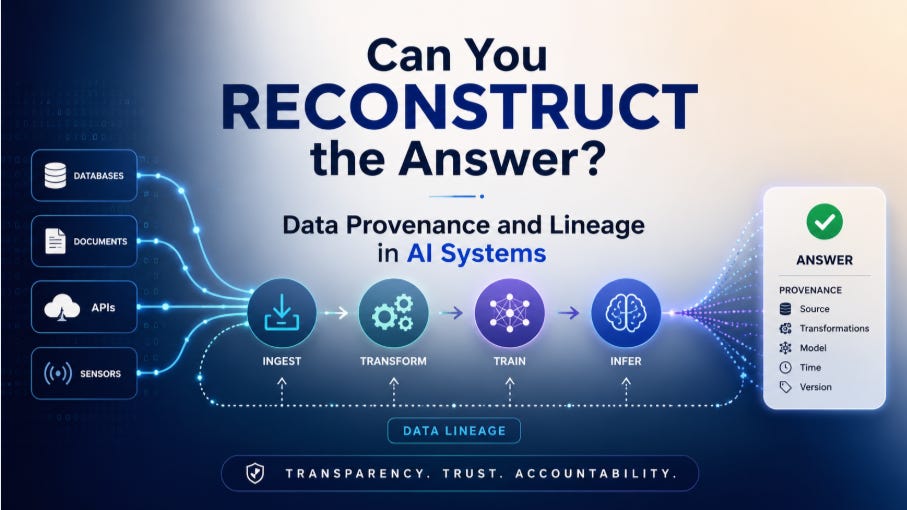
Every article in this series has ended on a version of the same question. Can you reproduce the context behind an answer? Can you reconstruct what an agent acted on and who authorized it? That question is not incidental. It is the thread that ties the whole series together, and it has a name in the world of regulated financial institutions: lineage. This article is about what data governance and lineage mean when the thing you are governing is not a static report but a generative or agentic system that reasons and acts on data in ways no fixed pipeline ever did.
The reason this matters is simple and unforgiving. In a regulated institution, an answer you cannot defend is a liability, no matter how good it was. Generative and agentic AI produce enormous volumes of answers and actions, and the governance question is not whether the model was clever. It is whether, months later, in front of an auditor or a regulator, you can show exactly what data produced a given outcome and prove the controls around it held. If you cannot, the sophistication of the model is irrelevant. You have an ungovernable system.
Governance Did Not Get Reinvented. Its Surface Area Exploded.
It is tempting to treat AI governance as a brand new discipline requiring brand new frameworks. That framing is mostly wrong and quietly harmful, because it invites institutions to bolt on parallel structures rather than extend the ones they already trust. The disciplines that govern models in a bank, inventory, validation, controls, change management, issue remediation, have not been replaced. What changed is the surface area they must cover.
Traditional model governance covered a model, its inputs, its assumptions, and its outputs. Generative and agentic AI widen that scope dramatically. The governed estate now includes the retrieval corpus and its currency, the prompts and prompt templates that shape behavior, the context assembled at inference time, the tool outputs an agent consumes, the memory it accumulates, and the actions it takes. Each of these is a new data surface that governance must inventory, control, and trace. The framework did not change. The map of what it governs grew several times larger, and most institutions are still working from the old map.
Lineage Is the Backbone, and It Is Harder Than It Sounds
Lineage is the ability to trace an output back through every input and transformation that produced it. In structured regulatory reporting, institutions have spent years and fortunes building this under mandates like BCBS 239: where did this number come from, through which systems, under which transformations. Generative and agentic AI demand the same capability over a far messier estate.
Consider what full lineage requires for a single AI answer. You need to know which model version responded, which prompt and template framed the request, which documents or records were retrieved and at which versions, which tool outputs were consumed and when, what context actually reached the model after assembly and truncation, and, for an agent, what action followed and who authorized it. Reproduce all of that and you can defend the answer. Miss any link and the chain breaks, because a defense with a gap is not a defense. This is why the five question tests throughout this series keep returning to reproduction. Reproduction is lineage made concrete.
The dimensions that make AI lineage real rather than aspirational:
1. Version everything
Model versions, prompt templates, embedding models, and retrieval corpora all change over time. Lineage must capture which version of each was in play for any given output, or you cannot reproduce the conditions that produced it.
2. Capture at run time, not after
Capturing lineage after the fact is guessing. It has to be recorded at the moment of execution, as retrieval, assembly, and action happen, because transient state is gone the instant the next step runs.
3. Make it immutable
A lineage record you cannot alter is the only kind worth having. If the trail can be quietly changed, it proves nothing to an examiner and protects no one internally.
4. Make it queryable
Lineage that requires a forensic project to read is lineage in name only. It must be queryable, so that answering why did the system do this last quarter is a lookup, not an investigation.
The Governance Estate for AI, Made Explicit
If governance surface area is the core challenge, it helps to name the estate plainly. These are the data assets a mature AI governance program inventories and controls, each with an owner, a classification, and a lineage obligation:
1. Models and model versions
Registered, versioned, and owned, whether third party or internal.
2. Prompts and prompt template
Treated as governed configuration, not free text, because a prompt change is a behavior change.
3. Retrieval corpora and knowledge bases
Owned and current, with the readiness discipline covered earlier in this series.
4. Embedding models and vector stores
Versioned, since re-embedding silently changes system Tool integrations and their outputs:validated at the boundary, with provenance on every response.
5. Agent memory
Structured, classified, and governed by a lifecycle rather than left to grow.
6. Action and retrieval logs
Captured immutably as the audit trail of everything the system did.
7. Evaluation datasets and ground truth
Owned as first-class assets, because what you measure against is as governed as what you measure.
Almost none of these appeared on a model inventory five years ago.All of them belong on one now. The institutions that scale AI safely are the ones that expanded the inventory deliberately rather than discovering the gaps through incidents.
Where the Regulators Already Are
None of this is speculative. Supervisory expectations point directly at it. SR 11-7 always demanded rigor around the data used to develop and validate models, and that logic extends naturally to corpora, prompts, context, and evaluation data. The EU AI Act codifies data governance, record keeping, and traceability obligations for higher risk systems. The NIST AI Risk Management Framework organizes its guidance around govern, map, measure, and manage, with data provenance and documentation threaded throughout. ISO 42001 formalizes an AI management system with the same instincts.
These frameworks differ in letter, but they converge on one demand: show me your data, its quality, its provenance, and the controls around it. An institution that has built genuine AI lineage can answer all of them at once. An institution that has not will be answering each one late and under pressure.
The Ownership Problem, One More Time
A recurring theme across this series, sharpened in the comments as much as the articles, is that none of this holds without ownership, and ownership without a forcing mechanism is just a name on a chart. Governance and lineage are exactly where that truth bites hardest. Lineage that nobody owns decays the moment a model version changes or a corpus is updated and the trail is not maintained.
The fix is the same one this series keeps arriving at: named owners for each asset in the governance estate, standards set centrally, stewardship at the domain level, and a consequence when the trail breaks that is visible and immediate rather than buried in a backlog. Governance is not a document. It is a set of owned, enforced, continuously operated controls, and lineage is the evidence that they worked.
The Test I Give Every AI Program
For any AI program claiming to be governed, five questions separate a framework on paper from control in practice.
Can you produce, on demand, an inventory of every model, prompt, corpus, tool, memory store, and log in scope, each with a named owner?
For any output or action from the last quarter, can you reconstruct the exact model version, context, and inputs behind it?
Is that lineage captured at run time and immutable, or reassembled after the fact?
When a model, prompt, or corpus changes, does your change management catch it and update the estate?
Can you map your governance evidence directly onto SR 11-7, the EU AI Act, NIST AI RMF, and ISO 42001 without a scramble?
Programs that can answer these have governance. Programs that cannot have aspiration, and the distance between the two is measured in whether the data trail exists when someone finally asks for it. In this domain, someone always eventually asks.
The next article in the series turns to measurement: evaluation datasets, ground truth curation, and the data behind judging whether an AI system is actually any good.
Explore more: Start Here · Topics · Archive · About