



"The most powerful ideas of tomorrow will be born from collaboration between human intuition and machine generation."
In my previous article, we looked at how an Artificial Intelligence (AI) model turns your prompt into an answer, the three roles in every conversation and the five components of a well-built prompt. Knowing the parts is the start. Knowing which type of prompt to reach for is what separates casual users from professionals who get reliable results.
Whatever your field, that choice matters. A prompt that works for drafting a friendly email is the wrong tool for checking a calculation or weighing both sides of a big decision. Here are the 12 prompt types I teach, grouped by what they help you do.
“Every prompt is a choice about how to think. Choose with purpose and give your ideas a clearer path forward.”
Category 1: Teaching with or without Examples
(Zero-Shot, One-Shot and Few-Shot)
1- Zero-Shot Prompting
Definition: The model is given a task without examples. It must infer the task from the instruction.
When to use: General-purpose quick queries that require quick response.
How to use: Translate the sentence to French: "How are you?"
AI Response: Comment ça va?
2- One-Shot Prompting
Definition: The model is provided with one example before being asked to complete a similar task.
When to use: Tasks where minimal guidance is needed.
How to use: Translate the sentence to French. English: "Good morning" / French: "Bonjour". Now, translate: English: "How are you?"
AI Response: French: "Comment ça va?"
3- Few-Shot Prompting
Definition: The model is provided with multiple examples before completing a task.
When to use: When the task requires reinforcement through patterns.
How to use: Translate the sentence to French. Example 1: English: "Good morning" > French: "Bonjour". Example 2: English: "Good night" > French: "Bonne nuit". Example 3: English: "See you later" > French: "À plus tard". Now, translate: English: "How are you?"
AI Response: French: "Comment ça va?"
Category 2: Structuring Complex Work
(Prompt Chaining and Chain of Thought (Cot))
4- Prompt Chaining
Definition: Breaking down a complex task into multiple prompts, each refining the output.
When to use: Used in multi-step problem-solving, storytelling, or iterative tasks.
How to use:
Human: "Generate an idea for a sci-fi story.
AI Response: A group of scientists discover a wormhole leading to a parallel Earth.
Human: Now, expand this into a 5-sentence story summary.
AI Response: (Provides a longer, refined story.)
5- Chain-of-Thought (CoT) Prompting
Definition: Encourages step-by-step reasoning before answering complex tasks.
When to use: Math problems, logical reasoning, and decision-making.
How to use: Solve this math problem step by step: A shop sells apples at $3 each. If you buy 4 apples, how much do you pay?
AI Response:
Step 1: Each apple costs $3.
Step 2: The customer buys 4 apples.
Step 3: Total cost = 4 x $3 = $12.
Final Answer: $12.
Chain of Thoughts versus Tree of Thoughts: a chain follows one path ("I went to the store" > "I bought apples."), while a tree branches into several possible paths ("I went to the store and bought..." > Apples, Oranges or Bananas).
Category 3: Shaping Perspective
(Role-Based, Deliberate Incorrect Answer and Debate)
6- Role-Based Prompting
Definition: The model is given a persona to respond in a particular style or expertise.
When to use: Helpful for role-playing scenarios, professional advice, or stylistic control.
How to use: You are a history professor. Explain the causes of World War I in simple terms.
AI Response: World War I was caused by nationalism, militarism, imperialism, and alliances. The assassination of Archduke Franz Ferdinand triggered the war, leading to conflicts among major powers. Countries formed alliances, leading to a global war.
7- Deliberate Incorrect Answer Prompting
Definition: Asking the AI to explain why a given incorrect answer is wrong to reinforce accuracy.
When to use: Useful in educational contexts to detect and correct misconceptions.
How to use: Someone said that the Earth is flat. Explain why this is incorrect.
AI Response: The Earth is not flat because satellite images and scientific measurements confirm it is an oblate spheroid. Gravity pulls objects toward the center, creating a round shape. Additionally, the way ships disappear over the horizon proves Earth's curvature.
8- Debate Prompting
Definition: AI is asked to argue both sides of an issue for a balanced perspective.
When to use: Critical thinking, policy discussions, ethical dilemmas.
How to use: Debate the pros and cons of AI in healthcare.
AI Response:
-Pros: AI improves diagnosis accuracy. Reduces human error in treatment. Enhances patient monitoring and data analysis.
-Cons: AI can lack empathy in patient interactions. Risk of bias in medical algorithms. Potential job displacement for healthcare workers.
Category 4: Controlling the Shape of the Answer
(Interactive, Multiple Choice, Conditional and Open-Ended)
9- Interactive Prompting
Definition: The AI is encouraged to ask clarifying questions before answering.
When to use: Reducing ambiguity and improving response accuracy.
How to use: Help me plan a vacation.
AI Response: Where would you like to go? What's your budget? Do you prefer adventure, relaxation, or cultural experiences?
10- Multiple Choice Prompt
Definition: AI is given a list of choices to select one of them as the right answer.
When to use: When you are sure the answer is one of the provided choices and you don't want it to guess.
How to use: What is the hottest planet in the solar system? A) Mercury B) Venus C) Mars D) Jupiter
AI Response: The answer is B) Venus
11- Conditional Prompting
Definition: Request an answer given a situation
When to use: Provide with more context
How to use: What should I carry if it is raining today?
AI Response: You should carry an umbrella
12- Open Ended Prompting
Definition: Request to opine on a topic with no restrictions
When to use: Soliciting and exploring opinions
How to use: What are some of the problems the world is facing today?
AI Response: Some of the biggest problems the world is facing: Climate Change..., Poverty..., Wars...
“Mastery begins when you stop using one approach for every task and start choosing the approach each task deserves.”
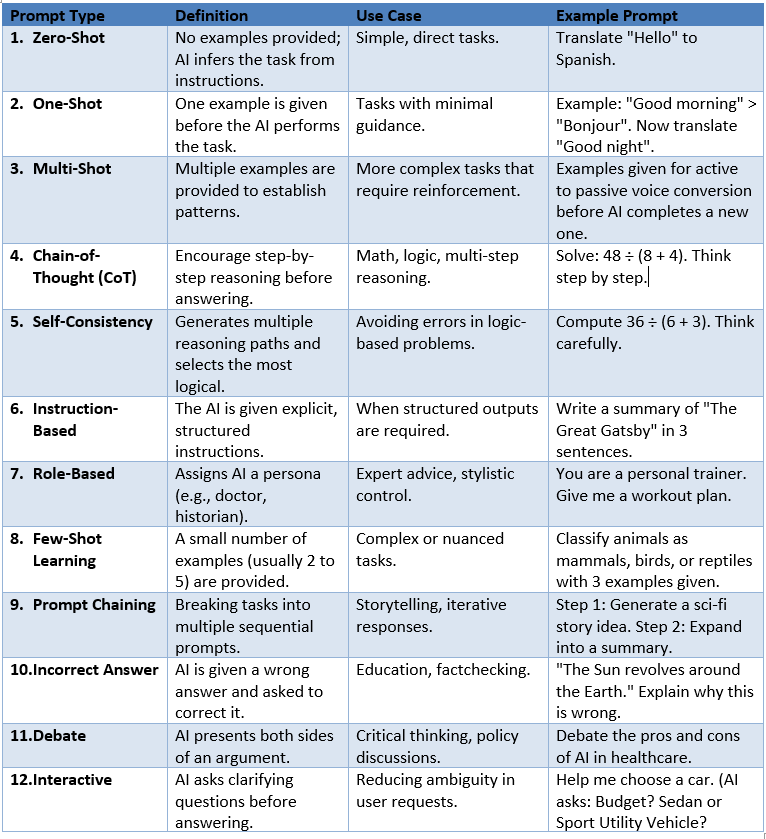
The Prompt Types at a Glance
The Table below consolidates the main prompt types into one reference, with a definition, a typical use case and an example prompt for each. It also adds three variations worth knowing: multi-shot prompting, self-consistency prompting (the model generates several reasoning paths and selects the most logical) and instruction-based prompting (explicit, structured instructions when you need a structured output).
Start With the Right Verb
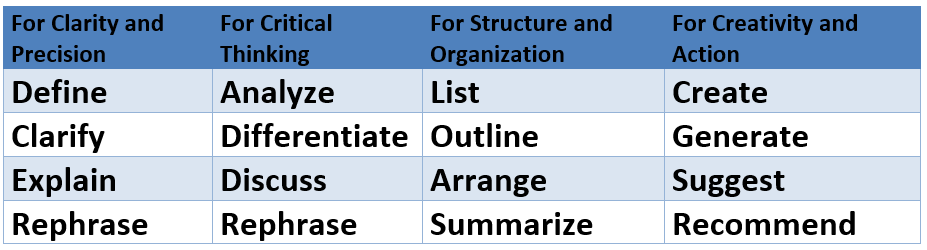
The first word of a prompt often decides the shape of the answer. The Table below groups the action verbs I recommend into four families:
Clarity and Precision
Critical Thinking
Structure and Organization
Creativity and Action.
“The first verb in your prompt sets a direction. Make it deliberate and turn intention into action.”
Key Takeaways
Match the prompt type to the task: examples for patterns, chaining and chain-of-thought for multi-step work, roles and debate for perspective.
Chain-of-thought and chaining make outputs easier to review, which matters wherever answers need to be checked.
Interactive prompting is the simplest fix for ambiguous requests:let the model ask before it answers.
Start prompts with a deliberate action verb: it sets the shape of the response.
Conclusion
In conclusion, mastering generative AI prompt engineering is not just about crafting better questions. It's about unlocking the full creative and problem-solving potential of these powerful models. By understanding how to design prompts thoughtfully, strategically, and with clear intent, we can drive more accurate, relevant, and innovative outcomes. Whether applied in business, education, art, or research, effective prompt engineering empowers users to collaborate with AI more naturally and meaningfully. As this technology continues to evolve, those who refine their skills will be best positioned to harness AI's capabilities and shape the future of human-AI interaction.
"The next breakthrough in your work may begin with a better prompt. Choose it with purpose, challenge the answer and turn what you learn into meaningful action"
Explore more: Start Here · Topics · Archive · About