



Autonomous AI doesn’t emerge by accident. It is engineered through deliberate design patterns. In this article, we continue the exploration of Autonomous Agentic AI design patterns. In the previous article, we explored five design patterns. In this article, we will discuss five additional design patterns: Autonomous Monitoring & Remediation Agent, the Learning Feedback Loop, the Supervisor–Worker (Manager Pattern), the Scheduler / Event-Driven Agent, and the Hierarchical Task Network (HTN). Each of these patterns represents a different way autonomy is structured, controlled, and scaled inside enterprise environments, not just to act intelligently, but to act responsibly, predictably, and sustainably.
Design Pattern 6: Autonomous Monitoring & Remediation Agent
1. Definition
Autonomous Monitoring & Remediation is an Agentic AI pattern where an AI system continuously observes environments (systems, data streams, processes), detects anomalies or policy violations, diagnoses root causes, and takes corrective action with minimal or no human intervention.
Unlike simple alerting systems, this pattern doesn’t just say “Something is wrong.” It says:
“Something is wrong. Here’s why...I’ve fixed it and documented it.”
In regulated environments (banking, risk, operations, cybersecurity), this becomes a self-healing control layer embedded directly into enterprise workflows.
2. How It Works (Operational Loop)
Continuous Loop:
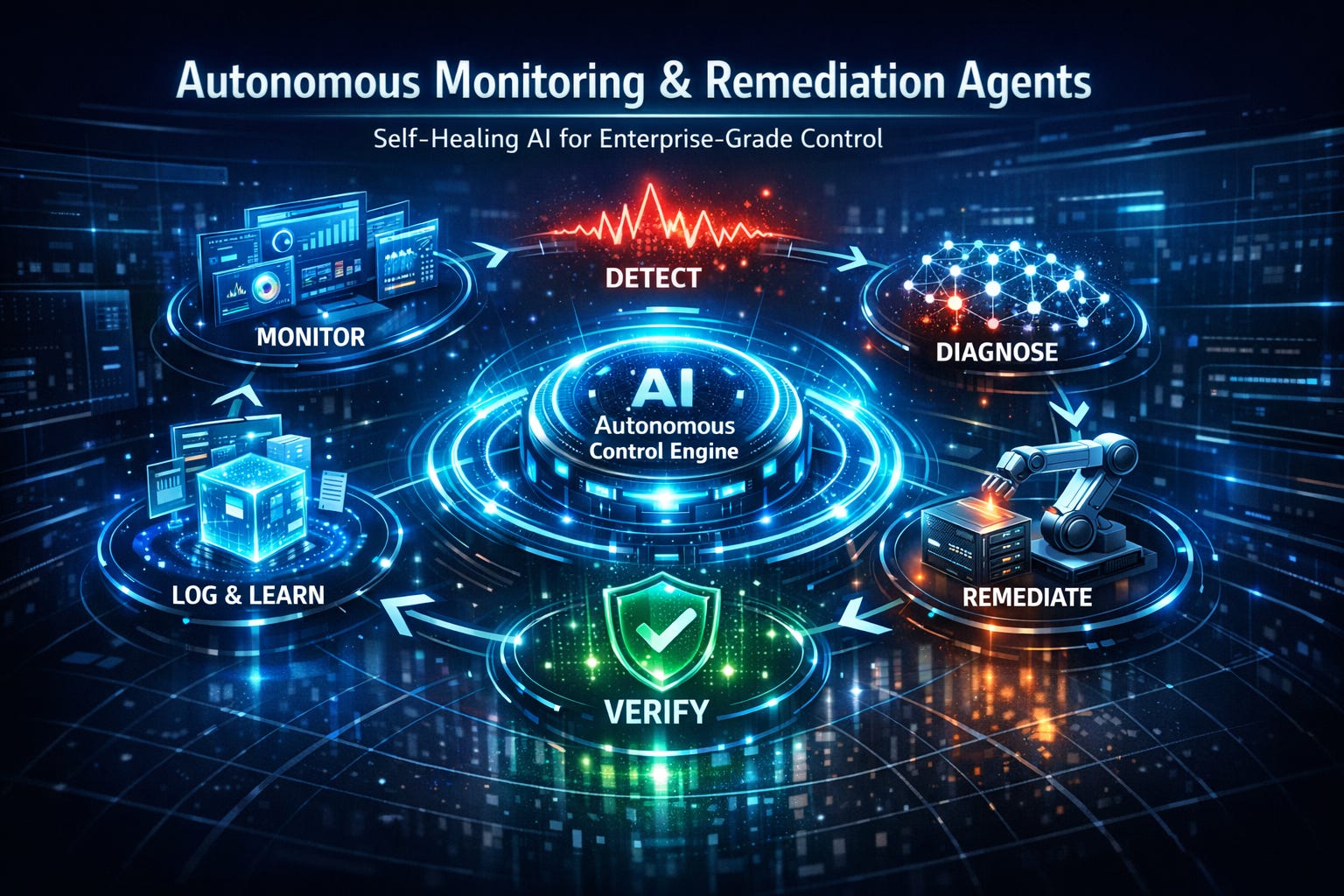
Monitor → Ingest logs, metrics, transactions, model outputs, API activity
Detect → Identify anomaly, drift, threshold breach, policy violation
Diagnose → Root cause analysis (correlation, historical comparison, pattern memory)
Remediate → Execute approved corrective action (restart service, rollback model, block transaction, escalate case)
Verify → Confirm issue resolution
Log & Learn → Store event, outcome, and effectiveness for future optimization
This is typically powered by:
LLM + structured rules
Predictive models for drift detection and anomaly detection
Policy engines
Guardrail layers
Persistent memory for recurring incidents
3. Example of the Agent in Action
Banking Example – Model Drift Control
A credit risk model begins to show prediction instability.
Agent Actions:
Detects statistical drift in feature distributions
Compares against historical baselines
Identifies a sudden shift in regional transaction patterns
Automatically switches to validated backup model
Notifies Model Risk team
Generates remediation report for audit trail
Logs event for governance review
The system remains stable; compliance is preserved and no production outage.
4. Where the Autonomous Monitoring & Remediation Agent adds value:
This pattern excels in:
Cybersecurity response
Model risk monitoring (MRM frameworks)
Infrastructure uptime & DevOps
Fraud detection systems
Financial reporting controls
Operational process compliance
It is especially powerful in high-volume, high-risk, real-time environments where manual oversight would be too slow.
5. Advantages / Strengths
Speed:Responds in milliseconds vs. human response time.
Consistency:Applies policies uniformly without fatigue or bias.
Scalability:Monitors thousands of systems simultaneously.
Risk Reduction:Prevents cascading failures through early intervention.
Auditability:All decisions and actions are automatically documented.
Continuous Improvement:Learns patterns of recurring incidents.
6. Inherent Risks
Even powerful self-healing systems come with risks:
False Positives:Over-remediation may disrupt normal operations.
Incorrect Diagnosis: LLM-based reasoning may misinterpret context.
Over-Autonomy:Executing actions beyond intended authority.
Feedback Loop Bias:Agent may reinforce flawed assumptions.
Governance Gaps:Unclear accountability boundaries.
In financial institutions, these risks intersect directly with:
Model Risk Management (SR 11-7)
Change Management controls
Three Lines of Defense frameworks
7. Risk Mitigation Strategies
Tiered Autonomy Levels:Low-risk issues → auto-remediate; High-risk issues → human approval required
Policy-Constrained Action Space:Pre-approved remediation playbooks only.
Human-in-the-Loop Escalation:Mandatory review for material incidents.
Shadow Mode Testing:Run in observation-only mode before activation.
Explainability Logs:Clear reasoning trace stored for audit.
Kill Switch & Rollback:Immediate override mechanism.
8. Summary & Recap
Autonomous Monitoring & Remediation agents represent a shift from:
Reactive IT to self-healing intelligent ecosystems.
They move enterprises from:
Detecting problems to
Resolving problems to
Learning from problems
But autonomy without governance is risk amplification.
The real maturity lies in balancing:
Automation speed + Policy discipline + Human accountability
In regulated industries, this pattern is not just an efficiency booster; it becomes a control architecture.
Design Pattern 7: Learning Feedback Loop Agent
1. Definition
A Learning Feedback Loop in Agentic AI is a design pattern where the agent continuously improves its performance by evaluating outcomes, deriving lessons, and updating its behavior or strategy over time. Unlike static agents that execute tasks the same way every time, a feedback-loop agent:
Acts
Observes Results
Evaluates Performance
Learns from Outcomes
Adapts Future Behavior
It transforms experience into capability.Think of it as an agent that not only does the job but continuously improves at it.
2. How It Works (Core Loop)
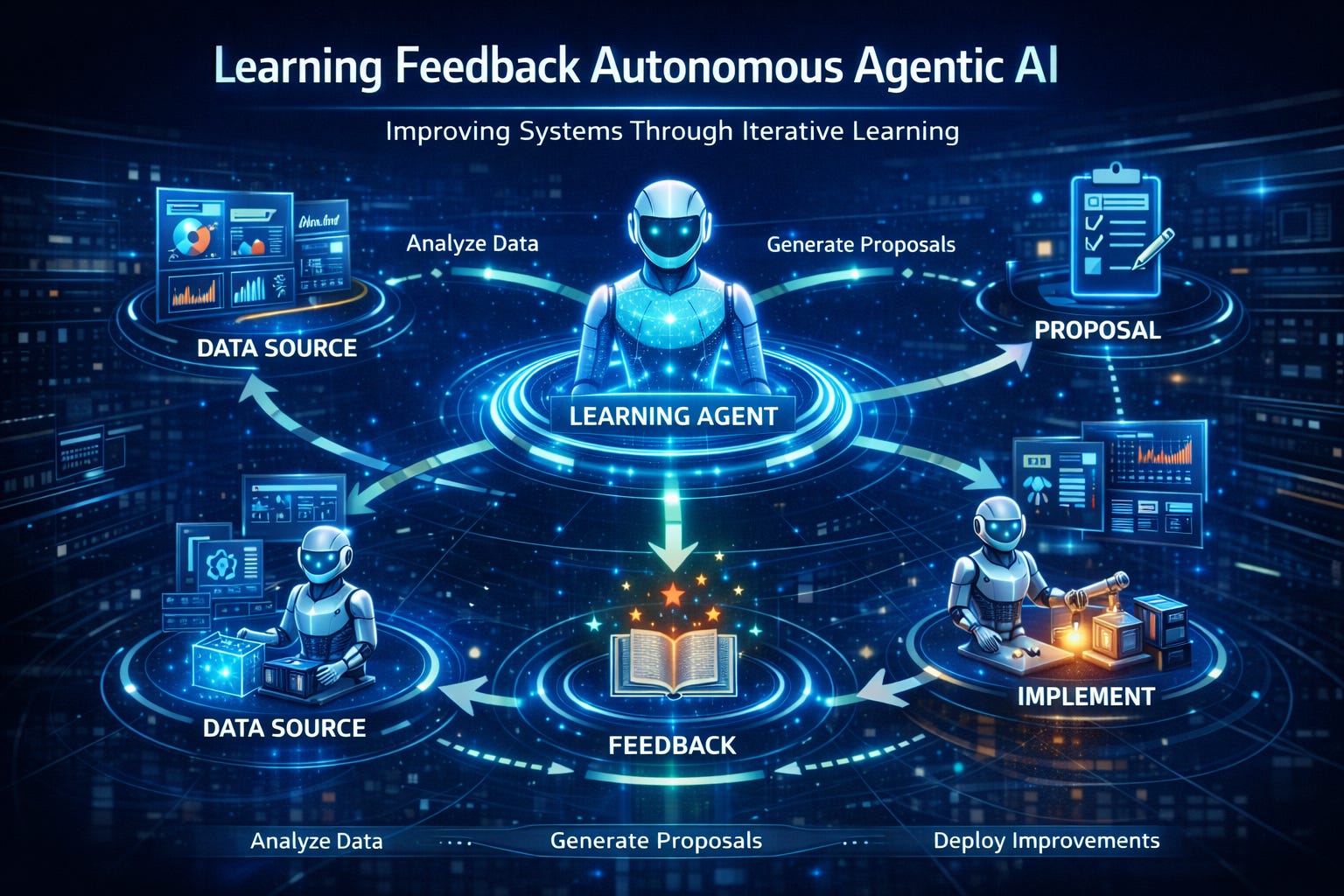
A typical Learning Feedback Loop follows this cycle:
Plan – Agent selects strategy or action.
Execute – Performs task (may use tools or APIs).
Observe – Captures outputs and environmental response.
Evaluate – Compares results against objective, metrics, or constraints.
Reflect – Identifies errors, inefficiencies, or improvements.
Update – Adjusts memory, strategy, prompts, skill library, or parameters.
Repeat – Applies improved approach to next task.
It can operate at different depths:
Prompt-level refinement
Tool selection optimization
Strategy adaptation
Skill acquisition
Long-term memory shaping
3. Example of the Agent in Action
Scenario: Enterprise Risk Reporting Agent
Objective: Generate monthly regulatory risk summaries.
Cycle 1
The agent generates a summary from data.
A compliance reviewer flags inconsistencies in categorization.
Agent analyzes feedback.
Agent adjusts classification rules and data mapping logic.
Cycle 2
Agent produces improved report.
Fewer corrections required.
It learns common compliance phrasing patterns.
Cycle 3
Agent generates near-perfect report.
It automatically flags ambiguous entries before submission.
Over time:
Agent builds institutional knowledge.
It reduces human correction effort.
It aligns more closely with regulatory language standards.
The agent evolves from assistant to capable operator to domain-aligned system.
4. Where the Learning Feedback Loop adds value:
The Learning Feedback Loop excels in:
Research agents that refine search strategies
Financial forecasting agents that recalibrate models
Customer support agents improving response accuracy
Coding copilots learning from bug reports
Compliance agents adapting to policy interpretation trends
It is particularly powerful in environments where:
Repetition exists
Feedback is measurable
Improvement compounds over time
5. Advantages / Strengths
Compounding Performance: Each iteration improves future outputs.
Contextual Adaptation: Learns organization-specific style and constraints.
Error Reduction Over Time:Systematically reduces recurring mistakes.
Scalability: Improvement benefits all future similar tasks.
Institutional Memory: Captures insights beyond a single execution.
Autonomous Optimization: Reduces need for continuous human micromanagement.
6. Inherent Risks
Learning systems introduce new categories of risk.
Reinforcing Wrong Lessons: If feedback is flawed, the agent may optimize toward incorrect behavior.
Drift from Original Objectives: Over time, adaptation may unintentionally shift priorities.
Bias Amplification: Feedback loops can reinforce biased outputs.
Overfitting to Local Context: Agent becomes too specialized and loses its generalization ability.
Uncontrolled Self-Modification: Autonomous updating without oversight can create instability.
7. Risk Mitigation
To safely implement Learning Feedback Loops:
Human-in-the-Loop Validation: Critical learning updates require approval.
Checkpointing: Freeze model states and allow rollback if drift occurs.
Structured Evaluation Metrics: Use measurable KPIs rather than subjective signals.
Policy Guardrails: Limit what can be updated (e.g., prompt layer only, not tool access).
Shadow Testing: Test learning updates in sandbox before production rollout.
Diverse Feedback Sources: Avoid single-source reinforcement bias.
In regulated industries, this aligns with governance controls, model validation, and continuous monitoring frameworks.
8. Summary & Recap
The Learning Feedback Loop transforms an AI agent from a task executor into a self-improving system.
It works by:
Acting
Measuring outcomes
Learning from evaluation
Updating future behavior
Its power lies in compounding intelligence; its risk lies in compounding mistakes.
When properly governed, it becomes one of the most powerful patterns in Agentic AI. It enables sustainable performance improvement rather than static automation.
In short:
Workflow agents execute. Open-ended agents explore. Learning feedback agents evolve.
Design Pattern 8: Supervisor–Worker (Manager Pattern)
1. Definition
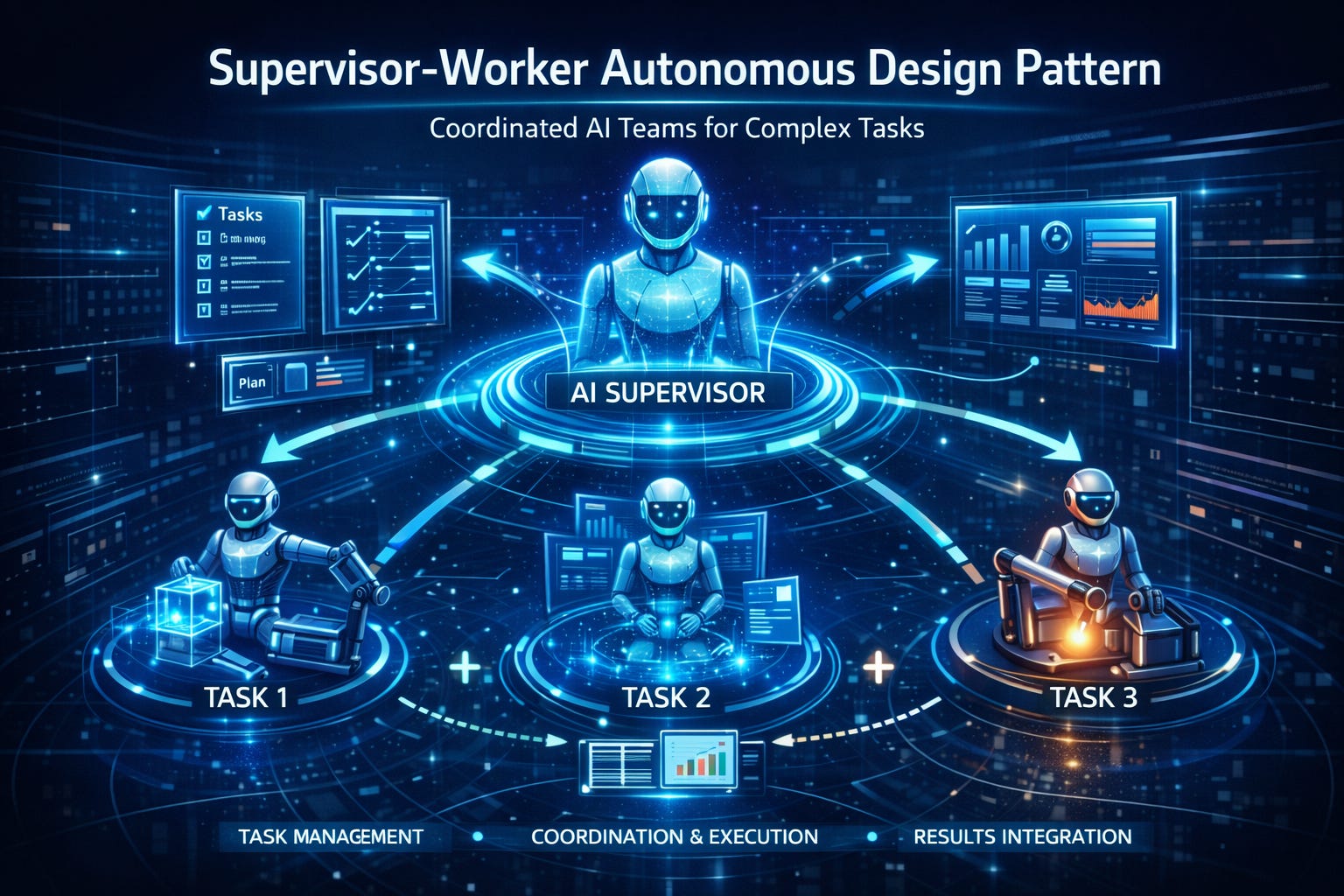
The Supervisor–Worker pattern (also called the Manager Pattern) is an agentic architecture where:
A central coordinating agent (Supervisor/Manager)
Decomposes a complex objective
Assigns subtasks to specialized Worker agents
Monitors outputs
Aggregates results into a final deliverable
This resembles a digital executive team:
The Supervisor sets direction. The Workers execute with focus. The Supervisor integrates, validates, and delivers.
It mirrors real-world enterprise operating models: Strategy resides at the top, with execution distributed across functional units.
2. How It Works (Execution Flow)
Core Loop:
Receive Goal: The Supervisor receives a high-level objective.
Task Decomposition: Breaks the goal into structured subtasks.
Assignment: Routes tasks to specialized Workers (Research, Analysis, Drafting, Validation, etc.).
Execution: Workers perform their tasks independently.
Collection & Review: Supervisor reviews outputs for quality, alignment, completeness.
Integration: Supervisor synthesizes results into a cohesive final output.
Optional Iteration: If gaps exist, Supervisor reassigns refinement tasks.
3. Example of the Agent in Action
Scenario: Regulatory Impact Assessment for a Bank
Goal:Analyze how a new AI regulation impacts internal model governance.
Supervisor Agent:Breaks the task into:
Regulatory extraction
Policy comparison
Risk gap analysis
Executive summary drafting
Workers:
Research Worker → Extracts relevant clauses.
Compliance Worker → Maps clauses to internal policy.
Risk Analyst Worker → Identifies control gaps.
Writer Worker → Drafts board-ready summary.
Supervisor:
Validates coherence
Ensures the tone matches the executive audience
Produces a final structured report
Result: A board-ready regulatory briefing produced through structured coordination.
4. Where the Supervisor-Worker Agent adds value:
The Supervisor–Worker pattern excels in:
Enterprise workflows
Multi-stage documentation generation
Research-heavy tasks
Structured analysis
Complex problem decomposition
Systems requiring orchestration and accountability
It’s especially powerful in regulated industries where:
Traceability matters
Roles are clearly defined
Oversight is mandatory
5. Advantages / Strengths
Scalability: Parallel workers can process tasks simultaneously.
Specialization: Each worker can be optimized for a specific capability.
Modular Design: Workers can be replaced or upgraded independently.
Governance-Friendly: Clear separation of roles supports auditability.
Quality Control: Supervisor enforces consistency and alignment.
Enterprise Alignment: Mimics real-world organizational hierarchies.
6. Inherent Risks
Even strong hierarchies can fail.
Supervisor Bottleneck: If too centralized, it slows the system.
Poor Task Decomposition: Bad breakdown → bad results.
Worker Drift: Workers may interpret tasks inconsistently.
Coordination Overhead: Too many agents increase complexity.
Cascading Errors: If the Supervisor fails, the entire output degrades.
7. Risk Mitigation Strategies
Structured Decomposition Templates:Use predefined task breakdown logic.
Validation Layer:Add evaluator agents between Workers and Supervisor.
Clear Role Definitions:Define scope and constraints per worker.
Bounded Authority:Supervisor operates within policy guardrails.
Logging & Traceability:Record all assignments, outputs, and revisions.
Fail-Safe Escalation:Human-in-the-loop for high-risk outputs.
In regulated environments, this pattern works best when paired with governance controls and validation checkpoints.
8. Summary & Recap
The Supervisor–Worker pattern brings organizational structure into agentic systems. It transforms AI from a single reasoning entity into a coordinated execution ecosystem:
The Supervisor provides direction and oversight.
Workers provide depth and execution.
The system provides scalability and modular intelligence.
This pattern is not about autonomy without control. It is about controlled delegation at machine speed.
In enterprise AI, structure is not bureaucracy; it is how intelligence scales responsibly.
Design Pattern 9: Scheduler / Event-Driven Agent
1. Definition
In the spectrum of Agentic AI architectures, the Scheduler / Event-Driven Agent is the quiet operator. It doesn’t wander. It doesn’t invent its own objectives. It reacts to Triggers. It waits… listens… and acts the moment something meaningful happens.
Examples of Triggers:
Time-based events (e.g., daily at 8 AM)
System events (e.g., new file uploaded)
Data changes (e.g., exposure exceeds threshold)
User actions (e.g., approval submitted)
External signals (e.g., API webhook, market alert)
It does not operate continuously in open exploration mode. Instead, it remains dormant until a trigger occurs, then executes predefined logic, reasoning steps, or tool calls.
It is reactive by design but can still be intelligent in execution.
Think of it as the AI equivalent of a motion-sensor light, one that instead of turning on a bulb, can initiate workflows, call APIs, trigger compliance reviews, escalate risk alerts, or orchestrate multi-step processes across systems.
2. How It Works
Core Flow (Reactive Loop):
Trigger → Validate Conditions → Reason → Execute Action(s) → Log → End / Wait
Architecture Components
Event Listener- Subscribes to message queues, APIs, webhooks, or schedulers - Detects trigger conditions.
Trigger Filter / Validator -Confirms relevance and eligibility. - Prevents false positives.
Reasoning Layer (LLM or Logic Engine) -Interprets context. - Decides what action to take. - May generate structured outputs.
Tool Executor -Calls APIs, updates systems, sends notifications. - Can chain sub-tasks.
Audit & Logging -Records what happened. - Supports governance and traceability.
Idle State -Returns to standby until the next event.
Unlike open-ended agents, it does not self-generate tasks. It reacts.
3. Example of the Agent in Action
Scenario:Exposure Threshold Monitoring in Banking
Trigger:Credit exposure to a counterparty has exceeded the risk tolerance threshold
Agent Actions:
Pulls latest transaction data.
Compares against policy thresholds.
Generates risk commentary.
Creates a structured incident ticket.
Notifies Risk Manager.
Logs decision rationale.
Result: Corrective action is taken within seconds (without manual monitoring).
4. Where the Scheduler / Event-Driven Agent adds value
Compliance monitoring
Fraud detection alerts
SLA breach notifications
Automated document routing
Scheduled financial reporting
Incident response workflows
Real-time system anomaly detection
It is ideal where responsiveness and consistency matter more than creativity.
5. Advantages / Strengths
Deterministic Activation:Acts only when conditions are met.
Operational Efficiency:Eliminates manual monitoring and repetitive checks.
Low Cognitive Drift:No autonomous goal evolution.
High Governance Alignment:Clear trigger logic = clear accountability.
Scalable Across Systems:Works well in microservices and event-driven architectures.
6. Inherent Risks
Even well-designed reactive agents carry risks:
False Triggers:Bad data may cause unnecessary actions.
Trigger Storms:Rapid repeated events may overwhelm systems.
Logic Misconfiguration:Incorrect condition rules can cause silent failures.
Over-Automation:Critical actions executed without sufficient review.
Cascading Effects:One trigger initiates unintended downstream workflows.
7. Risk Mitigation
Trigger Validation Layer:Add threshold checks and sanity filters.
Rate Limiting & Debouncing:Prevent trigger storms.
Human-in-the-Loop Gates:Require approval for high-impact actions.
Monitoring & Observability:Full logging and audit trails.
Policy Guardrails:Restrict tools and data access domains.
Sandbox Testing:Simulate events before deployment.
In regulated environments, this pattern is powerful but must be tightly governed.
8. Summary & Recap
The Scheduler / Event-Driven Agent is the disciplined responder of Agentic AI. It does not chase curiosity. It does not invent missions. It waits. And when something meaningful happens, it moves.
Its strength lies in structured reaction. Its value lies in speed, reliability, and governance alignment.
In enterprise environments, especially finance, operations, and compliance, this pattern is often the most immediately deployable form of Agentic AI.
Because sometimes intelligence is not about constant thinking. It is about knowing exactly when to act.
Design Pattern 10: Hierarchical Task Network Agent (HTN)
1. Definition
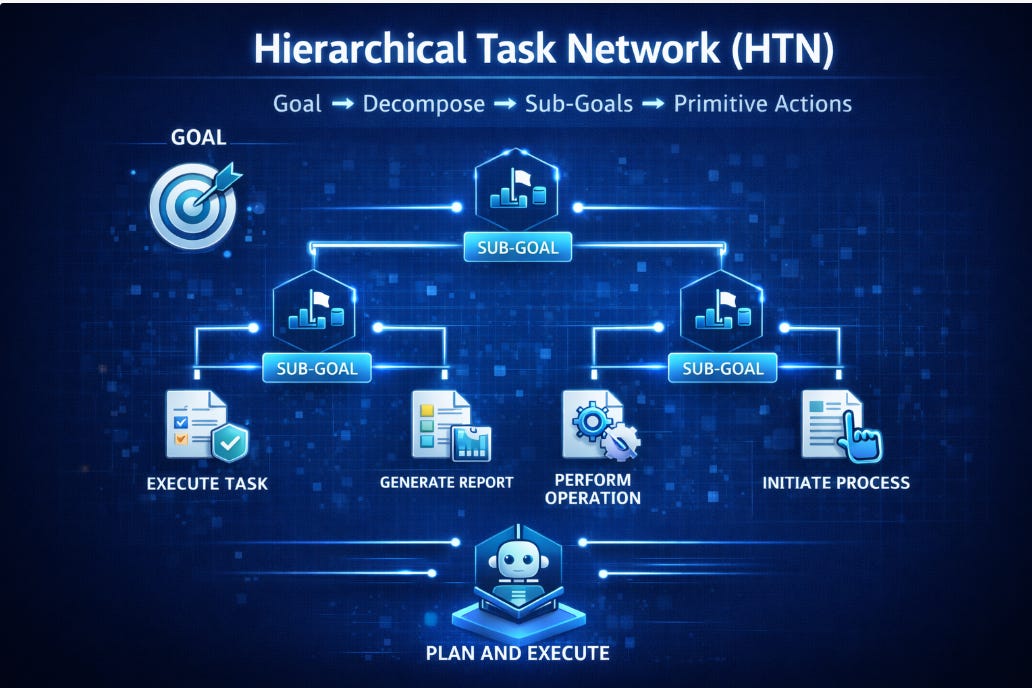
A Hierarchical Task Network (HTN) agent is an agentic architecture that plans by decomposing high-level goals into smaller, more granular structured sub-tasks using predefined domain knowledge.
Instead of asking, “What should I do next?” it asks:
“What are the required steps to accomplish this objective and how do they break down into executable actions?”
HTN is goal-driven and structured. It is deliberate, organized, and deeply aligned with controlled enterprise execution.
2. How It Works
At its core, HTN planning follows a top-down decomposition strategy:
Step-by-step logic:
Receive High-Level Goal - Example:“Launch a regulatory-compliant AI solution.”
Select a Task Decomposition Method -The agent chooses a predefined “method” for achieving that goal. - Each method contains ordered sub-tasks.
Break Goal into Subtasks -Strategic Planning - Compliance Validation - Technical Development - Testing & Monitoring
Continue Decomposition - Each sub-task is further broken down until reaching primitive actions (tool calls, API requests, document generation, etc.).
Execute Primitive Actions -Call tools - Query data - Generate documentation - Validate outputs
Monitor & Adjust - If a step fails, the agent can replan using alternative decomposition methods.
3. Example of the HTN Agent in Action
Enterprise AI Use Case (Banking Context)
Goal: Conduct quarterly model risk review.
HTN Decomposition:
Level 1:
Collect model documentation
Retrieve performance metrics
Validate regulatory compliance
Generate risk summary report
Level 2 (for compliance validation):
Check against internal AI policy
Check against SR 11-7 alignment
Confirm data lineage documentation
Validate monitoring thresholds
Level 3 (atomic actions):
Query model registry
Retrieve logs
Run validation checklist
Generate PDF summary
The agent doesn’t “wing it.” It executes according to a structured operational playbook.
4. Where the HTN Agent adds value
HTN agents perform best when:
Tasks are complex but structured
Processes are repeatable
Governance is mandatory
Order of execution matters
Domain expertise is encoded
Ideal Domains:
Regulated financial services
Supply chain orchestration
Large-scale IT deployments
Military/logistics planning
Enterprise compliance workflows
If the organization runs on Standard Operating Procedures (SOPs) and governance frameworks, HTN thrives.
5. Advantages / Strengths
Predictability:Execution follows explicit hierarchical logic.
Transparency:Each decomposition layer can be audited.
Alignment with Governance: Works naturally with: -3 Lines of Defense models - Change management workflows - Risk control frameworks
Reusability:Task decomposition “methods” become reusable enterprise assets.
Scalable Complexity:Handles large goals without collapsing into chaos.
In short: HTN agents think in structured roadmaps, not improvisation.
6. Inherent Risks
Even structured intelligence carries risk.
Rigidity:Predefined task decompositions can limit adaptability.
Knowledge Engineering Burden:Requires domain experts to define decomposition methods.
Combinatorial Explosion:Too many possible decomposition paths may complicate planning.
False Assumptions:If the hierarchy is poorly designed, the agent will systematically fail, but very confidently.
7. Risk Mitigation Strategies
Modular Method Libraries:Maintain version-controlled decomposition templates.
Human-in-the-Loop Gate:Require approval at major decomposition transitions.
Dynamic Replanning:Allow fallback methods if primary path fails.
Continuous Method Review:Audit decomposition trees like code reviews.
Bounded Autonomy:Restrict primitive actions to approved tool lists.
Structured intelligence must still be governed intelligence.
8. Summary & Recap
A Hierarchical Task Network agent:
Starts with a goal
Decomposes it into structured subtasks
Continues until executable actions are reached
Executes in a controlled, auditable manner
It serves as the architectural bridge between strategic intent and operational execution.
In regulated enterprises, hierarchical task trees are easier to audit than improvisation.
Article Conclusion & Recap:
Autonomous AI agents are not a single capability. They are an architectural discipline.
In this article and the previous article, we explored 10 foundational design patterns that define how real autonomy operates in enterprise environments.
Together, these patterns reveal an important truth:
Autonomy is not about letting AI “run free.” It’s about designing how it runs.
The organizations that will lead in this era are not the ones experimenting with autonomy casually, but the ones engineering it deliberately, embedding guardrails, visibility, and governance into the very architecture of their agents.

Explore more: Start Here · Topics · Archive · About