


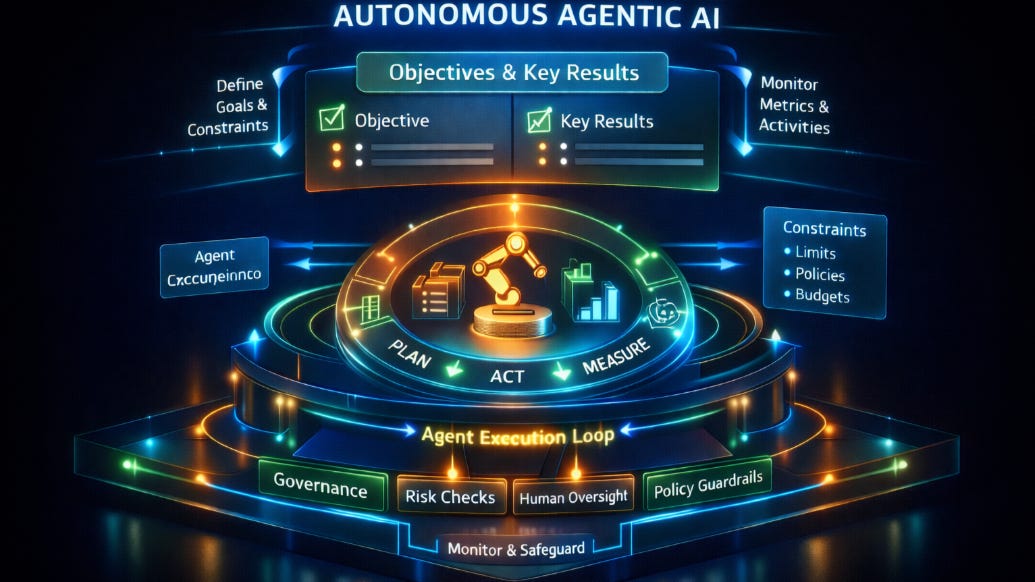
Autonomous agents are no longer experimental assistants waiting for prompts. They have become operational actors. They set direction, monitor environments, trigger actions, coordinate sub-systems, and manage themselves over extended time horizons. In enterprise settings, this is where Agentic AI moves from “interesting” to “infrastructure.”
In this article, we shift our focus to these self-directed, long-horizon operational autonomous agents. They are systems designed to run continuously, make decisions within defined boundaries, and pursue measurable objectives. These are not chatbots. They are digital operators.
We will explore the core design patterns that make autonomous Agentic AI viable, controllable, and scalable in real-world environments.
Each pattern represents a different answer to a fundamental question:
How do we give AI the ability to act independently without losing control, predictability, or accountability?
Autonomy without structure is chaos. Structure without autonomy is automation. The design patterns in this article show how to engineer systems that achieve operational independence with institutional guardrails.
Let’s examine how autonomous agents are designed to think, decide, adapt, and remain governable at scale.
Design Pattern 1: Goal / Objectives & Key Results (OKR) - Driven Agents
1. Definition
Goal / Objectives & Key Results (OKR)-Driven is an agentic design pattern in which an AI agent is steered by Objectives (“what success looks like”) and Key Results(“how success is measured”), then allowed to plan, act, and iterate until the key results are met (or constraints stop it). This borrows the OKR framing used in organizations to set ambitious, measurable outcomes.
2. How it works
The process begins by giving an agent a scoreboard of Key Results (KRs) and letting it run plays within guardrails.
Ingest OKRs + constraints
Objective statement (direction)
Key Results (measurable metrics)
Policies/constraints (allowed tools, data boundaries, approval gates, budgets, deadlines)
2. Translate OKRs into an execution plan
Decompose Objective → initiatives → tasks
Map each task to which KR it moves and by how much
Pick tools (search, databases, ticketing, code, workflow automations) as needed
3. Act + measure
Execute a step
Pull measurements (dashboards, logs, QA checks, SLA stats, audit results)
Update a “KR progress state”
4. Decide next step (control loop)
If KRs are improving: continue / scale
If stalled: change tactic, request help, or stop
If risk/policy triggers: pause, escalate, or require human approval
5. Close out / Hand Off
Produce evidence: what changed, what was measured, what decisions were made, and why
Hand off outputs + audit trail
This fits the common “LLM agent” structure of planning → tool use → feedback/observation → iteration.
3. Example of the OKR Agent in action
Scenario: “Finance Close Acceleration Agent” (enterprise setting)
Objective: Reduce month-end close cycle time without increasing risk. Key Results:
KR1: Close cycle time from 6 days → 4 days
KR2: Aged recon breaks reduced by 30%
KR3: Manual journal exceptions reduced by 20%
KR4: Zero increase in audit findings
What the agent does:
Pulls prior close issues and bottleneck metrics from approved sources.
Proposes a prioritized backlog (automation candidates, reconciliation rules, data-quality checks).
Runs controlled actions:
Creates tickets with pre-filled evidence packages
Suggests rule changes (but routes to approvers)
Generates daily “KR delta” updates with root causes
If KR2 improves but KR4 risk signals rise, it backs off, switches tactics, or escalates to a human gate.
In other words, it is not action without rationale; it is action driven by measurable outcomes.
4. Where the OKR Agent Adds Value
Multi-step operations with measurable outcomes (SLA reduction, defect reduction, cycle-time compression)
Optimization-like work where feedback exists (quality checks, KPIs, acceptance tests)
Portfolio execution: juggling many tasks, reprioritizing to maximize KR progress
Continuous improvement loops (monitor → diagnose → remediate → verify)
5. Advantages / Strengths
Clarity of intent: Objectives define direction; KRs define success metrics.
Measurable autonomy: You can grant more autonomy when the agent reliably improves KRs under constraints.
Adaptive planning: If one tactic stalls, the agent can pivot while staying aligned to the same KRs.
Governability: KRs become a natural anchor for logging, evaluation, and post-hoc accountability.
Alignment at scale: Multiple agents (or sub-agents) can each own KRs that roll up to the same Objective.
6. Inherent Risks
Metric gaming / “scoreboard hacking”:The agent finds ways to improve KRs that violate spirit, ethics, policy, or long-term value.
Wrong objective perfectly executed:If the Objective/KRs are poorly designed, the agent will enthusiastically drive you to the wrong destination.
Reward hacking / unintended side effects:Optimizing one KR harms another domain (e.g., speed improves but quality quietly degrades).
Overreach via tools:Autonomous actions can cause real-world changes (tickets, emails, database writes) that create incidents if not gated.
Data leakage + compliance issues:Pulling or summarizing sensitive data into the wrong channel or using unapproved sources.
Runaway loops / cost and time overruns:The agent keeps trying “one more thing” because KRs aren’t met leading to runaway execution cycles and escalating costs.
7. Risk mitigation
Use a governed autonomy approach: increase freedom only when safety and reliability are proven.
Control design (practical guardrails):
KR guardrails + counter-metrics:Pair each KR with “do-no-harm” metrics (quality, audit findings, customer complaints).
Action tiering:Read-only → recommend → draft → execute with approval → execute autonomously (only for low-risk actions).
Human-in-the-loop gates at critical transitions:Require approvals for irreversible actions or policy-sensitive operations.
Tool allow-lists + least privilege:Narrow tool access; restrict write operations; enforce scoped credentials.
Policy checks before actions:Automated checks for data classification, regulated content, and forbidden operations (block/route/escalate).
Monitoring, logging, and evaluation:Track decisions, tool calls, KR deltas, and rationale; continuously test for regressions and drift.
Red Teaming testing + scenario testing:Specifically test for metric gaming, prompt injection via external content, and unsafe tool sequences.
Lifecycle risk management:Apply structured AI risk processes (identify, assess, treat, monitor) and align them with recognized frameworks.
8. Recap:
OKR/Goal-Driven Autonomy turns agentic AI from “helpful assistant” into an outcome-seeking operator: it plans, acts with tools, measures progress against KRs and iterates - ideally inside tight governance. The magic is the feedback loop (measure → adjust), and the danger is the same: if you measure the wrong thing (or allow unsafe actions), the agent will optimize you into a mess...efficiently. Strong OKRs + guardrails + monitoring let you scale autonomy safely, one KR at a time.
Design Pattern 2: Governed Autonomy (3 Lines of Defense Style)
1. Definition:
Governed Autonomy is an agentic AI design pattern where AI agents operate with delegated decision-making authority, but within predefined governance controls structured around the Three Lines of Defense model:
First Line – Execution & Ownership: The AI agent (and its business owner) performs tasks and makes operational decisions.
Second Line – Risk & Compliance Oversight: Risk rules, policy engines, validation agents, and monitoring systems supervise behavior.
Third Line – Independent Assurance: Audit trails, logging, explainability, and independent review mechanisms validate compliance and performance.
It enables controlled autonomy in high-risk, high-stakes environments.
2. How It Works
Step-by-Step Flow:
1. Delegated Authority (First Line)
Agent receives a defined mandate.
It can execute tasks within a scoped domain.
It logs decisions, tool usage, and reasoning paths.
2. Embedded Guardrails (Second Line)
Real-time policy checks (data boundaries, tool allowlists, exposure limits).
Escalation triggers.
Confidence thresholds.
Risk scoring overlays.
Automatic pause on policy violations.
3. Independent Validation (Third Line)
Immutable logs.
Decision replay capability.
Model validation reports.
Post-execution sampling & audits.
Explainability layer (why this action was taken).
4. Feedback & Governance Loop
Incidents → update policy rules.
Drift detection → retraining.
Risk events → tighten autonomy scope.
Successful track record → expand authority.
Autonomy becomes dynamic and tiered, not binary.
3. Example: Governed Agent in Action
Scenario: Corporate Treasury Liquidity Monitoring Agent
Mandate: Monitor intraday liquidity exposures and suggest rebalancing actions.
What the agent does (First Line):
Aggregates real-time data.
Detects threshold breaches.
Proposes fund transfers.
Executes within approved limits.
Second Line Controls:
Cannot exceed daily transfer caps.
Cannot access restricted accounts.
Must escalate if exposure exceeds predefined volatility bands.
Real-time compliance API check before execution.
Third Line Oversight:
Full transaction log stored.
Decision rationale archived.
Weekly independent sampling.
Drift analysis on decision consistency.
Result: Autonomous action at operational speed without sacrificing governance.
4. Where Governance pattern adds value
Governed Autonomy is ideal for:
Banking and Financial Services
Credit and Risk Decisioning
Fraud Detection
Regulatory Reporting
Treasury & Liquidity Management
Healthcare Claims Processing
Insurance Underwriting
Supply Chain Risk Optimization
Anywhere where speed of execution matters
Anywhere where compliance is critical
5. Advantages / Strengths
Enables Safe Autonomy in Regulated Environments:Autonomy becomes scalable without regulatory panic.
Reduces Operational Friction:Agents don’t need constant human approval for routine decisions.
Creates Accountability Clarity:Ownership, oversight, and auditability are structured.
Improves Trust:Stakeholders understand who owns the model, who oversees risk, and who validates independently.
Supports Tiered Autonomy:Low-risk → fully automated - - Medium-risk → conditional approval High-risk → human-in-the-loop.
6. Inherent Risks
Even governed autonomy has exposure:
False Sense of Security:Overreliance on policy engines that may not catch edge cases.
Rule Lag:Governance rules may not evolve as fast as agent capability.
Model Drift:Performance degrades over time without detection.
Escalation Fatigue:Too many alerts → humans ignore them.
Scope Creep:Autonomy expands informally without risk review.
7. Risk Mitigation Strategies
Clear Authority Matrix: Define: What the agent may do, what requires escalation and what is prohibited
Real-Time Monitoring Dashboards: Track:Tool usage, Decision confidence, drift metrics and policy exceptions
Structured Escalation Logic:Risk thresholds, Confidence cutoffs and Dual-control triggers
Immutable Logging & Replay: Enable:Independent validation, Root cause analysis and Audit transparency
Periodic Model Re-Validation:Treat autonomous agents as regulated models: Performance Back-testing, Stress Scenarios and Bias audits
Kill Switches:Every autonomous agent must have an emergency override and Scope revocation capability because autonomy without reversibility is reckless
8. Recap
Governed Autonomy is the bridge between innovation and institutional responsibility. It answers the critical enterprise question:
“How do we move fast without breaking regulatory trust?”
By aligning agentic systems with the Three Lines of Defense framework, organizations can:
Delegate intelligently
Monitor continuously
Audit independently
Adapt dynamically
Autonomy does not eliminate accountability.It redistributes it across structured layers of control.
In regulated industries, the future will not belong to the most autonomous agents. It will belong to the most well-governed autonomous agents.
And that distinction makes all the difference.
Design Pattern 3: Budgeted Autonomy (Cost / Time / Tool Limits)
1. Definition
Budgeted Autonomy is a design pattern where an AI agent operates with predefined execution constraints such as:
Cost limits (max tokens, API spend, compute usage)
Time limits (execution timeout, iteration caps)
Tool limits (approved tools only, call frequency caps)
Step limits (maximum reasoning or action loops)
The agent is autonomous but only within a controlled resource envelope.
Think of it as:
“You’re free to explore… but you have a credit card limit and a deadline.”
2. How It Works
The architecture typically includes:
Planner Module:Breaks task into sub-steps and estimates expected resource usage
Budget Allocator:Assigns available cost/time/tool quotas and tracks usage in real time
Execution Engine:Runs reasoning → tool → observe loops and monitors token count, API calls, time elapsed
Budget Monitor / Governor:Interrupts execution if threshold is reached and triggers fallback strategies (summarize, stop, escalate)
Fallback / Escalation Layer:Return a partial result, ask for human approval, and request additional budget.
In short:Plan → Allocate Budget → Execute → Monitor → Enforce → Escalate (if needed)
3. Example of the Agent in Action
Scenario: Financial Research Agent
Task: “Analyze 5 competitors and produce a 10-page strategic comparison.”
Constraints: $2 API budget, Max 6 browsing calls, and a 3-minute execution window
What happens:
Agent prioritizes high-value sources
Summarizes instead of fully scraping
Stops deep iterative refinement
Returns a concise executive summary
Suggests: “Request extended budget for deeper analysis.”
This prevents:
Runaway browsing loops
Token explosions
Excessive compute costs
Latency spikes
4. Where the Budgeted Design Pattern adds value
Budgeted Autonomy is ideal for:
Enterprise copilots with usage caps
Regulated industries (banking, healthcare, legal)
Experimental sandbox agents
High-volume production workflows
Multi-agent systems where each agent has role-based quotas
Especially powerful in:
Multi-agent swarms (per-agent limits)
Voyager-style evolving agents (learning bounded by cost)
Customer-facing systems (predictable latency)
5. Advantages / Strengths
Cost Predictability:No surprise API bills.
Latency Control:Hard execution deadlines improve user experience.
Risk Containment:Limits reduce exposure to harmful tool overuse.
Scalability:Makes large-scale deployment economically viable.
Encourages Efficient Planning:Agents learn to prioritize high-impact actions.
In many ways, it makes autonomy sustainable.
6. Inherent Risks
Despite its strengths, it introduces trade-offs.
Premature Termination:Agent may stop before reaching optimal answer.
Strategic Shortcuts:Agent may favor shallow analysis over depth.
Manipulation Risk:If poorly designed, the agent may “game” the budget rules.
Over-Constrained Intelligence:Too tight budgets cripple capability.
7. Risk Mitigation Strategies
Dynamic Budget Adjustment:Allow escalation when confidence score is high.
Tiered Budgeting:Basic → Advanced → Deep analysis modes.
Human-in-the-Loop Overrides:Critical tasks can unlock extended budgets.
Priority-Based Allocation:Allocate more resources to high-value tasks.
Budget Transparency Logs:Track usage for auditability (important for governance).
8. Summary & Recap
Budgeted Autonomy is not about restricting intelligence. It is about making autonomy:
Sustainable
Economically viable
Governable
Predictable
Enterprise-ready
Without budget constraints, agents drift. With intelligent constraints, agents scale.
True enterprise autonomy isn’t unlimited freedom. It’s freedom within designed boundaries.
Design Pattern 4: Task Queue + State Machine Agent
1. Definition
A Task Queue + State Machine agent is an agentic architecture that combines:
Task Queue → A structured list of pending tasks, subtasks, or events waiting to be executed.
State Machine → A predefined set of states (e.g., Idle, Planning, Executing, Waiting, Escalated, Completed) and explicit transition rules between them.
Unlike open-ended agents that improvise each step, this pattern operates within controlled execution states and processes work items systematically from a queue.
Think of it as:
A disciplined operations manager that never forgets a task and always knows its current phase.
2. How It Works
Core Flow:
Task Creation:Tasks are generated from user requests, system events, or upstream agents, then each task enters a structured queue.
State Initialization:Every task begins in a defined state (e.g., Pending).
State Transition Logic: The agent evaluates: - If preconditions are met - if required tools are available - if policy constraints are satisfied It then transitions to the next valid state.
Execution:Executes actions (API calls, LLM prompts, data retrieval) and updates state based on results.
Completion or Escalation: Task moves to one of the following states:Completed, Retry, Failed, Human Review
State transitions are rule-based, not improvised.
3. Example of the Agent in Action
Enterprise Loan Processing Assistant
Scenario: A customer submits a loan application.
Task Queue:
Validate identity
Check credit score
Run risk model
Generate decision letter
Notify customer
State Machine:
Pending
Validating
Scoring
Risk Evaluation
Decision Generated
Awaiting Approval
Completed
Conditional Branching as follows: -If credit API fails → move to Retry - If risk score exceeds threshold → move to Escalation - If approved → move to Notification
Every step is traceable and governed.This is especially powerful in regulated industries (like financial services) where traceability and audit transparency are non-negotiable.
4. Where the Task Queue + State Machine Pattern adds value
This pattern excels in:
Regulated workflows (finance, healthcare, compliance)
Multi-step business processes
Ticketing & service orchestration
IT incident management
Claims processing
KYC / AML workflows
Enterprise automation requiring audit logs
It’s ideal when:
Predictability > creativity
Governance > improvisation
Accountability > autonomy
5. Advantages / Strengths
High reliability
Deterministic execution paths
Clear audit trail
Easier model validation
Controlled autonomy
Built-in retry and fallback logic
Human-in-the-loop insertion points
Works well with policy guardrails
It blends AI flexibility with traditional workflow control.
6. Inherent Risks
Even structured agents have risks:
State Explosion:Too many states make logic unmanageable.
Deadlock:Tasks stuck in waiting states indefinitely.
Over-Reliance on Rule:Hard-coded transitions limit adaptability.
Queue Backlog:Bottlenecks under heavy load.
Hidden Complexity:Interactions between states can create unexpected loops.
7. Risk Mitigation
Governance Controls:
Limit total state count.
Enforce timeout rules.
Add automatic retry thresholds.
Monitor queue depth.
Insert escalation policies.
Maintain state transition logs.
Run simulation testing before deployment.
In regulated environments:
Map states to governance controls.
Align transitions with Model Risk Management frameworks.
Document allowed transitions.
In short:
Structured autonomy must still be supervised autonomy.
8. Recap
The Task Queue + State Machine pattern is not the most creative agent architecture, but it is one of the most enterprise-ready patterns
It provides:
Structured orchestration
Deterministic transitions
Controlled execution
Clear auditability
It transforms an LLM from a “free thinker” into a disciplined process operator.
For enterprise AI, especially in financial services, this pattern often represents the safest bridge between automation and accountability.
Design Pattern 5: World-Model / Belief-State Agent
1. Definition
A World-Model / Belief-State Agent is an AI agent that maintains an internal representation of the environment, a structured “mental model” of how the world works and continuously updates it as new information arrives. Instead of reacting step-by-step like basic workflow agents, it:
Maintains a dynamic internal state
Tracks uncertainty and incomplete information
Simulates possible futures before acting
Chooses actions based on predicted outcomes
In short: It doesn’t just respond. It understands, predicts, and plans.
2. How It Works
At a high level, the loop looks like this:
Observe → Update Belief State → Simulate Futures → Evaluate Outcomes → Act → Repeat
Core Components:
Observation Layer:Collects signals (text, data, sensors, APIs, user input) e.g. market data, user query, system logs.
Belief State Update:Updates internal representation of the world, handles uncertainty (probabilities, confidence scores) and may use Bayesian reasoning or latent state modeling.
World Model Simulation:Predicts how the environment might evolve and runs internal “what-if” simulations.
Decision Policy:Selects the action that optimizes expected outcome while balancing risk vs. reward.
Execution + Feedback:Takes action, observes real-world consequences then refines belief model.
This is closer to strategic cognition than task automation.
3. Example of the Agent in Action
Example: Enterprise Liquidity Risk Monitoring Agent (Banking Context)
Imagine a large financial institution deploying a world-model agent to monitor liquidity stress.
What it tracks internally:
Market volatility trends
Counterparty exposures
Funding inflow/outflow probabilities
Regulatory liquidity buffers
Historical crisis patterns
When new data arrives:
Interest rates spike unexpectedly.
A major counterparty shows deteriorating credit signals.
The agent:
Updates its internal belief about systemic stress probability.
Simulates potential liquidity scenarios over 1 week, 1 month.
Evaluates capital adequacy under multiple paths.
Recommends preemptive funding reallocation.
It doesn’t wait for crisis. It anticipates trajectories. That’s the power of a maintained belief state.
4. Where the World-Model / Belief-State Pattern adds value
World-model agents excel in environments that are:
Dynamic and evolving
Partially observable
Uncertain
Sequentially dependent
Examples:
Strategic resource allocation
Supply chain resilience modeling
Autonomous robotics navigation
Fraud risk forecasting
Portfolio rebalancing
Long-horizon research agents
Multi-stage negotiation agents
When future states matter more than immediate outputs, this architecture dominates.
5. Advantages / Strengths
Long-Horizon Planning:Unlike workflow agents, these can optimize across multiple steps.
Proactive Decision Making:They anticipate downstream consequences.
Robustness Under Uncertainty:They reason probabilistically instead of assuming full information.
Adaptive Learning:They refine internal models continuously.
Strategic Alignment:Ideal for leadership-level AI systems where decisions have compounding impact.
6. Inherent Risks
With power comes complexity.
Model Mis-Specification Risk:If the world model is wrong, predictions compound errors.
Hallucinated Causality:The agent may infer relationships that do not exist.
Overconfidence in Simulation:Internal simulations may diverge from real-world complexity.
Governance Blind Spots:Harder to explain compared to simple workflows.
Feedback Loop Amplification:Incorrect beliefs are reinforced over time.
7. Risk Mitigation Strategies
For regulated enterprise contexts (especially financial institutions), safeguards are critical.
Model Validation Layer:Independent validation of the world model, Scenario stress testing and Back-testing under historical crises.
Uncertainty Calibration:Explicit confidence thresholds and human approval when uncertainty is high.
Guardrails Around Action Space:Constrain allowable action and prevent unbounded autonomy.
Belief Drift Monitoring:Monitor divergence between predicted & actual outcomes and trigger model recalibration.
Human-in-the-Loop Escalation:Strategic checkpoints for high-impact decisions.
In governance-heavy sectors, this architecture must align with formal model risk management frameworks.
8. Summary & Recap
A World-Model / Belief-State Agent is not merely a task executor. It:
Maintains internal memory of the world
Updates its understanding as new evidence appears
Simulates possible futures
Selects actions based on predicted trajectories
It moves AI from reactive execution → strategic foresight.
If Workflow Agents optimize process, and Open-Ended Agents optimize exploration, World-Model Agents optimize trajectory. They are the foundation for truly strategic AI systems.
Explore more: Start Here · Topics · Archive · About