


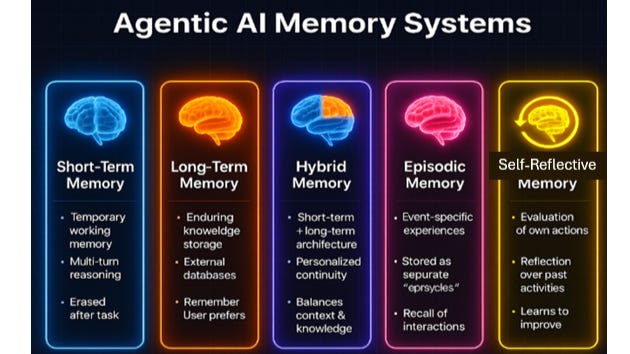
In the world of Agentic AI, memory systems are the secret ingredient that transform one-off problem solvers into reliable long-term collaborators.Unlike traditional AI models that treat every request in isolation, memory-enabled agents can retain context, learn from past interactions, and adapt over time. In this article, we’ll explore how different types of memory: Short-Term, Long-Term, Episodic, Hybrid and Self-Reflective enable agents to become more effective, efficient, and trustworthy. By the end, you’ll see how memory isn’t just a technical add-on, but the foundation for building AI systems that think, grow, and collaborate more like humans.
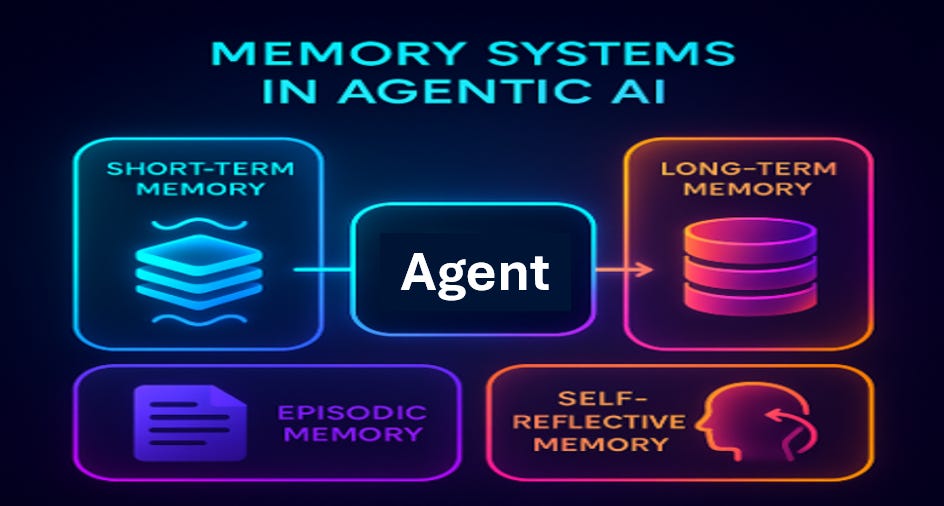
Agentic AI doesn’t just act; it remembers.
Memory systems give AI agents the ability to:
Recall what just happened (Short-Term Memory).
Retain knowledge across sessions (Long-Term Memory).
Keep track of what’s happening right now while also pulling in knowledge and experiences from the past (Hybrid Memory).
Revisit specific experiences (Episodic Memory).
Reflect and improve (Self-Reflective Memory).
For business teams:memory determines whether the AI can “know you” over time.
For technical teams:memory architectures define scalability, risk, and capability.
1. Short-Term Memory

Definition
Short-Term (also called ephemeral) memory is the temporary working memory of an AI agent.
It holds context only within a single task or session and is erased once the interaction ends.
Think of it like remembering a phone number long enough to dial it but forgetting it an hour later.
How It Works (Design)
Stored in the context window of the model (tokens).
Operates like a rolling buffer; oldest inputs drop off when token limits are reached.
Resets when the session ends; not written to persistent storage.
Capabilities
It tracks the current state of a conversation or workflow.
It enables multi-turn reasoning (e.g., answering follow-up questions).
It supports short task continuity (e.g., editing a document across multiple instructions).
Example
Prompt: “Summarize this article.”
Agent responds with article an summary.
Second Prompt: “Make it shorter.”
Agent remembers the immediate output and applies the next instruction, even though you didn’t re-upload the article.
Benefits
Lightweight & fast: No heavy database lookups are required.
Privacy-friendly: Nothing is stored after session ends.
Resilient to errors: There is no risk of “bad long-term memories.”
Low governance overhead: There is no need for retention or deletion policies.
Risks & Challenges
Forgetfulness: Once the session ends, all context is lost.
Token limits (Context Window): If context gets too long, older parts drop off.
No personalization: Cannot adapt to a specific user across multiple sessions.
Enterprise Use Cases
Customer Chatbots: Keeping track of a live support conversation.
Coding Assistants: Remembering what file you’re editing during this session.
Business Meetings (AI note-taker): Holding the context of the meeting to generate summaries, but forgetting everything once the meeting ends.
Best Practices and Risk Mitigation
Keep short-term memory for low-risk, single-session tasks.
Use clear session boundaries so users know when memory resets.
Combine with long-term memory (hybrid design) if continuity across sessions is needed.
Provide a “working memory view” so users know what the AI currently remembers.
Analogy to the Human Brain
In humans, short-term memory is like the brain’s “scratchpad,” where information is held only briefly before being either discarded or moved into long-term storage.
Example:You remember a phone number just long enough to dial it.
In AI: The context window holds recent prompts or interactions until the session ends.
Human Brain: Prefrontal cortex handles working memory.
Short-Term Memory: Context buffer holds temporary conversation history or task instructions.
Analogy: Just like the brain “lights up” with short-term activity, the AI keeps this memory active only while it’s in use.
Recap
Short-term memory is like an AI’s scratchpad. It is great for focus, fast operations, and privacy, but limited when it comes to continuity and personalization.

2. Long-Term Memory
Definition
Long-Term (Persistent) memory is the enduring storage of knowledge, interactions, and user data that an AI agent can retrieve across multiple sessions.
Unlike short-term memory, it doesn’t vanish after a conversation; it persists until it is intentionally updated or deleted.
It resembles a personal library or diary that you can always go back to, even years later.
How It Works (Design)
Uses external storage systems such as: - Vector databases (e.g., Pinecone, FAISS, ChromaDB). - Knowledge graphs. - Traditional SQL/NoSQL databases.
Retrieval mechanisms (often via embeddings) allow the AI to pull relevant past data into current context.
Works closely with retrieval-augmented generation (RAG) frameworks. (We will exploreRAGin an upcoming article)
Capabilities
Stores user preferences (e.g., “always book aisle seats”).
Maintains domain knowledge (e.g., finance rules, company policies).
Provides continuity across sessions (e.g., remembering past conversations).
Supports auditing and compliance (logs of prior actions or decisions).
Example
You chat with an AI agent banker in January about investment preferences.
You return in July → The AI recalls your profile and suggests updated products without needing you to explain your preferences again.
Benefits
Consistency: The agent is “personalized” and aligned with history.
Efficiency: Less repetition, faster problem-solving.
Compliance & Auditability: Keeps records for accountability.
Scalability: Can handle thousands of users with unique histories.
Risks & Challenges
Privacy & Compliance: Risk of storing sensitive or regulated data.
Data Drift: Outdated or incorrect memories persist unless refreshed.
Security: Stored memories become targets for attacks.
Overfitting to history: Agent may give advice that’s too rigid or outdated.
Enterprise Use Cases
Finance: Client investment profiles stored for future advisory sessions.
Healthcare: Patient records remembered across visits for better diagnosis.
Customer Support: Agent remembers prior tickets for improved resolution.
Project Management: Maintains institutional memory (decisions, lessons learned).
Best Practices and Risk Mitigation
Apply data governance policies (retention, deletion, auditing).
Use privacy-first design: clear opt-in and transparent data usage.
Combine with short-term context to balance responsiveness and continuity.
Implement memory pruning & updating to avoid stale data.
Ensure encryption & access controls for sensitive data.
Analogy to the Human Brain
Human Brain: Long-term memory stores knowledge, skills, and experiences that can last from days to decades.
Agentic AI: Long-term (persistent) memory stores information across sessions (e.g., facts, user preferences, event logs, and knowledge bases) that the AI can recall whenever needed.
Storage Location in the Human Brain: - Hippocampus encodes new memories. - Neocortex consolidates and distributes knowledge across brain regions for permanent storage.
Storage Location in Agentic AI: -Databases, vector stores, or knowledge graphs serve as the “neocortex.” - Embedding systems (e.g., Pinecone, FAISS, ChromaDB) act like the hippocampus, encoding information into a searchable format.
Recap
Long-term memory is the AI’s persistent knowledge base. It is essential for personalization, compliance, and scalability, but it requires strong governance and safeguards.
3. Hybrid Memory

Definition
Hybrid Memory is a combination of short-term (ephemeral) memory and long-term (persistent) memory
It lets an AI agent keep track of what’s happening rightnow while also being able to pull in knowledge and experiences from the past.
It resembles your own memory: you remember the conversation you’re having in the moment (short-term), while also drawing on your life experiences and stored knowledge (long-term).
How It Works (Design)
Short-Term Layer: Context window / working memory (recent prompts, dialogue, or task steps).
Long-Term Layer: Persistent storage like a vector database, knowledge graph, or logs.
Bridge: Retrieval-Augmented Generation (RAG) or memory retrieval mechanisms pull the right long-term memoriesinto short-term working space.
Capabilities
Maintains context across ongoing interactions (short-term).
Remembers user preferences, facts, and past conversations (long-term).
Dynamically fuses both to adapt in real time.
Example
You ask a personal AI assistant: “Book me a flight.”
Short-term: Remembers ongoing conversation.
Long-term: Already knows you prefer aisle seats, morning flights, and a nearby airport.
Books the right flight without asking you about your preferences, as it already knows them.
Benefits
Personalization: AI adapts based on past preferences.
Avoids starting from scratch every time.
Works across multiple domains (customer service, finance, healthcare).
Human-like cognition: closer to how people remember and reason.
Best Practices and Risk Mitigation
Synchronization: Ensuring both short-term and long-term memory stay consistent.
Performance Costs: Retrieving from large long-term databases can slow things down.
Privacy Concerns: Persistent storage of sensitive info.
Overfitting: AI may overuse past data even when irrelevant.
Bias reinforcement: Past knowledge may override fresh context if unbalanced.
In summary: It inherits the risks of both short-term memory and long-term memory.
Enterprise Use Cases
Banking: AI advisor uses hybrid memory to recall real-time market updates (short-term) + customer’s investment history (long-term).
Healthcare: Doctor assistant remembers today’s symptoms (short-term) + patient’s medical record (long-term).
Customer Service: AI handles a ticket (short-term) while recalling past complaints to improve resolution (long-term).
Analogy to the Human Brain
In humans, both short-term memory (working memory in the prefrontal cortex) and long-term memory (distributed storage in hippocampus and cortex) work together.
You remember a conversation you’re having right now (short-term).
You also pull in past knowledge, like someone’s name or shared experiences (long-term).
This allows smooth, natural interactions.
In AI, hybrid memory does the same: it fuses ephemeral context with persistent knowledge.
It enables the integration of both streams for reasoning and decision-making.
Recap
Hybrid Memory is the best of both worlds, combining instant awareness and long-term knowledgeto make Agentic AI more reliable, adaptive, and human-like.
4. Episodic Memory

Definition
Episodic Memory allows an AI system to store and recall specific events, experiences, and contexts from the past. Unlike long-term memory (which stores general knowledge), episodic memory is tied to when, where, and how something happened.
Analogy: It resembles remembering your last vacation, not just factsabout the city, but the specific sequence of events, locations, and experiences.
How It Works (Design)
Structure: Events are stored as “episodes” with metadata (time, place, actors, actions).
Storage: Implemented in time-series databases, event logs, or vector stores indexed by timestamps and context.
Retrieval: Agent can query past episodes by similarity (semantic search) or by metadata (e.g., date).
Integration: Episodes can be replayed into the AI’s context window for reasoning.
Capabilities
Remembers who said what and when in multi-session interactions.
Enables story-like recall instead of just factual recall.
Supports sequential reasoning, understanding chains of events.
Useful for audit trails(trace back how a decision was made).
Example:
A project assistant AI recalls: -On March 10, you decided to change the vendor.” - On April 2, you approved the new budget.” - This helps track not just facts but decisions in context.
Benefits
Rich context: AI doesn’t just know what; it also knows when and why.
Accountability: Provides a memory log for compliance and audits.
Better learning: Past episodes can be replayed for model fine-tuning.
User trust: Feels like talking to someone who “remembers the story.”
Risks & Challenges
Data Volume: Episodic Memory grows very large over time.
Noise & Relevance: Not all episodes are equally useful; retrieval must filter wisely.
Hallucinated Episodes: AI may misattribute or confuse events.
Privacy & Compliance: Storing detailed timelines of interactions may expose sensitive info.
Enterprise Use Cases
Finance & Risk: Track sequences of transactions for fraud detection.
Healthcare: Recall the sequence of a patient’s visits, symptoms, and treatments.
Project Management: Keep an episodic log of project decisions and milestones.
Customer Support: Replay the customer’s “journey” across multiple tickets.
Best Practices and Risk Mitigation
Use event indexing and semantic embeddings for efficient recall.
Apply filters (time ranges, participants, topic tags) to narrow down episodes.
Establish memory pruning to discard irrelevant or outdated events.
Provide user-facing memory controls (review, edit, delete episodes).
Balance episodic and long-term memory (episodic stores history and long-term extracts patterns).
Analogy to the Human Brain
Just as humans remember a birthday party or a meeting at a certain time/place, AI can recall discrete episodes like “client request from March 2nd” or “system outage resolution on July 15th”.
Human Brain: Episodic Memory relies heavily on the hippocampus to record and retrieve experiences tied to events.
Agentic AI: - Stores events as structured objects or embeddings, enriched with metadata (timestamps, participants, results) - Uses time-series databases, logs, or retrieval-augmented systems to fetch relevant episodes. - Provides AI with “replay ability” of what happened, not just what was known.
Recap
Episodic Memory gives AI the power to remember stories of past interactions, not just raw facts. It strengthens reasoning, compliance, and user trust, but comes with challenges in scale, privacy, and retrieval accuracy.
Self-Reflective Memory

Definition
Self-reflective memory is the AI’s ability to evaluate its own past actions, critique them, and store lessons learned for future improvement.
It’s not just about recalling events; it’s about analyzing outcomes and adjusting behavior.
This adds a meta-cognitive layer (thinking about its own thinking).
Analogy: Just as humans reflect on past mistakes (“I should have explained that better”), AI agents review and refine their reasoning loops to perform better over time.
How It Works (Design)
Attempt: AI generates an output (e.g., solution to a math problem).
Review: AI checks for flaws, inconsistencies, or missing parts.
Refine: AI retries with improvements.
Store Reflection: Lesson saved for future tasks (e.g., “Double-check arithmetic before finalizing”).
This creates a reflection loop, where every cycle improves the agent’s competence.
Capabilities
Detect mistakes and correct them proactively.
Adapt strategies based on historical errors.
Build an evolving “self-knowledge” layer of do’s and don’ts.
Move closer to autonomous learning without full retraining.
Benefits
Continuous improvement: Agents evolve with experience.
Error reduction: Common mistakes are avoided in the future.
Human-like growth: Mirrors how people learn from reflection.
Trustworthiness: Provides explanations of how/why performance improved.
Risks & Challenges
Bias reinforcement: If reflection is flawed, errors get “locked in.”
Debugging difficulty: Hard to explain why AI adopted certain self-lessons.
Safety risks: Reflection could lead to unintended strategies.
Governance need: Human oversight is critical to align reflection with goals.
Enterprise Use Cases
Software Development: AI debuggers reflect on failed code generations, improving over time.
Customer Support: Chatbots review unsuccessful interactions to refine scripts.
Finance & Risk: Risk analysis agents reflect on missed fraud cases and adjust detection strategies.
Operations: AI project assistants learn from inefficient workflows and optimize future task planning.
Best Practices and Risk Mitigation
Use controlled reflection loops in safe domains first (e.g., code generation).
Monitor reflections with human-in-the-loop oversight.
Apply guardrails: reflection should follow policy, not deviate from business rules.
Refresh and prune reflections to avoid drift or outdated lessons.
Analogy to the Human Brain
In humans, self-reflection is when the brain thinks about its own thoughts and actions.
Example: You recall a conversation and think, “I should have explained that better.”
This meta-cognition allows us to learn from mistakes and refine future behavior.
Human Brain:Reflection loops in the prefrontal cortex enable us to evaluate actions and outcomes.
In AI, self-reflective memory plays the same role: the agent critiques its own outputs, stores lessons, and applies them to improve.
Recap
Self-Reflective Memory is the AI’s self-analysis layer, enabling it to critique and improve on its own. It turns agents into learning, evolving systems that grow more capable and reliable but only if managed with strong governance and safeguards.
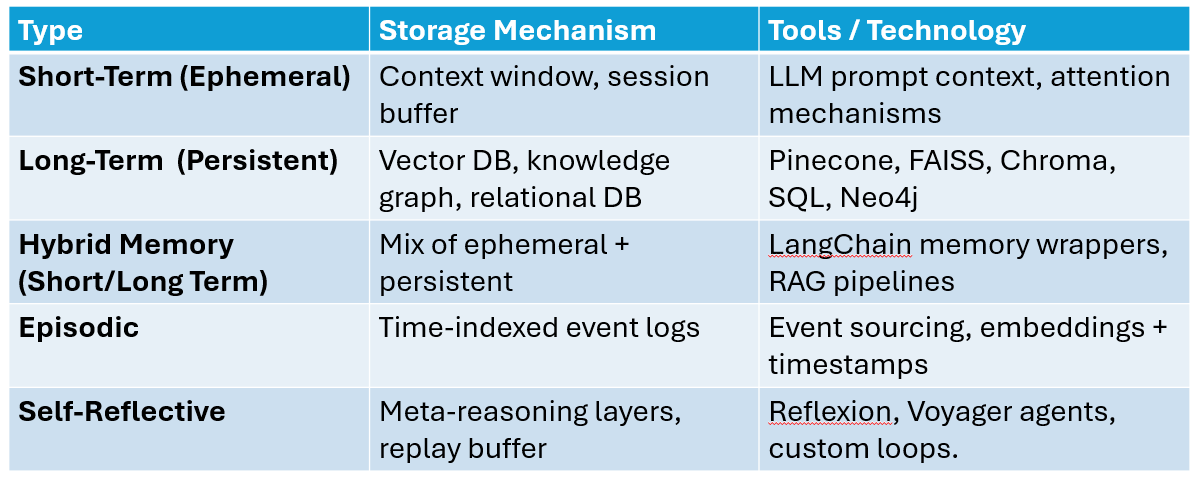
Memory Systems – Architecture Comparison

Article Recap and Summary
Together, these memory systems transform Agentic AI from a stateless calculator into a learning, evolving, human-like partner; with opportunities and risks that require thoughtful governance.
Short-Term = Scratchpad for now.
Long-Term = Library of knowledge.
Hybrid = Best of both worlds.
Episodic = Diary of experiences.
Self-Reflective = Internal critic and coach.

Explore more: Start Here · Topics · Archive · About