


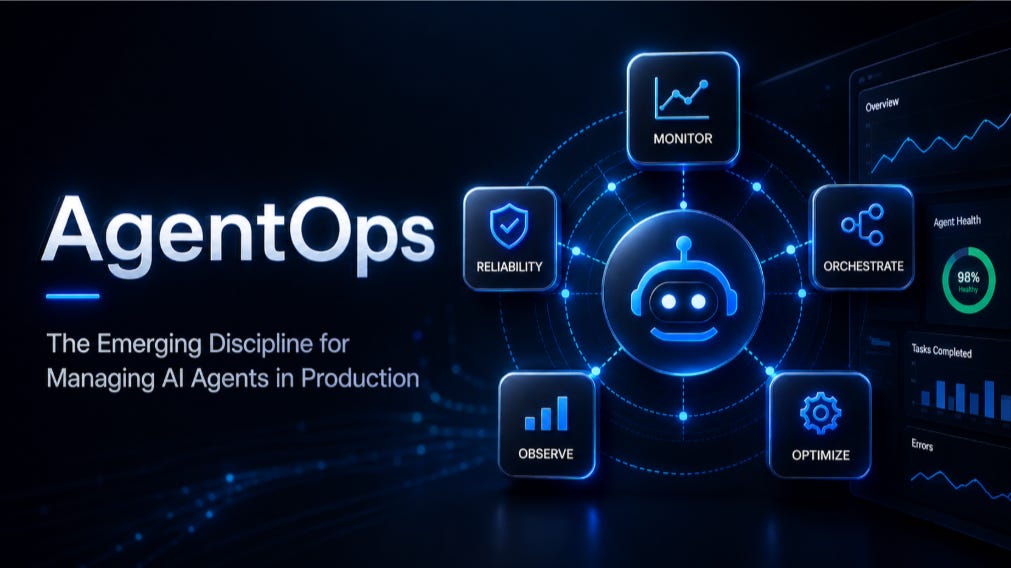
AgentOps is the emerging operational discipline for managing AI agents in production. It goes far beyond simply deploying agents. It is about monitoring, managing, improving, and catching failures in agentic AI systems before end users are affected. It is what every organization deploying Agentic AI needs when its AI systems can take actions in the real world: opening tickets, updating records, making decisions, and calling APIs. You need to know exactly what it did, why it did it, and whether it should have done it at all.
The Evolutionary Context
AgentOps sits within a lineage of operational disciplines:
DevOps:gave teams the tools to deploy software reliably
MLOps:gave teams the tools to manage machine learning models
AgentOps: gives teams the tools to govern AI agents that act autonomously in the real world
The Core Problem AgentOps Solves
Many organizations running AI agents in production are flying blind. Without AgentOps, the following critical questions go unanswered
Is the agent hallucinatingaccount numbers, trade identifiers, or regulatory codes?
Is the agent leaking sensitive customer or counterparty data?
Is the agent stuck in an infinite loop burning through API budget?
Did the agent actually complete the taskit was given?
Was the decision the agent made correct?
In high-stakes domains such as finance and capital markets, operating without this visibility is not merely inefficient. It is a legal and regulatory liability.
The AgentOps Three-Layer Framework
The AgentOps framework is organized into three sequential layers. The order is deliberate and non-negotiable:
1. Observability
What is happening? (Visibility and traceability)
2. Evaluation
Is it any good? (Quality and correctness)
3. Optimization
How can we make it better? (Continuous Improvement)
Layer 1: Observability
Observability is the visibility layer.When an agent makes a decision, you must be able to reconstruct exactly how it arrived at that decision.This requires capturing every tool call, every LLM invocation, and every handoff between agents.
The Three Key Observability Metrics:
1. End-to-End Trace Duration
Description:Time from the moment a user submits a request to the moment a final answer is returned.
Why it Matters:Your headline performance number. If this is slow, nothing else matters.
2. Agent-to-Agent Handoff Latency (A2A)
Description:Time required for one agent to pass work to another agent in a multi-agent system.
Why it Matters:Handoff delays are a hidden bottleneck. They accumulate and can silently degrade system performance.
3. Cost Per Request
Description:Total API cost (input tokens + output tokens) for each interaction across all agents.
Why it Matters:The metric your finance team will ask about first. Know it before they do.
What Observability Enables
Full trace reconstruction for every agent decision
Identification of hidden bottlenecks in multi-agent handoffs
Real-time cost tracking per request
Alerting when performance thresholds are breached
Root cause analysis when failures occur
Layer 2: Evaluation
Observability tells youwhat happened.Evaluation tells you whether what happened was actually good. This is the quality and correctness layer.
The Three Key Evaluation Metrics:
1. Task Completion Rate
Description:Out of every 100 requests, how many complete successfully without a human stepping in?
Why it Matters: Your North Star metric. Everything else is commentary. This measures autonomous reliability.
2. Guardrail Violation Rate
Description: How often does the agent attempt something it should not do: leaking sensitive data, executing unauthorized transactions, or accessing restricted systems?
Why it Matters:This number must be as close to zero as possible. If it is high, you have a compliance and safety problem.
3. Factual Accuracy Rate
Description:When the agent states a fact (trade ID, settlement amount, counterparty identifier), is it actually correct?
Why it Matters:In regulated industries such as finance, factual accuracy is non-negotiable. Errors here carry legal and financial consequences.
Note: The Human Validation Layer
Evaluation should not rely on the agent grading itself.Effective evaluation requires human reviewers to validate a sample of agent outputs. This is your ground truth. In the trade settlement example, a panel of operations analysts reviews a percentage of resolved exceptions to confirm accuracy and regulatory compliance. That human feedback loop is what makes the evaluation credible.
Layer 3: Optimization
Once you can see what is happening and judge whether it is good, the third layer enables systematic improvement over time. Optimization is not a one-time event. It is a continuous practice.
The Five Key Optimization Metrics:
1. Prompt Token Efficiency
Description:How much output quality are you getting per input token? After prompt tuning, you may achieve identical quality with 40% fewer tokens.
Why it Matters: Every token reduction multiplies across thousands of daily requests. This directly reduces API costs at scale.
2. Retrieval Precision
Description:When the agent pulls documents from a knowledge base, are the top results actually relevant to the task?
Why it Matters: Irrelevant retrieved documents force the agent to work with noise rather than signal, degrading decision quality.
3. Handoff Success Rate
Description:When one agent passes work to another, does the handoff actually complete successfully?
Why it Matters: A 2% failure rate sounds trivial until it represents thousands of failed transactions daily at scale.
4. Flow Step Efficiency
Description:How many steps does the agent actually take vs. the theoretical optimal path?
Why it Matters:Excess steps reveal where workflows are redundant or where data quality issues trigger unnecessary follow-up actions.
5. Improvement Velocity
Description: How frequently is the team shipping optimizations (prompt tuning, retrieval tuning, flow adjustments)?
Why it Matters:A healthy system should continuously improve.
The AgentOps Dashboard
An AgentOps dashboard is the operational control plane for your agent system. It is not an afterthought. It is the infrastructure that makes production-grade agentic AI possible.
What an AgentOps Dashboard Must Provide:
Real-time trace visibility for every agent decision and action
Agent-to-agent handoff monitoring with latency alerts
Tool execution tracking (which external systems are being called and how often)
Cost tracking per request, per agent, and per day
Guardrail violation alerts routed to human reviewers
Accuracy and quality metrics updated continuously
Optimization feedback loop data(token efficiency, retrieval precision, flow step counts)
Market Context and Strategic Importance
AI agents are not a future technology. They are a present-day operational reality, and the market is scaling fast.
The implication is significant:the number of teams shipping AI agents is growing rapidly. The majority will struggle to operate those agents reliably without an operational framework. The teams that invest in AgentOps early will be the ones running their agents confidently, reliably, and at scale, one year from now. The rest will either fail silently or face incidents that erode user trust.
Why AgentOps Investment Cannot Be Deferred
Agent failures in production are often silent.Without observability, you will not know a failure occurred until a user reports it or an audit uncovers it.
Regulatory exposure is real.In finance, an agent that hallucinates a settlement instruction or leaks Non-Public Information (NPI) is not a product bug. It is a compliance event with regulatory consequences under SR 11-7, OCC guidance, and the EU AI Act.
Cost overruns compound quickly.An agent burning extra tokens on every request may be undetectable without cost-per-request tracking, but it can materially impact your operational budget at scale.
Retrofitting is harder than building in.Observability and evaluation instrumentation added after deployment is significantly more complex and disruptive than building it in from the start.
Key Takeaways
AgentOps is a non-negotiable discipline.Deploying AI agents without operational infrastructure is a liability, not a strategy.
The three layers must be built in order.You cannot optimize what you have not evaluated. You cannot evaluate what you have not observed.
The metrics are specific and actionable.Each layer has defined, measurable KPIs that drive decisions.
Human validation remains essential.Evaluation is not the agent grading itself. Human reviewers provide the ground truth that makes evaluation credible.
Optimization is continuous, not one-time.Improvement velocity (how often the team ships optimizations) is itself a metric to track.
The business case is clear. Cost and processing time reduction are achievable outcomes when AgentOps is implemented rigorously.
Early investment pays compounding dividends.Teams that build AgentOps infrastructure from the start will outcompete those who try to retrofit it later.

Explore more: Start Here · Topics · Archive · About