


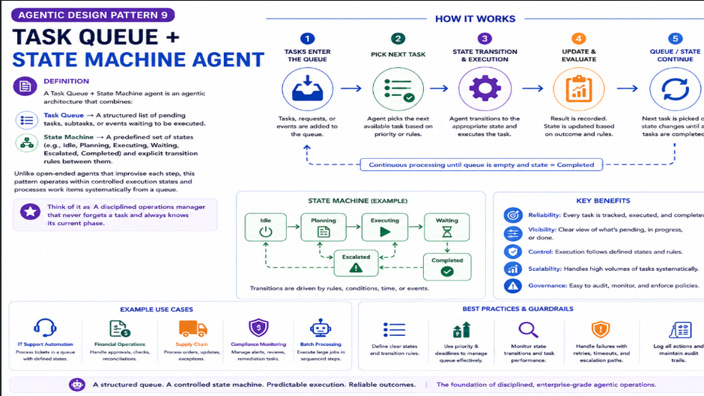
The Task Queue + State Machine Agent is one of the most enterprise-ready Agentic AI patterns because it combines structured task orchestration with controlled execution logic. Instead of improvising every step, this agent processes tasks from a queue and moves each task through predefined states such as Pending, Validating, Executing, Waiting, Escalated, or Completed. This makes the pattern especially valuable in regulated workflows where reliability, traceability, auditability, retry logic, and human-in-the-loop control are essential.
9.1 Definition
A Task Queue + State Machine agent is an agentic architecture that combines:
Task Queue→ A structured list of pending tasks, subtasks, or events waiting to be executed.
State Machine→ A predefined set of states (e.g., Idle, Planning, Executing, Waiting, Escalated, Completed) and explicit transition rules between them.
Unlike open-ended agents that improvise each step, this pattern operates within controlled execution states and processes work items systematically from a queue.
Think of it as A disciplined operations manager that never forgets a task and always knows its current phase.
9.2 How It Works
Core Flow:
Task Creation:Tasks are generated from user requests, system events, or upstream agents, then each task enters a structured queue.
State Initialization:Every task begins in a defined state (e.g., Pending).
State Transition Logic: The agent evaluates:- If preconditions are met - if required tools are available - if policy constraints are satisfied It then transitions to the next valid state.
Execution:Executes actions (API calls, LLM prompts, data retrieval) and updates state based on results.
Completion or Escalation: Task moves to one of the following states:Completed, Retry, Failed, Human Review
State transitions are rule-based, not improvised.
9.3 Example of the Agent in Action
Enterprise Loan Processing Assistant
Scenario: A customer submits a loan application.
A. Task Queue:
Validate identity
Check credit score
Run risk model
Generate decision letter
Notify customer
B. State Machine:
Pending
Validating
Scoring
Risk Evaluation
Decision Generated
Awaiting Approval
Completed
Conditional Branching as follows: -If credit API fails → move to Retry - If risk score exceeds threshold → move to Escalation - If approved → move to Notification
Every step is traceable and governed.This is especially powerful in regulated industries (like financial services)where traceability and audit transparency are non-negotiable.
9.4 Where the Task Queue + State Machine Pattern adds value
This pattern excels in:
Regulated workflows (finance, healthcare, compliance)
Multi-step business processes
Ticketing & service orchestration
IT incident management
Claims processing
KYC / AML workflows
Enterprise automation requiring audit logs
It’s ideal when:
Predictability is more important than Creativity
Governance is more important Improvisation
Accountability is more important Autonomy
9.5 Advantages / Strengths
High reliability
Deterministic execution paths
Clear audit trail
Easier model validation
Controlled autonomy
Built-in retry and fallback logic
Human-in-the-loop insertion points
Works well with policy guardrails
It blends AI flexibility with traditional workflow control.
9.6 Inherent Risks
Even structured agents have risks:
State Explosion:Too many states make logic unmanageable.
Deadlock:Tasks stuck in waiting states indefinitely.
Over-Reliance on Rule:Hard-coded transitions limit adaptability.
Queue Backlog:Bottlenecks under heavy load.
Hidden Complexity:Interactions between states can create unexpected loops.
9.7 Risk Mitigation
Governance Controls:
Limit total state count.
Enforce timeout rules.
Add automatic retry thresholds.
Monitor queue depth.
Insert escalation policies.
Maintain state transition logs.
Run simulation testing before deployment.
In regulated environments:
Map states to governance controls.
Align transitions with Model Risk Management frameworks.
Document allowed transitions.
In short: Structured autonomy must still be supervised autonomy.
9.8 Recap
The Task Queue + State Machine patternis not the most creative agent architecture, but it is one of the most enterprise-ready patterns
It provides:
Structured orchestration
Deterministic transitions
Controlled execution
Clear auditability
It transforms an LLM from a “free thinker” into a disciplined process operator. For enterprise AI, especially in financial services, this pattern often represents the safest bridge between automation and accountability.

Explore more: Start Here · Topics · Archive · About