


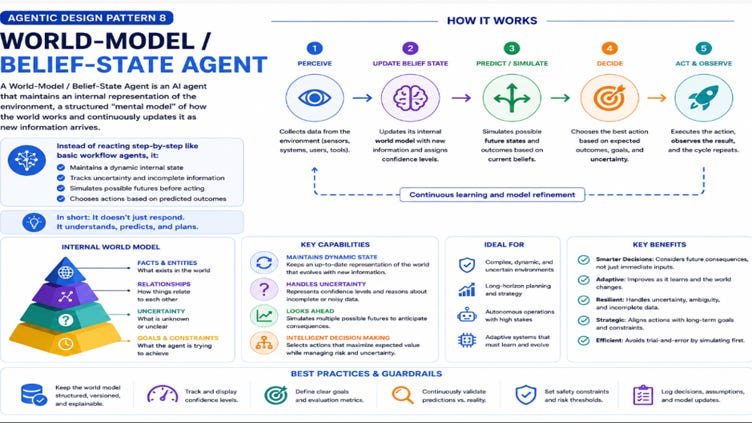
The World-Model / Belief-State Agent represents a more strategic form of Agentic AI. Instead of simply reacting to inputs or executing predefined workflows, this agent maintains an internal representation of the environment, updates that belief state as new information arrives, simulates possible futures, and selects actions based on predicted outcomes. This pattern is especially valuable in dynamic, uncertain, and partially observable environments where decisions unfold over time, such as liquidity risk monitoring, supply chain resilience, portfolio management, fraud forecasting, and long-horizon enterprise planning.
8.1 Definition
A World-Model / Belief-State Agentis an AI agent that maintains an internal representation of the environment, a structured “mental model” of how the world works and continuously updates it as new information arrives.
Instead of reacting step-by-step like basic workflow agents, it:
Maintains a dynamic internal state
Tracks uncertainty and incomplete information
Simulates possible futures before acting
Chooses actions based on predicted outcomes
In short: It doesn’t just respond. It understands, predicts, and plans.
8.2 How It Works
At a high level, the loop looks like this:Observe → Update Belief State → Simulate Futures → Evaluate Outcomes → Act → Repeat
Core Components:
Observation Layer:Collects signals (text, data, sensors, APIs, user input) e.g. market data, user query, system logs.
Belief State Update:Updates internal representation of the world, handles uncertainty (probabilities, confidence scores) and may use Bayesian reasoning or latent state modeling.
World Model Simulation:Predicts how the environment might evolve and runs internal “what-if” simulations.
Decision Policy:Selects the action that optimizes expected outcome while balancing risk vs. reward.
Execution + Feedback:Takes action, observes real-world consequences then refines belief model.
This is closer to strategic cognition than task automation.
8.3 Example of the Agent in Action
Example: Enterprise Liquidity Risk Monitoring Agent (Banking Context)
Imagine a large financial institution deploying a world-model agent to monitor liquidity stress.
What it tracks internally:
Market volatility trends
Counterparty exposures
Funding inflow/outflow probabilities
Regulatory liquidity buffers
Historical crisis patterns
When new data arrives:
Interest rates spike unexpectedly.
A major counterparty shows deteriorating credit signals.
The agent:
Updates its internal belief about systemic stress probability.
Simulates potential liquidity scenarios over 1 week, 1 month.
Evaluates capital adequacy under multiple paths.
Recommends preemptive funding reallocation.
It doesn’t wait for crisis. It anticipates trajectories. That’s the power of a maintained belief state.
8.4 Where the World-Model / Belief-State Pattern adds value
World-model agents excel in environments that are:
Dynamic and evolving
Partially observable
Uncertain
Sequentially dependent
Examples:
Strategic resource allocation
Supply chain resilience modeling
Autonomous robotics navigation
Fraud risk forecasting
Portfolio rebalancing
Long-horizon research agents
Multi-stage negotiation agents
When future states matter more than immediate outputs, this architecture dominates.
8.5 Advantages / Strengths
Long-Horizon Planning:Unlike workflow agents, these can optimize across multiple steps.
Proactive Decision Making:They anticipate downstream consequences.
Robustness Under Uncertainty:They reason probabilistically instead of assuming full information.
Adaptive Learning:They refine internal models continuously.
Strategic Alignment:Ideal for leadership-level AI systems where decisions have compounding impact.
8.6 Inherent Risks
With power comes complexity.
Model Mis-Specification Risk:If the world model is wrong, predictions compound errors.
Hallucinated Causality:The agent may infer relationships that do not exist.
Overconfidence in Simulation:Internal simulations may diverge from real-world complexity.
Governance Blind Spots:Harder to explain compared to simple workflows.
Feedback Loop Amplification:Incorrect beliefs are reinforced over time.
8.7 Risk Mitigation Strategies
For regulated enterprise contexts (especially financial institutions), safeguards are critical.
Model Validation Layer:Independent validation of the world model, Scenario stress testing and Back-testing under historical crises.
Uncertainty Calibration:Explicit confidence thresholds and human approval when uncertainty is high.
Guardrails Around Action Space:Constrain allowable action and prevent unbounded autonomy.
Belief Drift Monitoring:Monitor divergence between predicted & actual outcomes and trigger model recalibration.
Human-in-the-Loop Escalation:Strategic checkpoints for high-impact decisions.
In governance-heavy sectors, this architecture must align with formal model risk management frameworks.
8.8 Recap
A World-Model / Belief-State Agent is not merely a task executor. It:
Maintains internal memory of the world
Updates its understanding as new evidence appears
Simulates possible futures
Selects actions based on predicted trajectories
It moves AI from reactive execution → strategic foresight.
If Workflow Agents optimize process, and Open-Ended Agents optimize exploration, World-Model Agents optimize trajectory. They are the foundation for truly strategic AI systems

Explore more: Start Here · Topics · Archive · About