


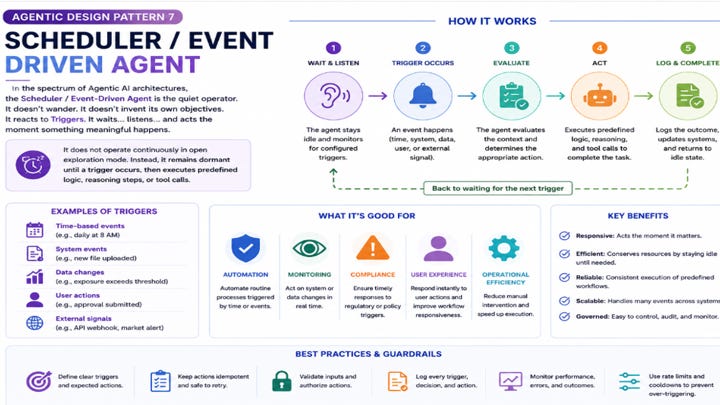
The Scheduler/Event-Driven Agent is one of the most immediately deployable patterns in Agentic AI because it is built around disciplined reaction rather than open-ended autonomy. This agent remains idle until a defined trigger occurs, such as a time-based schedule, system event, data threshold, user action, or external signal. Once activated, it validates the event, reasons over the context, executes approved actions, logs the outcome, and returns to standby. For enterprises, especially in banking, risk, compliance, operations, and cybersecurity, this pattern offers a practical path to faster response, stronger consistency, and governance-aligned automation.
7.1 Definition
In the spectrum of Agentic AI architectures, the Scheduler / Event-Driven Agent is the quiet operator. It doesn’t wander. It doesn’t invent its own objectives. It reacts to Triggers. It waits… listens… and acts the moment something meaningful happens.
Examples of Triggers:
Time-based events (e.g., daily at 8 AM)
System events(e.g., new file uploaded)
Data changes(e.g., exposure exceeds threshold)
User actions (e.g., approval submitted)
External signals(e.g., API webhook, market alert)
It does not operate continuously in open exploration mode. Instead, it remains dormant until a trigger occurs, then executes predefined logic, reasoning steps, or tool calls
7.2 How it Works: Reactive Loop
The core flow is Trigger → Validate Conditions → Reason → Execute Action(s) → Log → End/Wait
Key architecture components:
Event Listener:Subscribes to message queues, APIs, webhooks, or schedulers; detects trigger conditions.
Trigger Filter/Validator: Confirms relevance and eligibility; prevents false positives.
Reasoning Layer (LLM or Logic Engine):Interprets context and decides what action to take; may generate structured outputs.
Tool Executor: Calls APIs, updates systems, and sends notifications; can chain subtasks.
Audit and Logging: Records what happened; supports governance and traceability.
Idle State: Returns to standby until the next event.
Unlike open-ended agents, it does not self-generate tasks. It reacts.
7.3 Example in Action: Exposure Threshold Monitoring in Banking
Trigger: Credit exposure to a counterparty has exceeded the risk tolerance threshold.
The agent pulls the latest transaction data, compares it against policy thresholds, generates risk commentary, creates a structured incident ticket, notifies the Risk Manager, and logs the decision rationale. The result: corrective action is taken within seconds, without any manual monitoring.
7.4 Where This Pattern Adds Value
Compliance monitoring
Fraud detection alerts
SLA breach notifications
Automated document routing
Scheduled financial reporting
Incident response workflows
Real-time system anomaly detection
It is ideal where responsiveness and consistency matter more than creativity.
7.5 Advantages and Strengths
Deterministic Activation: Acts only when conditions are met.
Operational Efficiency: Eliminates manual monitoring and repetitive checks.
Low Cognitive Drift:No autonomous goal evolution.
High Governance Alignment: Clear trigger logic means clear accountability.
Scalable Across Systems:Works well in microservices and event-driven architectures.
7.6 Inherent Risks
False Triggers: Bad data may cause unnecessary actions.
Trigger Storms:Rapid repeated events may overwhelm systems.
Logic Misconfiguration:Incorrect condition rules can cause silent failures.
Over-Automation:Critical actions executed without sufficient review.
Cascading Effects: One trigger may initiate unintended downstream workflows.
7.7 Risk Mitigation
Trigger Validation Layer:Add threshold checks and sanity filters.
Rate Limiting and Debouncing: Prevent trigger storms.
Human-in-the-Loop Gates: Require approval for high-impact actions.
Monitoring and Observability: Full logging and audit trails.
Policy Guardrails: Restrict tools and data access domains.
Sandbox Testing:Simulate events before deployment.
In regulated environments, this pattern is powerful but must be tightly governed.
7.8 Recap
The Scheduler/Event-Driven Agent is the disciplined responder of Agentic AI.It does not chase curiosity. It does not invent missions. It waits. And when something meaningful happens, it moves. Its strength lies in structured reaction; its value lies in speed, reliability, and governance alignment. In enterprise environments, especially finance, operations, and compliance, this pattern is often the most immediately deployable form of Agentic AI. Because sometimes intelligence is not about constant thinking. It is about knowing exactly when to act.

Explore more: Start Here · Topics · Archive · About