


The Supervisor-Worker Model for Scalable Enterprise AI
The Supervisor-Worker pattern is one of the most practical agentic design patterns for enterprise AI because it mirrors how complex organizations already operate. A central Supervisor agent decomposes a high-level objective, assigns specialized Worker agents, reviews their outputs, and integrates the results into a final deliverable. This structure enables scalability, specialization, governance, and accountability, making it especially valuable for regulated industries, multi-stage analysis, and enterprise-grade document generation.
6.1 Definition
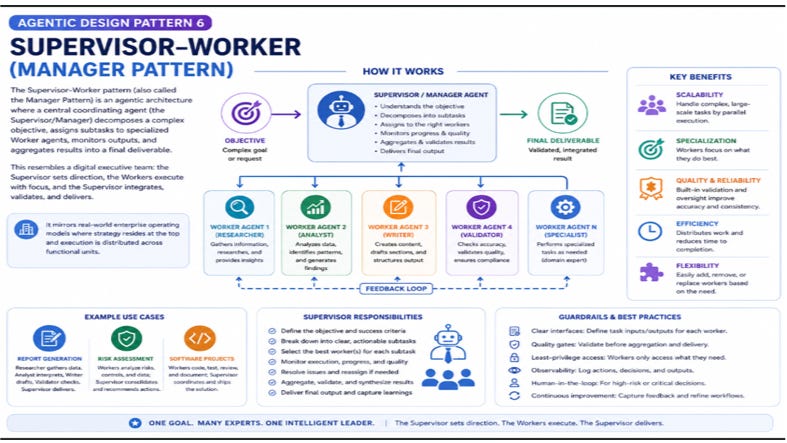
The Supervisor-Worker pattern (also called the Manager Pattern) is an agentic architecture where a central coordinating agent (the Supervisor/Manager) decomposes a complex objective, assigns subtasks to specialized Worker agents, monitors outputs, and aggregates results into a final deliverable.
This resembles a digital executive team: the Supervisor sets direction, the Workers execute with focus, and the Supervisor integrates, validates, and delivers. It mirrors real-world enterprise operating models where strategy resides at the top and execution is distributed across functional units.
6.2 How It Works: Execution Flow
Receive Goal:The Supervisor receives a high-level objective.
Task Decomposition:Breaks the goal into structured subtasks.
Assignment:Routes tasks to specialized Workers (Research, Analysis, Drafting, Validation, etc.).
Execution:Workers perform their tasks independently.
Collection and Review:The Supervisor reviews outputs for quality, alignment, and completeness.
Integration:The Supervisor synthesizes results into a cohesive final output.
Optional Iteration:If gaps exist, the Supervisor reassigns refinement tasks.
6.3 Example in Action: Regulatory Impact Assessment for a Bank
Goal: Analyze how a new AI regulation impacts internal model governance.
The Supervisor breaks the task into four streams:regulatory extraction, policy comparison, risk gap analysis, and executive summary drafting. Workers are assigned accordingly: a Research Worker extracts relevant clauses, a Compliance Worker maps clauses to internal policy, a Risk Analyst Worker identifies control gaps, and a Writer Worker drafts a board-ready summary. The Supervisor validates coherence, ensures the tone matches the executive audience, and produces the final structured report.
6.4 Where This Pattern Adds Value
Enterprise workflows requiring multi-stage document generation
Research-heavy tasks requiring parallel information gathering
Structured analysis and complex problem decomposition
Systems requiring both orchestration and accountability
Regulated industries where traceability, defined roles, and oversight are mandatory
6.5 Advantages and Strengths
Scalability: Parallel workers can process tasks simultaneously.
Specialization:Each worker can be optimized for a specific capability.
Modular Design:Workers can be replaced or upgraded independently.
Governance-Friendly:Clear separation of roles supports auditability.
Quality Control:The Supervisor enforces consistency and alignment.
Enterprise Alignment:Mirrors real-world organizational hierarchies.
6.6 Inherent Risks
Supervisor Bottleneck: If too centralized, the Supervisor slows the system.
Poor Task Decomposition: A flawed breakdown produces flawed results.
Worker Drift:Workers may interpret tasks inconsistently.
Coordination Overhead: Too many agents increase complexity.
Cascading Errors: If the Supervisor fails, the entire output degrades.
6.7 Risk Mitigation Strategies
Structured Decomposition Templates:Use predefined task breakdown logic.
Validation Layer: Add evaluator agents between Workers and the Supervisor.
Clear Role Definitions: Define scope and constraints per worker.
Bounded Authority:The Supervisor operates within policy guardrails.
Logging and Traceability:Record all assignments, outputs, and revisions.
Fail-Safe Escalation:Human-in-the-loop review for high-risk outputs.
6.8 Recap
The Supervisor-Worker pattern brings organizational structure into agentic systems. The Supervisor provides direction and oversight; Workers provide depth and execution; the system as a whole delivers scalability and modular intelligence. This pattern is not about autonomy without control. It is about controlled delegation at machine speed. In enterprise AI, structure is not bureaucracy; it is how intelligence scales responsibly.

Explore more: Start Here · Topics · Archive · About