


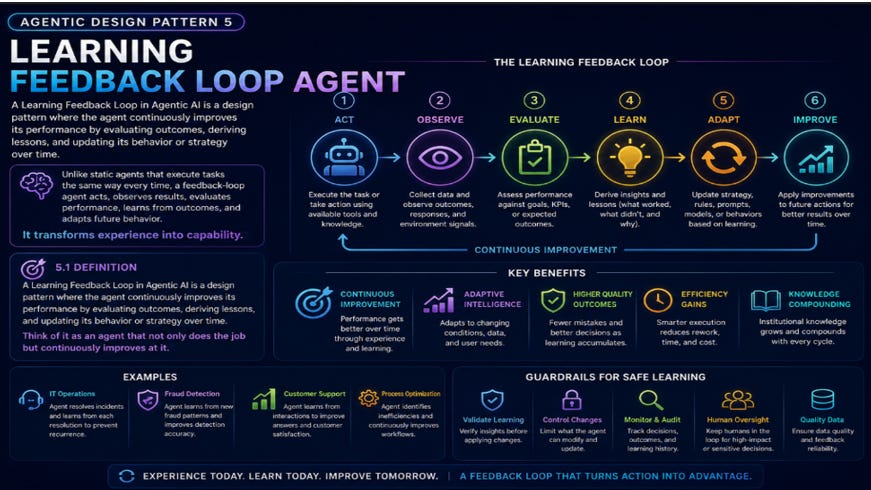
As Agentic AI matures, the most valuable agents will not be the ones that simply execute tasks. They will be the ones that improve from experience. Learning Feedback Loop Agents represent a powerful Agentic AI design pattern where agents act, observe results, evaluate performance, learn from outcomes, and adapt their future behavior. Instead of repeating the same process every time, these agents transform feedback into better strategy, stronger accuracy, and more organization-specific intelligence. For enterprises, this pattern offers a path from static automation to continuously improving AI systems that compound value over time.
5.1 Definition
A Learning Feedback Loop in Agentic AI is a design pattern where the agent continuously improves its performance by evaluating outcomes, deriving lessons, and updating its behavior or strategy over time. Unlike static agents that execute tasks the same way every time, a feedback-loop agent acts, observes results, evaluates performance, learns from outcomes, and adapts future behavior. It transforms experience into capability. Think of it as an agent that not only does the job but continuously improves at it.
5.2 How It Works: Core Loop
Plan: The agent selects a strategy or action.
Execute: Performs the task, potentially using tools or APIs.
Observe: Captures outputs and environmental response.
Evaluate: Compares results against objectives, metrics, or constraints.
Reflect: Identifies errors, inefficiencies, or opportunities for improvement.
Update:Adjusts memory, strategy, prompts, skill library, or parameters.
Repeat:Applies the improved approach to the next task.
It can operate at different depths: prompt-level refinement, tool selection optimization, strategy adaptation, skill acquisition, and long-term memory shaping.
5.3 Example in Action: Enterprise Risk Reporting Agent
Objective:Generate monthly regulatory risk summaries.
Cycle 1: The agent generates a summary. A compliance reviewer flags inconsistencies in categorization. The agent analyzes feedback and adjusts classification rules and data mapping logic.
Cycle 2: The agent produces an improved report with fewer corrections required. It learns common compliance phrasing patterns.
Cycle 3: The agent generates a near-perfect report and automatically flags ambiguous entries before submission.
Over time, the agent builds institutional knowledge, reduces human correction effort, and aligns more closely with regulatory language standards. It evolves from assistant to capable operator to domain-aligned system.
5.4 Where This Pattern Adds Value
Researchagents that refine search strategies
Financial forecasting agents that recalibrate models
Customer support agents improving response accuracy
Coding copilots learning from bug reports
Compliance agents adapting to policy interpretation trends
It is particularly powerful where repetition exists, feedback is measurable, and improvement compounds over time.
5.5 Advantages and Strengths
Compounding Performance: Each iteration improves future outputs.
Contextual Adaptation:Learns organization-specific style and constraints.
Error Reduction Over Time: Systematically reduces recurring mistakes.
Scalability: Improvement benefits all future similar tasks.
Institutional Memory: Captures insights beyond a single execution.
Autonomous Optimization: Reduces the need for continuous human micromanagement.
5.6 Inherent Risks
Reinforcing Wrong Lessons: If feedback is flawed, the agent may optimize toward incorrect behavior.
Drift from Original Objectives: Adaptation may unintentionally shift priorities over time.
Bias Amplification: Feedback loops can reinforce biased outputs.
Overfitting to Local Context: The agent becomes too specialized and loses generalization ability.
Uncontrolled Self-Modification: Autonomous updating without oversight can create instability.
5.7 Risk Mitigation
Human-in-the-Loop Validation: Critical learning updates require approval.
Checkpointing: Freeze model states and allow rollback if drift occurs.
Structured Evaluation Metrics:Use measurable KPIs rather than subjective signals.
Policy Guardrails: Limit what can be updated (for example, prompt layer only, not tool access).
Shadow Testing: Test learning updates in a sandbox before production rollout.
Diverse Feedback Sources: Avoid single-source reinforcement bias.
5.8 Recap
The Learning Feedback Loop transforms an AI agent from a task executor into a self-improving system. Its power lies in compounding intelligence; its risk lies in compounding mistakes. When properly governed, it becomes one of the most powerful patterns in Agentic AI, enabling sustainable performance improvement rather than static automation. Workflow agents execute. Open-ended agents explore. Learning feedback agents evolve.

Explore more: Start Here · Topics · Archive · About