


As enterprises adopt Agentic AI, the ability to detect problems is no longer enough. Organizations need systems that can continuously monitor environments, identify anomalies, diagnose root causes, take approved corrective actions, verify outcomes, and document every step for governance. Autonomous Monitoring and Remediation is an Agentic AI design pattern that turns AI from a passive alerting mechanism into an active self-healing control layer. In regulated industries such as banking, cybersecurity, risk, and operations, this pattern can improve resilience, reduce response time, and strengthen auditability while still requiring clear boundaries, escalation paths, and human accountability.
4.1 Definition
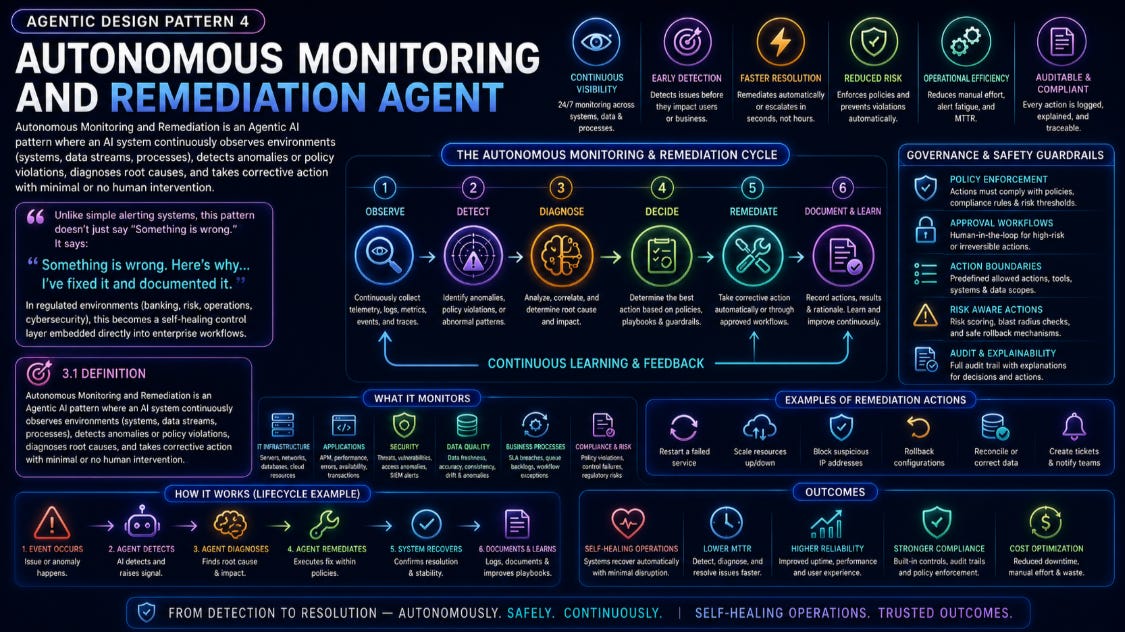
Autonomous Monitoring and Remediation is an Agentic AI pattern where an AI system continuously observes environments (systems, data streams, processes), detects anomalies or policy violations, diagnoses root causes, and takes corrective action with minimal or no human intervention.
Unlike simple alerting systems, this pattern doesn't just say "Something is wrong." It says:
"Something is wrong. Here's why... I've fixed it and documented it."
In regulated environments (banking, risk, operations, cybersecurity), this becomes a self-healing control layer embedded directly into enterprise workflows.
4.2 How It Works: Operational Loop
The agent runs a continuous six-step cycle:
Monitor: Ingest logs, metrics, transactions, model outputs, and API activity.
Detect: Identify anomalies, drift, threshold breaches, or policy violations.
Diagnose:Perform root cause analysis through correlation, historical comparison, and pattern memory.
Remediate: Execute approved corrective actions such as restarting a service, rolling back a model, blocking a transaction, or escalating a case.
Verify: Confirm that the issue has been resolved.
Log and Learn: Store the event, outcome, and effectiveness for future optimization.
This is typically powered by a combination of:LLM with structured rules, predictive models for drift and anomaly detection, policy engines, guardrail layers, and persistent memory for recurring incidents.
4.3 Example in Action: Banking Model Drift Control
A credit risk model begins to show prediction instability. The agent detects statistical drift in feature distributions, compares against historical baselines, and identifies a sudden shift in regional transaction patterns. It automatically switches to a validated backup model, notifies the Model Risk team, generates a remediation report for the audit trail, and logs the event for governance review. The system remains stable, compliance is preserved, and no production outage occurs.
4.4 Where This Pattern Adds Value
Cybersecurity response
Model risk monitoring under MRM frameworks
Infrastructure uptime and DevOps
Fraud detection systems
Financial reporting controls
Operational process compliance
It is especially powerful in high-volume, high-risk, real-time environments where manual oversight would be too slow.
4.5 Advantages and Strengths
Speed: Responds in milliseconds versus human response time.
Consistency: Applies policies uniformly without fatigue or bias.
Scalability: Monitors thousands of systems simultaneously.
Risk Reduction: Prevents cascading failures through early intervention.
Auditability: All decisions and actions are automatically documented.
Continuous Improvement: Learns patterns of recurring incidents.
4.6 Inherent Risks
False Positives: Over-remediation may disrupt normal operations.
Incorrect Diagnosis: LLM-based reasoning may misinterpret context.
Over-Autonomy: Executing actions beyond intended authority.
Feedback Loop Bias: The agent may reinforce flawed assumptions.
Governance Gaps: Unclear accountability boundaries.
In financial institutions, these risks intersect directly with Model Risk Management (SR 11-7 and SR 26-2), Change Management controls, and Three Lines of Defense frameworks.
4.7 Risk Mitigation Strategies
Tiered Autonomy Levels:Low-risk issues are auto-remediated; high-risk issues require human approval.
Policy-Constrained Action Space: Only pre-approved remediation playbooks are available.
Human-in-the-Loop Escalation: Mandatory review for material incidents.
Shadow Mode Testing: Run in observation-only mode before activation.
Explainability Logs:Clear reasoning trace stored for audit.
Kill Switch and Rollback:Immediate override mechanism available at all times.
4.8 Recap
Autonomous Monitoring and Remediation agents move enterprises from detecting problems, to resolving problems, to learning from problems. But autonomy without governance is risk amplification. The real maturity lies in balancing automation speed, policy discipline, and human accountability. In regulated industries, this pattern is not just an efficiency booster; it becomes a control architecture.

Explore more: Start Here · Topics · Archive · About