


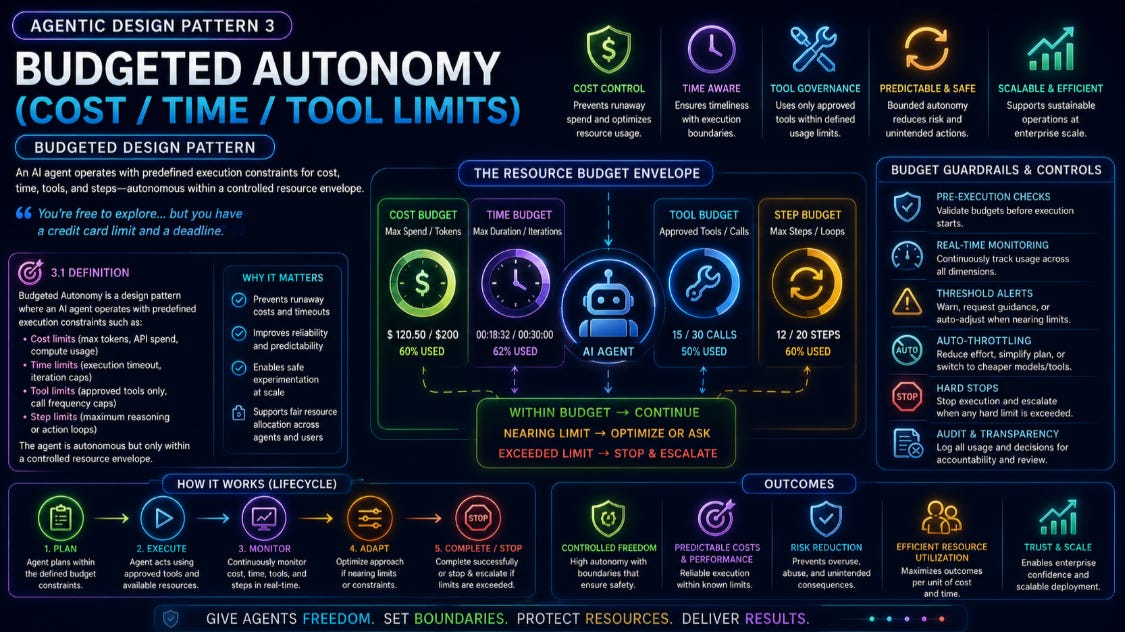
As AI agents become more autonomous, enterprises face a critical challenge: how to give agents enough freedom to solve complex problems without allowing costs, latency, or tool usage to spiral out of control. Budgeted Autonomy offers a practical design pattern for this challenge. By setting clear limits on cost, time, tools, and execution steps, organizations can make AI agents more predictable, governable, and economically viable. This article explores how Budgeted Autonomy works, where it creates business value, and why true enterprise autonomy depends on intelligent boundaries rather than unlimited freedom.
3.1 Definition
Budgeted Autonomyis a design pattern where an AI agent operates with predefined execution constraints such as:
Cost limits(max tokens, API spend, compute usage)
Time limits(execution timeout, iteration caps)
Tool limits(approved tools only, call frequency caps)
Step limits(maximum reasoning or action loops)
The agent is autonomous but only within a controlled resource envelope.
Think of it as:“You’re free to explore… but you have a credit card limit and a deadline.”
3.2 How It Works
The architecture typically includes:
Planner Module:Breaks task into sub-steps and estimates expected resource usage
Budget Allocator:Assigns available cost/time/tool quotas and tracks usage in real time
Execution Engine:Runs reasoning → tool → observe loops and monitors token count, API calls, time elapsed
Budget Monitor / Governor:Interrupts execution if threshold is reached and triggers fallback strategies (summarize, stop, escalate)
Fallback / Escalation Layer:Return a partial result, ask for human approval, and request additional budget.
In short: Plan → Allocate Budget → Execute → Monitor → Enforce → Escalate (if needed)
3.3 Example of the Agent in Action
Scenario: Financial Research Agent
Task:“Analyze 5 competitors and produce a 10-page strategic comparison.”
Constraints: $2API budget, Max 6browsing calls, and a 3-minute execution window
What happens:
Agent prioritizes high-value sources
Summarizes instead of fully scraping
Stops deep iterative refinement
Returns a concise executive summary
Suggests: “Request extended budget for deeper analysis.”
This prevents:
Runaway browsing loops
Token explosions
Excessive compute costs
Latency spikes
3.4 Where the Budgeted Design Pattern adds value
Budgeted Autonomy is ideal for:
Enterprise copilots with usage caps
Regulated industries (banking, healthcare, legal)
Experimental sandbox agents
High-volume production workflows
Multi-agent systems where each agent has role-based quotas
Especially powerful in:
Multi-agent swarms (per-agent limits)
Voyager-style evolving agents (learning bounded by cost)
Customer-facing systems (predictable latency)
3.5 Advantages / Strengths
Cost Predictability:No surprise API bills.
Latency Control:Hard execution deadlines improve user experience.
Risk Containment:Limits reduce exposure to harmful tool overuse.
Scalability:Makes large-scale deployment economically viable.
Encourages Efficient Planning:Agents learn to prioritize high-impact actions.
In many ways, it makes autonomy sustainable.
3.6 Inherent Risks
Despite its strengths, it introduces trade-offs:
Premature Termination:Agent may stop before reaching optimal answer.
Strategic Shortcuts:Agent may favor shallow analysis over depth.
Manipulation Risk:If poorly designed, the agent may “game” the budget rules.
Over-Constrained Intelligence:Too tight budgets cripple capability.
3.7 Risk Mitigation Strategies
Dynamic Budget Adjustment:Allow escalation when confidence score is high.
Tiered Budgeting:Basic → Advanced → Deep analysis modes.
Human-in-the-Loop Overrides:Critical tasks can unlock extended budgets.
Priority-Based Allocation:Allocate more resources to high-value tasks.
3.8 Recap
Budgeted Autonomy is not about restricting intelligence.
It is about making autonomy:
Sustainable
Economically viable
Governable
Predictable
Enterprise-ready
Without budget constraints, agents drift. With intelligent constraints, agents scale. True enterprise autonomy isn’t unlimited freedom. It’s freedom within designed boundaries.

Explore more: Start Here · Topics · Archive · About