


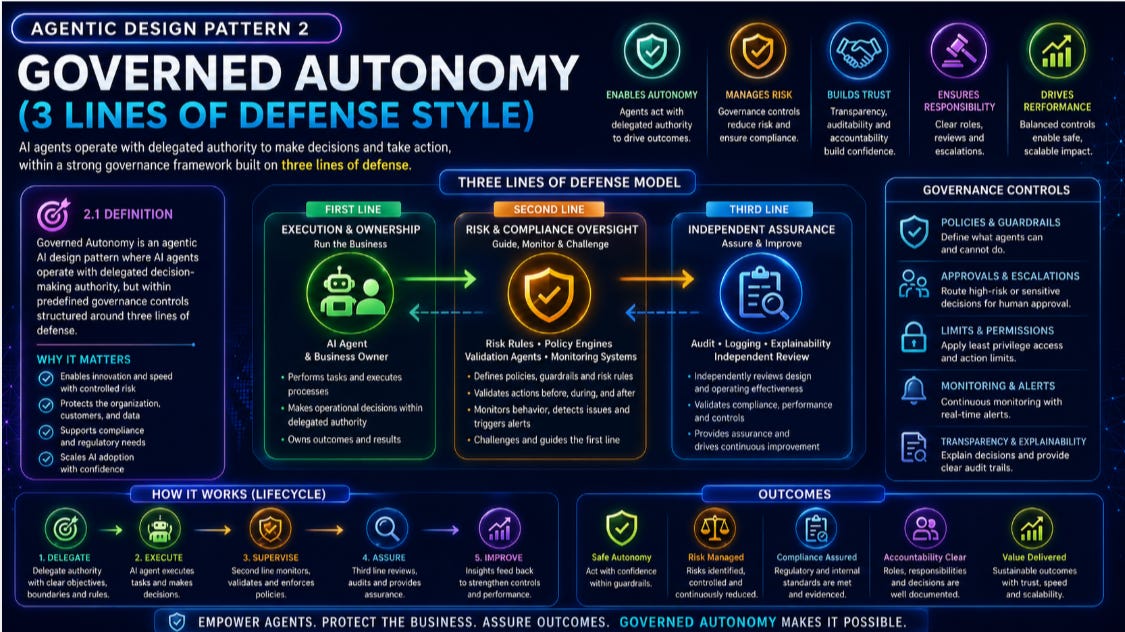
This is a new article in the Agentic Design Patterns series, focused on the Governed Autonomy pattern. The article explains how AI agents can operate with delegated decision-making authority while remaining within structured governance controls based on the Three Lines of Defense model. It highlights how enterprises, especially in regulated industries, can move faster with autonomous agents while preserving accountability, oversight, auditability, and regulatory trust.
2.1 Definition
Governed Autonomy is an agentic AI design pattern where AI agents operate with delegated decision-making authority, but within predefined governance controls structured around three lines of defense.
Three Lines of Defense model:
First Line – Execution & Ownership:The AI agent (and its business owner) performs tasks and makes operational decisions.
Second Line – Risk & Compliance Oversight:Risk rules, policy engines, validation agents, and monitoring systems supervise behavior.
Third Line – Independent Assurance:Audit trails, logging, explainability, and independent review mechanisms validate compliance and performance.
This enables controlled autonomy in high-risk, high-stakes environments.
2.2 How It Works
A. Delegated Authority (First Line)
Agent receives a defined mandate.
It can execute tasks within a scoped domain.
It logs decisions, tool usage, and reasoning paths.
B. Embedded Guardrails (Second Line)
Real-time policy checks (data boundaries, tool allowlists, exposure limits).
Escalation triggers.
Confidence thresholds.
Risk scoring overlays.
Automatic pause on policy violations.
C. Independent Validation (Third Line)
Immutable logs.
Decision replay capability.
Model validation reports.
Post-execution sampling & audits.
Explainability layer (why this action was taken).
D. Feedback & Governance Loop
Incidents → update policy rules.
Drift detection → retraining.
Risk events → tighten autonomy scope.
Successful track record → expand authority.
Autonomy becomes dynamic and tiered, not binary.
2.3 Example: Governed Agent in Action
Scenario: Corporate Treasury Liquidity Monitoring Agent
Mandate:Monitor intraday liquidity exposures and suggest rebalancing actions.
A. What the agent does (First Line):
Aggregates real-time data.
Detects threshold breaches.
Proposes fund transfers.
Executes within approved limits.
B. Second Line Controls:
Agent cannot exceed daily transfer caps.
Agent cannot access restricted accounts.
Agent Must escalate if exposure exceeds predefined volatility bands.
Real-time compliance API check before execution.
C. Third Line Oversight:
Full transaction log stored.
Decision rationale archived.
Weekly independent sampling.
Drift analysis on decision consistency.
Result: Autonomous action at operational speed without sacrificing governance.
2.4 Where Governance pattern adds value
Governed Autonomy is ideal for:
Banking and Financial Services
Credit and Risk Decisioning
Fraud Detection
Regulatory Reporting
Treasury & Liquidity Management
Healthcare Claims Processing
Insurance Underwriting
Supply Chain Risk Optimization
Anywhere where speed of execution matters
Anywhere where compliance is critical
2.5 Advantages / Strengths
Enables Safe Autonomy in Regulated Environments:Autonomy becomes scalable without regulatory panic.
Reduces Operational Friction:Agents don’t need constant human approval for routine decisions.
Creates Accountability Clarity:Ownership, oversight, and auditability are structured.
Improves Trust:Stakeholders understand who owns the model, who oversees risk, and who validates independently.
Supports Tiered Autonomy:Low-risk → fully automated - - Medium-risk → conditional approval High-risk → human-in-the-loop.
2.6 Inherent Risks
Even governed autonomy has exposure:
False Sense of Security:Overreliance on policy engines that may not catch edge cases.
Rule Lag:Governance rules may not evolve as fast as agent capability.
Model Drift:Performance degrades over time without detection.
Escalation Fatigue:Too many alerts → humans ignore them.
Scope Creep:Autonomy expands informally without risk review.
2.7 Risk Mitigation Strategies
Clear Authority Matrix: Define:What the agent may do, what requires escalation and what is prohibited
Real-Time Monitoring Dashboards: Track:Tool usage, Decision confidence, drift metrics and policy exceptions
Structured Escalation Logic:Risk thresholds, Confidence cutoffs and Dual-control triggers
Immutable Logging & Replay: Enable:Independent validation, Root cause analysis and Audit transparency
Periodic Model Re-Validation:Treat autonomous agents as regulated models: Performance Back-testing, Stress Scenarios and Bias audits
Kill Switches:Every autonomous agent must have an emergency override and Scope revocation capability because autonomy without reversibility is reckless
2.8 Recap
Governed Autonomy is the bridge between innovation and institutional responsibility. It answers the critical enterprise question:“How do we move fast without breaking regulatory trust?”
By aligning agentic systems with the Three Lines of Defense framework, organizations can:
Delegate intelligently
Monitor continuously
Audit independently
Adapt dynamically
Autonomy does not eliminate accountability.It redistributes it across structured layers of control. In regulated industries, the future will not belong to the most autonomous agents. It will belong to the most well-governed autonomous agents.
And that distinction makes all the difference.

Explore more: Start Here · Topics · Archive · About