


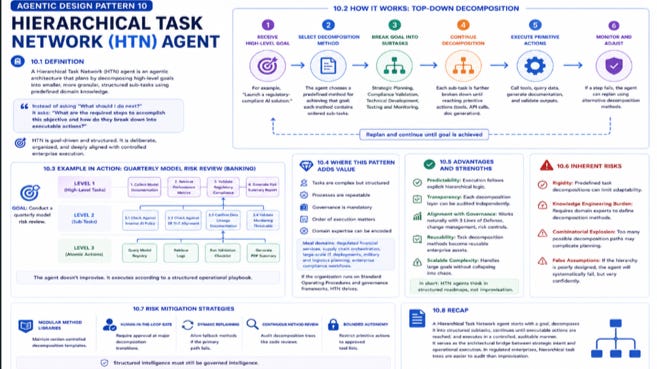
The HTN Agent for Structured Enterprise Planning
The Hierarchical Task Network, or HTN Agent, is an agentic AI pattern designed for structured, goal-driven planning. Instead of improvising the next action, an HTN Agent decomposes a high-level objective into smaller subtasks, continues breaking them down into executable actions, and follows predefined domain knowledge to complete the work. This makes the pattern especially valuable for regulated enterprises where complex processes must remain predictable, auditable, repeatable, and aligned with governance frameworks.
10.1 Definition
A Hierarchical Task Network (HTN) agent is an agentic architecture that plans by decomposing high-level goals into smaller, more granular structured sub-tasks using predefined domain knowledge.
Instead of asking "What should I do next?" it asks: "What are the required steps to accomplish this objective and how do they break down into executable actions?"
HTN is goal-driven and structured. It is deliberate, organized, and deeply aligned with controlled enterprise execution.
10.2 How It Works: Top-Down Decomposition
Receive High-Level Goal: For example, "Launch a regulatory-compliant AI solution."
Select a Task Decomposition Method: The agent chooses a predefined method for achieving that goal; each method contains ordered sub-tasks.
Break Goal into Subtasks: Strategic Planning, Compliance Validation, Technical Development, Testing and Monitoring.
Continue Decomposition: Each sub-task is further broken down until reaching primitive actions such as tool calls, API requests, or document generation.
Execute Primitive Actions: Call tools, query data, generate documentation, and validate outputs.
Monitor and Adjust: If a step fails, the agent can replan using alternative decomposition methods.
10.3 Example in Action: Quarterly Model Risk Review (Banking)
Goal: Conduct a quarterly model risk review.
Level 1 decomposition: Collect model documentation, retrieve performance metrics, validate regulatory compliance, and generate a risk summary report.
Level 2 (compliance validation): Check against internal AI policy, check against SR 11-7 alignment, confirm data lineage documentation, and validate monitoring thresholds.
Level 3 (atomic actions): Query the model registry, retrieve logs, run the validation checklist, and generate a PDF summary.
The agent doesn't improvise. It executes according to a structured operational playbook.
10.4 Where This Pattern Adds Value
HTN agents perform best when tasks are complex but structured, processes are repeatable, governance is mandatory, the order of execution matters, and domain expertise can be encoded.
Ideal domains include regulated financial services, supply chain orchestration, large-scale IT deployments, military and logistics planning, and enterprise compliance workflows. If the organization runs on Standard Operating Procedures and governance frameworks, HTN thrives.
10.5 Advantages and Strengths
Predictability: Execution follows explicit hierarchical logic.
Transparency: Each decomposition layer can be audited independently.
Alignment with Governance: Works naturally with Three Lines of Defense models, change management workflows, and risk control frameworks.
Reusability:Task decomposition methods become reusable enterprise assets.
Scalable Complexity: Handles large goals without collapsing into chaos.
In short: HTN agents think in structured roadmaps, not improvisation.
10.6 Inherent Risks
Rigidity: Predefined task decompositions can limit adaptability.
Knowledge Engineering Burden: Requires domain experts to define decomposition methods.
Combinatorial Explosion: Too many possible decomposition paths may complicate planning.
False Assumptions: If the hierarchy is poorly designed, the agent will systematically fail, but very confidently.
10.7 Risk Mitigation Strategies
Modular Method Libraries: Maintain version-controlled decomposition templates.
Human-in-the-Loop Gate: Require approval at major decomposition transitions.
Dynamic Replanning: Allow fallback methods if the primary path fails.
Continuous Method Review: Audit decomposition trees like code reviews.
Bounded Autonomy:Restrict primitive actions to approved tool lists.
Structured intelligence must still be governed intelligence.
10.8 Recap
A Hierarchical Task Network agent starts with a goal, decomposes it into structured subtasks, continues until executable actions are reached, and executes in a controlled, auditable manner. It serves as the architectural bridge between strategic intent and operational execution. In regulated enterprises, hierarchical task trees are easier to audit than improvisation.

Explore more: Start Here · Topics · Archive · About