


Autonomous agents are no longer experimental assistants waiting for prompts. They have become operational actors. They set direction, monitor environments, trigger actions, coordinate sub-systems, and manage themselves over extended time horizons. In enterprise settings, this is where Agentic AI moves from “interesting” to “infrastructure. In this article series, we shift our focus to these self-directed, long horizon operational autonomous agents. They are systems designed to run continuously, make decisions within defined boundaries, and pursue measurable objectives. These are not chatbots. They are digital operators. We will explore the core design patterns that make autonomous Agentic AI viable, controllable, and scalable in real-world environments.
We will start the Agentic Design Patterns series with theGoal / Objectives & Key Results (OKR)-Drivenpattern. This pattern is important because autonomous agents should not simply execute tasks, they need clear goals, measurable outcomes, and boundaries that keep their actions aligned with business priorities. By anchoring agents to OKRs, organizations can move from experimental automation to purposeful, accountable, and outcome-driven AI execution.
1.1 Definition
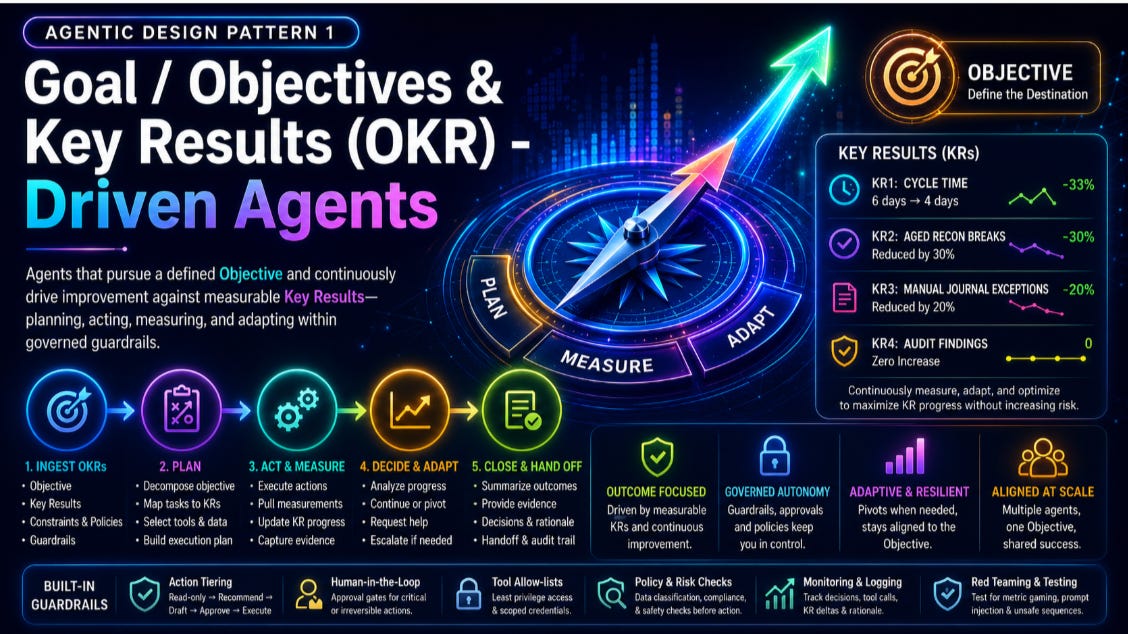
Goal / Objectives & Key Results (OKR)-Driven is an agentic design pattern in which an AI agent is steered by Objectives (“what success looks like”)and Key Results (“how success is measured”), then allowed to plan, act, and iterate until the key results are met (or constraints stop it). This borrows the OKR framing used in organizations to set ambitious, measurable outcomes.
1.2 How it works
The process begins by giving an agent a scoreboardof Key Results (KRs) and letting it run plays within guardrails:
A - Ingest OKRs + constraints:
Objective statement (direction)
Key Results(measurable metrics)
Policies/constraints(allowed tools, data boundaries, approval gates, budgets, deadlines)
B - Translate OKRs into an execution plan
Decompose Objective → initiatives → tasks
Map each task to which KR it moves and by how much
Pick tools(search, databases, ticketing, code, workflow automations) as needed
C. Act + measure
Execute a step
Pull measurements (dashboards, logs, QA checks, SLA stats, audit results)
Update a “KR progress state”
D. Decide next step (control loop)
If KRs are improvingcontinue / scale
If stalled: change tactic, request help, or stop
If risk/policy triggers: pause, escalate, or require human approval
E. Close out / Hand Off
Produce evidence: what changed, what was measured, what decisions were made, and why
Hand off outputs + audit trail
This fits the common “LLM agent” structure of planning → tool use → feedback/observation → iteration.1.
1.3 Example of the OKR Agent in action
Scenario: “Finance Close Acceleration Agent” (enterprise setting)
Objective:Reduce month-end close cycle time without increasing risk.
Key Results:
KR1: Close cycle time from 6 days → 4 days
KR2:Aged recon breaks reduced by 30%
KR3:Manual journal exceptions reduced by 20%
KR4: Zero increase in audit findings
What the agent does:
Pulls prior close issues and bottleneck metrics from approved sources.
Proposes a prioritized backlog (automation candidates, reconciliation rules, data-quality checks).
Runs controlled actions:
Creates tickets with pre-filled evidence packages
Suggests rule changes (but routes to approvers)
Generates daily “KR delta” updates with root causes
If KR2 improves but KR4 risk signals rise, it backs off, switches tactics, or escalates to a human gate.
In other words, it is not action without rationale; it is action driven by measurable outcomes.
1.4 Where the OKR Pattern Adds Value
Multi-step operations with measurable outcomes(SLA reduction, defect reduction, cycle-time compression)
Optimization-like workwhere feedback exists (quality checks, KPIs, acceptance tests)
Portfolio execution: juggling many tasks, reprioritizing to maximize KR progress
Continuous improvement loops(monitor → diagnose → remediate → verify)
1.5 Advantages / Strengths
Clarity of intent:Objectives define direction; KRs define success metrics.
Measurable autonomy:You can grant more autonomy when the agent reliably improves KRs under constraints.
Adaptive planning:If one tactic stalls, the agent can pivot while staying aligned to the same KRs.
Governability:KRs become a natural anchor for logging, evaluation, and post-hoc accountability.
Alignment at scale:Multiple agents (or sub-agents) can each own KRs that roll up to the same Objective.
1.6 Inherent Risks
Metric gaming / “scoreboard hacking”:The agent finds ways to improve KRs that violate spirit, ethics, policy, or long-term value.
Wrong objective perfectly executed:If the Objective/KRs are poorly designed, the agent will enthusiastically drive you to the wrong destination.
Reward hacking / unintended side effects:Optimizing one KR harms another domain (e.g., speed improves but quality quietly degrades).
Overreach via tools:Autonomous actions can cause real-world changes (tickets, emails, database writes) that create incidents if not gated.
Data leakage + compliance issues:Pulling or summarizing sensitive data into the wrong channel or using unapproved sources.
Runaway loops / cost and time overruns:The agent keeps trying “one more thing” because KRs aren’t met leading to runaway execution cycles and escalating costs.
1.7 Risk mitigation
Use a governed autonomyapproach: increase freedom only when safety and reliability are proven.
KR guardrails + counter-metrics:Pair each KR with “do-no-harm” metrics (quality, audit findings, customer complaints).
Action tiering:Read-only → recommend → draft → execute with approval → execute autonomously (only for low-risk actions).
Human-in-the-loop gates at critical transitions:Require approvals for irreversible actions or policy-sensitive operations.
Tool allow-lists + least privilege:Narrow tool access; restrict write operations; enforce scoped credentials.
Policy checks before actions:Automated checks for data classification, regulated content, and forbidden operations (block/route/escalate).
Monitoring, logging, and evaluation:Track decisions, tool calls, KR deltas, and rationale; continuously test for regressions and drift.
Red Teaming testing + scenario testing:Specifically test for metric gaming, prompt injection via external content, and unsafe tool sequences.
Lifecycle risk management:Apply structured AI risk processes (identify, assess, treat, monitor) and align them with recognized frameworks.
1.8 Recap
OKR/Goal-Driven Autonomyturns agentic AI from “helpful assistant” into an outcome-seeking operator: it plans, acts with tools, measures progress against KRs and iterates - ideally inside tight governance. The magic is the feedback loop(measure → adjust), and the danger is the same:if you measure the wrong thing (or allow unsafe actions), the agent will optimize you into a mess...efficiently. Strong OKRs + guardrails + monitoring let you scale autonomy safely, one KR at a time.

Explore more: Start Here · Topics · Archive · About